Every year, our production team in Foshan processes hundreds of orders bound for Vietnam, and one question keeps coming back from distributors and furniture factories alike: which finish will actually survive the heat, the rain, and the salty coastal air anodizing or powder coating 1? tropical climate 2
To choose the right surface treatment for aluminum furniture handles in Vietnam’s tropical climate, prioritize high-quality anodizing or powder coating over properly pretreated aluminum. The best option depends on whether the handles face coastal salt air, inland humidity, intense sunlight, or heavy daily touch wear.
Vietnam’s climate is uniquely punishing on hardware finishes. The combination of year-round humidity above 80%, monsoon rains, intense UV radiation 3, and salt-laden air in coastal cities creates conditions that accelerate corrosion and finish failure faster than most buyers expect. In this guide, we will walk through the main surface treatment options, compare their strengths, and help you make the right call for your specific market.
Which aluminum surface treatment provides the best long-term protection against Vietnam's high humidity?
When we ship aluminum handles to Ho Chi Minh City or Hanoi, the number one concern from our buyers is always the same: will the finish hold up after two monsoon seasons?
For long-term protection against Vietnam's high humidity, anodizing and high-quality powder coating are the two strongest choices. Anodizing creates a hard, integrated oxide layer that resists moisture penetration, while powder coating adds a thick barrier that seals the aluminum from humid air and condensation.
Why Humidity Is the Silent Finish Killer
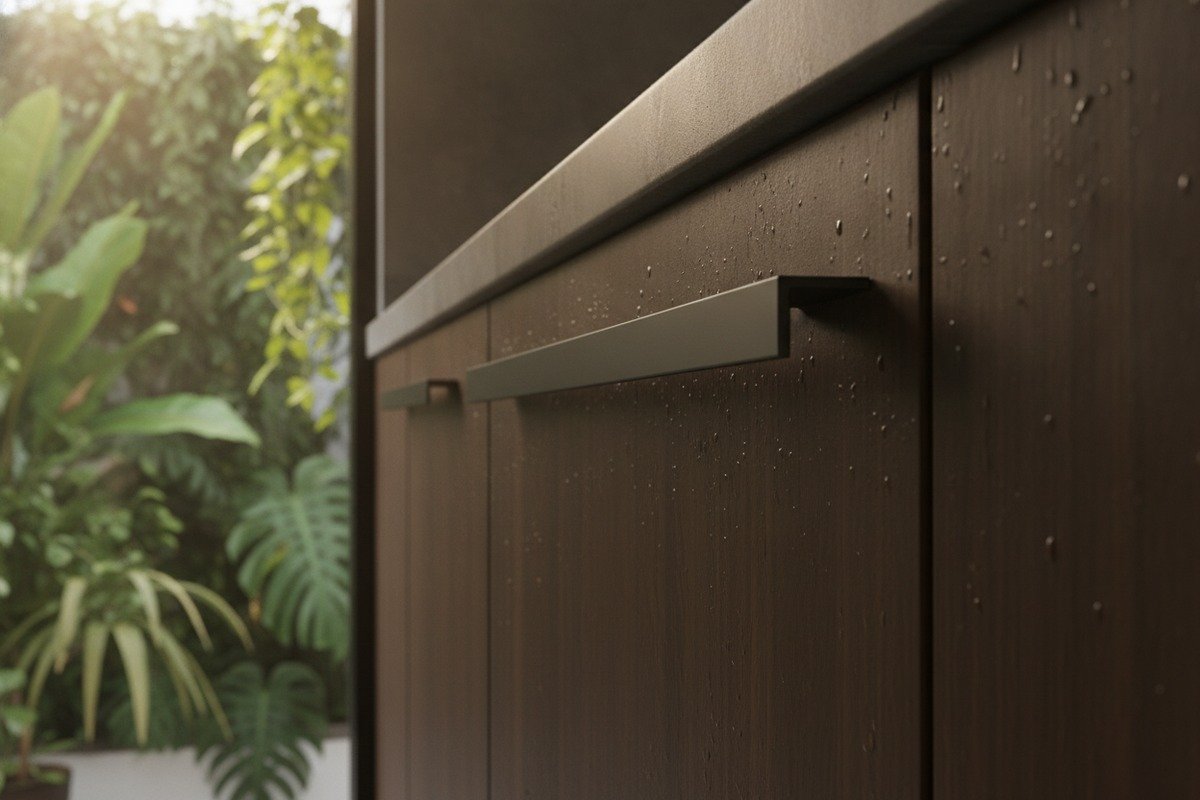
Humidity does not attack aluminum the way it attacks steel. Aluminum does not rust. But high humidity still causes problems. Moisture in the air reacts with untreated aluminum to form a white, chalky oxide layer called aluminum hydroxide 4. This is not the same as the protective oxide that forms during anodizing. It is uneven, unsightly, and it weakens the surface over time. In Vietnam, where relative humidity regularly exceeds 80% and often hits 95% during the rainy season, this reaction happens fast.
On top of that, humidity carries airborne pollutants. In industrial areas near factories or in coastal zones, the moisture carries salt, sulfur, and other chemicals that speed up surface degradation. Even indoor furniture handles are not safe. Kitchens and bathrooms have constant moisture exposure, and air conditioning cycles create condensation on metal surfaces.
How Each Treatment Handles Moisture
Not all surface treatments respond to humidity the same way. Here is a clear comparison:
| Surface Treatment | Humidity Resistance | How It Works | Best For |
|---|---|---|---|
| Anodizing | Excellent | Converts the aluminum surface into a hard aluminum oxide layer that bonds at the molecular level | Indoor and outdoor handles, premium furniture |
| Powder Coating | Very Good | Applies a thick polymer barrier that physically blocks moisture from reaching the aluminum | Color-matched furniture, high-volume production |
| Electrophoretic Coating (E-Coat) 5 | Good | Deposits a uniform resin layer using electrical current, covering edges and recesses evenly | Complex handle shapes, base layer protection |
| Bare Brushed/Polished Aluminum | Poor to Fair | Relies on aluminum's natural thin oxide film, which is inconsistent and easily damaged | Indoor decorative use only, low-humidity rooms |
The Pretreatment Factor
One thing we always stress to our buyers is that the coating itself is only half the story. The pretreatment process 6 before coating determines whether the finish will actually stick and stay sealed. Proper pretreatment includes cleaning, degreasing, and applying a conversion coating such as chromate or chromate-free alternatives. Without this step, even the best powder coat can peel or blister within months in a humid environment. When evaluating a supplier, always ask what pretreatment steps they use. If they cannot answer clearly, that is a red flag.
Indoor vs. Outdoor Humidity Exposure
For indoor cabinet and drawer handles, humidity resistance is still important but the exposure is less extreme. Anodized finishes and standard powder coatings both perform well indoors. For semi-outdoor applications like balcony furniture, covered patio cabinets, or entryway storage, the humidity exposure jumps significantly. In these cases, we recommend thicker powder coatings or sealed anodized finishes with at least 15 microns of oxide thickness.
Should I prioritize anodized or powder-coated finishes for my furniture handles in a tropical climate?
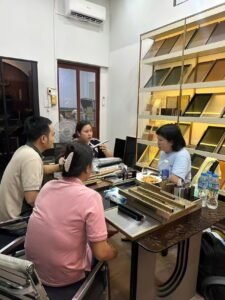
This is the question we hear most often during sample discussions with Vietnam-based furniture factories. The answer is not one-size-fits-all, and our engineering team often walks buyers through the trade-offs before recommending a direction.
Both anodized and powder-coated finishes work well in tropical climates, but anodizing is best when you want a durable metallic look with superior scratch resistance, while powder coating is the better choice when you need specific colors, matte textures, or a furniture-matched aesthetic at scale.
Anodized Finishes: Strengths and Limits
Anodizing is an electrochemical process 7 that converts the surface of aluminum into a hard oxide layer. This layer is not painted on. It is grown from the aluminum itself, so it cannot peel or flake. The result is a finish that is extremely hard, scratch-resistant, and tightly sealed against moisture.
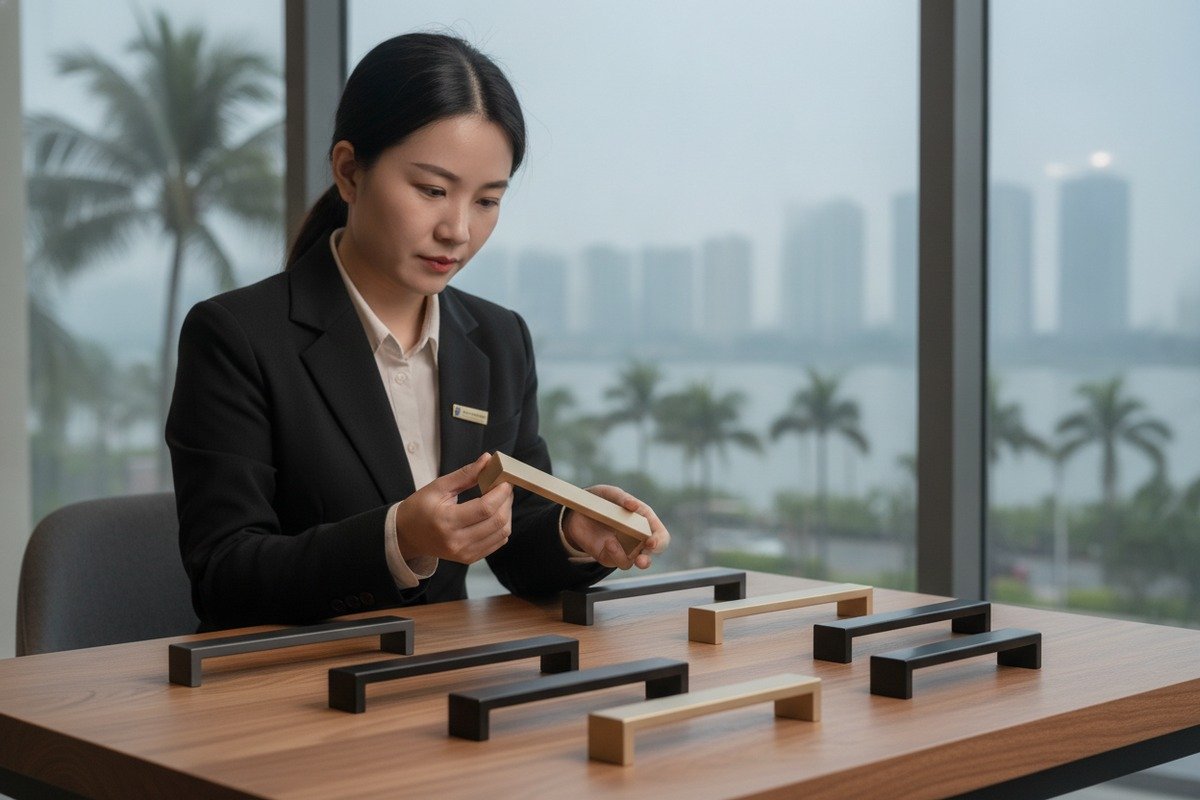
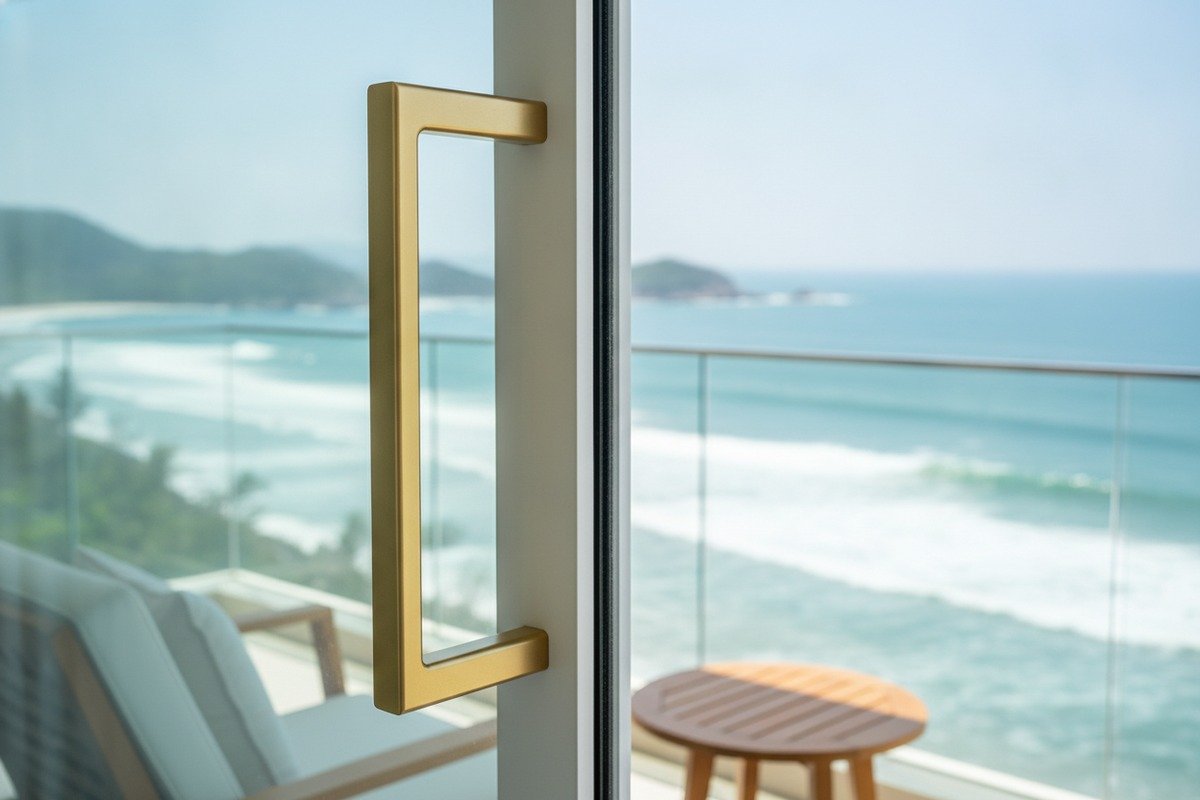
For furniture handles, anodizing produces a clean, metallic appearance. Common finishes include natural silver, champagne gold, light bronze, and black. The champagne gold anodized finish, for example, is very popular in our Vietnam orders because it gives a warm, upscale look that pairs well with wood-grain laminates and light-colored cabinetry.
However, anodizing has limits. The color range is narrower than powder coating. You can achieve metallics, blacks, and earth tones reliably, but bright reds, greens, or exact RAL color matches 8 are difficult or impossible. Also, anodized surfaces can feel slightly cooler and smoother to the touch, which some designers prefer and others do not.
Powder Coating: Strengths and Limits
Powder coating sprays dry polymer powder onto the aluminum surface and then bakes it in an oven. The result is a thick, even coating that acts as a physical barrier between the aluminum and the environment. Done well, powder coating offers excellent UV resistance, corrosion protection, and color flexibility.
Our production line can match virtually any color or texture a buyer requests. Matte black, matte white, charcoal grey, champagne, light beige — these are the finishes we produce most for the Vietnamese market. The matte, non-reflective textures are especially practical in tropical settings because they hide fingerprints and feel comfortable in warm weather.
The catch is quality control. A cheap powder coat over poorly pretreated aluminum will fail. The coating can chip at edges, blister in humid conditions, or lose adhesion where the surface was not properly cleaned. This is why we always emphasize that "powder-coated" on a spec sheet is not enough information. You need to know the pretreatment method, the coating thickness, and the curing process.
Head-to-Head Comparison
| Factor | Anodizing | Powder Coating |
|---|---|---|
| Corrosion Resistance | Excellent (integrated oxide layer) | Very Good (barrier coating) |
| Scratch Resistance | Superior (hard oxide surface) | Good (can chip under impact) |
| Color Range | Limited (metallics, blacks, earth tones) | Wide (any RAL color, matte, gloss, textured) |
| UV Stability | Very Good | Very Good (with UV-stable pigments) |
| Heat Comfort | Cool metallic feel | Slightly warmer, matte textures help |
| Peel/Flake Risk | None (oxide is part of the metal) | Low if properly pretreated, higher if not |
| Cost | Moderate to high | Moderate |
| Best Use Case | Premium metallic-look handles, high-wear | Color-matched handles, large orders, matte finishes |
Which Should You Choose?
If your market values a sleek, metallic, premium look and your handles will see heavy daily use, anodizing is the stronger choice. If your buyers want color variety, matte finishes, or need to match specific furniture palettes, powder coating is the way to go. For coastal areas in Vietnam, either finish works if properly executed, but we often recommend powder coating with enhanced pretreatment for maximum barrier protection against salt air.
Many of our clients actually use both finishes across their product lines. They stock anodized handles in champagne gold and silver for premium ranges, and powder-coated handles in matte black and white for standard collections.
How can I ensure my aluminum profiles won't fade or corrode under intense heat and moisture?
Our quality control team tests every batch of finished handles before they leave our warehouse, but we also know that real-world conditions in Vietnam are harsher than any factory test chamber. Here is what we tell our buyers to look for.
To prevent fading and corrosion, specify UV-stable pigments in your coating, require proper multi-step pretreatment, choose lighter or matte finishes for sun-exposed applications, and request salt-spray test data from your supplier. These steps together ensure your aluminum handles maintain their look and integrity over years of tropical exposure.
Understanding What Causes Fading
Fading happens when UV radiation from sunlight breaks down the pigments or dyes in a surface finish. In Vietnam, the UV index regularly reaches 10 or higher during summer months. That level of solar radiation degrades low-quality coatings quickly. Within one to two years, a poorly specified finish can turn chalky, lose its color depth, or develop an uneven patchy appearance.
The solution is straightforward: use UV-stable pigments. In powder coating, this means choosing powder formulations that are rated for outdoor or architectural use, not just indoor decorative use. For anodized finishes, the oxide layer itself is UV-stable, but the dyes used to color the anodized surface must also be lightfast. Always ask your supplier whether the pigments are rated for outdoor UV exposure.
Understanding What Causes Corrosion
Even though aluminum does not rust, it corrodes. The most common form is pitting corrosion 9, where small holes form on the surface due to exposure to chloride ions from salt or cleaning chemicals. In coastal cities like Da Nang, Nha Trang, or Vung Tau, salt air accelerates this dramatically.
Galvanic corrosion is another risk. If aluminum handles are mounted with steel screws or brackets without proper insulation, the contact between two different metals in the presence of moisture creates an electrical reaction that corrodes the aluminum. This is a common and avoidable problem.
Your Anti-Fade and Anti-Corrosion Checklist
Here is a practical checklist to share with your supplier or use when evaluating samples:
| Checkpoint | What to Ask | Why It Matters |
|---|---|---|
| Pretreatment method | Chromate conversion, zirconium, or phosphate? | Determines coating adhesion and base corrosion protection |
| Coating type | Anodized, powder-coated, e-coated, or painted? | Each has different durability profiles |
| Coating thickness | Microns for anodizing; mil thickness for powder coat? | Thicker coatings generally last longer |
| UV pigment rating | Indoor-grade or outdoor/architectural-grade? | Low-grade pigments fade within 1-2 years in direct sun |
| Salt spray test hours | How many hours passed in ASTM B117 10 or equivalent? | 500+ hours is good; 1000+ hours is excellent for coastal use |
| Mounting hardware | Stainless steel screws included? | Prevents galvanic corrosion at contact points |
| Color and finish | Matte, satin, or gloss? Light or dark? | Matte and lighter colors perform better in sun and heat |
The Role of Heat
Aluminum conducts heat very well. In direct sunlight, a dark-colored aluminum handle can become uncomfortably hot to the touch. This is not a corrosion issue, but it is a user comfort issue that affects customer satisfaction. Our recommendation for handles that may be exposed to sunlight — such as balcony storage, outdoor kitchens, or south-facing cabinets near windows — is to choose lighter colors like champagne, silver, light beige, or white, and to use matte or textured finishes. Matte finishes absorb and re-radiate heat differently than glossy surfaces, and they also reduce glare in bright environments.
Multi-Layer Protection
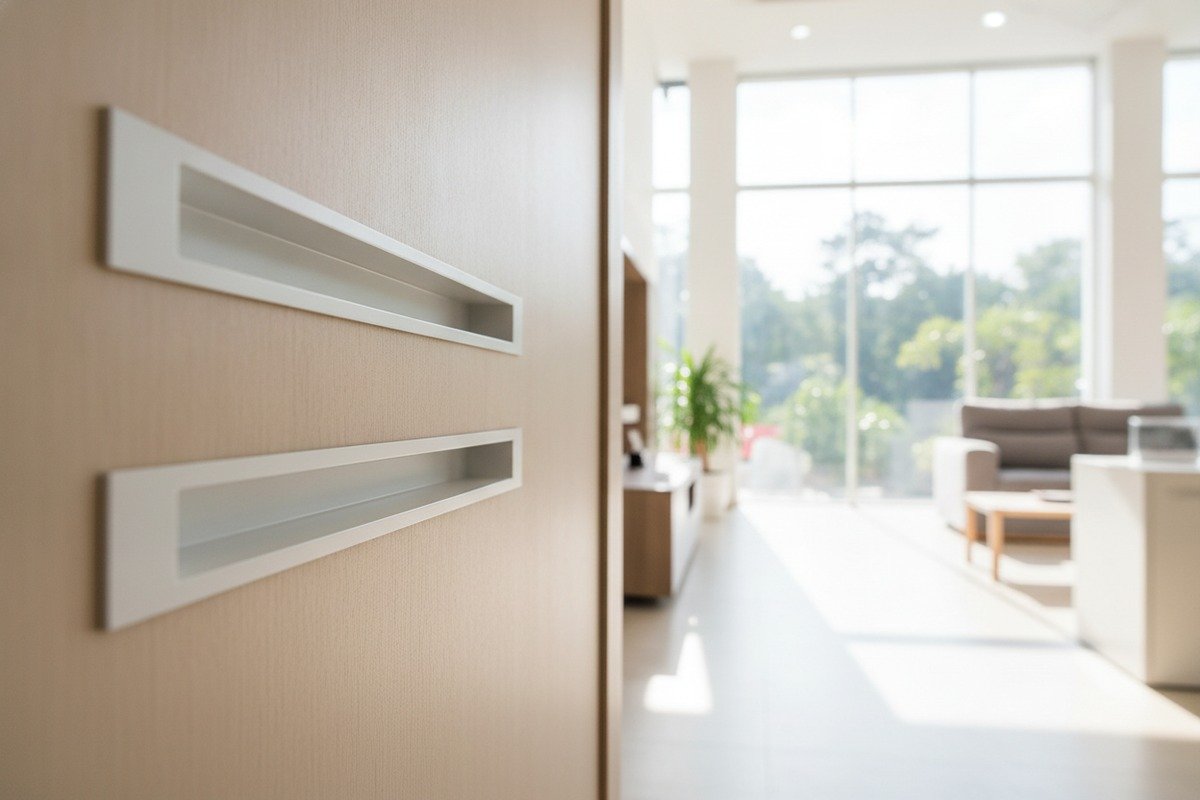
For the highest level of protection, consider a multi-layer approach. One option is an e-coat base layer followed by a powder coat topcoat. The e-coat provides uniform coverage on all edges and recesses, while the powder coat provides the color, texture, and UV protection. This is especially useful for handles with complex geometric profiles, like recessed pulls with deep finger channels, where a single coating layer might not cover every surface evenly.
Can I request custom surface treatments from my supplier to meet the specific environmental needs of my market?
When our Vietnam-based distributors first started asking for finishes tailored to their local conditions, we realized that standard catalog options were not always enough. That realization shaped how we run our finishing operations today.
Yes, you can and should request custom surface treatments. A capable supplier will adjust coating type, thickness, color, texture, and pretreatment processes based on your market's specific environmental challenges. The key is to communicate your end-use conditions clearly and verify the supplier's ability to deliver consistent custom finishes at scale.
What "Custom" Actually Means in Surface Treatment
Custom does not always mean inventing a new technology. In most cases, it means adjusting existing processes to meet your needs. For example, a distributor in Da Nang selling to coastal furniture makers might request:
- Powder coating with marine-grade pretreatment and 80-micron minimum thickness
- Salt spray resistance rated at 1000+ hours
- Matte champagne gold color matched to a specific sample chip
- All mounting screws in stainless steel to prevent galvanic corrosion
This is not exotic. It is practical specification. But many buyers do not know they can ask for these details, so they end up with generic finishes that underperform in their local climate.
How to Communicate Your Needs
The most effective way to get the right custom finish is to tell your supplier exactly where and how the handles will be used. Here is a simple framework:
Location: Coastal, inland, or mixed?
Application: Indoor cabinets, outdoor furniture, semi-outdoor storage?
Sun exposure: Direct sunlight, shaded, or indirect?
Touch frequency: High-traffic (kitchen pulls, door handles) or low-traffic (decorative trim)?
Aesthetic goal: Metallic, matte color, wood-grain match, glossy?
Maintenance expectation: Wipe-and-forget, or willing to polish periodically?
When our clients share this information upfront, we can recommend the right alloy, pretreatment, and finish combination in one conversation instead of going back and forth through multiple sample rounds.
What a Good Supplier Should Offer
Not every aluminum profile supplier can handle custom finish requests. Here are the capabilities to look for:
- In-house or closely managed finishing lines for anodizing and powder coating
- Ability to match custom colors from sample chips or RAL codes
- Willingness to provide salt spray test reports and coating thickness measurements
- Flexibility on minimum order quantities for custom finishes
- Fast turnaround on samples — ideally within 3 to 7 days for custom colors
Our facility in Foshan maintains both anodizing and powder coating capabilities, and we keep 300 tons of ready stock in popular finishes. For custom orders, we typically produce and ship within 3 to 7 days, which lets our distributors respond quickly to their own customers without holding excessive inventory.
Beyond Standard Finishes: Advanced Options
For buyers who want the absolute best weather resistance and are willing to invest in premium finishes, there are advanced options worth knowing about:
- PVDF coatings are common in architectural curtain walls and exterior cladding. They offer exceptional UV resistance and color retention over 20+ years. While they are less common on small furniture handles, they are available for high-end projects where finish longevity is critical.
- Electrophoretic coating (e-coat) works well as a hidden base layer under a topcoat. It provides consistent coverage on complex handle shapes, including inside recessed channels and around sharp edges where spray coatings might be thin.
- Combination systems — such as anodizing plus a clear topcoat, or e-coat plus powder coat — provide layered protection that exceeds what any single treatment can achieve alone.
The Bottom Line on Custom Requests
Do not settle for a finish just because it is the supplier's default. Vietnam's climate demands more than a generic coating. Specify your requirements, ask for test data, and work with a supplier who treats surface treatment as an engineering decision — not just a cosmetic one.
Conclusion
Choosing the right surface treatment for aluminum furniture handles in Vietnam is an engineering decision, not just a design preference. Match the finish to the real-world exposure — humidity, salt, sun, and touch — and work with a supplier who can back their recommendations with test data and production consistency.
Footnotes
1. Compares anodizing and powder coating for aluminum, highlighting their differences. ↩︎
2. Replaced with Wikipedia for authoritative definition. ↩︎
3. Replaced with World Health Organization (WHO) for authoritative information on UV radiation effects. ↩︎
4. Replaced with Wikipedia for authoritative chemical compound information. ↩︎
5. Replaced with Wikipedia for a comprehensive explanation of the process. ↩︎
6. Emphasizes the critical role of pretreatment for coating adhesion and durability. ↩︎
7. Explains anodizing as an electrochemical process that forms a protective oxide layer. ↩︎
8. Replaced with Wikipedia for an authoritative explanation of the RAL color system. ↩︎
9. Replaced with Wikipedia for a detailed explanation of pitting corrosion. ↩︎
10. Explains the ASTM B117 standard for salt spray testing and its purpose in corrosion resistance evaluation. ↩︎