
Every week on our production floor in Foshan, we see buyers make the same costly mistake with aluminum handles.
Anodizing does not make aluminum furniture handles structurally stronger, but it dramatically improves surface durability — the scratch resistance, corrosion protection, and color retention that determine how your handles look and perform after years of daily use. Sourcing success depends on specifying the right anodizing type, layer thickness, and sealing quality for your market’s actual use environment.
This article breaks down exactly what you need to specify, verify, and watch out for when sourcing anodized aluminum handles surface durability 1. Whether you supply residential cabinetry in Vietnam or commercial furniture projects in the Middle East, these details will save you returns, complaints, and money. Let’s get into it.
How Does the Thickness of the Anodized Layer Affect the Long-Term Durability of My Aluminum Handles?
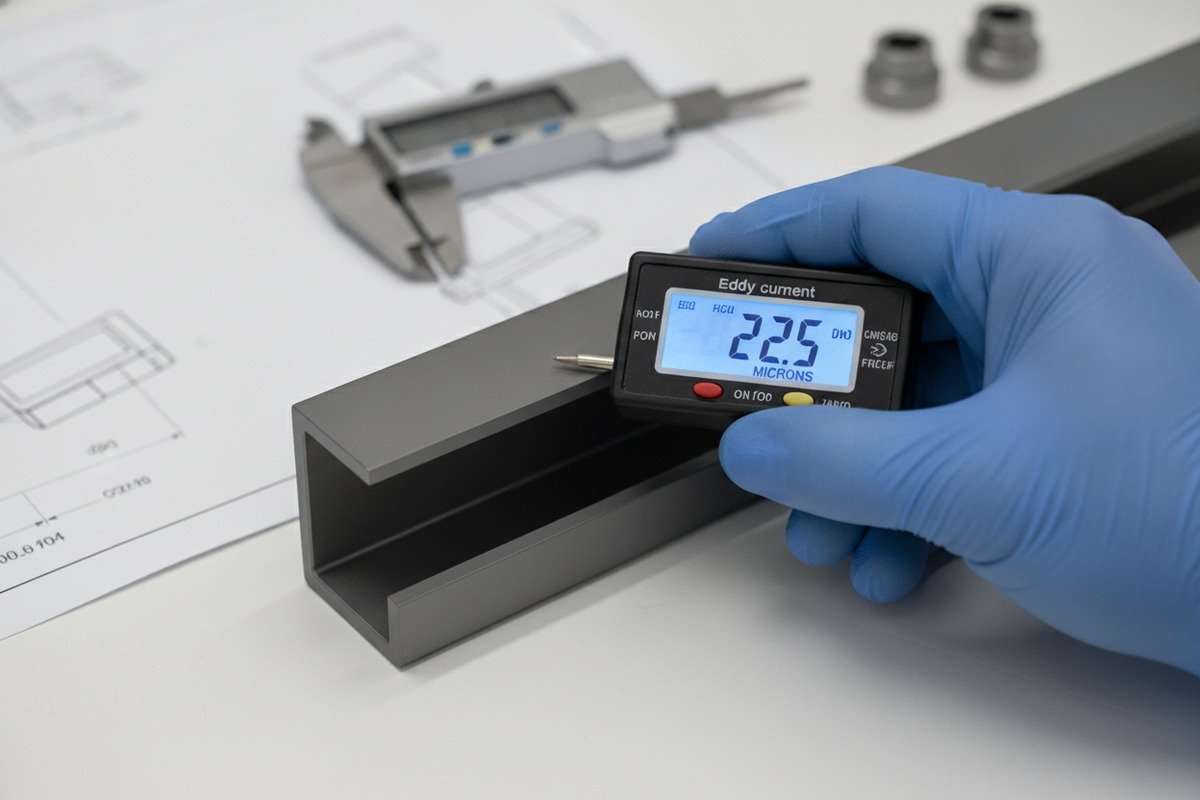
Our engineers test anodized layer thickness on every batch before it ships, and the difference between 10 microns and 25 microns is not subtle — it is the difference between a handle that lasts 5 years and one that lasts 15 ASTM B244 2.
The thickness of the anodized layer directly determines how well your aluminum handles resist scratches, abrasion, and corrosion over time. Thicker layers — typically 15 to 25 microns for Type III hard anodizing — offer significantly better wear resistance than thinner decorative coatings of 5 to 10 microns, making layer thickness the single most important specification for long-term handle durability.
Why Thickness Is Not Just a Number
Think of the anodized layer as armor. A thin layer stops light scratches. A thick layer stops deep gouges, chemical attack, and years of repetitive contact from hands, rings, and cleaning products Delta E color difference 3.
The anodized oxide layer is not a paint or a coating sitting on top of the metal. It grows into and out of the aluminum surface through an electrochemical process 4. This means it cannot peel or flake like paint. But if the layer is too thin, it wears through. Once it wears through, the bare aluminum underneath is exposed to moisture and corrosion alloy 6063 5.
Type II vs. Type III: What the Numbers Mean for Your Handles
Most furniture handles use Type II (decorative) or Type III (hard) anodizing. Here is how they compare in practice:
| Specification | Type II (Decorative) | Type III (Hard Anodizing) |
|---|---|---|
| Typical Thickness | 5–25 microns | 25–75 microns |
| Surface Hardness | 200–400 HV | 400–600 HV |
| Best For | Residential pulls, light-use cabinet handles | Commercial hardware, hotel projects, high-traffic doors |
| Color Options | Wide range of dye colors | Limited (usually dark grey to black) |
| Cost Impact | Lower | 20–40% higher |
| Typical Lifespan | 5–10 years indoor use | 10–20+ years indoor use |
For most residential cabinet handles, Type II anodizing at 15–20 microns is more than enough. But if you are supplying handles for hotel bathrooms, commercial kitchens, or healthcare facilities, you should seriously consider Type III or at minimum request the upper range of Type II thickness.
How to Verify Thickness from Your Supplier
When we ship samples, we include coating thickness test reports. You should always ask your supplier for these. The standard test method is eddy current measurement per ISO 2360 6 or ASTM B244. If a supplier cannot provide thickness data, that is a red flag.
Here is what to request:
- Minimum coating thickness, not just average
- Thickness measured at multiple points on the handle, including edges and recessed areas
- Confirmation that the sealing step was completed after anodizing
Edges and finger-grip channels — like the deep geometric channel on our recessed pull handles — are often thinner than flat surfaces. A good factory monitors these critical areas.
The Real-World Impact
We had a buyer in Dubai who initially ordered handles with 8-micron decorative anodizing for a hotel fit-out. Within 18 months, the handles in the lobby showed visible wear lines where guests gripped them daily. We replaced those with 20-micron Type II handles with hot water sealing 7. Three years later, they still look new. Thickness matters more than most buyers realize.
Can I Ensure Perfect Color Consistency Across Different Production Batches for My Custom Hardware?
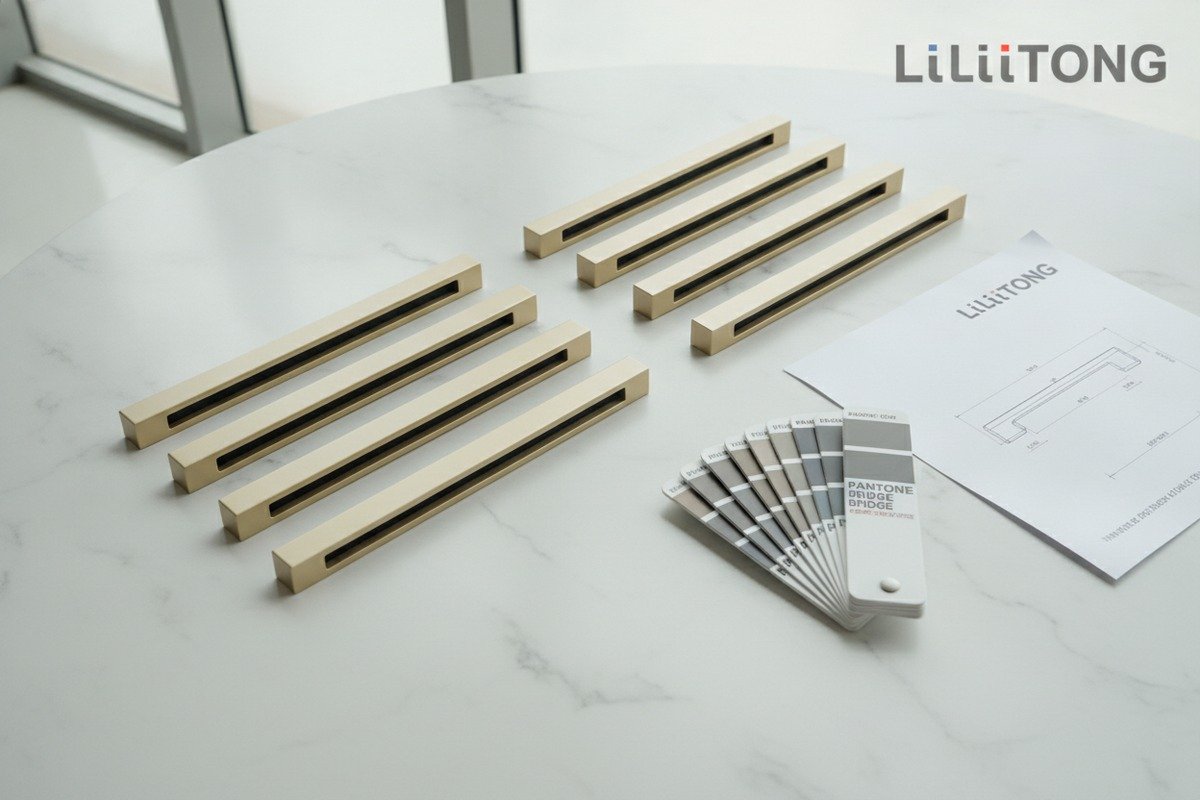
When we run a champagne gold anodized finish across three separate production batches, the biggest challenge is not making the color — it is making it match every single time.
Perfect color consistency across anodizing batches is extremely difficult to guarantee, but you can get very close by controlling the aluminum alloy grade, surface preparation, electrolyte chemistry, dye concentration, and process timing. Specifying alloy 6063 or 6061, providing a sealed reference sample, and requiring Delta E color difference below 1.0 will give you the best results across orders.
Why Color Variation Happens
Anodized color is not like spray painting. The color comes from dye molecules that are absorbed into the porous oxide layer before sealing. Several variables affect how the dye absorbs:
- Alloy composition: Different aluminum alloys contain different trace elements. Silicon, iron, magnesium, and copper all affect the base color and dye uptake. Even two batches of the same alloy grade from different smelters can produce slightly different results.
- Surface grain structure: Extruded profiles have a directional grain. If handles from one batch are cut from a different section of the extrusion billet, the grain texture can shift, changing how light reflects off the anodized surface.
- Process variables: Electrolyte temperature, acid concentration, current density, anodizing time, and dye bath conditions all influence the final color.
What You Can Control as a Buyer
You cannot control every process variable from a distance, but you can set clear expectations. Here is a practical checklist:
| Control Point | What to Specify | Why It Matters |
|---|---|---|
| Alloy Grade | 6063-T5 or 6061-T6 | These alloys anodize most consistently and produce cleaner colors |
| Reference Sample | Sealed physical sample with color code | Provides a visual and measurable target for every batch |
| Color Tolerance | Delta E ≤ 1.0 (or ≤ 0.5 for premium projects) | Delta E measures perceptible color difference; below 1.0 is generally invisible to the eye |
| Surface Finish | Specify brushed, sandblasted, or polished before anodizing | Surface texture dramatically changes how color appears |
| Batch Tracking | Require alloy mill certificates per batch | Ensures consistent raw material between orders |
The Role of Sealing in Color Stability
After the dye is absorbed, the anodized layer must be sealed. Sealing closes the pores and locks the dye in place. Poor sealing leads to fading, blotching, or color shift over time — especially in humid environments.
There are three common sealing methods: hot water sealing, nickel acetate sealing, and cold sealing. Hot water and nickel acetate sealing generally provide the best long-term color stability. When we produce our champagne gold and light bronze finishes, we use hot water sealing at 96°C or above for consistent results.
Practical Advice for Multi-Batch Orders
If you are ordering handles across several months for a large project, request that your supplier reserves alloy material from the same billet lot for all batches. We do this routinely for our Middle East clients who need hundreds of matching handles delivered in stages. It costs slightly more in inventory management, but it eliminates the biggest source of batch-to-batch color drift.
Also, always approve production samples against your sealed reference before the full run begins. Photos on a phone screen are not reliable for color matching. Physical samples under consistent lighting are the only trustworthy method.
Which Anodizing Specifications Should I Require to Prevent Corrosion and Wear in My Specific Market?
We export handles to climates ranging from the dry heat of Riyadh to the tropical humidity of Ho Chi Minh City, and the same anodizing spec does not work for both.
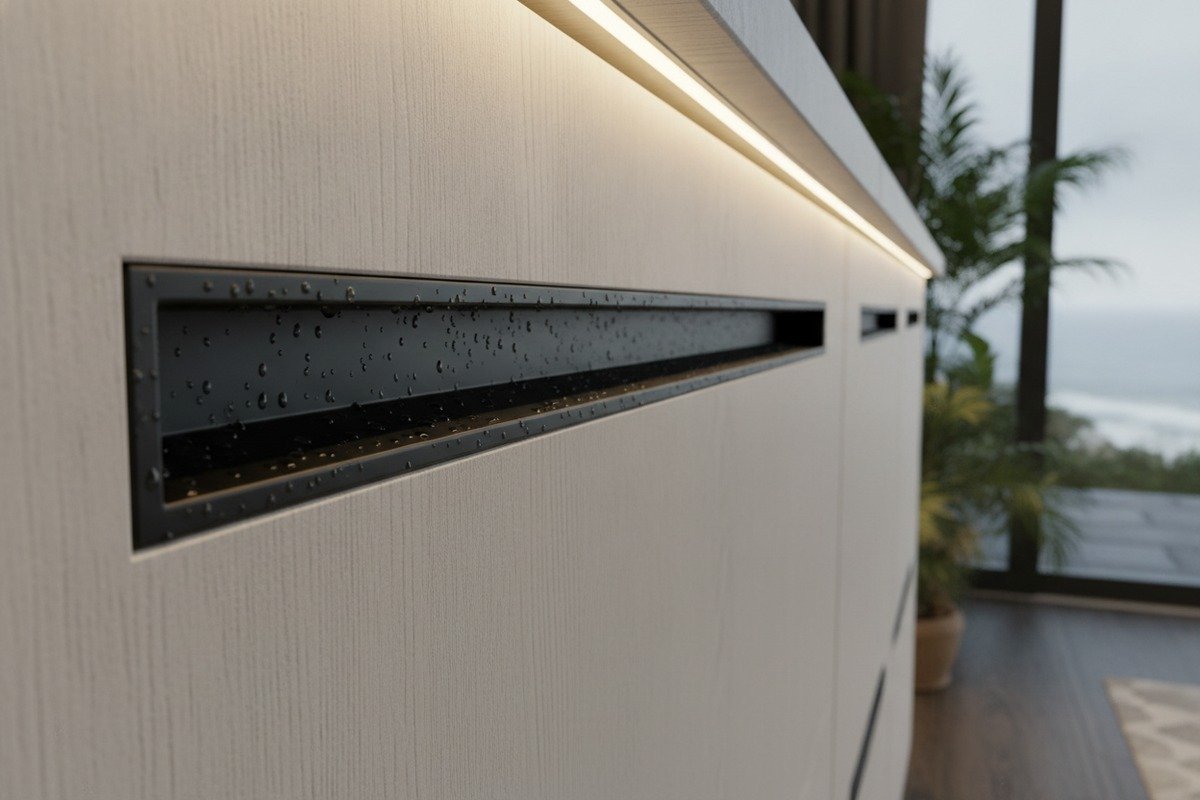
The anodizing specifications you need depend on your handles' end-use environment. For dry indoor residential use, Type II anodizing at 10–15 microns with standard sealing is sufficient. For humid, coastal, or high-traffic commercial environments, specify Type II at 15–25 microns or Type III hard anodizing with hot water or nickel acetate sealing, and require salt spray testing of at least 336 hours.
Matching the Spec to the Market
The right anodizing specification is not about choosing the "best" option. It is about choosing the right option for where and how the handle will be used. Over-specifying wastes money. Under-specifying causes premature failure and warranty claims.
Here is a practical guide based on market and environment:
| Market / Environment | Recommended Anodizing | Min. Thickness | Sealing Method | Salt Spray Requirement |
|---|---|---|---|---|
| Residential indoor (dry climate) | Type II | 10–15 µm | Standard (hot water) | 168 hours |
| Residential indoor (humid climate) | Type II | 15–20 µm | Hot water or nickel acetate | 336 hours |
| Kitchen / Bathroom | Type II | 15–20 µm | Nickel acetate | 336 hours |
| Coastal property | Type II (upper range) or Type III | 20–25 µm | Nickel acetate | 500+ hours |
| Commercial / Hotel / Healthcare | Type III (hard anodizing) | 25–50 µm | Hot water | 500+ hours |
| Outdoor or semi-outdoor furniture | Type III | 25+ µm | Nickel acetate | 750+ hours |
Understanding Salt Spray Testing
Salt spray testing 8 (per ASTM B117 or ISO 9227) is the most common accelerated corrosion test. It exposes the anodized handle to a salt fog environment and measures how long before corrosion appears. It is not a perfect simulation of real life, but it is the industry standard for comparing finishes.
When you ask a supplier for a salt spray test report, make sure they test the actual handle — not just a flat sample panel. Handles have edges, screw holes, and recessed areas where the anodized layer may be thinner. These are the points most likely to fail first.
Wear Resistance for High-Touch Applications
Corrosion is only half the story. The other half is abrasion. Every time someone grips a handle, the surface experiences micro-friction. Over thousands of cycles, this can dull a thin anodized layer.
For high-touch applications, request Taber abrasion test results. This test measures weight loss after a set number of abrasion cycles. Type III hard anodizing 9 typically loses less than 1 mg per 1000 cycles, while thin Type II finishes may lose 3–5 mg.
Chemical Resistance and Cleaning Products
In kitchens, bathrooms, and healthcare settings, handles get wiped down with cleaning chemicals regularly. Alkaline cleaners are particularly aggressive to anodized surfaces. Make sure your anodizing spec includes chemical resistance testing, and advise your end customers to use pH-neutral cleaners.
Our standard care recommendation for all our anodized handles is simple: mild soap, warm water, and a soft cloth. Avoid ammonia-based or highly alkaline cleaners.
Anodizing vs. Powder Coating: When to Choose What
Some buyers ask whether powder coating would be better. The honest answer is: it depends.
- Anodizing is better for metallic appearance, thin profile finishes, scratch resistance, and long-term UV stability.
- Powder coating is better for thick color coverage, impact resistance, and applications where a wider color palette is needed.
For our sleek, minimalist recessed handles with their sharp edges and low-profile L-shaped cross-sections, anodizing preserves the precision of the design better than powder coating, which can build up unevenly in tight channels.
How Will the Anodizing Process Impact the Lead Times and MOQ for My Bulk Furniture Handle Orders?
One of the most common questions we hear from new buyers is straightforward: "How much longer will anodizing add to my order?"
Anodizing typically adds 2–5 days to your production lead time compared to raw or mill-finish aluminum handles. MOQs may increase slightly because anodizing lines run most efficiently in batches, and custom colors often require minimum lot sizes of 200–500 pieces per color. However, suppliers with in-house anodizing can minimize these impacts significantly compared to those who outsource the process.

How Anodizing Affects Your Production Timeline
The anodizing process 10 itself — cleaning, etching, anodizing, dyeing, and sealing — takes several hours per batch. But the real lead time impact comes from scheduling, color matching, and quality inspection steps around it.
Here is a realistic timeline breakdown for a typical bulk order:
| Production Stage | Without Anodizing | With Standard Anodizing | With Custom Color Anodizing |
|---|---|---|---|
| Raw material preparation | 1–2 days | 1–2 days | 1–2 days |
| Extrusion and cutting | 2–3 days | 2–3 days | 2–3 days |
| Surface preparation (degreasing, etching) | N/A | 0.5–1 day | 0.5–1 day |
| Anodizing and dyeing | N/A | 1–2 days | 2–3 days |
| Sealing and curing | N/A | 0.5–1 day | 0.5–1 day |
| Quality inspection and packing | 1 day | 1–2 days | 1–2 days |
| Total Lead Time | 4–6 days | 6–11 days | 7–12 days |
For stock finishes like our standard champagne gold, matte black, or charcoal grey, the anodizing step is faster because the dye baths are already calibrated. Custom colors require test runs and buyer approval, which can add another 2–3 days.
MOQ Considerations for Anodized Handles
Anodizing is a batch process. The tanks hold a specific volume. Running a small quantity through a full anodizing cycle is inefficient and expensive. This is why most factories set higher MOQs for anodized finishes, especially custom colors.
From our production experience, here is what to expect:
- Standard colors (black, silver, champagne gold, charcoal): MOQ as low as 100–200 pieces because these run continuously.
- Custom colors: MOQ of 300–500 pieces per color, sometimes higher, to justify the dye bath setup.
- Type III hard anodizing: MOQ may be higher if the factory outsources this to a specialized facility.
In-House vs. Outsourced Anodizing
This is a critical sourcing consideration. A factory that handles anodizing in-house can control timing, quality, and cost much more tightly than one that ships semi-finished handles to an external anodizing shop.
When the anodizing is outsourced, you add transit time, external scheduling delays, and an extra layer of quality risk. We have seen cases where outsourced anodizing created a 7–10 day delay on what should have been a 3-day process, simply because the anodizing shop prioritized a larger client's order.
Tips to Reduce Lead Time on Anodized Handle Orders
Here are practical strategies we recommend to our buyers:
- Choose from stock finishes whenever possible. Our ready-to-ship inventory of 300 tons includes pre-anodized handles in popular colors that can ship within 48 hours.
- Consolidate color options. Ordering five colors in small quantities takes much longer than ordering two colors in larger quantities.
- Approve samples early. The biggest lead time killer is waiting for color approval. If you can approve production samples within 24 hours, you save days.
- Plan repeat orders in advance. If you know you will reorder quarterly, let your supplier reserve alloy material and pre-schedule anodizing slots.
For most of our buyers in Vietnam and the Middle East, the standard lead time for custom anodized handles is 3–7 days after sample approval. Stock items with standard finishes ship within 48 hours. The anodizing step is not the bottleneck — decision-making speed usually is.
Conclusion
Anodizing protects the surface your customers actually touch and see every day. Specify the right type, thickness, sealing, and color controls — and your aluminum handles will perform for years, not months.
Footnotes
1. Discusses how anodizing enhances metal surface durability and corrosion resistance. ↩︎
2. Provides the ASTM standard for measuring anodic coating thickness using eddy-current instruments. ↩︎
3. Explains Delta E as a metric for quantifying perceptible color differences. ↩︎
4. Replaced HTTP 403 with an authoritative Wikipedia page explaining electrochemical processes. ↩︎
5. Provides information on the composition and properties of aluminum alloy 6063. ↩︎
6. Describes the ISO standard for non-destructive measurement of coating thickness. ↩︎
7. Describes the hydrothermal sealing process for anodized aluminum to enhance corrosion resistance. ↩︎
8. Explains the standard accelerated corrosion test method for evaluating finishes. ↩︎
9. Details Type III hard anodizing, emphasizing its durability and wear resistance. ↩︎
10. Explains the fundamental electrochemical anodizing process for metals. ↩︎