
Every year, our team in Foshan fields dozens of questions from Vietnamese distributors worried about one thing: will these aluminum handles pass inspection at customs or fail a buyer’s quality audit Ministry of Science and Technology 1? TCVN National Standards 2 The fear is real. A single rejected shipment can cost thousands and damage a business relationship permanently.
To determine if aluminum furniture handles comply with Vietnam’s TCVN standards, you must identify the specific TCVN numbers that apply to your product category, request test reports and conformity documents from the supplier, verify whether any mandatory QCVN regulation references those standards, and validate test results through accredited laboratories.
This guide walks you through the entire process step by step. We will cover which documents to request, how to check surface treatment quality, what to look for during a factory audit, and when third-party testing makes sense. Let’s get into it.
What specific TCVN certification documents should I request from my aluminum handle supplier?
When we ship our recessed aluminum pulls and champagne-gold anodized profiles 3 to Ho Chi Minh City or Hanoi, buyers always ask: "Do you have the TCVN certificate?" The problem is that there is no single universal TCVN certificate for aluminum furniture handles. That question alone can lead you down the wrong path if you do not know what to actually ask for.
You should request the exact TCVN standard numbers the supplier claims to meet, third-party test reports from accredited labs, material composition certificates for the aluminum alloy, a Declaration of Conformity or Certificate of Conformity, and internal quality control records that tie the tested samples to the product you are ordering.
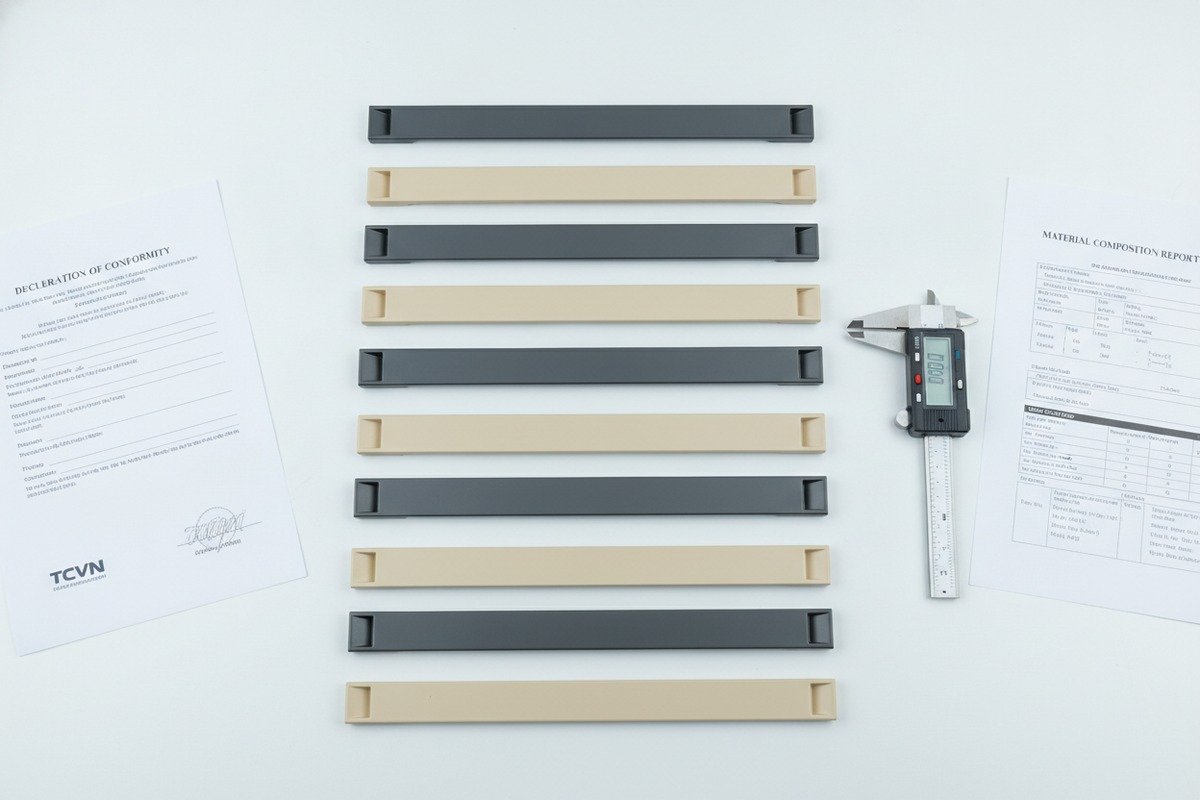
Why There Is No Single "TCVN Certificate" for Handles
Vietnam maintains nearly 13,000 national standards under the TCVN system, managed by STAMEQ 4 under the Ministry of Science and Technology. These standards are generally voluntary. They only become mandatory when a law or a QCVN technical regulation references them. Because aluminum furniture handles sit at the intersection of several product categories — metal hardware, furniture fittings, surface coatings, and sometimes even consumer safety — multiple TCVNs may apply at once.
For example, one standard might cover the aluminum alloy composition 5. Another might govern the anodizing or powder-coating process. A third might specify mechanical load testing for furniture fittings. Asking for "the TCVN certificate" without a standard number is like asking a doctor for "the test" without saying which one.
Documents You Should Collect
Here is a clear list of what to request and why each document matters:
| Document | What It Proves | Why It Matters |
|---|---|---|
| TCVN standard number list (with revision year) | Which specific standards the supplier claims to follow | Prevents vague or generic compliance claims |
| Third-party test report | Product was tested by an independent lab | More credible than supplier self-declarations |
| Material certificate (mill cert) | Aluminum alloy grade and chemical composition | Confirms the raw material meets strength and safety requirements |
| Declaration of Conformity 6 (DoC) | Supplier formally declares the product meets a named standard | Legal document that assigns liability |
| Certificate of Conformity (CoC) | A certification body has verified compliance | Strongest form of evidence, often from bodies like QUACERT |
| Internal QC records | Factory inspection and process control data | Shows consistency, not just one-time test passing |
How to Verify Document Authenticity
Do not simply accept a PDF at face value. Check the testing laboratory's name and accreditation status. Confirm the test report date is recent and that the tested samples match the exact SKU, alloy, and finish you are ordering. Our production team always recommends that buyers cross-reference the lab's registration with STAMEQ's database or with international accreditation bodies like ILAC. A test report from an unaccredited lab carries very little weight in a dispute.
Also, pay close attention to whether the supplier claims "full compliance" or "partial compliance." Partial compliance means some parameters were tested and passed, but others were not. This is a common area where misunderstandings occur.
How do I verify that the surface treatment on my handles meets Vietnam's durability standards?
Surface finish 7 is where most quality complaints originate. On our production floor, we see it constantly — a buyer approves a champagne-gold anodized sample, then the bulk shipment arrives in Vietnam and the finish peels, fades, or corrodes within months. The damage to a distributor's reputation is severe, and reversing it is expensive.
To verify surface treatment durability, request test reports for salt spray resistance, coating thickness measurement, adhesion cross-cut tests, and UV weathering performance, all conducted per the relevant TCVN or equivalent ISO test methods. Compare the reported values against the minimum thresholds specified in the applicable standard.

Key Surface Treatment Tests for Aluminum Handles
Aluminum furniture handles typically undergo anodizing, powder coating, or electrophoretic coating 8. Each treatment has different durability characteristics. Vietnam's climate — hot, humid, and often coastal — makes surface durability even more critical. Here are the core tests you need to understand:
| Test | What It Measures | Typical Standard Reference | Minimum Acceptable Result |
|---|---|---|---|
| Salt spray test (NSS) | Corrosion resistance | TCVN/ISO 9227 | 200–500 hours with no visible corrosion (depends on grade) |
| Coating thickness | Micron depth of anodize or powder coat | TCVN/ISO 2360 or ISO 2808 | Anodize: ≥15 µm for architectural; Powder coat: ≥60 µm |
| Cross-cut adhesion | How well the coating sticks to the substrate | TCVN/ISO 2409 | Grade 0 or Grade 1 (minimal flaking) |
| UV resistance / weathering | Color and gloss retention after UV exposure | TCVN/ISO 16474 | ΔE < 1.5 after 1000 hours (for high-end finishes) |
| Hardness (pencil or Mohs) | Scratch resistance of the surface | TCVN/ISO 15184 9 | ≥ 3H pencil hardness for powder coat |
Understanding What "Passes" Actually Means
A test report that simply says "pass" is not very useful. You need the raw data. For instance, if a salt spray test ran for only 48 hours and the standard requires 200 hours, the product did not actually meet the standard — even if the lab wrote "no corrosion observed." The duration matters as much as the outcome.
When we prepare shipments for our Vietnamese partners, we include coating thickness measurements taken at multiple points on the handle, not just one spot. A handle's edges, recessed channels, and flat surfaces can all have different coating thicknesses. Our matte-finish recessed pulls, for example, require extra attention in the deep geometric channel where powder coat tends to be thinner. If your supplier only tests the flat face, the channel might fail.
Matching Test Methods to TCVN
Vietnam's TCVN system often adopts ISO standards directly. So a test conducted per ISO 9227 may be accepted as equivalent to the corresponding TCVN. However, you should confirm this with your buyer or with STAMEQ. Some Vietnamese importers insist on seeing the TCVN number on the report, not just the ISO number. A quick way to handle this is to ask the testing lab to dual-reference both numbers on the report.
If you are buying handles with a specialized finish — like the champagne gold anodized profiles we produce — make sure the color stability test specifically covers that finish type. Generic aluminum test data from a different alloy or coating process is not valid for your product.
What steps should I take to audit a Foshan factory's production line for TCVN compliance?
Foshan is the heart of China's aluminum hardware manufacturing, and our facility has hosted audit teams from Vietnam, the Middle East, and Southeast Asia dozens of times. But here is what most buyers get wrong: they walk through the factory, look at machines, take photos, and leave thinking they have "audited" the supplier. A real compliance audit is far more structured.
To audit a Foshan factory for TCVN compliance, you should review raw material traceability records, inspect the extrusion and surface treatment process controls, verify that quality checkpoints match the claimed TCVN test parameters, examine calibration records for measuring equipment, and confirm that finished goods are tested against the specific TCVN standards referenced in the supplier's documentation.

Before You Arrive: Prepare Your Audit Checklist
Do not show up without a plan. Before visiting any factory, compile a list of the exact TCVN standards the supplier claims to meet. Bring copies of those standards or at least summaries of the key parameters. Your audit should verify whether the factory's actual process can produce a product that meets those parameters consistently — not just once.
Key areas to inspect include:
- Raw material receiving: Does the factory check incoming aluminum billets against a material certificate? Do they verify the alloy grade?
- Extrusion process: Are the extrusion temperatures, pressures, and die specifications documented and controlled?
- Surface treatment line: Is the anodizing bath chemistry monitored? Are powder coat ovens calibrated? Are coating thickness gauges available and recently calibrated?
- Quality inspection station: Does the factory have a final inspection process? What do they check, and how do they record results?
- Traceability: Can the factory trace a finished handle back to the specific aluminum billet, extrusion batch, and surface treatment batch?
What to Look for on the Production Floor
Walk the line in order: material storage, extrusion, cutting, machining, surface treatment, inspection, and packing. At each stage, ask to see the process control document. A well-run factory will have a traveler card or digital record that follows each batch.
Pay special attention to the surface treatment area. This is where most TCVN-relevant quality parameters are determined. Check whether the factory monitors:
- Anodizing voltage and time
- Sealing temperature and duration (for anodized finishes)
- Powder coat application thickness (in-process, not just final)
- Oven cure temperature profile
If the factory cannot show you these records, their TCVN compliance claim is weak.
Red Flags During a Factory Audit
| Red Flag | What It Suggests |
|---|---|
| No material certificates on file | Cannot prove alloy grade compliance |
| Measuring instruments without calibration stickers | Test results may be inaccurate |
| No written process specifications | Production is not controlled or repeatable |
| Finished goods stored outdoors without protection | Surface damage may occur before shipping |
| Supplier cannot name the specific TCVN numbers they follow | Compliance claim is likely generic and unverified |
| Single QC person for a large production volume | Inspection coverage is probably insufficient |
When our team prepares for a customer audit, we lay out our calibration records, batch traceability logs, and third-party test reports in advance. We encourage every buyer to do more than a visual walkthrough. Ask questions. Request data. Compare what you see on the floor with what the documents say. If there is a mismatch, that is your signal to dig deeper.
Digital Traceability Is Becoming Essential
Vietnam is increasingly pushing for digital traceability in product quality management. If your factory can provide batch-level digital records — linking raw material lots to finished products — it significantly strengthens the TCVN compliance case. This is especially valuable if you need to demonstrate compliance to Vietnamese customs or to institutional buyers running government-funded projects.
Can I use third-party testing to confirm my custom handles pass Vietnam's quality requirements?
We often advise our Vietnamese and Middle Eastern partners to invest in independent testing, especially for the first order or when introducing a new handle design. It is not a sign of distrust — it is smart procurement. Even with 18 years of experience and 300 tons of ready stock in our Foshan warehouse, we welcome third-party verification because it protects both sides.
Yes, third-party testing by an accredited laboratory is one of the most reliable ways to confirm your custom aluminum handles meet Vietnam's TCVN quality requirements. Choose a lab accredited under ISO/IEC 17025, ensure they test against the exact TCVN or equivalent ISO standard, and verify that the tested samples are identical to the production batch you will receive.

Why Third-Party Testing Matters More Than Supplier Declarations
A supplier's self-declaration is only as strong as the data behind it. Third-party testing removes the conflict of interest. An accredited lab has no financial stake in whether the product passes or fails. This independence makes the test report far more credible in the eyes of Vietnamese customs, downstream buyers, and project tender committees.
For aluminum furniture handles specifically, third-party testing can cover:
- Alloy composition verification (spectrographic analysis)
- Mechanical strength and load-bearing capacity
- Surface coating thickness and adhesion
- Corrosion resistance (salt spray)
- Chemical safety (heavy metals, restricted substances)
- Dimensional accuracy against design drawings
How to Choose the Right Lab
Not all labs are equal. Here is what to look for:
| Criteria | What to Check |
|---|---|
| Accreditation | ISO/IEC 17025 10 accredited for the specific test methods you need |
| Geographic acceptance | Reports recognized by Vietnamese authorities (STAMEQ) or by your buyer |
| Test scope | Lab can perform all relevant tests (mechanical, chemical, surface) — or you may need multiple labs |
| Sample handling | Lab has clear procedures for sample receipt, identification, and storage |
| Turnaround time | Fits your order timeline — some tests take 2–4 weeks |
| Cost transparency | Detailed quote per test, not a lump sum that hides what was actually done |
In Vietnam, QUACERT is a well-known certification body operating under STAMEQ. Internationally, labs like SGS, Bureau Veritas, TÜV, and Intertek have offices in both China and Vietnam and can issue reports accepted in multiple markets. If your handles ship from Foshan, it is often practical to test in China before shipment and then do a confirmation spot-check in Vietnam upon arrival.
Matching Tested Samples to Your Actual Order
This is a critical detail that many buyers overlook. The test report is only valid for the exact product that was tested. If the lab tested a matte black anodized handle and you are ordering champagne gold, the report does not cover your order. Alloy grade, surface treatment type, dimensions, and even the batch of raw material can all affect test outcomes.
When we run custom orders — say, a specific recessed pull in a light beige finish with a particular L-shaped cross-section — we pull test samples from the actual production run, not from an old stockpile. This ensures the test report represents what the buyer will actually receive. Ask your supplier to do the same, and have the lab note the sample's batch number, SKU, and finish type on the report.
When QCVN Makes Third-Party Testing Mandatory
Remember the distinction between TCVN and QCVN. If a QCVN technical regulation applies to your product category, third-party testing and a Certificate of Conformity may not just be a good idea — they may be legally required for market entry. Check with a Vietnamese compliance consultant or directly with STAMEQ to confirm whether any active QCVN covers aluminum furniture hardware. This step can save you from costly border rejections.
Even when QCVN does not apply, many Vietnamese institutional buyers and large furniture factories require third-party test reports as part of their procurement qualification process. Having these reports ready accelerates your sales cycle and builds trust from day one.
Conclusion
Verifying TCVN compliance for aluminum furniture handles requires specific standard numbers, credible test reports, factory-level traceability, and third-party validation — not just a supplier's word.
Footnotes
1. Wikipedia details the role of Vietnam’s Ministry of Science. ↩︎
2. Official portal for Vietnamese National Standards. ↩︎
3. Wikipedia explains the anodizing process for aluminum profiles. ↩︎
4. Official website of Vietnam’s Directorate for Standards, Metrology and Quality. ↩︎
5. Wikipedia provides background on aluminum alloy chemical compositions. ↩︎
6. Defines the formal declaration by a manufacturer that a product meets safety directives. ↩︎
7. Wikipedia covers the engineering principles of surface finish. ↩︎
8. Wikipedia explains the electrophoretic deposition and coating process. ↩︎
9. Details the international standard for determining film hardness using a pencil test. ↩︎
10. Provides general requirements for the competence of testing and calibration laboratories. ↩︎