
Every commercial complex project we ship hardware to in Vietnam teaches our team the same lesson: specification chaos is the silent budget killer salt spray test 1. When a developer sources aluminum furniture handles from multiple batches or suppliers without a locked standard, the result on-site is mismatched finishes, inconsistent hole spacing 2s, and rework that delays handover by weeks. Our production line in Foshan processes hundreds of handle SKUs a month, and the projects that run smoothly always start with one thing — a clear, written hardware specification.
To standardize aluminum furniture handle specifications for a Vietnam commercial complex, you should create a project hardware standard that locks material alloy, surface finish type, dimensional tolerances, hole spacing, wall thickness, mounting method, and QC acceptance criteria before any supplier quote is accepted.
This article walks you through the exact specification fields, testing benchmarks 3, supplier qualification steps, and cost-balance strategies that keep large-scale commercial fit-outs on time and on budget. Let’s break it down section by section.
What are the standard hole spacings and dimensions I should follow for high-traffic commercial furniture handles?
Hole spacing mistakes are among the top three reasons our after-sales team gets emergency calls from Vietnamese project sites — panels drilled wrong, handles that look identical but mount 2 mm off adhesion cross-cut test 4.
For high-traffic commercial furniture, the most common standard hole spacings (center-to-center) are 64 mm, 96 mm, 128 mm, 160 mm, 192 mm, and 256 mm, with a recommended dimensional tolerance of ±0.1–0.3 mm to ensure consistent fit across thousands of repeated installations.
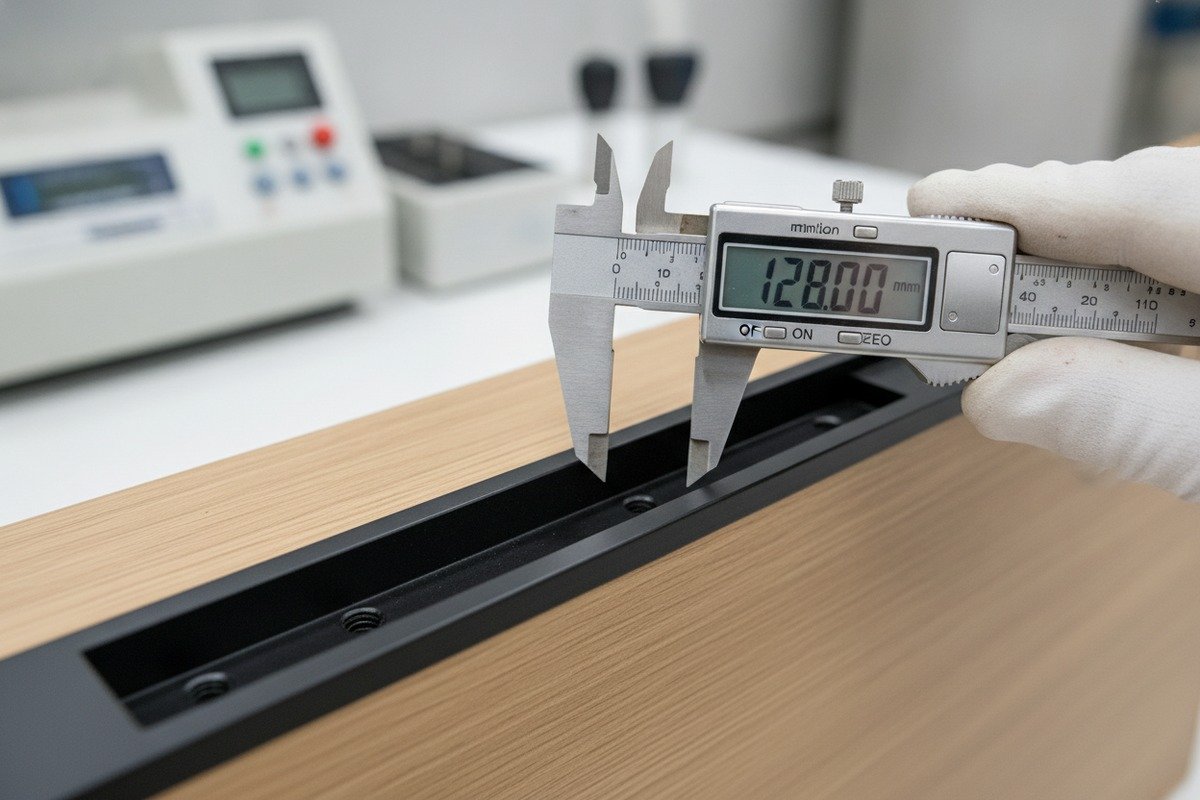
Why Hole Spacing Consistency Matters at Scale
In a residential kitchen, one misaligned handle is a minor annoyance OEM/ODM production lines 5. In a 200-unit serviced apartment block or a mixed-use mall with hundreds of cabinets, a 1 mm drift in hole spacing multiplies into visible misalignment across entire floors. Installers start shimming, re-drilling, or forcing handles into place. That damages the panel face, weakens the mount, and shortens the handle's service life.
The fix is simple: lock your center-to-center (C-C) distances in the project specification before procurement begins. Do not let suppliers substitute "close enough" alternatives.
Common Commercial Hole Spacings
| Hole Spacing (C-C) | Typical Application | Recommended Handle Length |
|---|---|---|
| 64 mm | Small drawers, bedside units | 80–100 mm |
| 96 mm | Standard kitchen drawers | 110–130 mm |
| 128 mm | Mid-size cabinet doors | 140–160 mm |
| 160 mm | Wardrobe doors, office joinery | 170–192 mm |
| 192 mm | Large cabinet doors, retail displays | 200–220 mm |
| 256 mm | Tall wardrobe panels, back-of-house storage | 260–280 mm |
Dimensional Fields to Lock in Your Spec
Beyond hole spacing, your written specification should fix the following for every handle SKU:
- Overall length — the total end-to-end measurement.
- Projection (depth) — how far the handle stands off the panel surface. For recessed profile handles, this is often 17–22 mm.
- Cross-section width and height — critical for integrated channel-style pulls where the finger groove must be deep enough for a comfortable grip.
- Screw thread and bolt length — must match panel thickness plus any backing material. A common error is specifying M4 bolts for 18 mm panels and then discovering the site uses 25 mm panels in certain zones.
- Tolerance — our factory works to ±0.1 mm on extruded aluminum profiles 6. For cast or stamped parts, ±0.3 mm is a realistic floor. Anything looser than that will show on long runs of cabinetry.
Fixing Method Specification
Commercial furniture handles are mounted in three main ways: through-bolt with a rear nut, machine screw into a threaded insert, or concealed channel clip. Each method has different load capacity and panel-thickness compatibility. Your spec should state which fixing method is approved and which fastener hardware the supplier must include in the package.
When we ship stock items from our Foshan warehouse — often within 48 hours — we pre-pack the correct bolt lengths based on the customer's stated panel thickness. That one detail eliminates a surprising number of site problems.
How can I verify that the aluminum surface treatment and oxidation quality will withstand the climate and usage in my Vietnam project?
Vietnam's tropical humidity and high indoor foot traffic create a punishing environment for hardware finishes — something our R&D team factors into every anodizing 8 and powder-coating batch we run.
You can verify surface treatment quality by requiring salt spray test reports (minimum 200–500 hours per BS EN ISO 9227), adhesion cross-cut test results (ASTM D3359 Grade 4B or higher), and UV resistance data, then confirming each production batch against an approved color and gloss master sample.
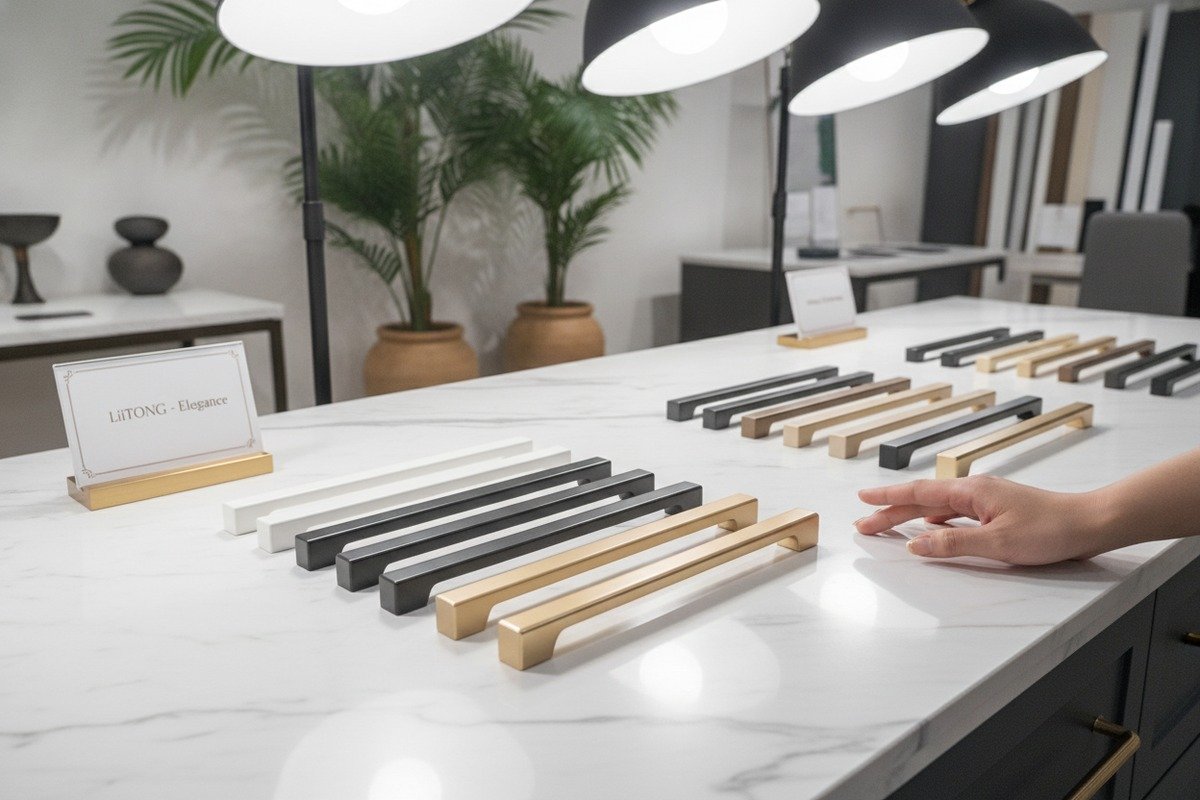
Understanding the Two Main Finish Types
For commercial aluminum furniture handles, the two dominant surface treatments are anodizing and powder coating 9. Each has strengths and trade-offs.
Anodizing converts the aluminum surface into a hard oxide layer. It is integral to the metal, so it cannot peel or flake. It resists scratches, UV fading, and fingerprints. For high-traffic zones — lobbies, corridors, public restrooms — anodized finishes are the safer choice. Our champagne gold and light bronze handles, for example, use an anodized process that delivers a smooth, matte, non-reflective surface with excellent grip feel.
Powder coating applies a colored polymer layer cured at high temperature. It offers a wider color range and can achieve matte, satin, or gloss textures. However, it sits on top of the aluminum rather than inside it, so it can chip under heavy impact. For design-forward retail or hospitality zones with lower physical contact, powder coating gives more aesthetic freedom.
Surface Treatment Comparison
| Property | Anodized Finish | Powder-Coated Finish |
|---|---|---|
| Scratch resistance | High — oxide layer is very hard | Moderate — polymer layer can chip |
| Color range | Limited (natural, champagne, bronze, black) | Very wide (RAL and custom colors) |
| UV resistance | Excellent | Good, but may yellow over years |
| Fingerprint visibility | Low | Moderate (depends on gloss level) |
| Salt spray endurance | 500+ hours typical | 200–500 hours typical |
| Recommended use zone | High-traffic public areas | Design-accent or low-contact areas |
| Repairability | Cannot be touched up on site | Can be spot-repaired with care |
Testing You Should Require
Before approving any supplier for a commercial project, request these test results:
- Salt spray test (BS EN ISO 9227) — Anodized handles should endure 500 hours minimum. Powder-coated handles should reach at least 200 hours without blistering, flaking, or color shift.
- Cross-cut adhesion test (ASTM D3359) — For powder-coated finishes, the coating must pass Grade 4B or higher, meaning less than 5% of the test grid area lifts off.
- Hardness test — Anodized layers should meet a minimum of 300 HV (Vickers hardness 10) for architectural-grade durability.
- UV aging test — Ask for data on color stability after simulated UV exposure equivalent to 2–3 years of indoor use in tropical conditions.
- Master sample approval — Every production batch should be compared against a sealed, signed-off master sample for color code, gloss level, and surface texture. Our QC team photographs each batch against the master under standardized lighting before packing.
Vietnam Climate Factors
Ho Chi Minh City averages 80% relative humidity year-round. Coastal cities like Da Nang add salt-air exposure. Even indoor environments in shopping malls and office towers experience humidity cycling as HVAC systems turn on and off. A finish that looks fine in a dry factory showroom can develop micro-corrosion, dullness, or adhesion failure within 12–18 months in these conditions if the surface treatment was substandard.
This is why we always recommend anodized aluminum profile handles for any commercial project in Vietnam unless the designer has a specific aesthetic reason to choose powder coating — and even then, we suggest powder coating only for low-touch zones.
Can I find a Foshan manufacturer that supports my custom OEM designs while offering fast 48-hour shipping for stock items?
One of the most common frustrations we hear from Vietnamese project buyers is the either-or dilemma: you can get fast delivery on generic stock, or you can wait weeks for custom items, but rarely both from the same supplier.
Yes — select Foshan manufacturers maintain 300+ ton ready-to-ship inventories for standard handles with 48-hour dispatch, while simultaneously running OEM/ODM production lines that deliver custom designs in 3–7 days for simple modifications and 30–45 days for fully bespoke tooling.
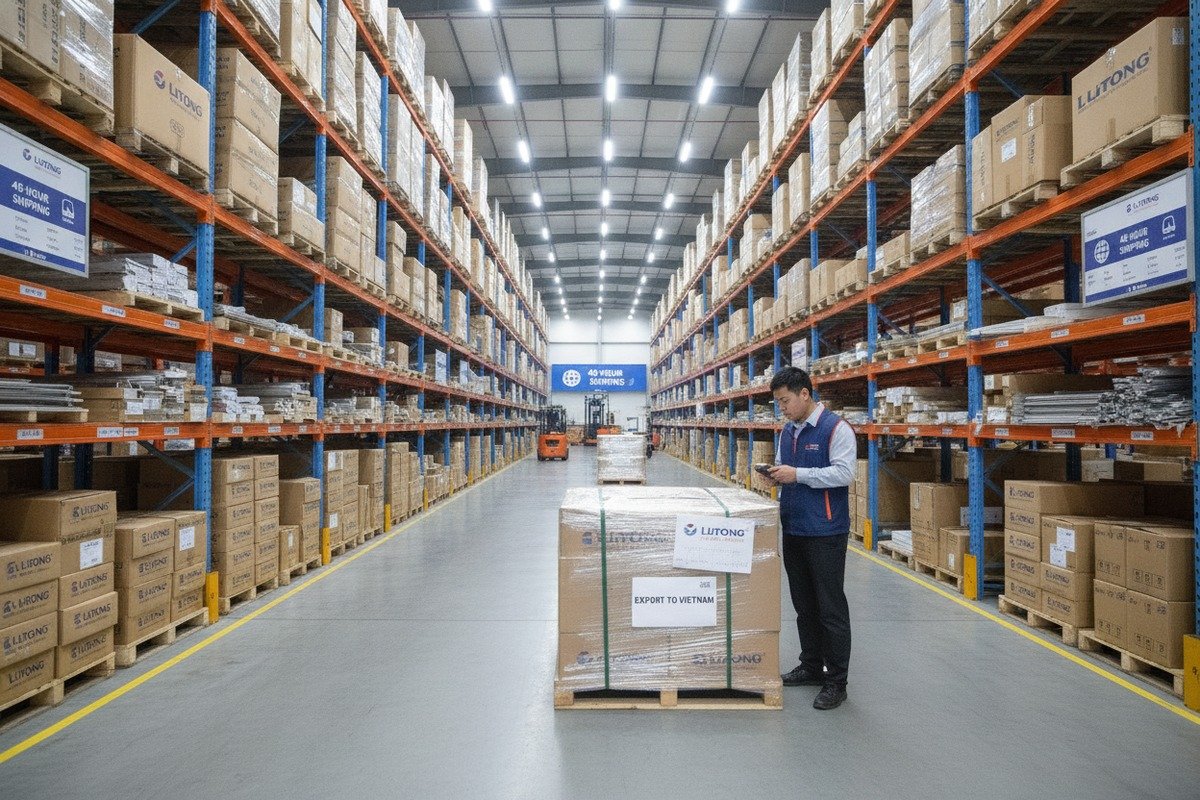
How the Dual-Track System Works
The key is to separate your project's handle requirements into two categories:
Category A — Stock items. These are standard profile handles in popular finishes (matte black, champagne gold, charcoal grey, light beige, white) and standard lengths (128 mm, 160 mm, 192 mm, 256 mm). A factory with deep inventory can ship these within 48 hours of order confirmation. For a commercial complex, stock items typically cover 60–80% of all handle needs: back-of-house storage, standard apartment kitchens, office joinery, and utility cabinetry.
Category B — Custom OEM items. These are design-specific handles for lobby feature walls, premium suites, executive offices, or branded retail zones. They may require a unique cross-section profile, a special finish color, laser-engraved branding, or a non-standard length. Lead time depends on complexity: simple length or finish variations take 3–7 days; a new extrusion die for a completely original profile takes 30–45 days.
Supplier Qualification Checklist for Vietnam Projects
When vetting a Foshan manufacturer, ask these questions:
- Stock depth: How many tons of finished inventory do you hold? Can you provide a current stock list with SKU photos and dimensions?
- Custom capability: Do you have in-house die-making, CNC machining, and anodizing/powder-coating lines, or do you outsource?
- Lead time guarantees: Will you commit to 48-hour shipping for stock items in the contract? What is the penalty for late delivery?
- Sample process: Can you produce a confirmed sample within 3–5 days for OEM items? Do you provide 3D CAD drawings before sampling?
- QC documentation: Do you issue inspection reports with photos, dimensional measurements, and finish verification for each shipment?
- MOQ flexibility: What is the minimum order per SKU for stock items versus custom items?
- Export experience: Have you shipped to Vietnam before? Do you understand the import documentation and packaging requirements?
Our team, for instance, has been exporting to Vietnam and the Middle East for over 18 years. We know that Vietnamese import clearance runs smoother when packaging labels include both English and Vietnamese descriptions, and when packing lists match the buyer's purchase order format exactly. These small operational details matter more than most developers realize until something goes wrong at customs.
Why "One-Stop" Matters for Commercial Projects
A commercial complex might need profile pulls for kitchen cabinets, recessed handles for wardrobe doors, aluminum profiles for glass partition doors, and edge trim for honeycomb panel cladding. If each product category comes from a different supplier, the developer manages four sets of samples, four QC processes, four shipping schedules, and four points of failure. Consolidating with a single manufacturer that covers aluminum handles, glass door profiles, and panel systems reduces coordination cost and finish-matching risk significantly.
Price negotiation is the stage where many Vietnamese developers unknowingly sacrifice long-term project quality for short-term savings — a pattern we see repeatedly when buyers chase the lowest unit price without accounting for hidden costs.
Balance aesthetics and pricing by standardizing one or two handle families for 80% of the project volume to secure bulk pricing, then allocate a controlled premium budget for bespoke designs in high-visibility zones like lobbies and executive areas, always comparing lifecycle cost rather than unit price alone.

The Real Cost Is Not the Unit Price
A handle that costs $0.80 less per piece but arrives with inconsistent finish, loose tolerances, or weak mounting threads can generate costs that dwarf the savings:
- Rework cost: Re-drilling panels, filling old holes, and reinstalling handles across hundreds of units.
- Delay cost: Late handover penalties in commercial lease agreements can run thousands of dollars per day.
- Replacement cost: Sourcing emergency replacements from a different batch that does not match the original finish.
- Reputation cost: Visible quality inconsistency in a premium commercial space damages the developer's brand.
Lifecycle Cost Comparison
| Cost Factor | Low-Price Handle (Unspecified Alloy) | Mid-to-High-End Handle (6063 Alloy, Anodized) |
|---|---|---|
| Unit price (per piece) | $1.20 | $2.00 |
| Defect rate (estimated) | 5–8% | <1% |
| Replacement and rework cost per 1,000 units | $400–$650 | $0–$50 |
| Finish consistency across batches | Variable | Controlled to master sample |
| Expected service life | 3–5 years | 8–12 years |
| Total 10-year cost per 1,000 units | $2,200–$2,800 | $2,050–$2,100 |
The table shows that the "cheap" handle often costs more over a project's lifecycle once rework, replacements, and premature failure are factored in.
The Hybrid Specification Strategy
The smartest developers we work with use a two-tier approach:
Tier 1 — Standard specification (high volume, moderate aesthetic). This covers 80% of the project: apartment kitchens, office workstations, back-of-house storage, utility rooms. One or two handle profiles in standard finishes (matte black, champagne gold) at fixed lengths. Bulk volume drives the unit price down. Finish is controlled but not bespoke.
Tier 2 — Premium specification (low volume, high aesthetic). This covers 20% of the project: hotel lobby feature joinery, executive office suites, branded retail displays, VIP lounge cabinetry. Custom cross-sections, unique finishes (brushed bronze, satin rose gold), or non-standard lengths. Unit price is higher, but the volume is small enough that the total budget impact is manageable.
By locking Tier 1 early and ordering in bulk, you secure volume pricing and fast delivery. Tier 2 items are ordered as custom OEM runs with dedicated sampling and approval cycles.
Negotiation Tactics That Protect Quality
- Request a sealed master sample — not a catalog photo — as the contractual quality benchmark.
- Negotiate price per approved SKU, not per generic "handle." This prevents the supplier from substituting a thinner alloy wall or a cheaper finish to hit a lower number.
- Set a maximum defect rate in the purchase contract (e.g., <1% critical defects per shipment).
- Include a re-inspection clause — if a batch fails QC, the supplier must replace it at their cost within an agreed timeframe.
- Ask for volume-tiered pricing across the full project timeline, not just one order. If the project will consume 10,000 handles over 18 months, negotiate a blanket price that rewards total commitment rather than forcing you to re-quote every phase.
When to Invest More
Certain zones in a commercial complex justify a higher per-handle investment because the handles are visible, frequently touched, and directly associated with the property's perceived quality. These include:
- Main lobby and reception areas
- Hotel guest room entry and bathroom cabinetry
- Premium retail storefronts
- Executive office suites
- Spa, lounge, and dining areas
In these zones, the handle is not just hardware — it is a tactile brand touchpoint. Specifying a premium anodized profile handle with a deep geometric channel for finger grip, clean edges, and a low-profile L-shaped cross-section communicates quality that tenants, guests, and shoppers register subconsciously every time they open a door or drawer.
Conclusion
Standardizing aluminum furniture handle specifications before you source is the single most effective way to protect your Vietnam commercial project from costly rework, finish mismatches, and installation delays. Lock the material, dimensions, tolerances, surface treatment, and QC criteria first — then find the right supplier who can meet that standard consistently.
Footnotes
1. Explains a key method for testing corrosion resistance of finishes. ↩︎
2. Explains the critical importance of consistent hole spacing for furniture hardware. ↩︎
3. Explains the importance of testing standards in product evaluation. ↩︎
4. Describes a method to assess the adhesion of coatings to a substrate. ↩︎
5. Clarifies the differences between OEM and ODM manufacturing models. ↩︎
6. Authoritative source (Aluminum Extruders Council) explaining the fundamental aspects of the aluminum extrusion process and profiles, which is highly relevant to sourcing aluminum furniture handles. ↩︎
7. Defines a critical dimensional field for handle specifications. ↩︎
8. Explains the electrochemical process of anodizing for aluminum. ↩︎
9. Describes a common dry finishing process for metal surfaces. ↩︎
10. Defines a standard method for measuring material hardness. ↩︎