
Every week, our export team in Foshan handles payment inquiries from Vietnamese buyers who are eager to place orders but unsure how to send money safely across the border.
The most common cross-border payment methods for sourcing aluminum furniture handles from China to Vietnam include SWIFT telegraphic transfer (T/T), cross-border QR code payments via Alipay or VIETQRGlobal, and escrow services like Alibaba Trade Assurance. Key precautions include verifying supplier credentials, locking exchange rates, using split payment terms, and ensuring all documentation matches for customs clearance.
This guide breaks down each method, compares costs and speeds, and walks you through the exact precautions that protect your money and your production schedule Ant International in China 1. Let’s get into it.
Which payment methods are most reliable for my bulk aluminum handle orders from China to Vietnam?
Over the past 18 years of shipping aluminum handles to Vietnam, our finance team has processed payments through almost every channel available. Some methods save money. Others save time. The trick is matching the right method to the right order size.
For bulk aluminum handle orders, SWIFT T/T transfers remain the most reliable method for transactions above $10,000, while cross-border QR code payments through Alipay or VIETQRGlobal are ideal for smaller orders under $5,000 due to their low fees and instant settlement.
SWIFT T/T: The Industry Standard
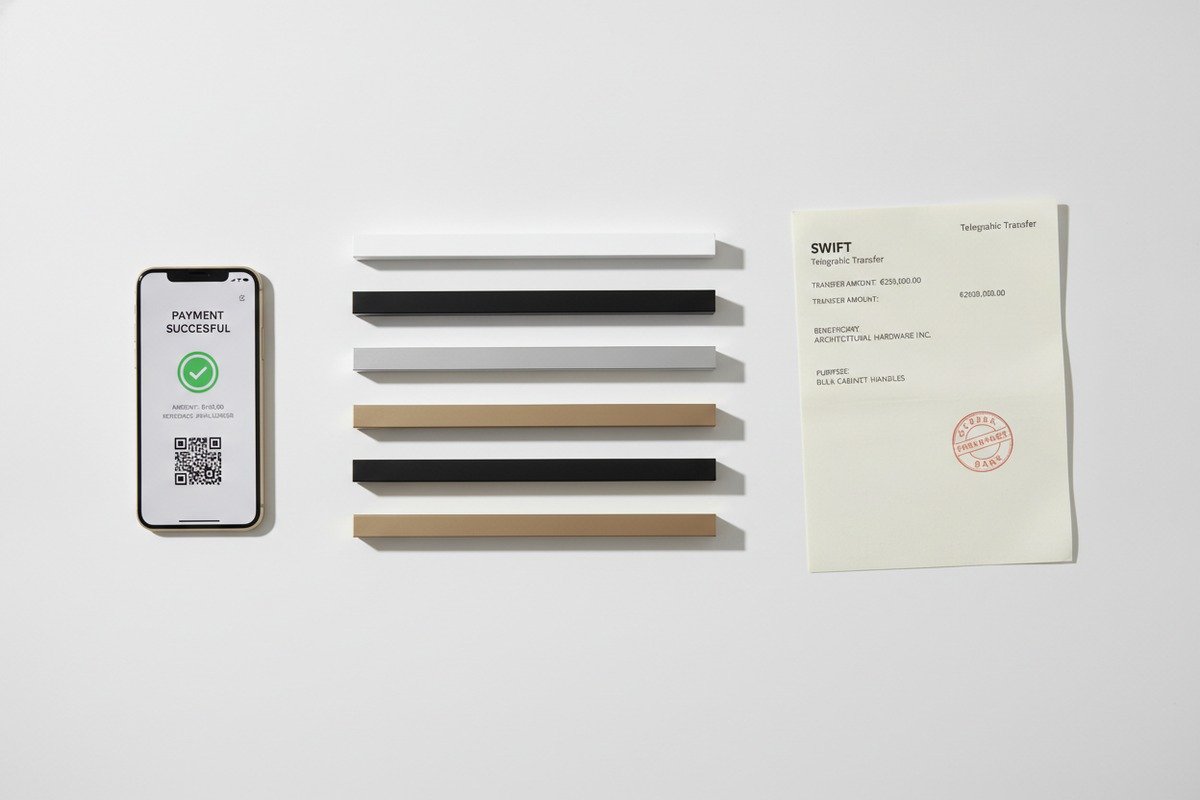
SWIFT telegraphic transfer is still the backbone of B2B trade between China and Vietnam. SWIFT telegraphic transfer (T/T) 2 Nearly every Chinese aluminum handle supplier has a bank account that can receive SWIFT payments. The process is straightforward. You go to your Vietnamese bank, provide the supplier's bank details and SWIFT code, and initiate the transfer. Funds typically arrive in 3 to 5 business days.
The main drawback is cost. SWIFT transfers often involve intermediary banks, especially when you convert VND to USD first, then USD to CNY. Each conversion adds a spread. Each intermediary bank charges a fee. For a $15,000 order of custom champagne gold anodized handles, you might lose $50 to $150 in total fees.
Still, the reliability is hard to beat. Banks verify both sender and receiver. You get a clear paper trail for customs and tax purposes. And every supplier in Foshan accepts it without question.
Cross-Border QR Code Payments: The New Frontier
In 2025, NAPAS in Vietnam 3 and Ant International in China expanded QR code interoperability. This means a Vietnamese buyer can use a local banking app that supports VIETQRGlobal 4 to scan a QR code linked to a Chinese supplier's Alipay 5 or UnionPay wallet. The settlement happens directly in VND to CNY. No USD conversion needed.
We have started seeing a handful of our Vietnamese buyers use this for sample orders and small test batches. It is fast — funds arrive in minutes — and the fees are minimal. But there are limits. Not every small Chinese workshop has a digital wallet set up. And daily transaction caps may restrict larger orders.
Alibaba Trade Assurance: The Safety Net
For buyers who find suppliers on Alibaba, Trade Assurance acts as an escrow service. Alibaba Trade Assurance 6 Your payment is held by Alibaba until you confirm the goods meet your specifications. If the aluminum handles arrive with the wrong finish or wrong dimensions, you can file a dispute and get a refund.
The trade-off is speed and cost. Platform fees range from 1% to 3%. The process takes longer than a direct T/T. But for a first-time order from an unknown supplier, it offers peace of mind that no other method can match.
Payment Method Comparison Table
| Feature | SWIFT T/T | QR Code (Alipay/VIETQR) | Trade Assurance (Alibaba) |
|---|---|---|---|
| Best Order Size | > $10,000 | < $5,000 | Any size |
| Speed | 3–5 business days | Minutes | 5–10 business days |
| Fees | $30–$150+ | Near zero | 1%–3% of order value |
| Currency Path | VND → USD → CNY | VND → CNY direct | USD or CNY |
| Fraud Protection | Bank verification | Wallet verification | Full escrow |
| Documentation | Strong paper trail | Limited | Platform records |
| Supplier Acceptance | Universal | Growing but limited | Alibaba sellers only |
Using a Local Sourcing Agent
Some Vietnamese buyers use a trusted agent based in China. The agent pays the supplier in CNY cash or domestic transfer, and the buyer settles with the agent in VND. This is practical for very small or urgent orders. But it adds a layer of risk — you are trusting a middleman with your money. Only use agents with a verified track record.
How can I ensure my cross-border transactions are secure when working with a new Foshan aluminum profile supplier?
When our sales team onboards a new Vietnamese client, we always encourage them to verify us thoroughly before sending any money. That might sound unusual coming from the supplier side, but we have seen too many buyers get burned by fake factories claiming to be in Foshan.
To secure your transactions with a new Foshan supplier, always verify the business license through official Chinese government portals, request a live video factory tour, start with a small test order using 30/70 split payment terms, and never scan QR codes or wire funds to unverified accounts.

Step 1: Verify the Supplier's Identity
China's National Enterprise Credit Information Publicity System 7 allows anyone to look up a company's registered name, address, legal representative, and business scope. Ask your supplier for their full registered company name in Chinese, then search it. The address should match what they told you. The business scope should include aluminum processing or hardware manufacturing.
You can also ask for a copy of their business license and cross-reference the registration number. If the supplier refuses or provides excuses, that is a red flag.
Step 2: Request a Live Video Tour
Photos can be faked. Websites can be copied. But a live video call showing the factory floor, the extrusion machines, the anodizing line, and the finished handle inventory is very hard to fabricate. At our facility, we regularly do WeChat or WhatsApp video calls with new buyers. We walk them through the production area, show them the raw aluminum billets, and demonstrate the surface treatment process.
If a supplier declines a live video tour, consider it a serious warning sign.
Step 3: Use Split Payment Terms
Never pay 100% upfront for a first order. The standard in the aluminum hardware trade is 30% deposit before production and 70% balance before shipment. Some buyers negotiate 30/70 with the balance paid after inspection. This protects both sides. The supplier gets enough capital to start production. The buyer retains leverage until quality is confirmed.
Step 4: Protect Against Fake Bank Details
A common scam involves intercepting emails between buyer and supplier, then sending modified bank details. The buyer wires money to a fraudster's account instead of the real supplier. To prevent this, always confirm bank details via a separate communication channel. If you received an invoice by email, call the supplier on WhatsApp to verify the account number digit by digit.
Supplier Verification Checklist
| Verification Step | How to Do It | Red Flag if Missing |
|---|---|---|
| Business license check | Search official Chinese government portal | Supplier refuses to share license |
| Live video factory tour | WhatsApp or WeChat video call | Only sends photos, avoids video |
| Sample order | Order 50–100 handles before bulk | Demands large MOQ with no samples |
| Bank detail confirmation | Verify via phone call, not just email | Only communicates via email |
| Third-party inspection | Hire SGS 8 or similar before final payment | Supplier objects to inspection |
| Reference check | Ask for 2–3 existing Vietnamese buyer contacts | No references available |
The Value of Third-Party Inspection
For orders above $5,000, hiring a third-party inspection company like SGS, Bureau Veritas 9, or even a local Vietnamese inspector based in Guangdong is a smart investment. They will check the aluminum grade, measure handle dimensions, verify the anodized or powder-coated finish, and confirm packaging quality. The cost is typically $200 to $400 per inspection — a small price to protect a $20,000 shipment.
Should I settle my custom furniture handle invoices in USD or CNY to minimize exchange rate losses?
Our accounting team tracks every payment we receive, and we have noticed a clear pattern — Vietnamese buyers who settle in CNY consistently save 2% to 4% compared to those who go through USD as an intermediary currency. That difference adds up fast when you are importing containers of handles every month.
Settling invoices in CNY is generally more cost-effective for Vietnamese buyers because it avoids the double conversion spread of VND to USD to CNY. However, if your Vietnamese bank offers poor CNY rates or limited CNY services, USD remains a safer and more accessible choice for large orders.

Why Double Conversion Hurts Your Margins
When you pay in USD, here is what actually happens. Your Vietnamese bank converts VND to USD. The Chinese supplier's bank then converts USD to CNY. Each conversion carries a spread — the difference between the buy and sell rate. For a $20,000 order, the first spread might cost you $100 to $200. The second spread costs another $50 to $100 on the Chinese side. That is $150 to $300 gone before the handles even leave the factory.
Now consider direct CNY settlement. Your bank converts VND to CNY in one step. One spread. One fee. With the growing CNY corridors between Vietnamese and Chinese banks, this option is becoming more accessible and competitive.
When USD Still Makes Sense
Not all Vietnamese banks offer competitive CNY exchange rates. Smaller regional banks may have limited CNY liquidity, resulting in wider spreads that negate the savings. In that case, USD is the better option because it is the world's most liquid currency. The spreads are tighter, and every bank handles it efficiently.
Also, if your contract includes components sourced from multiple countries (not just China), denominating in USD creates a single reference currency that simplifies your accounting.
Currency Settlement Comparison
| Factor | Settlement in USD | Settlement in CNY |
|---|---|---|
| Conversion steps | VND → USD → CNY (2 steps) | VND → CNY (1 step) |
| Typical spread cost | 1.5%–3% | 0.5%–1.5% |
| Bank accessibility | Universal | Growing but limited at some banks |
| Exchange rate volatility | Moderate (USD stable) | Moderate (CNY managed float) |
| Contract simplicity | Good for multi-country sourcing | Best for China-only sourcing |
| Recommended for | Orders > $20,000 with established USD accounts | Frequent orders to China under $20,000 |
Locking Exchange Rates with Forward Contracts
If you place large or recurring orders, ask your bank about forward contracts 10. A forward contract lets you lock in today's exchange rate for a payment that will happen in 30, 60, or 90 days. This is especially useful if you are ordering custom handles with a 3 to 7 day production window. You know the exact cost in VND before production even starts.
Our recommendation: if you order from China more than twice a month, open a CNY-denominated account at a major Vietnamese bank like Vietcombank or BIDV. This gives you flexibility to hold CNY and pay suppliers when the rate is favorable. It also speeds up transfers because the money does not need to go through a USD intermediary.
Add a Currency Clause to Your Contract
Always include a currency clause in your purchase agreement. This clause should specify which currency the price is fixed in, who bears the exchange rate risk, and whether there is a price lock period. For example: "Unit price is fixed at 8.5 CNY per handle for 60 days from contract date. Exchange rate risk is borne by the buyer." This eliminates disputes when rates shift between order and payment.
What precautions should I take to avoid payment delays that might impact my 3-7 day custom production timeline?
In our production scheduling system, a custom handle order only enters the queue once the deposit clears. We have seen cases where a Vietnamese buyer placed an order on Monday, but the payment did not arrive until Friday due to banking delays. That pushed the production start to the following week and delayed the entire shipment by seven days.
To avoid payment delays, use fast payment channels like QR codes or pre-funded CNY accounts for deposits, ensure your bank has all required compliance documents ready before transfer, confirm the supplier's exact bank details in advance, and align payment timing with your supplier's production schedule.
Why Payment Delays Happen
Payment delays in China-Vietnam trade usually stem from a few predictable causes. The most common is incomplete documentation. Vietnamese banks require specific forms and declarations for outbound international transfers. If you walk into the bank without the proforma invoice, the purchase contract, or the correct beneficiary details, the transfer gets held up while the bank requests additional paperwork.
Another common cause is intermediary bank processing. When your payment routes through a correspondent bank in Hong Kong or Singapore, it can add one to two business days. National holidays in either country also cause delays — Chinese New Year, Tet, and Golden Week are notorious for freezing payment pipelines for a week or more.
Pre-Fund Your Payments
The single most effective way to avoid delays is to have funds ready before you place the order. If you use a CNY-denominated account, convert VND to CNY during favorable rate periods and keep a working balance. When you need to pay a deposit for a rush order of matte black recessed handles, the transfer is domestic on the Chinese side and settles in hours, not days.
Prepare Documentation in Advance
Before you initiate any transfer, have the following documents ready:
- Proforma invoice from the supplier
- Signed purchase contract
- Supplier's bank account details (account name, account number, bank name, SWIFT code, bank address)
- Payment declaration form (required by Vietnamese customs)
- Your company's import license or registration
Having these documents organized in a folder — digital and physical — speeds up every future transaction.
Align Payment with Production Scheduling
Talk to your supplier about their production schedule. At our factory, we start custom orders within 24 hours of deposit confirmation. If you can time your deposit to arrive on a Monday morning China time, production begins that same day, and your handles can ship by Thursday or Friday. If the deposit arrives Friday afternoon, production starts the following Monday.
Holiday Planning Calendar
| Holiday | Country | Typical Duration | Impact on Payments |
|---|---|---|---|
| Chinese New Year | China | 7–15 days | Banks and factories closed |
| Tet (Lunar New Year) | Vietnam | 7–10 days | Vietnamese banks closed |
| Golden Week (October) | China | 7 days | Banks and factories closed |
| Mid-Autumn Festival | Both | 1–3 days | Minor delays |
| Weekends | Both | Every week | No bank processing |
Build a Payment Timeline Into Your Order Process
Here is a practical workflow we recommend to our Vietnamese buyers:
- Day 1: Finalize specs and receive proforma invoice. Confirm bank details via phone call.
- Day 1–2: Initiate 30% deposit via the fastest available method. If using SWIFT, initiate early in the day to avoid next-day processing.
- Day 2–3: Deposit clears. Supplier confirms and enters order into production.
- Day 3–7: Production completes. Supplier sends photos and inspection report.
- Day 7: Buyer approves quality. Initiates 70% balance payment.
- Day 8–9: Balance clears. Supplier arranges shipment.
This timeline assumes no holidays and no documentation issues. Add a two-day buffer for SWIFT delays and a five-day buffer around major holidays.
Communicate Proactively
Send your supplier a screenshot or bank reference number as soon as you initiate the payment. This lets them track the incoming transfer on their end and prepare production materials in parallel. At our end, when a buyer sends us a transfer receipt, we often begin material preparation before the funds formally clear — because we trust the documentation. This can save one to two days on the overall timeline.
Conclusion
Choosing the right payment method and taking proper precautions protects both your budget and your production timeline when sourcing aluminum furniture handles from China to Vietnam.
Footnotes
1. Offers details on the global digital payment and financial technology provider. ↩︎
2. Explains the standard international bank transfer method. ↩︎
3. Provides information on Vietnam’s national payment corporation. ↩︎
4. The original URL was broken. This NAPAS news release details the expansion of cross-border QR payment connectivity between Vietnam and China, explicitly mentioning ‘VIETQRGlobal codes’ and is an authoritative source from NAPAS. ↩︎
5. Provides information on a major Chinese mobile payment platform. ↩︎
6. Details Alibaba’s escrow service for buyer protection. ↩︎
7. Explains China’s official system for company verification. ↩︎
8. Provides information on a leading inspection, verification, testing, and certification company. ↩︎
9. Offers details on a global leader in testing, inspection, and certification services. ↩︎
10. Explains financial instruments used to lock in exchange rates. ↩︎