
Every year, our team in Foshan works alongside Vietnamese furniture factories who face one recurring nightmare: failed quality audits from their EU and US buyers. It starts with a rejected shipment — maybe inconsistent anodizing color, maybe hole spacing that is off by half a millimeter. Then the buyer sends a corrective action request, and the factory scrambles. The problem is rarely a single defect. It is a pattern of weak specification control, missing documentation, and no repeatable inspection process. We have seen this cycle so many times that we built our entire supply chain 1 around preventing it.
To pass European and American quality audits, Vietnamese OEM factories should source aluminum handles from suppliers who provide verified material grades, consistent surface finishes, documented traceability, strict dimensional inspections, and packaging designed to prevent transit damage — all backed by a repeatable quality management system.
This article walks you through the exact steps and checkpoints that help your aluminum handle supply chain become audit-ready. We will cover material and finish verification, customization support, lead time reduction, and the quality control processes that matter most to demanding Western buyers.
How do I verify that the surface treatment and material grade of my aluminum handles meet international export standards?
When we ship handles to Vietnamese factories who re-export to Europe and the US, the first question is always about material certificates and finish specs. Buyers in those markets do not accept "it looks fine" as proof. They want data.
Verify your aluminum handles by requesting mill test certificates for alloy grade (such as 6063-T5 or 6061-T6), spectral analysis reports for composition, and surface treatment test results including adhesion, thickness, salt spray resistance, and color consistency measurements for every production batch.

Why Material Grade Matters More Than You Think
Aluminum furniture handles are not all the same. The alloy grade determines strength, machinability, and corrosion resistance. For most furniture handles, 6063 aluminum 2 is the standard because it extrudes cleanly and anodizes well. But some applications — especially heavy-duty pulls or handles for commercial furniture — need 6061 for higher tensile strength.
At our factory, we run spectral analysis 3 on every batch of aluminum billets before extrusion begins. This confirms the chemical composition 4 matches the alloy specification. Without this step, you might receive handles made from recycled aluminum with impurities that cause surface pitting or inconsistent anodizing.
Surface Treatment: The Most Visible Quality Factor
European and American buyers inspect surface finish closely. A handle with uneven powder coating, visible tool marks, or color variation between batches will fail an audit immediately. Here is what to check:
| Surface Treatment | Key Test | Acceptance Criteria |
|---|---|---|
| Anodizing | Film thickness test (eddy current) | Typically 10–25 µm depending on buyer spec |
| Anodizing | Adhesion test (cross-cut tape) | No peeling or lifting allowed |
| Powder coating | Salt spray test (ASTM B117) | 500–1000 hours minimum, depending on application |
| Powder coating | Impact resistance test | No cracking or delamination |
| All finishes | Color consistency (Delta E measurement 5) | Delta E ≤ 1.5 across batches for most buyers |
Our production line includes inline color measurement stations. We compare every batch against a sealed master sample. If the Delta E value drifts beyond the agreed tolerance, the batch is held and reprocessed before shipping.
Ask for These Documents Before You Order
A reliable supplier should provide the following without hesitation:
- Mill test certificate for aluminum alloy grade
- Spectral analysis report
- Surface treatment process specification sheet
- Salt spray or corrosion test report
- Adhesion test results
- Color measurement records with Delta E values
If your supplier cannot produce these documents, that is a red flag. European and American auditors will ask for them, and you need to have them in your file before the audit, not after.
The Difference Between European and American Expectations
European buyers often reference EN standards 6 for aluminum profiles and surface treatments. American buyers may reference ASTM standards 7. The test methods are similar, but the specific references matter. Make sure your supplier knows which standard framework your end customer follows and can map their test results to it.
Can I find a Chinese supplier that offers the customization flexibility and technical support needed for my specific OEM projects?
Our engineering team regularly collaborates with Vietnamese furniture factories who need handles that are not available off the shelf. Custom lengths, unique finishes, private logo engraving — these are standard requests on our production floor.
Yes, established Chinese aluminum handle suppliers like LiliTONG offer full OEM/ODM customization including bespoke profiles, custom lengths, specialized finishes, logo engraving, and dedicated technical support from design through mass production, with turnaround times as fast as three to seven days for custom orders.

What Customization Actually Means in Practice
Customization is not just about choosing a color. For furniture handles, it can include:
- Profile design: creating a new cross-section shape for a unique handle design
- Length adjustment: cutting standard extrusions to non-standard lengths for specific cabinet widths
- Surface finish: matching a specific Pantone color, texture, or gloss level
- Mounting configuration: adjusting hole spacing, screw depth, or mounting hardware compatibility
- Branding: laser engraving a logo or model number on the handle
We handle all of these at our Foshan facility. Our mold library has over 200 existing profile dies, which means many custom shapes can be adapted from existing tooling rather than starting from scratch. This saves both time and money.
Technical Support That Goes Beyond Order Taking
Many Vietnamese OEM factories tell us their biggest frustration is working with suppliers who take the order but offer no guidance. When a European buyer sends a drawing with tight tolerances, you need a supplier who can review the drawing, flag potential manufacturing issues, and suggest alternatives if needed.
Our team provides DFM (Design for Manufacturability) feedback 8 on every custom order. For example, if a handle design has a very thin wall section that could warp during anodizing, we will recommend a minimum wall thickness before tooling starts. This prevents defects at the source.
How to Evaluate a Supplier's Customization Capability
| Capability | What to Look For | Red Flag |
|---|---|---|
| Tooling | In-house die making, large die library | Outsourced tooling with long lead times |
| Sampling | 3–7 day sample turnaround | More than 14 days for a simple sample |
| Finish range | Anodizing, powder coating, electrophoresis, wood grain | Only one or two finish options |
| Minimum order | Flexible MOQ for custom items | Rigid high MOQ with no negotiation |
| Technical review | DFM feedback on drawings | No engineering review before production |
| Communication | Responsive on WhatsApp or email within 24 hours | Slow or unclear communication |
A Real Scenario
One of our Vietnamese partners needed a recessed pull handle in a champagne gold anodized finish, cut to 17 non-standard lengths for a kitchen cabinet series destined for the German market. We produced the master sample in five days, confirmed the color match with a Delta E reading of 0.8, and shipped the first production batch within two weeks. The German buyer approved it on the first audit. That is the kind of outcome that builds long-term business.
How can I reduce my production lead times by sourcing from a supplier with ready-to-ship inventory and fast custom turnaround?
Long lead times are the silent killer of OEM contracts. We have heard from dozens of Vietnamese factory owners who lost orders because their handle supplier could not deliver on time, forcing them to delay their own shipments to European or American buyers.
Reduce lead times by partnering with a supplier that maintains large ready-to-ship inventory — our warehouse holds over 300 tons of popular aluminum handle profiles — and offers 48-hour dispatch for stock items plus 3–7 day turnaround for custom orders, so your production schedule stays on track.
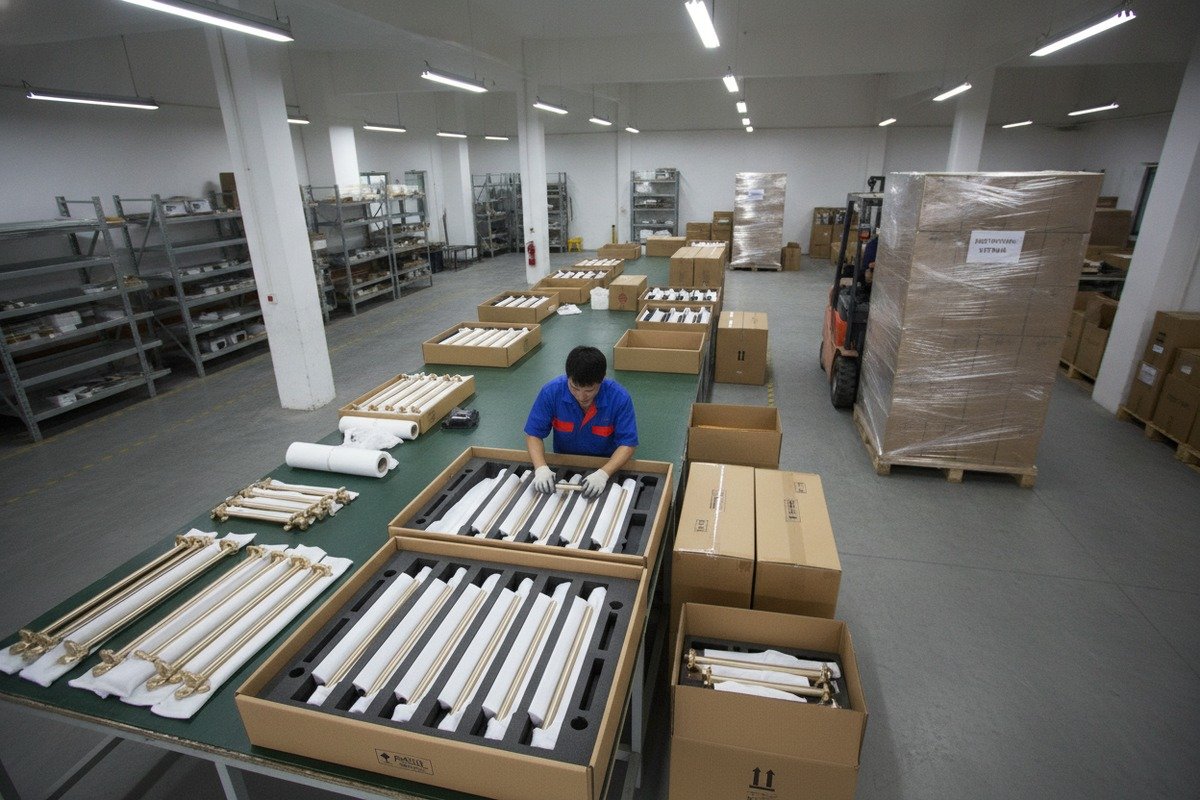
The Cost of Late Delivery
When a handle shipment is late, the entire furniture production line can stall. Cabinets sit in the warehouse waiting for hardware. The European buyer's delivery window passes. Penalties apply. And worst of all, the buyer loses confidence in your factory's ability to manage the supply chain. This is not a hypothetical scenario — it happens regularly in the Vietnamese OEM furniture industry.
Stock vs. Custom: A Two-Track Strategy
The smartest approach is to use a two-track sourcing strategy:
Track 1 — Stock items: For your most popular handle models and finishes, source from a supplier with ready inventory. Our top 50 SKUs are always in stock. We ship within 48 hours of order confirmation. This covers your urgent needs and repeat orders.
Track 2 — Custom items: For project-specific handles with unique finishes, lengths, or profiles, plan ahead and work with a supplier who can turn around custom orders in 3–7 days. This requires the supplier to have in-house extrusion, machining, and finishing capabilities — not outsourced to multiple sub-contractors.
Lead Time Comparison
| Sourcing Scenario | Typical Lead Time (Industry Average) | LiliTONG Lead Time |
|---|---|---|
| Stock handle, standard finish | 7–14 days | 48 hours |
| Custom length, existing profile | 14–21 days | 3–5 days |
| New profile, new finish | 30–45 days | 7–15 days |
| Reorder of previous custom item | 10–14 days | 3–5 days |
Why Integrated Manufacturing Matters for Speed
A supplier who extrudes, machines, finishes, and packs under one roof will always be faster than one who outsources finishing or machining. Every handoff between sub-contractors adds days and introduces quality risk. At our Foshan facility, all processes happen in-house, which is why we can promise and deliver fast turnaround without sacrificing consistency.
Planning Tips for Vietnamese OEM Factories
- Keep a rolling forecast of your top 10 handle SKUs and share it with your supplier monthly.
- For large European or American projects, place a blanket order and arrange staggered shipments.
- Ask your supplier to hold safety stock for your most critical items — a good supplier will agree if the relationship is stable.
- Build a 2-week buffer into your production schedule for custom handle orders, even with a fast supplier.
What quality control processes should my aluminum handle supplier have in place to help me pass strict European and American audits?
Over 18 years of exporting aluminum handles, we have learned exactly what European and American auditors look for — and more importantly, what causes factories to fail. The answer is almost never a single bad handle. It is a broken system.
Your supplier should operate a documented quality management system (ideally ISO 9001 certified) with defined incoming material inspection, in-process checkpoints at extrusion, machining, and finishing stages, AQL-based final inspection, full batch traceability, packaging integrity controls, and a corrective action procedure for nonconformances.

The Six Pillars of Audit-Ready Quality Control
Let me walk you through the quality control framework that Western auditors expect to see. It is not complicated, but every step must be documented.
Pillar 1: Incoming Material Control
Before any aluminum billet enters the extrusion press, it must be verified. This means checking the mill certificate against the purchase specification, running spectral analysis for composition, and inspecting the billet surface for defects. Our incoming inspection team rejects any billet lot that does not match the stated alloy grade.
Pillar 2: In-Process Inspection
During extrusion, CNC machining, and finishing, operators must check critical dimensions and surface quality at defined intervals. We use go/no-go gauges for hole spacing and digital calipers for profile dimensions. Surface inspectors use standardized lighting booths to check for scratches, dents, and coating defects.
Pillar 3: Final Inspection with AQL Sampling
Before packing, a final inspection is performed using AQL (Acceptable Quality Level) sampling plans 9. Most European and American buyers specify AQL 1.5 for critical defects and AQL 2.5 for minor defects. Your supplier should know these standards and apply them consistently.
Pillar 4: Full Batch Traceability
Every carton of handles should be traceable back to the raw material batch, extrusion run, machining lot, and finishing batch. We label every production lot with a unique code that links to all QC records. When an auditor asks "Where did the aluminum for this batch come from?", your supplier must be able to answer in minutes, not days.
Pillar 5: Packaging and Transit Protection
Handle defects discovered after shipping are the most frustrating kind. Scratched finishes, dented edges, and broken mounting points are often caused by poor packaging, not poor manufacturing. Our packaging process includes:
- Individual PE foam sleeves for each handle
- Cardboard separators between layers
- Reinforced outer cartons with edge protectors
- Drop-test validation for carton design
Pillar 6: Corrective Action and Continuous Improvement
When a defect is found — by your factory or by the end buyer — your supplier must have a formal corrective action process. This means root cause analysis, containment action, corrective action, and verification that the fix works. Auditors always check the CAPA (Corrective and Preventive Action) log 10. An empty log is suspicious. A log with real issues and real fixes shows a mature quality system.
What Auditors Actually Check: A Quick Reference
| Audit Area | What the Auditor Looks For | Common Failure Cause |
|---|---|---|
| Material records | Mill certs, spectral analysis, alloy traceability | Missing or generic certificates |
| Dimensional accuracy | Hole spacing ±0.1mm, profile symmetry, edge geometry | No calibrated measuring tools |
| Surface finish | Color consistency, no scratches, uniform coating thickness | Poor lighting in inspection area |
| Batch consistency | Same color, gloss, and dimensions across cartons | No master sample comparison system |
| Documentation | Inspection records, CAPA log, process flow chart | Records exist but are incomplete |
| Packaging | Adequate protection, no mixed lots in one carton | Thin cartons, no inner separators |
The Most Common Audit Failure Pattern
Auditors rarely reject a supplier for one defect. The pattern that triggers failure looks like this: unclear product specifications → no incoming material control → inconsistent finishing → no traceability records → no corrective action system. If you fix the system, you fix the audit results. This is why choosing a supplier with a mature, documented quality system is the single most impactful decision a Vietnamese OEM factory can make.
A Practical Suggestion
Before your first order, ask your Chinese handle supplier for a factory audit or a detailed quality manual. Visit the factory if possible. Check that they have calibrated instruments, trained inspectors, clean finishing lines, and organized documentation. At our facility, we welcome audits because our system is built to withstand them.
Conclusion
Building an audit-ready aluminum handle supply chain starts with choosing the right supplier. Focus on verified materials, consistent finishes, documented traceability, and fast delivery from an experienced partner.
Footnotes
1. Defines supply chain management as the coordination of a product’s flow from materials to distribution. ↩︎
2. Describes 6063 aluminum alloy, its composition, mechanical properties, and common uses in architectural applications. ↩︎
3. Explains spectral analysis as a materials-testing procedure to determine the chemical composition of metals. ↩︎
4. Replaced with a Wikipedia page providing a comprehensive overview of aluminium alloy chemical composition. ↩︎
5. Defines Delta E as a standardized metric for measuring the visible difference between two colors, crucial for color accuracy. ↩︎
6. Explains European Standards (EN) as harmonized technical requirements developed by CEN and CENELEC for the EU. ↩︎
7. Provides an overview of ASTM International, a global leader in developing and delivering voluntary consensus standards. ↩︎
8. Defines Design for Manufacturability (DFM) as optimizing product design for easier, faster, and more cost-efficient production. ↩︎
9. Explains AQL (Acceptance Quality Limit) sampling as a standard method in product inspections to determine acceptable defect levels. ↩︎
10. Defines Corrective and Preventive Action (CAPA) as improvements to eliminate causes of non-conformities or undesirable situations. ↩︎