Finding reliable honeycomb panel manufacturers in China used to keep me up at night — one wrong supplier choice could derail an entire infrastructure project.
The top 10 honeycomb panel manufacturers in China for 2026 include Winsom (Xiamen), Guangdong Nanbeiwang, Foshan Liming, Suzhou Beessun, Shanghai Huayuan, Hangzhou Holycore, Suzhou Haxcore, Huarui Honeycomb, Bihore Honeycomb, and Foshan Onebond, selected for production capacity, certifications, and global export capability.
Below, I break down how to evaluate these suppliers, verify quality, negotiate custom specs, and lock down delivery timelines Environmental Product Declaration (EPD) 1. Every insight comes from years of coordinating large-scale B2B material shipments from Chinese factories to project sites across Southeast Asia, Africa, and South America.
How do I choose the right honeycomb panel manufacturer for my specific project needs?
A conversation with a project director in Singapore changed how I think about supplier selection — he told me his last honeycomb panel order arrived with mismatched thicknesses because he picked the cheapest quote without checking production lines.
Choose a honeycomb panel manufacturer by evaluating five dimensions: production capacity (at least two automated lines), verified project case studies, ISO and fire-resistance certifications, on-site installation support, and at least five years of export experience in your target application sector.
Why Production Capacity Matters First
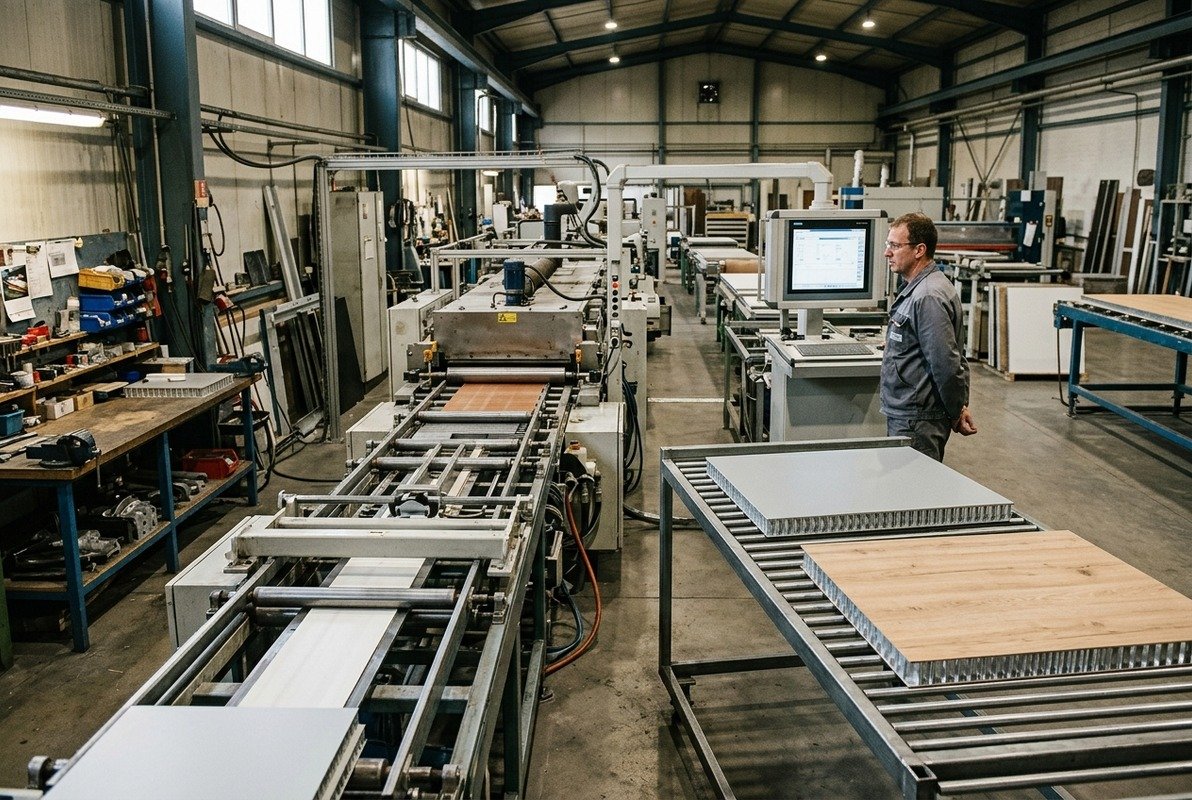
When you source aluminum honeycomb panels or composite sandwich panels for a large curtain wall project, the factory must handle volume without cutting corners. A manufacturer running two or more fully automated composite lines can typically process urgent orders exceeding 50,000 m² per cycle. Smaller shops may promise the same, but they subcontract — and that is where quality variance creeps in.
I have seen this firsthand. We coordinate cable management systems for EPC projects, and the material suppliers we recommend to our partners must meet the same rigor we apply to our own tray and trunking production. If a honeycomb panel factory cannot show you its actual production floor, move on.
The Five-Dimension Evaluation Framework
| Evaluation Dimension | What to Look For | Red Flag |
|---|---|---|
| Production Capacity | ≥2 automated composite lines; annual output figures | Only one manual line; vague capacity claims |
| Project Case Studies | Completed high-rise, irregular-shape, or overseas landmark jobs with photo-contract matching | No verifiable references; stock photos only |
| Certifications | ISO 9001, ISO 14001, CE, SGS RoHS, IMO MED, fire-resistance ratings | Missing or expired certificates; no third-party audits |
| Installation Support | On-site technical guidance, node design drawings, BIM integration | "We only ship panels" — no engineering support |
| Export Experience | ≥5 years serving your region; familiarity with local building codes | First-time exporter; no knowledge of destination standards |
Matching Manufacturer to Application
Not every factory excels in every product type. The honeycomb panel market in China spans architectural cladding, aerospace applications, transportation industry panels, and interior decoration. Here is a quick guide:
| Application | Best-Fit Manufacturer Type | Key Product |
|---|---|---|
| Curtain walls / facades | Architectural specialists (Winsom, Nanbeiwang, Onebond) | Aluminum honeycomb panels with PVDF coating |
| Commercial vehicle walls/floors | Thermoplastic innovators (Holycore) | Thermoplastic honeycomb (HolyPan®) |
| Aerospace / EMI shielding | Advanced composites (Haxcore) | Aramid and aluminum honeycomb core materials |
| Interior ceilings / furniture | Mid-range producers (Beessun, Huarui) | Lightweight panels with wood-grain finish |
| Stone-faced exteriors | Stone composite specialists (Bihore) | Stone honeycomb panels |
The China honeycomb panel market reached approximately RMB 18.83 billion in 2025, with projections exceeding RMB 22.27 billion by 2032. China holds about 41% of the global market share. This means you have over 100 manufacturers to choose from — but only a handful meet international project standards. Narrow your shortlist using the framework above before requesting quotes. For a broader perspective on who leads outside China, see our guide to the top 10 honeycomb panel manufacturers in the world.
How can I verify the quality and durability of panels from these Chinese suppliers?
Last year, one of our EPC partners in Africa received a shipment of fire resistant panels that failed the local building inspector's peel-strength test — a $40,000 lesson in skipping pre-shipment inspection.
Verify quality by requesting original ISO 9001 and fire-resistance certificates, ordering third-party lab samples for peel strength and flatness testing, conducting a pre-shipment factory audit, and checking that the supplier uses AI-driven quality control on their production line.
Certifications Are the Starting Point, Not the Finish Line
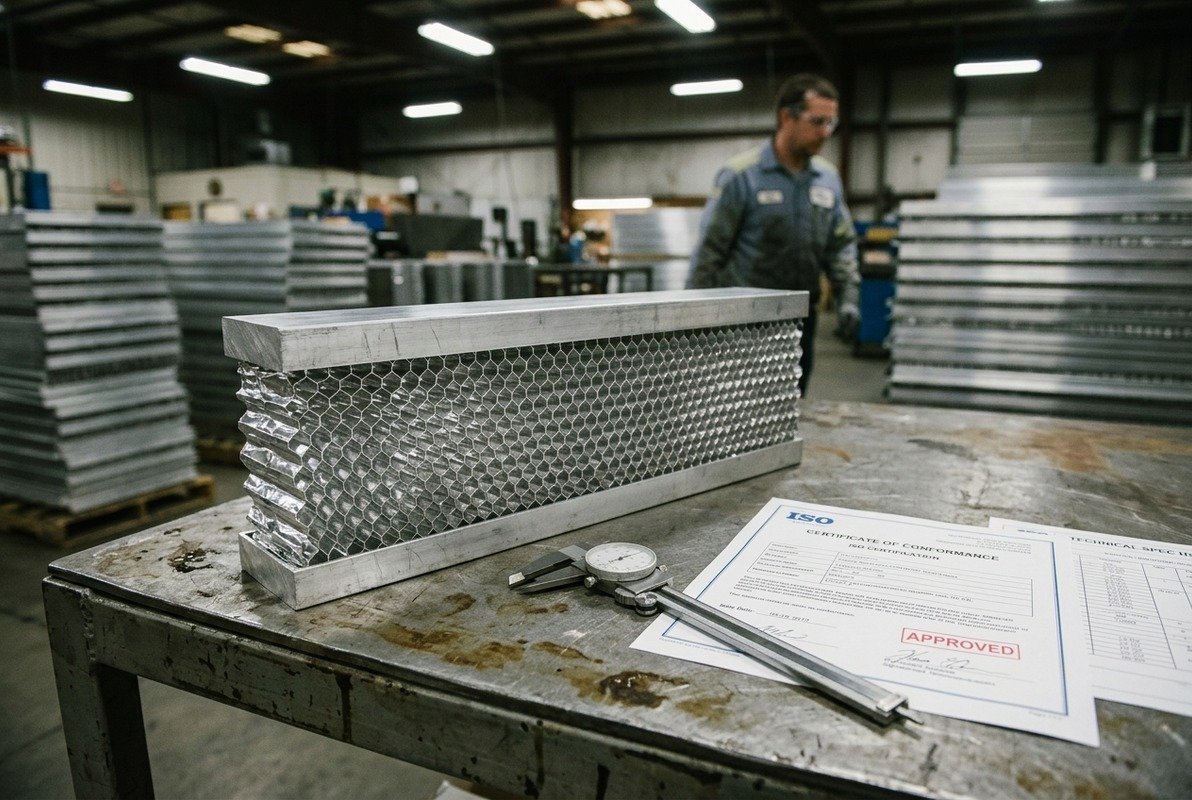
Every serious honeycomb panel manufacturer in China will show you an ISO 9001 certificate 2. The question is whether that certificate is current, whether it covers the specific product line you need, and whether the certifying body is accredited. Ask for the certificate number and verify it directly on the issuing body's website. For fire resistant panels, look for GB 8624 (China), EN 13501-1 (Europe) 3, or ASTM E84 (North America) test reports — not just a claim on a brochure.
The Three-Layer Quality Check Process
I recommend a three-step approach. It mirrors what we do internally when qualifying raw material suppliers for our cable tray production.
Step 1 — Sample Testing. Request two to three sample panels and send them to an independent lab. Key tests include:
- Peel strength (T-peel test per ASTM D1781 4) — measures how well the face sheet bonds to the honeycomb core materials.
- Flatness tolerance — critical for architectural cladding where visual aesthetics matter.
- Fire reaction — smoke density, flame spread, and heat release rate.
- Corrosion resistance — salt spray test (ASTM B117) for panels destined for coastal or tropical projects.
Step 2 — Factory Audit. Visit or hire a third-party inspection firm (SGS, Bureau Veritas, TÜV) to walk the production floor. Check whether the factory uses robotics and AI-driven quality control — leading manufacturers in 2026 integrate real-time defect detection cameras on the lamination line.
Step 3 — Pre-Shipment Inspection. Before containers are sealed, an inspector measures random panels for thickness, weight, and surface finish. This catches problems before they become your problem.
What Tests Matter Most by Product Type
| Panel Type | Critical Test | Standard | Pass Threshold |
|---|---|---|---|
| Aluminum honeycomb panels | Peel strength | ASTM D1781 | ≥1.5 N/mm |
| FRP honeycomb panels | Flexural strength | ASTM C393 | ≥15 MPa |
| Thermoplastic honeycomb | Impact resistance | ISO 6603-2 | No through-crack |
| Stone honeycomb panels | Bond shear strength | EN 12002 | ≥1.0 MPa |
| Fire resistant panels | Flame spread index | ASTM E84 | Class A (≤25) |
Sustainability is also becoming a verification point. Top manufacturers now use recycled aluminum content and track energy consumption per square meter of panel produced. If your project requires LEED or BREEAM credits 5, ask for an Environmental Product Declaration (EPD).
Can I get custom specifications and OEM support for my large-scale infrastructure project?
One detail that surprises many first-time buyers: the best Chinese honeycomb panel manufacturers treat customization as standard operating procedure, not a special favor.
Yes — leading Chinese honeycomb panel manufacturers offer full OEM/ODM support including custom panel dimensions, core densities, surface finishes, edge profiles, and branded packaging, typically requiring a minimum order of 500–1,000 m² and a 15–30 day sampling lead time.

How Deep Does Customization Go?
In our own cable management business, we build every tray, ladder, and trunking system to project-specific drawings. The same principle applies to composite sandwich panels. A capable honeycomb panel factory will customize at multiple levels:
- Panel dimensions: Length, width, and total thickness tailored to your curtain wall module or vehicle floor layout.
- Core specification: Cell size (typically 6 mm to 25 mm), foil thickness, and material — aluminum, aramid (Nomex), or polypropylene for different strength and weight targets.
- Face sheet material: Aluminum alloy grade, FRP (fiberglass-reinforced plastic) 6, stainless steel, or natural stone veneer.
- Surface finish: PVDF fluorocarbon coating, powder coating, anodizing, wood-grain transfer printing, or mill finish.
- Edge treatment: Open edge, folded edge, U-channel, or concealed-fix edge for clean architectural lines.
- Special performance: Enhanced fire resistance, EMI shielding layers, UV-resistant coatings, or sound-damping interlayers.
The OEM Collaboration Timeline
The process from initial inquiry to mass production typically follows this flow:
- Technical discussion — Share your project drawings or performance specs. The factory's engineering team proposes a panel build-up.
- Sample production — 15 to 30 days. You receive physical samples for fit, finish, and testing.
- Sample approval — You test, adjust if needed, and sign off.
- Production order — Lead time varies from 25 to 45 days depending on volume and complexity.
- Quality inspection — Factory QC plus your third-party inspector.
- Shipping and logistics — The factory handles export packing; you or your freight forwarder arranges sea or rail freight.
For lightweight panels destined for the transportation industry — say, commercial vehicle side walls or railway coach interiors — manufacturers like Hangzhou Holycore offer thermoplastic honeycomb solutions with integrated mounting features molded directly into the panel. This eliminates secondary machining and speeds up vehicle assembly.
BIM integration is another growing capability. Several top-10 manufacturers now provide digital panel models that architects and engineers can drop directly into their Building Information Modeling software 7. This cuts coordination errors between the panel supplier and the general contractor.
Customization vs. Standard: What Changes?
| Parameter | Standard Panel | Custom OEM Panel |
|---|---|---|
| Dimensions | Fixed sizes (1220×2440 mm typical) | Any size up to factory max (e.g., 1500×6000 mm) |
| Core density | One or two options | Specified to project load requirements |
| Surface finish | Limited catalog | Matched to RAL color, custom texture |
| MOQ | Low (50–100 m²) | Higher (500–1,000 m²) |
| Lead time | 7–15 days | 25–45 days |
| Price | Lower unit cost | 10–30% premium depending on complexity |
How do I ensure on-time delivery and avoid shipping delays for my bulk order?
Delivery delay is the pain point I hear about most — it comes up in nearly every first conversation with a new project buyer on WhatsApp.
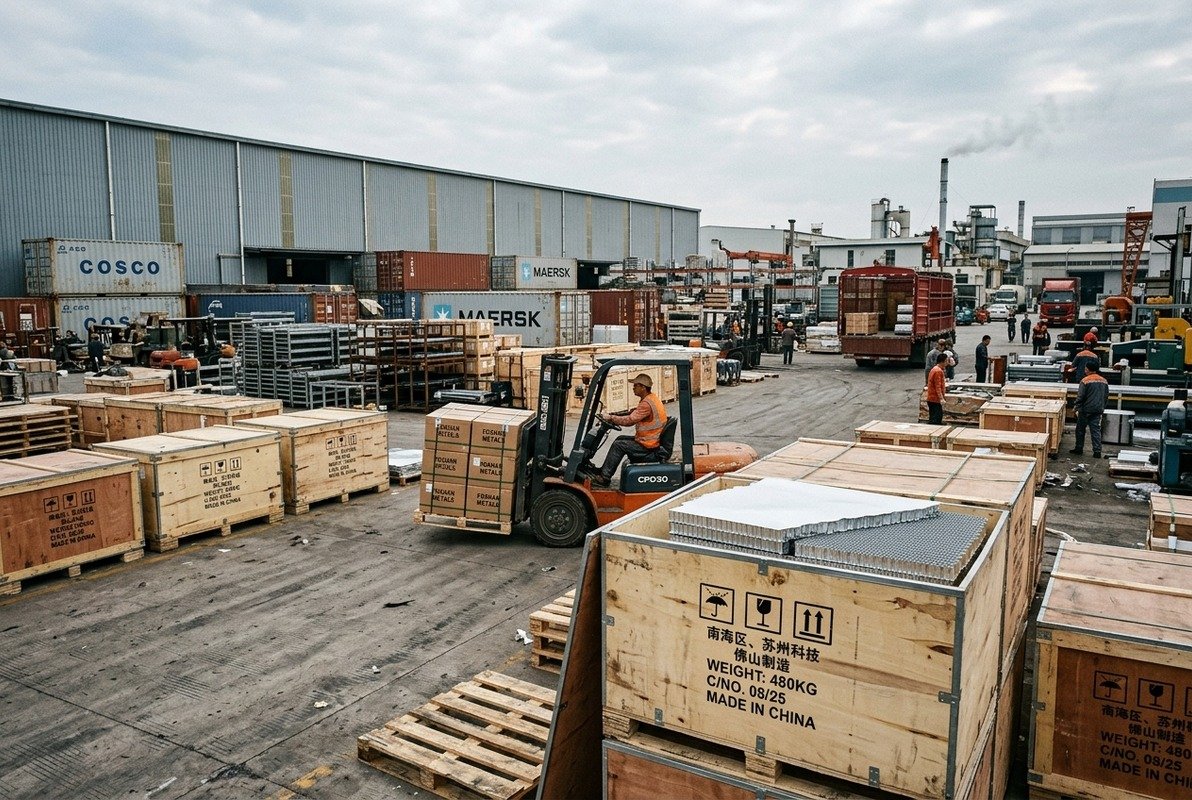
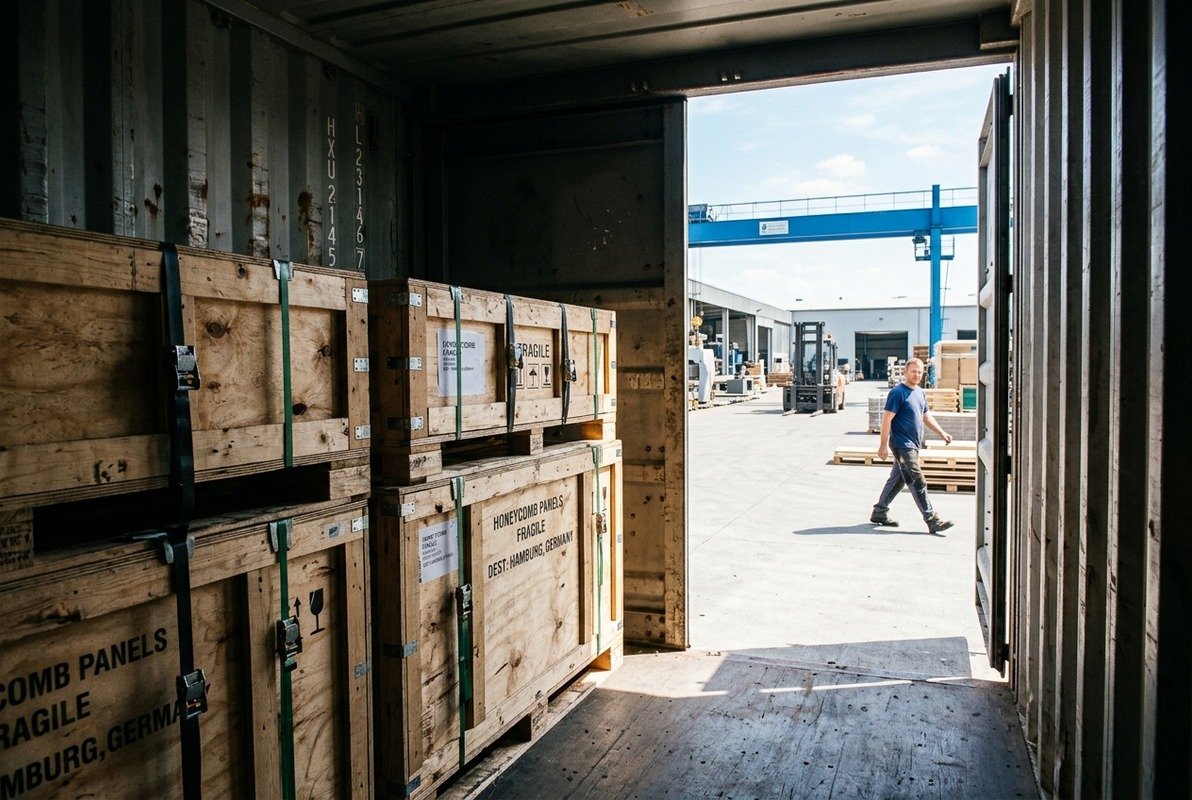
Ensure on-time delivery by locking in production slots 60–90 days before your site deadline, splitting large orders into phased shipments, requiring weekly production progress photos, and using a freight forwarder experienced in Chinese port logistics.
Why Delays Happen — and How to Prevent Each One
Delays in bulk honeycomb panel orders usually trace back to one of four causes. I have dealt with every one of them while managing cable tray shipments to Southeast Asia and South America.
Cause 1 — Late raw material arrival. Aluminum coil prices and availability fluctuate. If the factory did not pre-purchase material before your order confirmation, it may wait weeks for supply. Prevention: confirm that the manufacturer holds buffer stock of common alloys (3003, 5052) or has locked-in supply agreements.
Cause 2 — Production queue congestion. Peak season in China (March–June, September–November) fills factory schedules fast. Prevention: place your order and pay the deposit at least 60 to 90 days before your required delivery date.
Cause 3 — Quality rework. If panels fail in-line QC, the batch must be remade. Prevention: approve samples thoroughly upfront and agree on clear acceptance criteria in the contract.
Cause 4 — Port and shipping disruption. Container shortages, customs holds, or weather delays at Shenzhen, Shanghai, or Xiamen ports. Prevention: work with an experienced freight forwarder and build a one-to-two-week buffer into your site schedule.
Phased Shipping Strategy
For orders above 10,000 m², I always recommend splitting into two or three shipments. This way, your installation crew can start work while later batches are still in production or transit. It also reduces the financial risk of having your entire order on a single vessel.
Communication Protocol That Works
Set up a clear reporting cadence with the factory:
- Weekly: Production progress photos and quantity completed versus planned.
- Milestone: Notification when raw material arrives, when lamination starts, when packing begins.
- Pre-shipment: Inspection report, packing list, and container loading photos.
Use WhatsApp or WeChat for real-time communication. Most top Chinese manufacturers assign a dedicated export sales manager who speaks English and understands international shipping terms (FOB, CIF, DDP) 8.
Real-time digital order tracking is now offered by several advanced factories. You log into a portal and see exactly where your order sits in the production pipeline. This kind of supply chain digitalization is a hallmark of the best honeycomb panel manufacturers heading into 2026. If you are also evaluating sourcing partners beyond manufacturers, our list of top 10 honeycomb panel suppliers in China covers trading companies and distributors that can simplify logistics.
Conclusion
Selecting from the top honeycomb panel manufacturers in China requires disciplined evaluation of capacity, certifications, customization depth, and delivery reliability — the framework above gives you a repeatable process to get it right.
Footnotes
1. Defines a verified document communicating a product’s life-cycle environmental impact. ↩︎
2. Explains the global standard for quality management systems. ↩︎
3. Details the European standard for fire classification of construction products. ↩︎
4. Describes the standard test method for measuring peel resistance of adhesive bonds. ↩︎
5. Explains leading green building certification systems for sustainable projects. ↩︎
6. Provides a definition and overview of fiberglass-reinforced plastic composite material. ↩︎
7. Explains the intelligent 3D model-based process for building design and management. ↩︎
8. Clarifies common international commercial terms for shipping responsibilities and costs. ↩︎