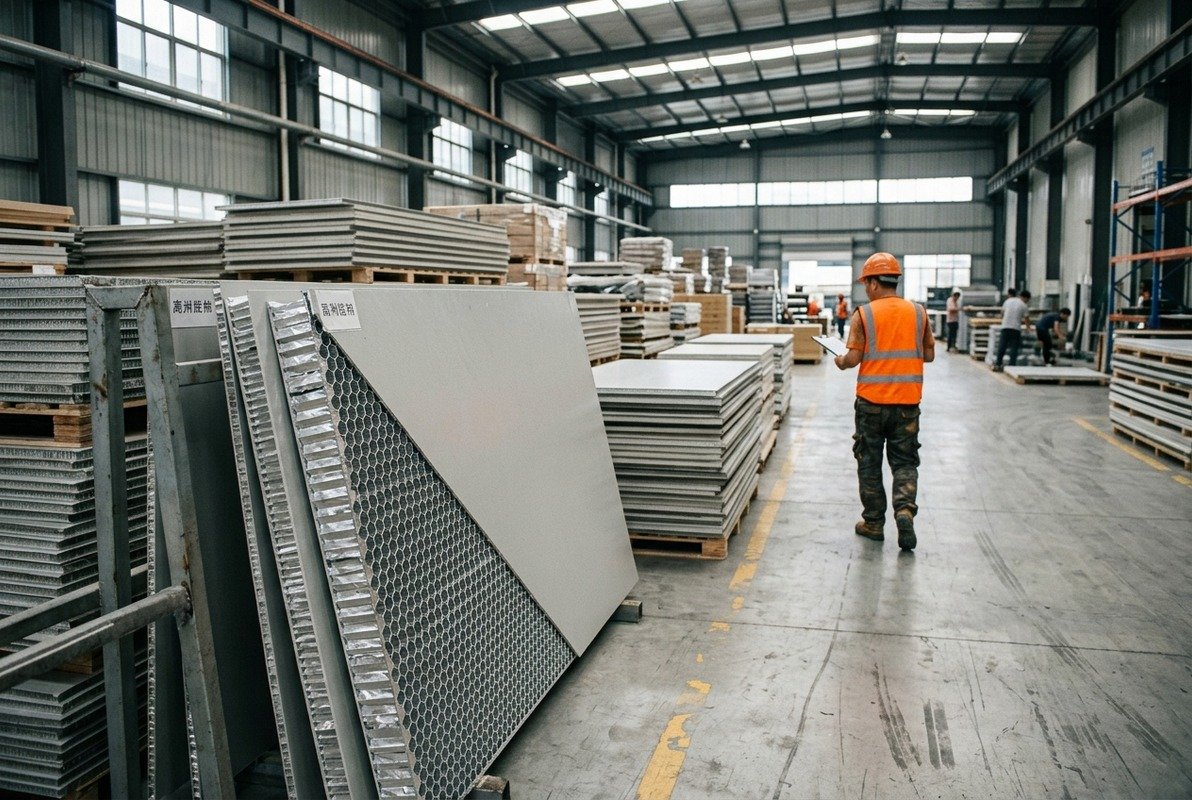
Finding reliable honeycomb panel companies in China can feel overwhelming when dozens of suppliers claim top-tier quality but deliver inconsistent results.
The top 10 honeycomb panel companies in China for 2026 include Winsom (Xiamen), Foshan Liming, Suzhou Haxcore, Hangzhou Holycore, Shanghai Huayuan, Suzhou Beessun, Foshan Onebond, Guangzhou Lanzuan, Indy Honeycomb, and Huarui Honeycomb — leaders in aluminum honeycomb panels, composite sandwich panels, and lightweight materials for construction, aerospace, and transportation.
Below, I break down what makes each company stand out CE certifications 1. I also share practical tips on choosing the right supplier, verifying quality, and managing logistics — lessons drawn from years of sourcing and shipping building materials from China to projects across Southeast Asia, Africa, and South America.
Quick Overview: Top 10 Honeycomb Panel Companies in China (2026)
| Rank | Company | Headquarters | Core Specialty | Key Applications |
|---|---|---|---|---|
| 1 | Winsom (Xiamen) | Xiamen, Fujian | Aluminum honeycomb panels 2, composite panels | Architectural curtain walls, facades |
| 2 | Foshan Liming | Foshan, Guangdong | Industrial & architectural honeycomb composites | Construction cladding, interiors |
| 3 | Suzhou Haxcore | Kunshan, Jiangsu | Honeycomb cores, EMI shielding panels | Aerospace applications, defense |
| 4 | Hangzhou Holycore | Hangzhou, Zhejiang | Thermoplastic honeycomb 3 (HolyPan®) | Commercial vehicle walls/floors |
| 5 | Shanghai Huayuan | Shanghai | Aluminum-plastic & honeycomb panels | Construction, transportation solutions |
| 6 | Suzhou Beessun | Suzhou, Jiangsu | Honeycomb cores & panels | Furniture, packaging, construction |
| 7 | Foshan Onebond | Foshan, Guangdong | Bonded composite materials | Curtain walls, interior decoration |
| 8 | Guangzhou Lanzuan | Guangzhou, Guangdong | Curtain wall materials | Building exteriors, facades |
| 9 | Indy Honeycomb | China | Industrial honeycomb applications | Aerospace, industrial panels |
| 10 | Huarui Honeycomb | China | Aluminum honeycomb panels | Construction, interior decoration |
Market Snapshot
The global aluminum composite panel market 4 is projected to reach $7.73 billion by 2026. China sits at the center of this growth. Infrastructure mega-projects, stricter fire safety regulations, and demand for eco-friendly building materials all push the honeycomb panel sector forward Peel strength test 5. From fire resistant panels for high-rise facades to polypropylene honeycomb sheets for lightweight vehicle floors, these companies cover a wide spectrum.
I have seen this firsthand. When our team at LANYE CABLETRAY works with EPC contractors on large infrastructure projects, we often coordinate with honeycomb panel suppliers for integrated building material shipments. The quality gap between top-tier and second-tier Chinese manufacturers is real — and it matters for project timelines and budgets.
What Sets the Leaders Apart
The best honeycomb panel companies in China share a few traits. They invest heavily in R&D. They hold ISO 9001 6 and CE certifications. They export to 50+ countries. And they offer panel thickness ranges from 10mm to 90mm with custom surface finishes.
Companies like Suzhou Haxcore push into FRP honeycomb core 7 and advanced composites for aerospace applications. Hangzhou Holycore leads in thermoplastic innovation for transportation solutions. Shanghai Huayuan and Winsom dominate the construction cladding space with fire resistant panels that meet international building codes.
The trend is clear: lightweight materials 8 with high structural integrity are replacing traditional heavy panels. Sound insulation panels and energy-efficient composites are gaining traction in smart building projects across Asia and the Middle East.
How do I choose the best honeycomb panel manufacturer for my specific project needs?
A lesson I learned early in my career sourcing material suppliers in China: the "best" manufacturer depends entirely on your application, not on who has the biggest factory.
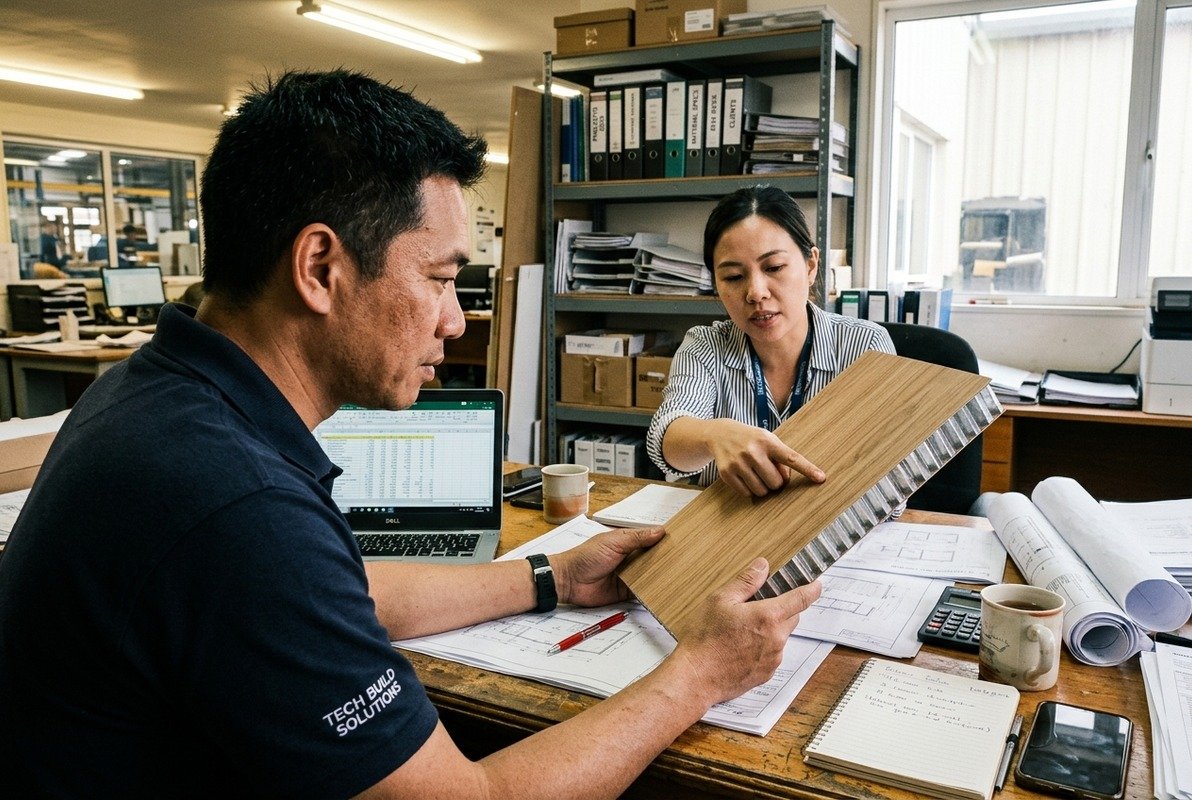
Choose the best honeycomb panel manufacturer by matching your project requirements — application type, certifications needed, panel specifications, budget, and export experience — against each supplier's proven strengths, production capacity, and quality certifications like ISO 9001 and CE.
Define Your Application First
Before you contact a single supplier, get clear on what you need. A curtain wall project in Singapore demands different panels than a cold-chain truck floor in Nigeria. Here is a simple framework:
| Project Type | Recommended Panel Type | Key Properties | Best-Fit Suppliers |
|---|---|---|---|
| Building facades | Aluminum honeycomb panels | Fire resistance, weather resistance | Winsom, Huayuan, Lanzuan |
| Commercial vehicles | Thermoplastic honeycomb | Lightweight, corrosion-resistant | Holycore |
| Aerospace / defense | FRP honeycomb core, aramid | High strength-to-weight ratio | Haxcore, Indy Honeycomb |
| Interior decoration | Composite sandwich panels | Sound insulation, aesthetic finish | Liming, Onebond, Huarui |
| Furniture / packaging | Polypropylene honeycomb | Cost-effective, recyclable | Beessun |
Check Certifications and Export Experience
I always tell procurement managers: certifications are your first filter, not your last. ISO 9001 tells you the company has a quality management system. CE marking means the product meets European safety standards. ISO 14001 signals environmental responsibility.
But certifications alone are not enough. Ask how many countries the supplier exports to. Ask for references from projects similar to yours. A manufacturer that has shipped fire resistant panels to a high-rise project in Dubai operates at a different level than one that only sells domestically.
Evaluate Production Capacity and Customization Range
Top honeycomb panel companies in China can produce panels in thicknesses from 10mm to 90mm. They offer custom colors, surface textures (wood grain, stone, solid matte), and core densities. If your project requires non-standard dimensions or special coatings, make sure the supplier has the tooling and experience to deliver.
Compare Pricing in Context
Mid-range pricing does not mean mid-range quality. In my experience coordinating shipments for infrastructure projects, the cheapest quote often costs more in the long run — through delays, rework, or failed inspections. Get three to five quotes. Compare them against the same specification sheet. Look at total landed cost, not just FOB price.
Can I get custom designs and OEM services from these top Chinese honeycomb panel companies?
One of the most common questions I hear from project directors is whether Chinese suppliers can truly deliver custom composite sandwich panels — or if "customization" is just a marketing buzzword.
Yes, most top Chinese honeycomb panel companies offer full OEM/ODM services, including custom panel dimensions, core densities, surface finishes, colors, and even co-branded packaging — making them ideal partners for project-specific designs and private-label requirements.
What Customization Actually Looks Like
Customization in this industry goes far beyond picking a color. It includes panel thickness (10mm to 90mm), core cell size, surface material (PVDF coating, wood grain laminate, stone texture), edge profiles, and structural reinforcements. Some projects require sound insulation panels with specific acoustic ratings. Others need lightweight materials that meet aviation-grade fire resistance standards.
Here is what leading suppliers typically offer:
| Customization Area | Options Available | Typical Lead Time Impact |
|---|---|---|
| Panel thickness | 10mm – 90mm | Minimal (standard tooling) |
| Surface finish | PVDF, PE, wood grain, stone, solid color | +3–5 days for lamination |
| Core material | Aluminum, polypropylene honeycomb, FRP | Depends on material sourcing |
| Panel dimensions | Custom width and length | +2–3 days for cutting |
| Edge treatment | Open, closed, folded, reinforced | +1–2 days |
| Fire rating | A2, B1, or custom tested | May require third-party testing |
| Branding / packaging | Custom labels, co-branding, palletizing | Minimal |
OEM vs. ODM: Know the Difference
OEM means the supplier manufactures your design to your exact specifications. ODM means the supplier helps you develop the design based on their existing capabilities. Both models are common among the top 10 honeycomb panel companies in China.
In our own business at LANYE CABLETRAY, we work under both OEM and ODM models for cable management systems. The same principle applies to honeycomb panels. If you bring a complete drawing, the supplier builds it. If you describe a performance requirement, their engineering team proposes a solution.
Minimum Order Quantities
Custom orders typically come with minimum order quantities (MOQs). For aluminum honeycomb panels, expect MOQs between 200 and 500 square meters for standard customization. Highly specialized configurations — like aerospace-grade FRP honeycomb core panels — may have higher MOQs due to tooling and material costs.
Intellectual Property Protection
If you are developing a proprietary panel design, discuss IP protection upfront. Reputable suppliers sign non-disclosure agreements 9 and keep your molds separate from other clients' production runs. This is standard practice among the top material suppliers in China.
How do I verify the quality control standards of my chosen honeycomb panel supplier?
Quality control failures are the single biggest pain point I hear about from EPC contractors. A project director in Singapore once told me he lost three weeks on a water treatment plant because incoming panels failed the on-site adhesion test.
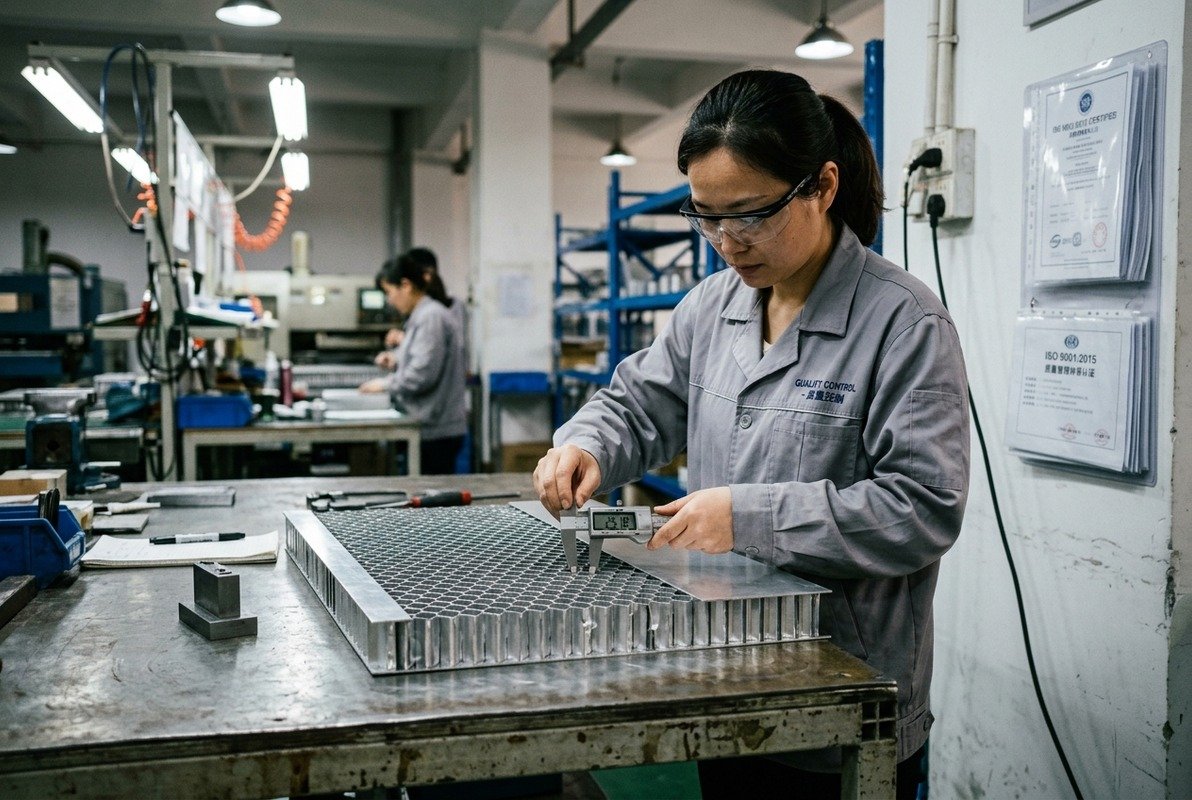
Verify your honeycomb panel supplier's quality control by requesting ISO 9001 and CE certificates, conducting a factory audit (in person or via third party), reviewing test reports for fire resistance and structural integrity, and inspecting samples before committing to a full production order.
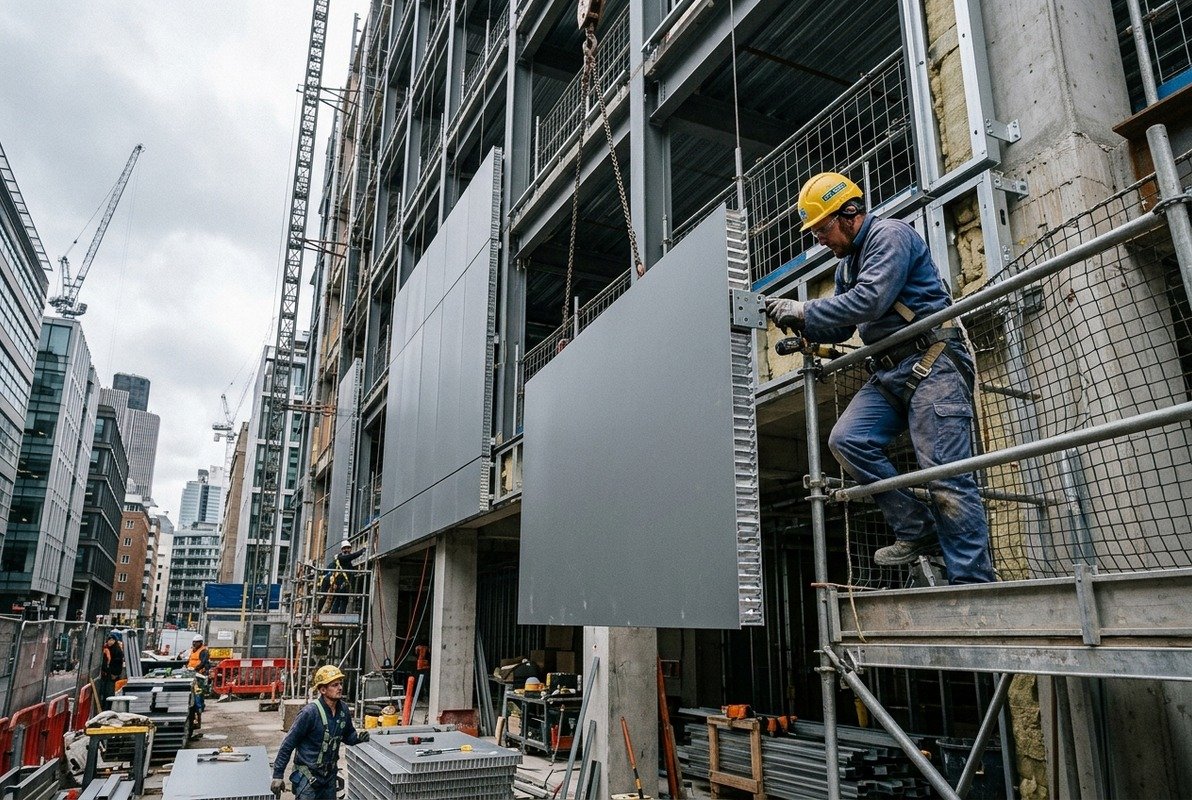
Start With Certifications — But Don't Stop There
ISO 9001 certification means the company follows a documented quality management system. CE marking indicates compliance with European product safety directives. ISO 14001 covers environmental management. These are baseline indicators, not guarantees.
Ask the supplier to provide current, verifiable certificates — not expired ones. Check the issuing body. Well-known certification agencies include SGS, TÜV, and Bureau Veritas.
Request Third-Party Test Reports
For construction cladding and fire resistant panels, you need test reports that prove specific performance claims. Key tests include:
- Peel strength test — measures the bond between surface skin and honeycomb core
- Fire resistance test — A2 or B1 classification per EN 13501
- Flatness and dimensional tolerance — critical for curtain wall installations
- Weather resistance test — UV exposure, humidity cycling
- Sound insulation test — if acoustic performance matters for your project
Conduct a Factory Audit
Nothing replaces walking through a production line. If you cannot visit in person, hire a third-party inspection firm like SGS or Asia Inspection. They will check raw material storage, production processes, in-line quality checks, and finished goods warehousing.
During audits at our own LANYE CABLETRAY facility, we see how important process controls are — from incoming steel inspection to final packaging. The same rigor applies to honeycomb panel production. Look for automated cutting equipment, clean lamination rooms, and systematic defect tracking.
Pre-Shipment Inspection
Before the supplier loads your container, arrange a pre-shipment inspection. This typically covers:
- Visual inspection of surface finishes for scratches, dents, or color inconsistencies
- Dimensional measurements against your approved drawings
- Random peel tests on finished panels
- Packaging review to ensure transit protection
Build a Quality Timeline
Do not wait until panels arrive at your project site to discover problems. Build quality checkpoints into your procurement timeline:
- Week 1: Review and approve material certificates
- Week 2–3: Approve production samples
- Week 4–6: In-line production check (at 30% and 70% completion)
- Week 7: Pre-shipment full inspection
- Week 8: Container loading supervision
This structured approach reduces the risk of returns and rework — problems that cost far more than the inspection fees.
How do I manage lead times and logistics when ordering from these honeycomb panel manufacturers?
When we ship cable trays and building materials to projects in Africa and South America, lead time management is everything. A two-week delay at the factory can cascade into a two-month project setback on site.
Manage lead times by confirming production schedules before signing the contract, building buffer time for custom orders, using freight forwarders experienced with oversized building materials, and coordinating delivery milestones with your project installation timeline.
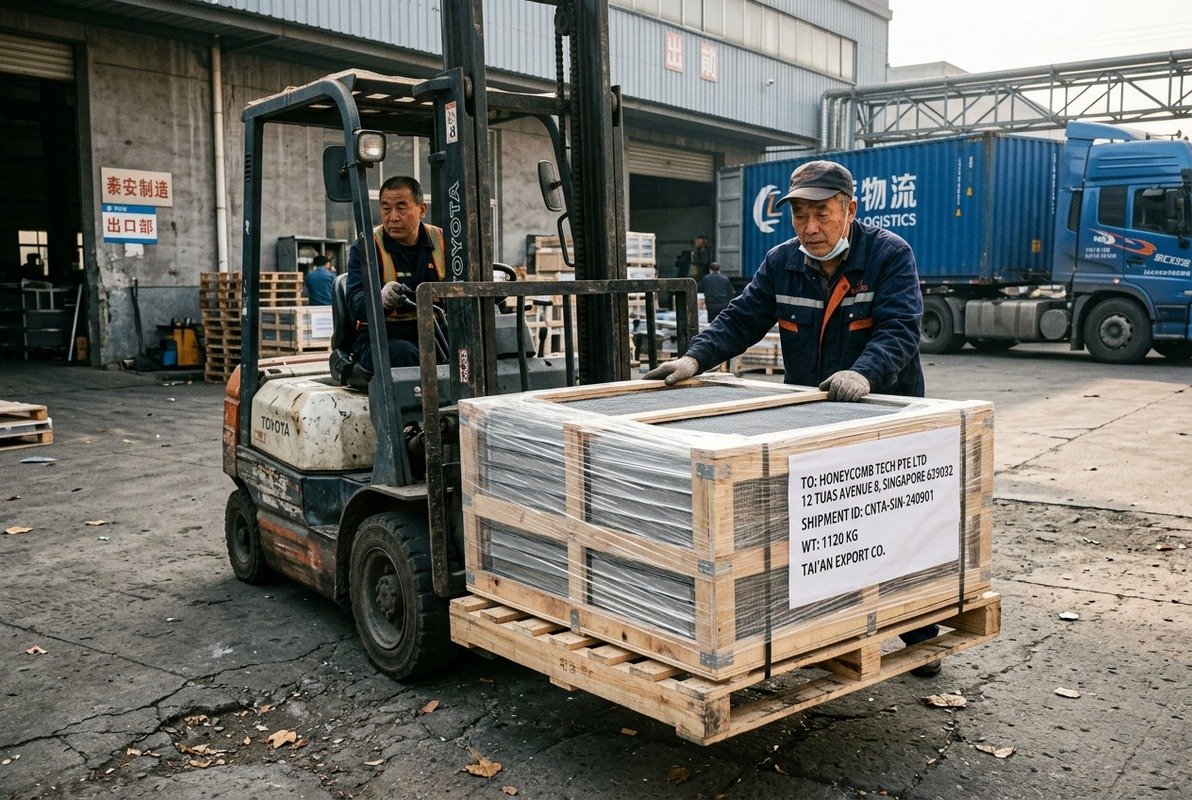
Understand Typical Production Lead Times
Production lead times vary based on order complexity, panel type, and factory capacity. Here is a general guide:
| Order Type | Typical Production Time | Shipping Time (Sea Freight) |
|---|---|---|
| Standard aluminum honeycomb panels | 15–25 days | 15–35 days (depending on destination) |
| Custom composite sandwich panels | 25–40 days | 15–35 days |
| Thermoplastic / polypropylene honeycomb | 20–30 days | 15–35 days |
| Aerospace-grade FRP honeycomb core | 30–50 days | Varies (often air freight) |
| Small trial / sample orders | 7–15 days | 5–7 days (air) or 15–35 days (sea) |
Plan for Peak Seasons
Chinese factories experience peak demand from March to June and again from September to November. During these periods, production slots fill up fast. Place your order at least two weeks earlier than you normally would. Around Chinese New Year (January/February), most factories shut down for 15–30 days. Plan accordingly.
Choose the Right Freight Method
Honeycomb panels are lightweight but bulky. This means you often pay for volume, not weight. Sea freight in full container loads (FCL) is the most cost-effective option for large orders. A standard 20-foot container can hold roughly 50–80 cubic meters of honeycomb panels, depending on thickness and packaging.
For urgent orders or small quantities, less-than-container-load (LCL) or air freight works — but at a significantly higher cost per square meter.
Packaging Matters
Improper packaging causes edge damage, surface scratches, and moisture problems during ocean transit. Insist on the following:
- Protective PE film on all panel surfaces
- Corner protectors on every panel
- Wooden crate or pallet packaging for FCL shipments
- Moisture-absorbent desiccant bags inside sealed packaging
- Clear labeling with panel specifications and handling instructions
Coordinate With Your Project Schedule
The best practice is to work backward from your installation date. Identify the latest acceptable delivery date at your project site. Subtract shipping time, customs clearance time, and inland transport time. That gives you the latest acceptable factory dispatch date. Then subtract production time. That tells you when you must place your order.
I use this method for every LANYE CABLETRAY shipment. It forces discipline and prevents the "we'll figure it out later" mentality that causes delivery delays — the number one pain point among project contractors I work with.
Communication Is Key
Set up a shared project timeline with your supplier. Use WhatsApp or WeChat for quick updates. Request photos at key production milestones: raw material arrival, core bonding, surface lamination, quality inspection, and packing. This keeps everyone aligned and reduces surprises.
Conclusion
Choosing the right honeycomb panel company in China comes down to matching your project needs with a supplier's proven strengths in certifications, customization, quality control, and logistics reliability. For a broader perspective beyond China, you can also explore the top honeycomb panel manufacturers in the world as well as leading honeycomb panel suppliers globally.
Footnotes
1. Official EU guide to CE marking requirements and benefits. ↩︎
2. Explains the structure, properties, and applications of these panels. ↩︎
3. Detailed explanation of thermoplastic composite honeycomb and its properties. ↩︎
4. Provides market size, growth projections, and key drivers for the industry. ↩︎
5. Describes ASTM D903, a standard method for measuring adhesive peel strength. ↩︎
6. Official international standard for quality management systems. ↩︎
7. Explains FRP honeycomb panels and the polypropylene honeycomb core. ↩︎
8. Provides an overview of lightweight materials and their engineering applications. ↩︎
9. Provides a comprehensive definition and overview of non-disclosure agreements. ↩︎