Sourcing aluminum furniture handle suppliers used to keep me up at night — missed shipments, inconsistent finishes, and zero after-sales support 1 nearly derailed two of our projects last year.
The top 10 aluminum furniture handle suppliers in 2026 include Top Knobs, Richelieu Hardware, Mebel-alu, and several emerging Asian manufacturers that offer stable quality, ready stock, proven export experience, and reliable after-sales guarantees for global cabinet hardware and furniture hardware market needs.
Below, I break down exactly how to evaluate these suppliers, what quality control steps matter most, and how to protect your delivery timelines. Let’s get into it.
How do I choose the right aluminum furniture handle supplier for my 2026 projects?
A lesson I learned the hard way: the cheapest quote almost never means the best value when you are buying aluminum profile handles 2 at scale for overseas projects.
Choose a supplier with proven export history, consistent surface finishes, in-stock inventory, flexible MOQ, clear OEM terms, and responsive after-sales service — these six factors determine whether your 2026 cabinet hardware project stays on schedule and on budget.

Start With Export Experience
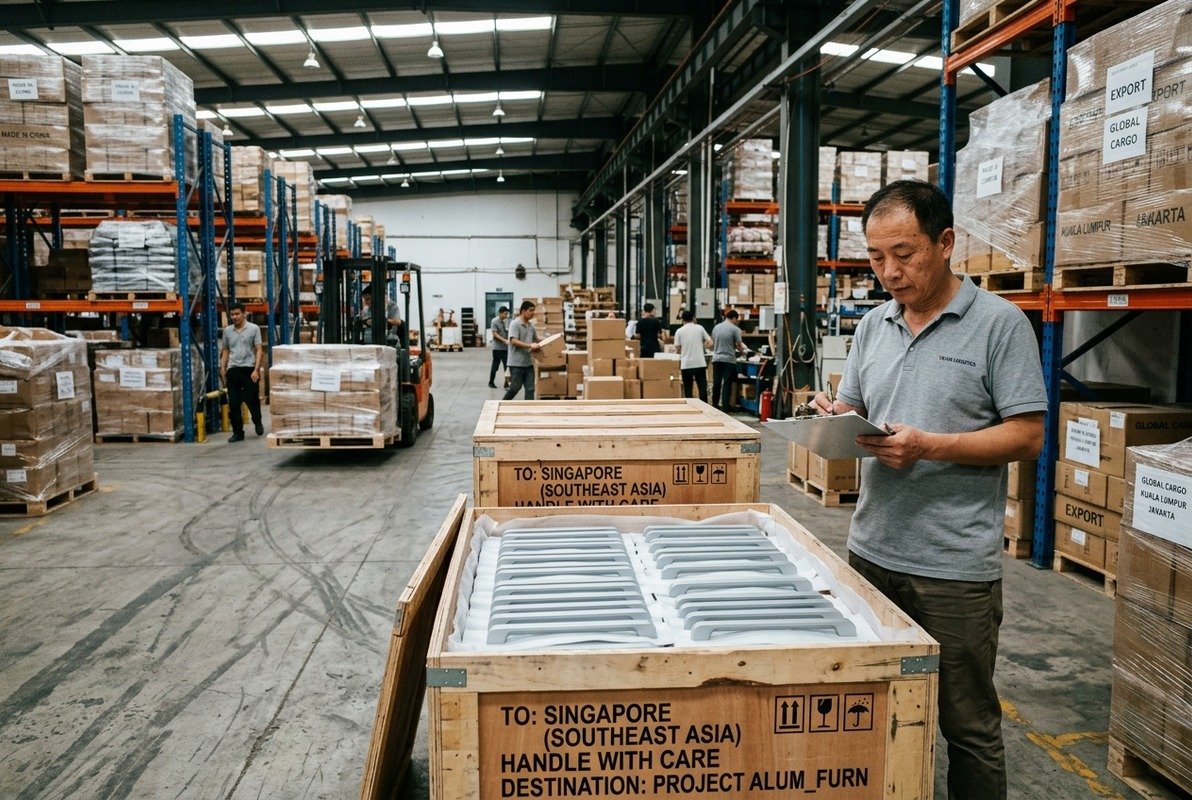
Not every factory that makes great drawer pulls can ship them correctly. I have seen beautiful samples arrive at our warehouse in Tai'an, only to discover the supplier had never handled fumigation certificates 3 or understood CIF terms. When we coordinate shipments to Southeast Asia and Africa, we always confirm the supplier has shipped to similar destinations before. Ask for bill-of-lading copies. Ask for container-loading photos. These small steps save weeks of customs headaches.
Match Product Range to Your Design Needs
The furniture hardware market in 2026 favors flush horizontal styles, brushed aluminum finishes, and mixed-metal aesthetics. Your supplier must keep up. Top Knobs offers the industry's most extensive line of premium cabinet hardware, including modern cabinet design pulls in dozens of finishes. Richelieu Hardware covers the widest functional and specialty hardware catalog for the woodworking industry. Smaller suppliers like Mebel-alu specialize in brushed aluminum cabinet pulls that integrate seamlessly into contemporary decor.
Here is a quick comparison of leading supplier types:
| Criteria | Specialty Brand (e.g., Top Knobs) | Integrated Distributor (e.g., Mebel-alu) | Asian OEM Factory |
|---|---|---|---|
| Design variety | Very high | Moderate | High (custom) |
| Price competitiveness | Premium | Mid-range | Budget to mid-range |
| MOQ flexibility | Medium | Low | Negotiable |
| Export documentation | Established | Varies | Often experienced |
| OEM/ODM capability | Limited | Limited | Strong |
| Lead time (stock items) | 1–2 weeks | 2–3 weeks | 3–6 weeks |
Evaluate Surface Finish Quality
Aluminum extrusion handles come in anodized, powder-coated, brushed, and chrome options. Each finish reacts differently to humidity and UV exposure. For projects in tropical climates — common in our Southeast Asia orders — anodized or powder-coated finishes hold up best. Ask for salt-spray test reports 4. If the supplier cannot provide one, that is a red flag.
Check for Ready Stock
Stable quality and ready stock availability are two pillars I never compromise on. A supplier with warehouse inventory can cover urgent orders. A supplier running purely make-to-order will leave you waiting four to eight weeks. In my experience, the best approach is to partner with a supplier that keeps popular SKUs — like standard kitchen cabinet handles and wardrobe handles — in stock, while offering custom runs for specialty items like gola profiles or decorative hardware.
Where can I find reliable manufacturers that offer OEM customization for my brand?
One of our clients in Singapore — a project director sourcing cable management systems — once told me he applies the same vetting method to every hardware supplier: "Show me your last three OEM projects, or I walk."
Find reliable OEM aluminum handle manufacturers through B2B platforms like Alibaba and Made-in-China, industry trade shows such as Canton Fair and Interzum, LinkedIn outreach, and direct factory visits — always request branded samples and verify customization capability before committing.
Where to Search
The search starts online but should not end there. Here are the primary channels ranked by reliability:
| Channel | Pros | Cons | Best For |
|---|---|---|---|
| Alibaba / Made-in-China | Large supplier pool, verified badges | Quality varies widely | Initial shortlisting |
| Canton Fair / Interzum | Face-to-face samples, factory reps | Travel cost, time commitment | Serious bulk buyers |
| LinkedIn outreach | Direct contact with decision-makers | Slower response from some factories | Relationship building |
| Google search + company website | Detailed product catalogs, certifications | Hard to verify claims without audit | Technical evaluation |
| Industry referrals | Pre-vetted, trusted | Limited pool | Niche or high-spec needs |
What OEM Customization Really Means
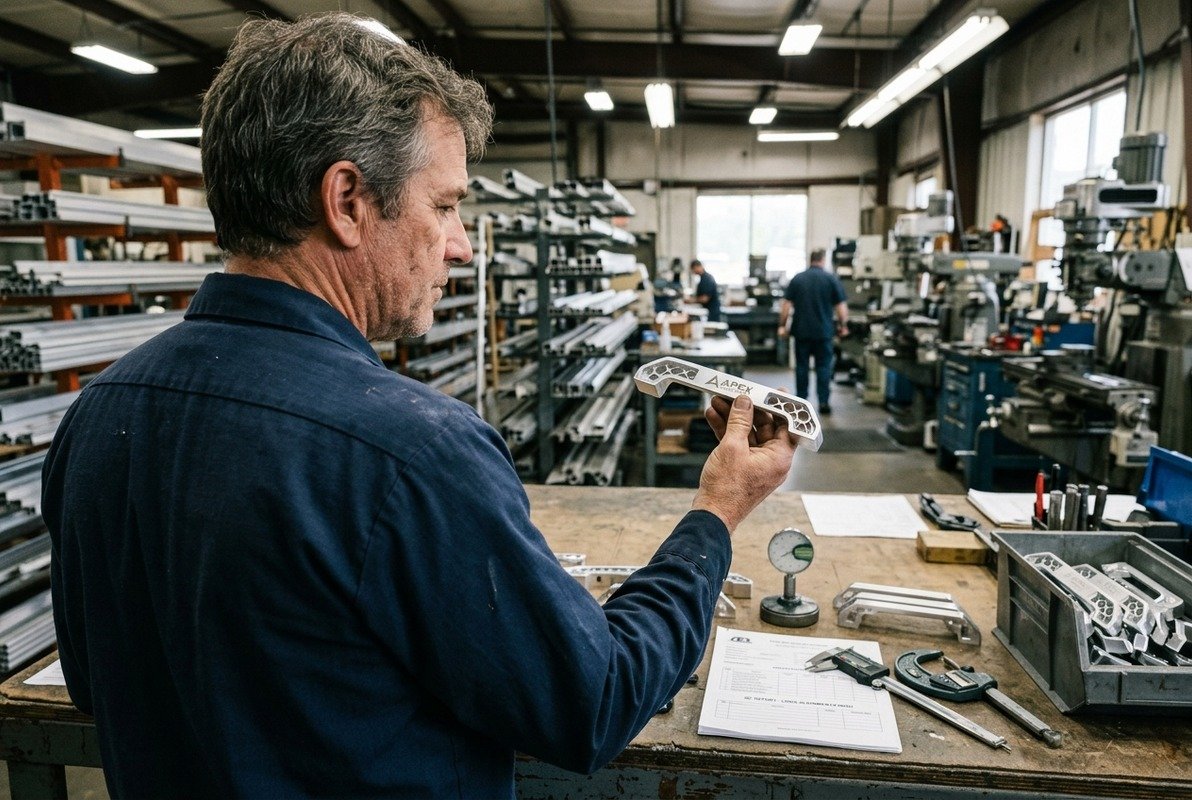
OEM is not just logo engraving. True OEM customization for aluminum profile handles includes custom lengths, unique cross-section profiles through dedicated aluminum extrusion dies 5, specific surface finishes (brushed, anodized in Pantone-matched colors, powder-coated), branded packaging, and even custom screw-hole spacing. In our own business, we handle similar collaborative development for cable tray systems — the principle is the same. You need a supplier willing to invest in tooling and iterate on prototypes.
Verify Before You Commit
Ask for a factory audit report or conduct a virtual tour. Confirm the factory owns its own extrusion press and finishing line. Subcontracting is not inherently bad, but you must know about it. Check whether the supplier has served brands in your target market. If you are selling into South America or Africa, a factory that has shipped container loads to Lagos or São Paulo understands the logistical nuances.
China remains a prominent global manufacturing hub for aluminum furniture handles. The country offers a wide range of products at competitive prices, from budget drawer pulls to premium wardrobe handles with integrated flush designs. But "made in China" spans an enormous quality spectrum. If you are also exploring related aluminum profile products, our guide to the top slim frame glass door aluminum profile suppliers in the world illustrates just how wide that spectrum can be. The homework you do upfront determines which end of that spectrum you land on.
What quality control steps should I take when sourcing aluminum handles from overseas?
The first container of decorative hardware I ever helped coordinate arrived with 15% of the units showing uneven anodizing. That single shipment taught me more about QC than any textbook could.
Implement a four-stage QC process — raw material verification, in-line production checks, pre-shipment inspection, and documented acceptance criteria — to minimize defects and protect your brand when sourcing aluminum handles from overseas suppliers.

The Four-Stage QC Framework
Quality problems compound. A tiny dimensional error at the extrusion stage becomes a noticeable gap at the cabinet assembly stage. Here is the framework I recommend, based on our own export operations:
Stage 1 — Raw Material Verification. Confirm the aluminum alloy grade (6063-T5 is standard for furniture hardware). Ask for the mill test certificate. Low-grade alloy leads to brittleness and poor finish adhesion.
Stage 2 — In-Line Production Checks. During extrusion and finishing, your inspector (or the factory's QC team with photo evidence) should verify dimensional tolerances, surface finish consistency, and color matching against the approved sample. This is where brushed aluminum finishes and anodized coatings go wrong most often.
Stage 3 — Pre-Shipment Inspection (PSI). Hire a third-party inspection firm (SGS, Bureau Veritas, or a local agency) to check a random sample per AQL 2.5 standards 7. They should test handle strength, finish adhesion (cross-cut tape test), and packaging integrity.
Stage 4 — Documented Acceptance Criteria. Before production starts, both parties sign off on a QC agreement listing acceptable tolerances, finish standards, packing specs, and defect categories. This document is your legal shield.
Common Defect Types and How to Catch Them
| Defect Type | Where It Occurs | How to Detect | Prevention |
|---|---|---|---|
| Uneven anodizing | Finishing stage | Visual comparison with master sample | Require process parameter logs |
| Dimensional variation | Extrusion stage | Caliper measurement at PSI | Specify tolerances in QC agreement |
| Scratch marks | Packing / shipping | Random carton inspection | Mandate individual PE wrap |
| Screw-hole misalignment | CNC drilling | Gauge fit test with sample screws | Fixture verification before run |
| Color inconsistency | Powder coating | Spectrophotometer reading | Batch-level color QC |
Salt-Spray and Durability Testing
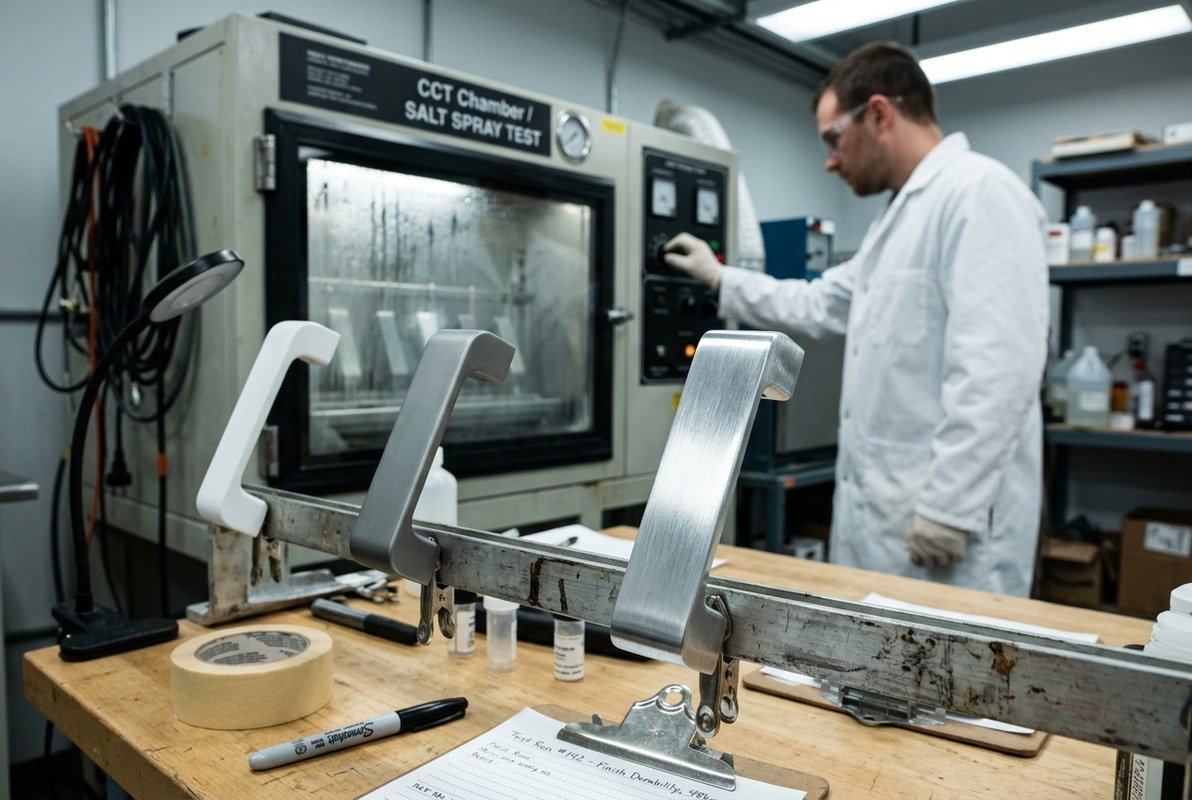
For kitchen cabinet handles exposed to moisture, insist on a 48-hour salt-spray test at minimum. Premium suppliers offer 200-hour or even 500-hour results. Antimicrobial coatings are also gaining traction in 2026, especially for commercial settings. If your buyer specifies this, confirm the coating certification before shipment.
I cannot overstate this: document everything. Photos, test reports, signed QC agreements. When a dispute arises — and eventually one will — your documentation is the only thing that stands between a resolution and a loss.
How can I verify if a supplier can meet my strict delivery timelines and volume needs?
Last quarter, a project contractor we work with nearly lost a government tender because his handle supplier missed the delivery window by three weeks. He now treats delivery verification as seriously as price negotiation.
Verify delivery capability by requesting production capacity data, reviewing past on-time shipment records, confirming raw material stock levels, agreeing on penalty clauses for delays, and running a trial order before committing to full-volume production.
Capacity Is Not Just About Machines
A factory might own ten extrusion presses but run them all at full load for other clients. The real question is: what is their available capacity for your order, right now? When we plan production runs at our own facility, we map out machine availability week by week. Ask your handle supplier to do the same. If they cannot show you a production schedule, they are guessing.
The Trial Order Strategy
Never commit your full annual volume on the first purchase order. Place a trial order — typically one to two pallets — and measure three things:
- Lead time accuracy. Did they ship on the promised date?
- Quality consistency. Does the delivered product match the approved sample?
- Communication responsiveness. Did they answer questions within 24 hours?
If all three pass, scale up gradually. If any one fails, address it before increasing volume.
Build a Delivery Scorecard
I maintain a simple scorecard for every supplier we work with. Here is a template you can adapt:
| Metric | Target | How to Measure | Weight |
|---|---|---|---|
| On-time shipment rate | ≥ 95% | Compare PO ship date vs. actual B/L date | 30% |
| Order accuracy | ≥ 98% | Correct SKU, qty, finish in each shipment | 25% |
| Defect rate | ≤ 2% | PSI report defect count / total inspected | 25% |
| Communication speed | ≤ 24 hrs | Average response time on email/WhatsApp | 10% |
| Issue resolution time | ≤ 5 days | Time from complaint to corrective action | 10% |
Score each metric quarterly. Share the results with your supplier. Good suppliers welcome transparency. Bad ones avoid it.
Penalty Clauses and Backup Plans
Include a late-delivery penalty in your purchase contract. A common structure is 1% of order value per week of delay, capped at 10%. This creates accountability. At the same time, maintain a secondary supplier for your highest-volume SKUs. If your primary source stumbles, you can redirect part of the order without stopping your project.
Modular and interchangeable aluminum handle systems — a growing trend in 2026 — actually help here. Because modular designs share common base components, you can source the base from one factory and the decorative face from another. This splits risk and improves flexibility.
Sustainability as a Delivery Factor
Suppliers prioritizing recycled aluminum 8 often have more stable raw material supply because they are less dependent on primary smelter output. In regions where energy costs fluctuate, recycled-aluminum factories maintain steadier production schedules. This same principle applies to slim frame glass door aluminum profile factories in China, where recycled-material sourcing is becoming a competitive differentiator. Ask about their material sourcing mix. It is both an environmental and a practical advantage.
Conclusion
Choosing the right aluminum furniture handle supplier in 2026 comes down to export experience, quality control discipline, OEM capability, and delivery reliability — verify each one before you commit.
Footnotes
1. Comprehensive guide on after-sales service from an authoritative e-commerce platform. ↩︎
2. Explains the aluminum extrusion process used to create various profiles and shapes. ↩︎
3. Details requirements for wood packaging material treatment and ISPM 15 compliance in international trade. ↩︎
4. Describes the ASTM B-117 standard for evaluating corrosion resistance of materials and coatings. ↩︎
5. Explains the function, types, and design of dies used in the aluminum extrusion process. ↩︎
6. Defines business-to-business (B2B) e-commerce and its role in online transactions between companies. ↩︎
7. Clarifies the Acceptance Quality Limit (AQL) and its application in sampling for quality inspection. ↩︎
8. Highlights the environmental and performance benefits of using recycled aluminum in manufacturing. ↩︎