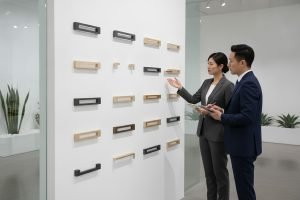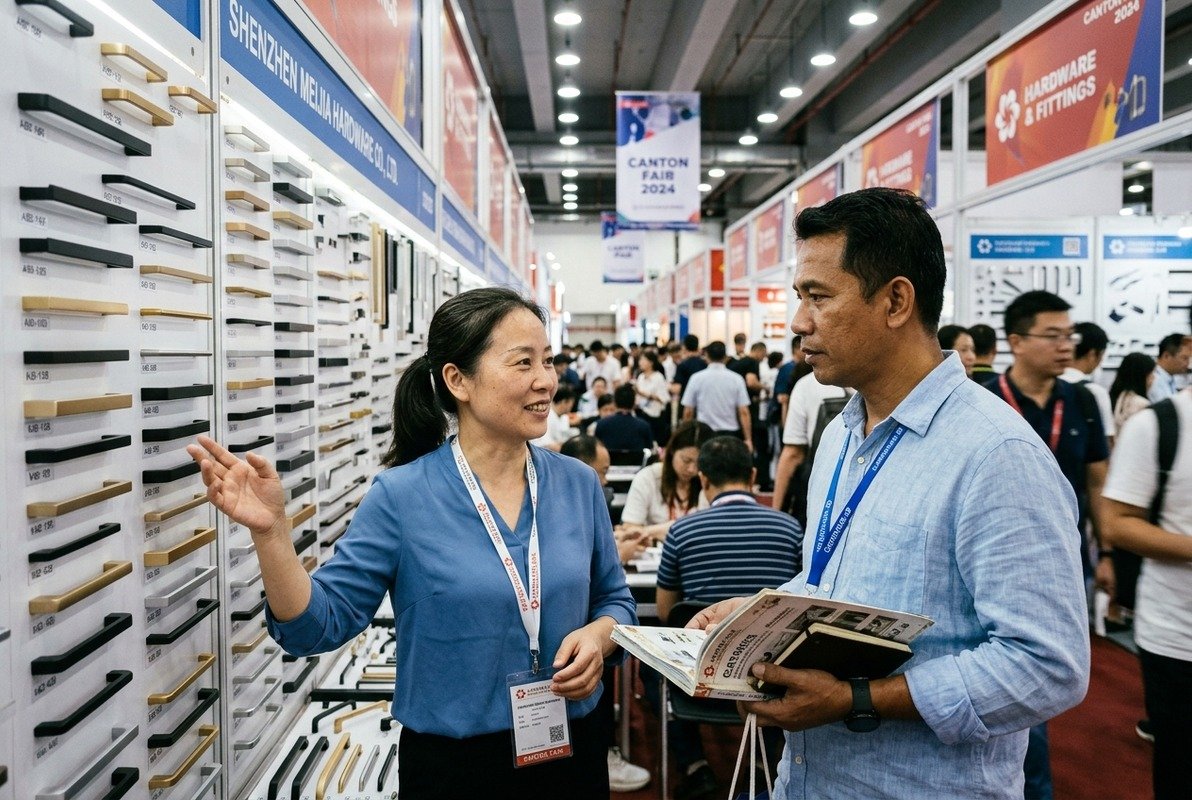
Finding reliable aluminum furniture handle manufacturers in China has been one of the trickiest sourcing challenges I’ve tackled — bad finishes, missed deadlines, and inconsistent quality plague buyers every year.
The top 10 aluminum furniture handle manufacturers in China for 2026 include HUTLON, Hettich China, Blum China, JINSHENG Hardware, Ghonor, KRC Aluminum Profiles, SAB Hardware, FUTONG Hardware, KUKA Hardware, and Meilv Hardware — each offering certified quality, custom OEM capability, and stable production capacity for global B2B buyers.
Below, I break down how to verify quality, request custom designs, manage lead times, and lock in fair pricing so you can choose the right partner with confidence 1.
How do I verify the quality and surface finish standards of these aluminum handle manufacturers?
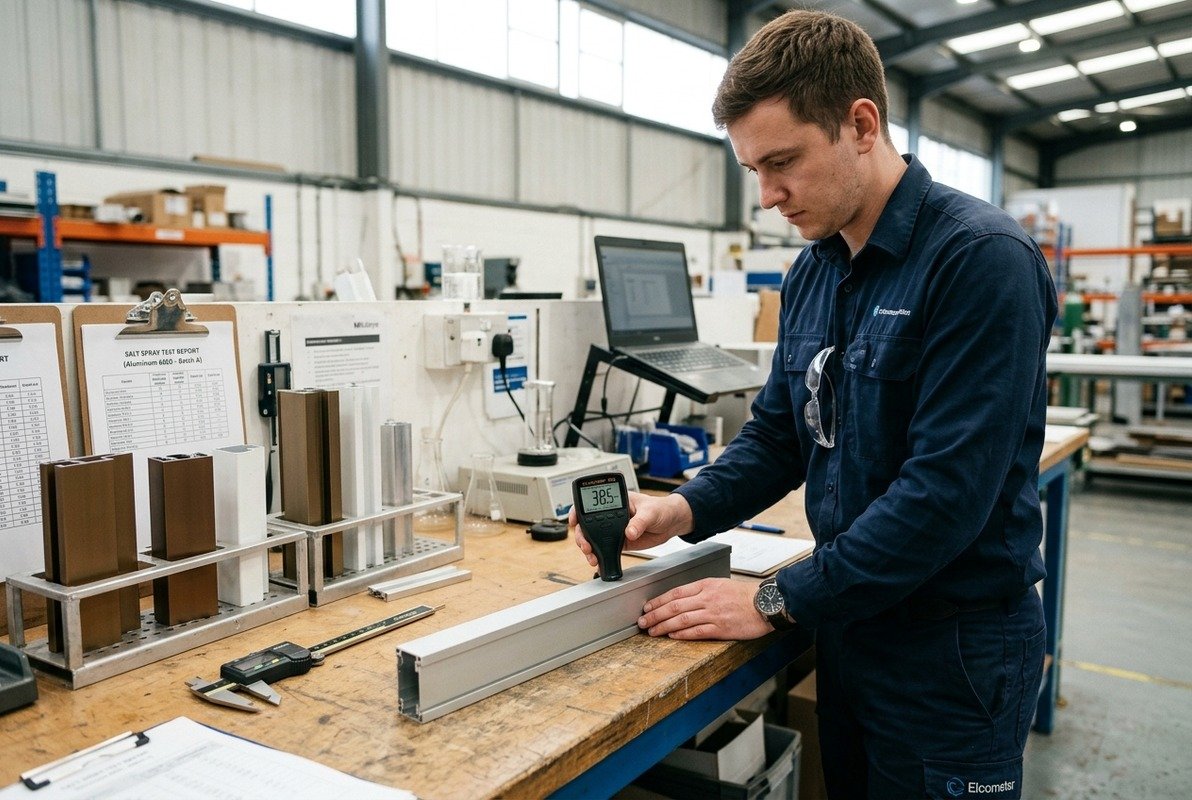
A lesson I learned early in our cable tray export business applies directly here: never trust a product photo alone — always request physical samples and check the coating thickness yourself.
To verify quality, request certified test reports (ISO 9001, RoHS, ASTM), ask for anodized or powder-coated samples, measure coating thickness with a gauge, and confirm the aluminum alloy grade (6063 or 6082) matches the spec sheet before placing bulk orders.
Start with Certifications
The first filter is paperwork. Reputable aluminum furniture handle manufacturers hold ISO 9001 2 for quality management, RoHS for hazardous substance compliance, and CE for European market access. When I source components for our own cable management systems, I always ask vendors to send scanned certificates and then verify the certificate number against the issuing body's online database. Fake certificates exist. A five-minute check saves months of headaches.
Inspect Surface Finish In Person or Via Third-Party
Surface treatment is where aluminum cabinet pulls either shine or fail. The most common finishes are anodizing, powder coating 3, brushed, and knurled textures. Each has a measurable standard. Anodized aluminum finish thickness 4, for example, should typically fall between 10–25 microns for architectural-grade handles. Powder coating should be 60–120 microns.
| Surface Treatment | Typical Thickness | Key Test | Visual Result |
|---|---|---|---|
| Anodizing | 10–25 µm | Salt spray 500+ hrs | Metallic sheen, smooth |
| Powder Coating | 60–120 µm | Cross-hatch adhesion | Matte or semi-gloss |
| Brushed | N/A (mechanical) | Visual consistency | Linear grain texture |
| Knurled | N/A (mechanical) | Touch/grip test | Diamond or straight pattern |
Ask the manufacturer for salt spray test reports. A good aluminum profile handle should withstand at least 500 hours without visible corrosion. If a factory hesitates to share this data, move on.
Alloy Grade Matters
Not all aluminum is equal. The 6063 aluminum alloy 5 is the industry standard for extruded furniture hardware. It offers excellent corrosion resistance, good machinability, and a clean anodized appearance. Some manufacturers use 6082 for higher-strength applications. Ask for a mill certificate (MTC) that confirms the alloy composition.
Third-Party Inspection Services
If you cannot visit the factory, hire a third-party QC firm 6 like SGS or Bureau Veritas. They will pull random samples from your production run, measure dimensions, test surface hardness, and photograph defects. I have used this approach for shipments heading to Southeast Asia and Africa, and it has caught problems before containers left port.
Can I request custom OEM designs and prototypes for my specific furniture project?
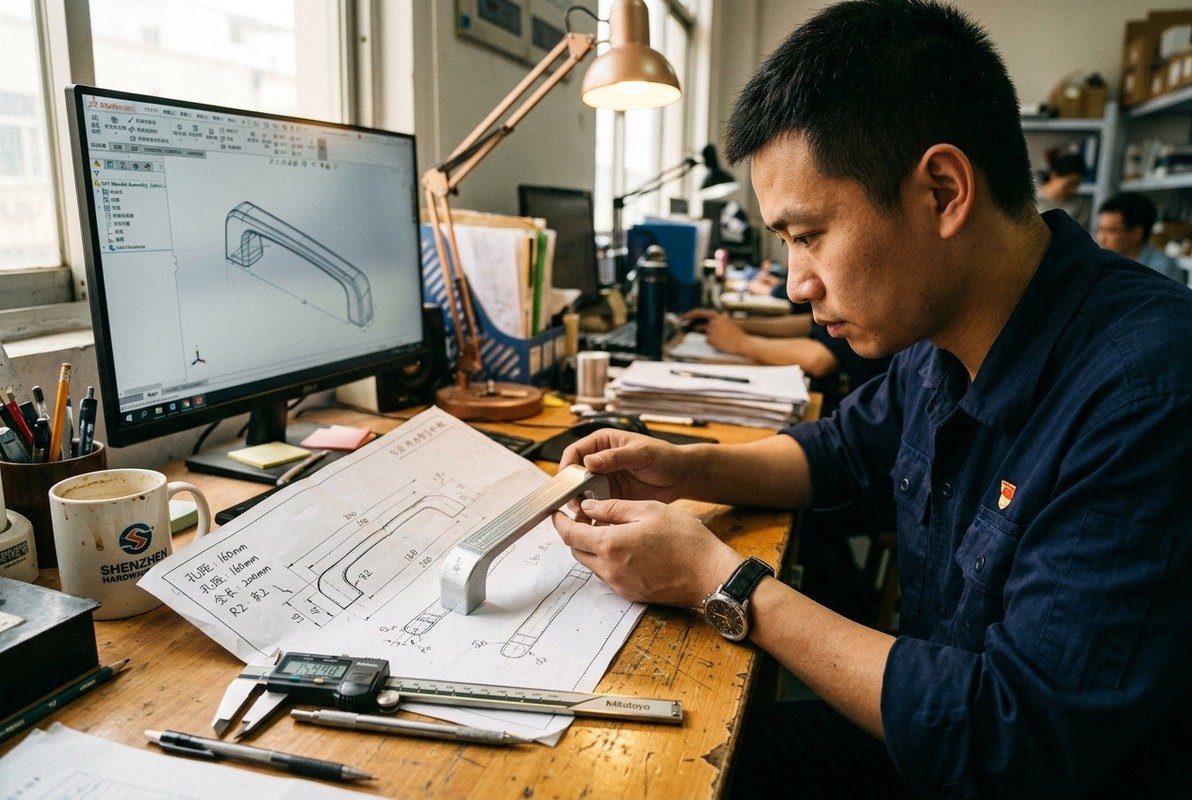
One of the most rewarding buyer conversations I had last year involved a Singapore-based project director who needed a non-standard drawer pull profile to fit a proprietary sliding mechanism — we collaborated on CAD drawings and had a working sample in 12 days.
Yes, most top Chinese aluminum handle manufacturers offer full OEM and ODM services, including custom dimensions, finishes, and logo engraving. You can typically submit a CAD drawing or sketch, receive a CNC-machined prototype within 7–15 days, and approve it before mass production begins.
How the Custom Process Works
The typical workflow is straightforward. You send a drawing or even a rough sketch with dimensions. The manufacturer's engineering team converts it into a production-ready CAD file. They then CNC-machine a single prototype from the specified 6063 aluminum alloy, apply the requested surface treatment, and ship it for your approval. CNC-machined prototype 7
| OEM Process Step | Timeline | What You Provide | What You Receive |
|---|---|---|---|
| Design consultation | 1–3 days | Sketch, reference photo, or CAD file | Revised 2D/3D drawing |
| Prototype machining | 5–10 days | Approved drawing | 1–3 physical samples |
| Surface treatment | 2–5 days | Finish specification | Finished prototype |
| Approval & revisions | 1–7 days | Feedback | Updated sample if needed |
| Mass production | 15–35 days | Confirmed PO | Bulk shipment |
What Can Be Customized?
Almost everything. Length, cross-section, hole spacing, mounting method, color, and finish are all adjustable. Kitchen cabinet handles can be produced in T-bar, cup pull, integrated flush, or completely bespoke profiles. Furniture hardware suppliers in China have invested heavily in five-axis CNC machines that cut complex shapes with tight tolerances — often ±0.1 mm.
Minimum Order Quantities for Custom Runs
MOQs vary. Large factories like HUTLON or Hettich China may require 1,000–5,000 pieces for a custom cabinet door hardware run. Smaller specialized firms like Meilv Hardware or Ghonor sometimes accept 200–500 pieces, especially if the design reuses an existing extrusion die. A new extrusion die typically costs $300–$800 and is a one-time investment.
Prototyping Tips from Experience
I always recommend ordering at least two or three samples. Keep one for reference, send one for fit testing in your furniture assembly, and hold one as a benchmark for quality comparison when the bulk order arrives. This practice has saved our team from disputes multiple times when exporting custom cable tray fittings — the same logic applies to wholesale furniture handles.
What are the typical lead times and shipping costs for bulk aluminum handle orders from China?
Delivery delays nearly cost me a key project relationship in 2023 — since then, I build buffer time into every schedule and get written confirmation of production milestones before signing a contract.
Typical lead times for bulk aluminum handle orders from China range from 15 to 45 days for production, plus 15–35 days for ocean freight depending on destination. Shipping costs for a full 20-ft container average $1,200–$3,500 to Southeast Asia, Africa, or South America, while express air freight runs $4–$8 per kilogram.

Production Lead Times Breakdown
Production speed depends on order size, finish complexity, and factory workload. A standard order of 5,000 corrosion resistant handles with a single anodized finish ships faster than 20,000 pieces in four different powder-coat colors. Here is a realistic timeline breakdown:
| Order Size | Finish Complexity | Estimated Production Time |
|---|---|---|
| 1,000–3,000 pcs | Single finish | 15–20 days |
| 3,000–10,000 pcs | Single finish | 20–30 days |
| 3,000–10,000 pcs | Multiple finishes | 25–35 days |
| 10,000–50,000 pcs | Multiple finishes + custom packaging | 30–45 days |
Shipping Options and Costs
Most B2B buyers choose ocean freight for bulk aluminum handle orders because handles are dense and heavy relative to their value. Air freight makes sense only for urgent samples or small reorders.
For ocean freight, transit times are roughly:
- China → Southeast Asia: 7–15 days
- China → Africa (East/West): 25–35 days
- China → South America: 30–40 days
Container costs fluctuate with fuel prices and seasonal demand. As of early 2026, a 20-ft container to Southeast Asian ports averages $1,200–$2,000. African and South American routes run higher, typically $2,500–$3,500.
How to Protect Your Timeline
From our experience managing exports to multiple continents, here are practical steps:
- Get a production schedule in writing. Ask the factory to commit to milestone dates — die cutting, extrusion, surface treatment, packing.
- Request weekly photo updates. A factory that refuses transparency is a red flag.
- Book freight early. During peak seasons (September–November), container space fills fast.
- Factor in customs clearance. Budget 3–7 extra days for destination customs, especially in African and South American ports where paperwork delays are common.
Hidden Costs to Watch
Packaging upgrades, palletization, fumigation certificates, and inland trucking from the factory to the port all add up. Ask your drawer pull manufacturer for a DDP or CIF quote so you can compare total landed costs, not just FOB prices.
How do I ensure I am getting the best mid-range pricing without compromising on material durability?
A trade-off I weigh on every project is whether to chase the lowest unit price or invest a bit more for consistent quality — in my experience, the cheapest quote almost always comes with hidden costs down the line.
To secure the best mid-range pricing, compare quotes from at least three to five certified manufacturers, specify 6063 aluminum alloy and a defined finish standard upfront, negotiate based on annual volume commitments, and request a cost breakdown separating material, processing, and surface treatment charges.

Understanding the Price Spectrum
Aluminum handle prices on B2B platforms range from roughly $0.46 to $1.10 per piece for standard models. Premium or custom designs from global brands like Blum or Hettich can cost 1.5–3× more. The mid-range sweet spot — where you get certified 6063 aluminum alloy, a durable anodized or powder-coated finish, and reliable delivery — typically falls between $0.60 and $0.90 per unit for order quantities above 5,000 pieces.
| Price Tier | Typical Range (per unit) | What You Get | Risk Level |
|---|---|---|---|
| Budget | $0.30–$0.55 | Recycled alloy, thin coating, no certs | High — finish peeling, alloy inconsistency |
| Mid-Range | $0.60–$0.90 | 6063 alloy, ISO/RoHS 8 certs, 15+ µm anodizing | Low — balanced cost and durability |
| Premium | $1.00–$2.50+ | Top-brand name, design IP, smart integration | Very low — but higher capital outlay |
How to Negotiate Effectively
When I negotiate with our own component suppliers, I follow a simple framework:
- Request an itemized cost breakdown. Raw material, extrusion, CNC machining, surface treatment, packaging — each line should be visible.
- Benchmark against Alibaba and CIFF exhibitor catalogs. KRC Aluminum Profiles, for instance, showcased at CIFF 57 in 2026 with 85 square meters of aluminum furniture displays, giving you a reference for market-rate pricing.
- Offer volume commitment. A 12-month blanket order with quarterly call-offs often unlocks 5–10% savings without increasing inventory risk.
- Don't squeeze too hard. If you push a factory below their material cost, they will substitute cheaper alloy or thinner coatings. That leads to corrosion complaints and product returns — the exact pain points our project director clients want to avoid.
Material Durability Checks at Mid-Range Prices
Even at mid-range pricing, you should insist on:
- Mill test certificates confirming 6063-T5 or 6063-T6 temper.
- Salt spray test results showing 500+ hours for anodized finishes.
- Cross-hatch adhesion test for powder-coated surfaces (ASTM D3359, Class 4B minimum).
These tests cost the factory very little to perform but give you documented proof of durability. If a supplier refuses, they are likely cutting corners.
The Sustainability Angle
Sustainability is becoming a competitive differentiator. Manufacturers using recycled aluminum and energy-efficient extrusion presses can often offer competitive mid-range pricing because recycled feedstock is cheaper than virgin ingot. Ask about recycled content — it's good for your budget and good for your green procurement targets.
Conclusion
Choosing among the top aluminum furniture handle manufacturers in China comes down to verified certifications, tested surface finishes, transparent pricing, and reliable delivery — invest time upfront and your projects run smoother. For a broader perspective beyond the Chinese market, you can also explore the top aluminum furniture handle manufacturers in the world or review our guide to the best aluminum furniture handle suppliers to compare sourcing options globally.
Footnotes
1. Official European Commission guidance on CE marking requirements and significance. ↩︎
2. Official ISO page detailing the ISO 9001 quality management system standard. ↩︎
3. Guide explaining typical thickness guidelines and standards for powder coating applications. ↩︎
4. Industry association resource explaining the basics and specifications of anodized aluminum. ↩︎
5. Wikipedia article providing a comprehensive overview of 6063 aluminum alloy properties and uses. ↩︎
6. Defines third-party inspection, its scope, and importance in quality control processes. ↩︎
7. Detailed guide on the process, benefits, and applications of CNC machining for prototypes. ↩︎
8. Official European Commission page on the Restriction of Hazardous Substances (RoHS) Directive. ↩︎