
Every year, our team fields dozens of calls from furniture factories in Vietnam asking the same question before their first export shipment goes out.
There is no single universal certification for aluminum furniture handles. Export buyers should prioritize suppliers with ISO 9001 quality management certification, then verify product-level compliance with destination-market standards such as EU REACH, US ASTM specifications, or Japan’s JIS standards depending on where the furniture will be sold.
The certification landscape can feel overwhelming, but it breaks down into two clear categories: factory-level management certifications and product-level compliance standards ISO 9001 quality management certification 1. Below, we walk through the exact certifications, tests, and supplier checks you need for each major export market. This is the same framework we share with our wholesale partners before they place their first container order.
What specific ISO or SGS certifications should my aluminum furniture handles have for global export?
When we first started shipping handles to furniture factories across Southeast Asia, buyers often asked for "SGS 2 certification" without knowing exactly what that meant EU REACH 3.
Your aluminum furniture handles supplier should hold ISO 9001 as a baseline factory certification. Beyond that, request SGS or equivalent third-party test reports for alloy composition, dimensional tolerance, and surface finish durability—these are product-level verifications, not blanket certifications.

Understanding the Difference: Factory Certification vs. Product Testing
This is the most common source of confusion. ISO 9001 is a management-system certification. It tells you the factory has documented processes for quality control, defect tracking, and continuous improvement US ASTM specifications 4. It does not tell you anything about the chemical composition of the aluminum or whether the anodized finish will last five years.
SGS, on the other hand, is a testing and inspection company—not a certification itself Japan's JIS standards 5. When someone says "SGS certified," they usually mean the product was tested at an SGS laboratory and passed specific criteria. Always ask: tested for what? Against which standard?
Which ISO Certifications Matter Most?
For aluminum furniture handles destined for export, here are the certifications that matter at the factory level:
| Certification | What It Covers | Why It Matters for Handles |
|---|---|---|
| ISO 9001 | Quality management system | Ensures consistent production, defect control, and traceability across batches |
| ISO 14001 | Environmental management system | Shows the factory manages waste, emissions, and chemical use responsibly |
| ISO 9001 + ISO 14001 combined | Quality + environmental management | Preferred by EU and Australian importers with sustainability commitments |
ISO 9001 is non-negotiable for serious export work ISO 14001 environmental management system 6. Without it, you have no documented proof that the factory can repeat quality from one order to the next. In our experience producing handles for over 18 years, the most common complaint from buyers is inconsistency between sample and bulk production ISO 9227 7. ISO 9001 directly addresses that pain point.
What Should You Request from an SGS or Third-Party Lab?
Rather than asking for a vague "SGS certificate," specify the tests you need. For aluminum furniture handles, the most relevant third-party tests include:
| Test Type | Standard Reference | What It Verifies |
|---|---|---|
| Alloy composition analysis | ISO 209 / ASTM B221 | Confirms the aluminum alloy grade matches the spec sheet |
| Dimensional inspection | Customer drawing or EN/ASTM tolerance tables | Verifies handle dimensions fall within acceptable tolerance |
| Coating thickness measurement | ISO 2360 / ASTM B244 | Measures anodizing or powder coating thickness in microns |
| Adhesion test (cross-cut) | ISO 2409 / ASTM D3359 | Checks whether the surface finish bonds properly to the substrate |
| Mechanical strength test | ISO 6892 | Confirms tensile strength and hardness of the aluminum |
When we prepare shipments for our clients, we include material certificates and finish test reports as standard documentation. This saves our buyers the cost and delay of arranging separate third-party testing. But if your supplier does not offer these documents proactively, you should arrange independent testing through SGS, TÜV, or Bureau Veritas before committing to a large order.
A Practical Note on Vietnam's Certification Bodies
Vietnam has its own network of accredited testing laboratories, including QUATEST1, QUATEST2, QUATEST3, and QUACERT under the STAMEQ directorate. These bodies can certify products to international standards including ASTM, EN, JIS, and AS/NZS. If your Vietnam-based supplier provides a test report from one of these labs, it is legitimate—but always confirm the lab's accreditation scope covers the specific test you need.
How can I verify that the surface finish of my handles passes professional salt spray and durability tests?
Our production line runs anodized and powder-coated finishes every day, and we have seen firsthand how a beautiful champagne gold finish can fail within months if the process is not controlled properly.
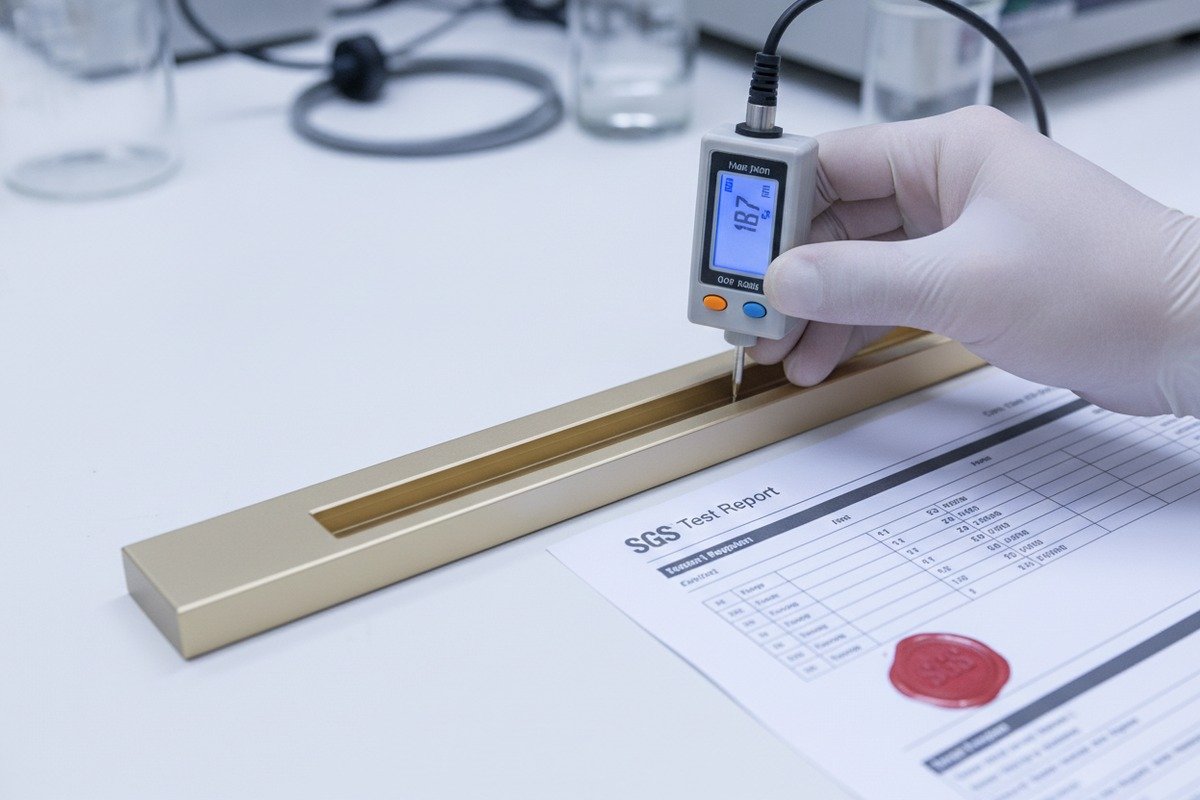
To verify surface finish durability, request salt spray test reports per ASTM B117 or ISO 9227, coating adhesion results per ISO 2409, and coating thickness measurements per ISO 2360. These three tests together give you a reliable picture of whether the finish will survive real-world use and transit.
Why Surface Finish Testing Matters More Than You Think
For recessed aluminum handles with matte finishes—like the minimalist pulls popular in modern Vietnamese export furniture—the surface is the product. Your end customer touches and sees the finish every day. If the anodizing is too thin, it scratches easily. If the powder coating has poor adhesion, it chips during installation. If the champagne gold anodize is not sealed properly, it corrodes in humid climates.
This is not theoretical. We have replaced entire batches for clients who sourced from factories that skipped proper anodizing steps. The cost of re-handling and re-shipping far exceeds the cost of proper testing upfront.
The Three Core Finish Tests
Here is what each test tells you:
Salt spray testing (ASTM B117 / ISO 9227): This test places finished handles in a controlled salt fog chamber and measures how many hours the finish survives before showing corrosion, blistering, or discoloration. For anodized aluminum handles, a minimum of 336 hours (14 days) is a reasonable benchmark. For powder-coated handles, 500+ hours is common for quality export products.
Coating adhesion (ISO 2409 / ASTM D3359): A cross-hatch pattern is cut into the finish, then adhesive tape is applied and removed. The amount of finish that lifts off determines the adhesion rating from 0 (best) to 5 (worst). For export-grade handles, you want a rating of 0 or 1.
Coating thickness (ISO 2360 / ASTM B244): An eddy-current or magnetic gauge measures the coating thickness in microns. For architectural-grade anodizing, the minimum is typically 15–20 microns. For powder coating, 60–80 microns is standard.
How to Request and Interpret Test Reports
When you ask your supplier for these reports, be specific. State the test standard, the number of samples tested, and the acceptance criteria. A vague request like "send me a quality report" will get you a vague answer.
Here is a practical checklist:
- Request the actual lab report, not a summary.
- Check the issuing lab's accreditation. Look for CNAS, ILAC, or ISO 17025 accreditation marks.
- Verify the sample description matches your product. Some suppliers submit a different product for testing than what they ship to you.
- Compare results against your own specification sheet or the end buyer's requirements.
If the supplier cannot provide these reports, that is a red flag. At our facility, we maintain ongoing salt spray testing records because our clients—wholesalers and furniture factories—need this documentation for their own customers. A supplier who takes finish quality seriously will already have these reports on file.
UV Resistance and Humidity Testing
For handles used in kitchens, bathrooms, or outdoor furniture, you may also need UV resistance testing per ASTM G154 and humidity resistance testing per ASTM D2247. These tests are less commonly requested for indoor furniture handles but can be critical depending on the end application.
Do my aluminum profiles and handles need to meet RoHS or REACH environmental standards for the international market?
When we prepare export documentation for markets in Europe and North America, the question of chemical compliance comes up on nearly every order.
If you export aluminum handles to the EU, REACH compliance is essential—your products must not contain restricted substances above permitted thresholds. RoHS applies mainly to electrical and electronic equipment, so it is only mandatory for handles integrated into smart furniture or illuminated cabinets, not for plain aluminum hardware.

REACH: When and Why It Applies to Aluminum Handles
REACH is a European Union regulation that governs chemicals in products sold within the EU. Even though an aluminum handle is not a chemical product, the regulation still applies because of what is in or on the handle. The anodizing process uses chemicals. Powder coatings contain resins and pigments. Lubricants may remain on machined surfaces. Any of these could contain Substances of Very High Concern (SVHCs) above the 0.1% threshold.
For your aluminum handles to be REACH-compliant, you need:
- A declaration from the supplier confirming SVHC content is below thresholds.
- Material Safety Data Sheets (MSDS) for coatings and finishes used.
- Periodic third-party testing if your EU buyer requires it.
This is product conformity, not a factory certificate. Your factory can be ISO 9001-certified and still ship a handle that fails REACH because the powder coating supplier changed their pigment formula.
RoHS: Does It Really Apply to Furniture Handles?
RoHS restricts six hazardous substances—lead, mercury, cadmium, hexavalent chromium, PBB, and PBDE—in electrical and electronic equipment. A plain aluminum pull handle is not electronic equipment. So technically, RoHS does not apply.
However, there are two exceptions:
- Smart furniture integration: If the handle is part of an illuminated drawer system, a touch-activated cabinet, or any furniture with electronic components, RoHS applies to the entire assembly.
- Buyer preference: Some large furniture retailers apply RoHS requirements to all hardware regardless of legal obligation, as part of their corporate sustainability policy.
Our recommendation: even if RoHS is not legally required for your handles, it is easy and inexpensive to comply. Aluminum alloys like 6063 and 6061 naturally contain negligible levels of restricted substances. The main risk area is the surface finish—particularly if hexavalent chromium is used in any conversion coating or pre-treatment step.
California Proposition 65
If any of your export furniture ends up in California, Proposition 65 requires warnings for products containing chemicals known to cause cancer or reproductive harm. California Proposition 65 9 For aluminum handles, the most likely concern is lead content in brass inserts, zinc alloys, or certain coatings. Pure aluminum alloy handles with standard anodized or powder-coated finishes rarely trigger Prop 65 issues, but you should confirm with testing if your buyer requires it.
Environmental Compliance by Market
| Export Market | Key Environmental Standard | What You Need |
|---|---|---|
| European Union | REACH + GPSR (General Product Safety Regulation 10) | SVHC declaration, MSDS for coatings, EU Responsible Person designation |
| United States | Prop 65 (California), CPSIA (if children's furniture) | Third-party lab testing for lead and restricted chemicals |
| Japan | Chemical Substances Control Law (CSCL) | Supplier declaration, material composition data |
| Australia / NZ | Industrial Chemicals Act 2019 | Importer registration if chemicals exceed thresholds |
| Middle East (GCC) | GSO technical regulations | Conformity certificate, often based on EN or ISO standards |
The EU's General Product Safety Regulation (GPSR), effective since December 2024, now requires an EU Responsible Person for all consumer products sold in the EU. If your furniture with aluminum handles is sold to EU consumers, this is a new compliance requirement to address with your importer.
How do I ensure my supplier's quality control process aligns with the high standards required for my custom furniture brand?
Over the past 18 years, our team has built quality control systems specifically because our clients—wholesalers and furniture factory owners—cannot afford to discover defects after installation.
Ensure supplier quality alignment by conducting a factory audit, approving golden samples before production, requiring in-process inspection checkpoints, and arranging pre-shipment third-party inspection. Combine these steps with clear written specifications covering alloy grade, finish type, tolerances, and packaging requirements.

Why Certification Alone Is Not Enough
A factory can hold ISO 9001 and still ship handles that do not match your brand standards. ISO 9001 sets up a quality framework, but the output quality depends on what specifications are fed into that framework. If your purchase order says "aluminum handle, champagne gold" with no further detail, the factory's quality system will produce to their default internal standard—which may or may not match what your customer expects.
This is why the combination of certification plus clear specifications plus physical verification is essential. Certification reduces systemic risk. Specifications reduce interpretation risk. Inspection reduces execution risk.
Step-by-Step Supplier Quality Verification
Step 1: Factory audit. Visit the factory or hire a third-party auditor to verify ISO 9001 is actively implemented—not just a certificate hanging on the wall. Check for documented work instructions, inspection equipment (calipers, coating thickness gauges, color matching tools), and defect tracking records.
Step 2: Golden sample approval. Before production starts, request a sealed golden sample. This is the physical reference standard for the entire order. Our facility keeps a reference sample library for every active client, so any production run can be checked against the original approved piece.
Step 3: In-process quality checkpoints. Ask the supplier to perform inspections at key production stages:
- After extrusion: check alloy grade and dimensional accuracy.
- After surface treatment: check coating thickness, color, and adhesion.
- After cutting and finishing: check final dimensions, edge quality, and packaging.
Step 4: Pre-shipment inspection. Arrange a third-party inspection (SGS, Bureau Veritas, or TÜV) using AQL sampling before the container is loaded. Standard AQL levels for furniture hardware are typically AQL 1.0 for critical defects and AQL 2.5 for minor defects.
What Documentation to Request
Beyond certificates, here is the documentation package that protects your custom brand:
- Material test certificate for each alloy batch (mill certificate).
- Coating thickness and adhesion test report per production lot.
- Dimensional inspection report with actual measured values vs. drawing tolerances.
- Salt spray test report if corrosion resistance is specified.
- Packing list with quantity, weight, and carton dimensions.
- Photos of finished goods and packaging before shipment.
Social and Ethical Compliance
For buyers selling into European retail chains or working with global furniture brands, social compliance audits are increasingly required. Standards like BSCI (Business Social Compliance Initiative) and SEDEX verify labor rights, working conditions, and environmental practices at the factory level. While these are not product certifications, they can determine whether a major retailer will accept your supply chain.
Working with a Supplier Who Understands Export Requirements
The biggest time-saver is partnering with a supplier who already exports to your target market. When we ship handles to Vietnam-based furniture factories producing for EU or US end customers, we already know which documentation is needed, which tests to run, and how to package for ocean freight to minimize transit damage. This experience eliminates the back-and-forth that slows down first-time sourcing from an unfamiliar factory.
Our 300-ton ready stock inventory and 48-hour shipping for stock items exist specifically because our clients cannot wait weeks for a missing handle to hold up a furniture order. When your supplier understands your delivery pressure and quality standards from day one, the entire supply chain runs smoother.
Conclusion
Sourcing aluminum furniture handles for export requires both factory certifications and product-level compliance matched to your destination market. Start with ISO 9001, verify finishes with lab testing, confirm environmental compliance, and protect your brand with clear specifications and pre-shipment inspection.
Footnotes
1. Explains the ISO 9001 standard for quality management systems and its importance. ↩︎
2. Provides an overview of SGS as a leading testing, inspection, and certification company. ↩︎
3. Replaced with the official European Commission page on REACH regulation. ↩︎
4. Official website for ASTM International, a developer of voluntary consensus technical standards. ↩︎
5. Official source for Japanese Industrial Standards (JIS) and their development. ↩︎
6. Explains the ISO 14001 standard for environmental management systems. ↩︎
7. Explains the ISO 9227 standard for salt spray corrosion resistance tests. ↩︎
8. Official standard practice for operating salt spray (fog) apparatus. ↩︎
9. Provides official information and background on California’s Proposition 65. ↩︎
10. Replaced with the official European Commission page providing information on product safety and the General Product Safety Regulation. ↩︎