
Every week, our production team in Foshan ships aluminum furniture handles to wholesalers across Vietnam who serve completely different market segments—from budget apartment fit-outs to luxury kitchen showrooms dimensional tolerances 1. The frustration we hear most often is this: retailers apply one blanket quality spec to every handle they buy, and it backfires. They either overpay for entry-level SKUs by demanding premium finishes, or they under-specify high-end lines and face returns when handles tarnish in humid Saigon kitchens. The result is wasted margin, inconsistent shelf quality, and eroded trust with end customers.
To set differentiated quality standards, Vietnamese retailers should establish a universal baseline covering safety, dimensional accuracy, and basic corrosion protection, then layer tier-specific requirements for surface finish, wall thickness, durability testing, and inspection intensity across value, mid-range, and premium product lines.
Below, we break down exactly how to define surface treatment requirements, technical specifications, material selection trade-offs, and quality control benchmarks so you can protect your margins and your reputation at every price point.
Surface finish 2 is the first thing a buyer sees and the last thing they forgive when it fails. Our finishing line runs anodizing 3, powder coating, brushing, and polishing—and each process has a different cost curve, durability profile, and visual impact.
Define surface treatment by tier: economy handles need basic anodizing or electrophoresis for adequate corrosion protection, while premium handles require thicker anodized layers, tighter color-match tolerances, and specialty finishes like champagne gold or matte black with verified scratch and salt-spray resistance.

Why One Finish Standard Doesn't Work
A recessed cabinet handle destined for a budget wardrobe faces light daily use in a dry bedroom. A similar profile installed on a kitchen cabinet in Ho Chi Minh City's humidity encounters steam, grease, and constant hand contact. Applying the same anodizing thickness to both is either wasteful or insufficient.
Economy collections generally tolerate a thinner anodized layer—around 8–10 µm—because the environment is less aggressive and the price sensitivity is higher. Premium collections, especially those matte champagne gold or charcoal grey finishes your showroom customers expect, need 15–25 µm anodizing or a high-quality powder coat with UV-stable pigments.
Surface Treatment Tiers at a Glance
| Specification | Economy Line | Mid-Range Line | Premium Line |
|---|---|---|---|
| Primary Finish | Basic anodizing or electrophoresis | Standard anodizing or powder coating 4 | Thick anodizing, specialty powder coat, or PVD |
| Anodizing Thickness | 8–10 µm | 12–15 µm | 15–25 µm |
| Salt Spray Resistance | ≥ 200 hours | ≥ 400 hours | ≥ 600 hours |
| Scratch Resistance | Pencil hardness ≥ 2H | Pencil hardness ≥ 3H | Pencil hardness ≥ 4H |
| Color Match Tolerance | ΔE ≤ 3.0 | ΔE ≤ 2.0 | ΔE ≤ 1.0 |
| Gloss Consistency | Visual check per batch | Gloss meter ±5 units | Gloss meter ±3 units |
| UV Stability | Not required | 500-hour UV test | 1000-hour UV test |
Practical Steps to Define Your Requirements
First, classify every handle SKU by its intended use environment: dry interior, humid interior, or kitchen/bathroom. Second, assign a finish tier. Third, write it into your purchase order. We always recommend that retailers send a signed-off reference sample for each finish tier. That sample becomes the benchmark our QC team checks against during production.
For champagne gold and light bronze finishes—like the precision-anodized recessed pulls in our catalog—color consistency matters enormously. A ΔE shift of 3.0 might be invisible on a matte black handle but glaringly obvious on champagne gold. So your premium spec should tighten that tolerance.
One more thing: packaging protection scales with finish quality. Premium anodized handles scratch easily during transit. We use individual PE foam sleeves and partitioned cartons for high-end orders. For economy lines, bulk poly-bag packing is standard. Specify this in your PO to avoid surprises.
What specific technical specifications should I demand from my Foshan supplier to ensure consistency across my custom product lines?
When our team onboards a new Vietnamese retailer, the most common gap we find is vague specifications. Requests like "good quality" or "similar to this photo" leave too much room for interpretation—and that's where inconsistency creeps in.
Demand written specs covering alloy grade, wall thickness, dimensional tolerances, surface finish parameters, salt-spray hours, and lot-to-lot color deviation limits. Pair these with a signed reference sample, a supplier quality agreement, and a defined inspection protocol for incoming goods.
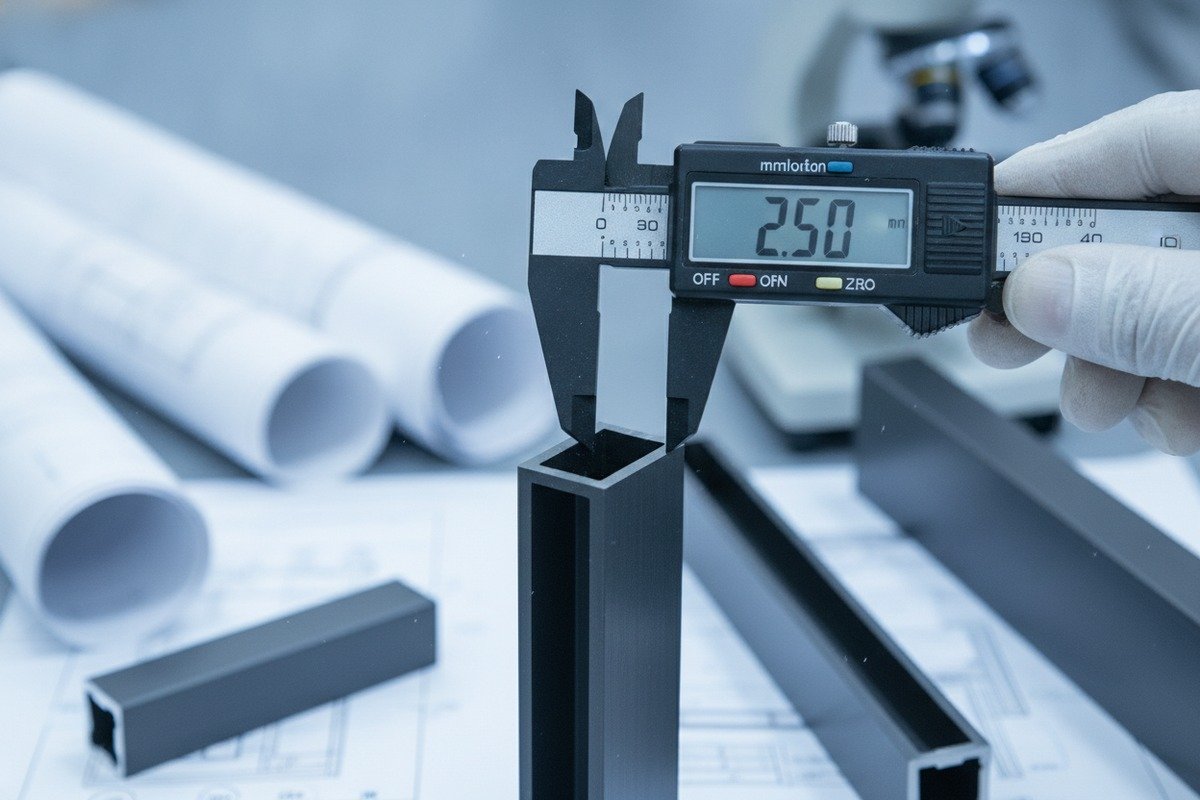
The Core Technical Parameters
Every purchase order for aluminum handles should lock down these parameters in writing. Verbal agreements are not enough, especially when you order across multiple product lines.
| Parameter | What to Specify | Why It Matters |
|---|---|---|
| Alloy Grade 6 | 6063-T5 (standard) or 6061-T6 (high-strength) | Determines base strength and extrudability |
| Wall Thickness | 0.8–1.0 mm (economy), 1.0–1.2 mm (mid), 1.2–1.5 mm (premium) | Affects rigidity, feel in hand, and resistance to bending |
| Length Tolerance | ±0.3 mm (economy), ±0.2 mm (mid), ±0.1 mm (premium) | Ensures flush fit in CNC-cut furniture panels |
| Hole Center Distance | ±0.2 mm across all tiers | Critical for installation compatibility |
| Straightness | ≤ 0.3 mm per 300 mm | Prevents visible bowing on long recessed pulls |
| Surface Roughness (Ra) | ≤ 1.6 µm (brushed), ≤ 0.8 µm (polished) | Defines tactile quality and reflective consistency |
| Edge Condition | No burrs, no sharp edges, radius ≥ 0.3 mm | Safety and perceived quality |
| Anodizing / Coating | Per tier table above | Durability and aesthetics |
Why Alloy Grade Matters More Than You Think
Most aluminum furniture handles use 6063-T5 alloy. It extrudes beautifully, takes anodizing well, and costs less than 6061. For economy and mid-range lines, 6063-T5 is the right choice. But if your premium line includes extra-long handles—say 600 mm or more—for large kitchen islands, consider 6061-T6. It has higher tensile strength and resists deflection under load.
We once had a Vietnamese distributor who ordered 800 mm recessed pulls in 6063-T5 with 0.8 mm walls. End users reported the handles flexing when pulled. Switching to 1.2 mm walls in 6063-T5 solved the problem without changing alloy grade. The lesson: wall thickness and alloy interact. Specify both.
Supplier Quality Agreement Essentials
Beyond product specs, put these items into a written supplier quality agreement 7:
- Reference sample retention: Supplier keeps a sealed golden sample for each SKU.
- Material certificates: Mill test reports for every alloy batch.
- Dimensional inspection reports: At least 5 pieces per production run, measured on calibrated instruments.
- Finish test reports: Salt-spray hours, adhesion cross-cut test results, and color deviation readings.
- Defect classification: Define what counts as a critical, major, or minor defect. Agree on Acceptable Quality Limits (AQL) 8 per tier.
- Corrective action process: If a batch fails, how quickly must the supplier respond?
At our facility, we issue these reports as standard practice. But not every factory does. Ask before you order.
Trial Orders and Pilot Runs
Never scale a new SKU without a pilot run. Order 200–500 pieces first. Measure them. Test the finish. Install them on actual furniture. This small investment prevents large-scale quality failures. Our 3–7 day turnaround for custom products makes pilot runs practical even on tight timelines.
How do I balance durability and cost-effectiveness when selecting aluminum profiles for my mass-market furniture handles?
Our sales team talks to Vietnamese wholesalers daily about this exact tension. Everyone wants a handle that lasts, but mass-market margins are thin. The goal is not to find the cheapest handle—it's to find the most cost-effective handle that won't generate returns.
Balance durability and cost by using 6063-T5 alloy with 0.8–1.0 mm wall thickness, basic anodizing of 8–10 µm, and streamlined cross-sections that reduce material weight while maintaining adequate grip strength for residential furniture applications.
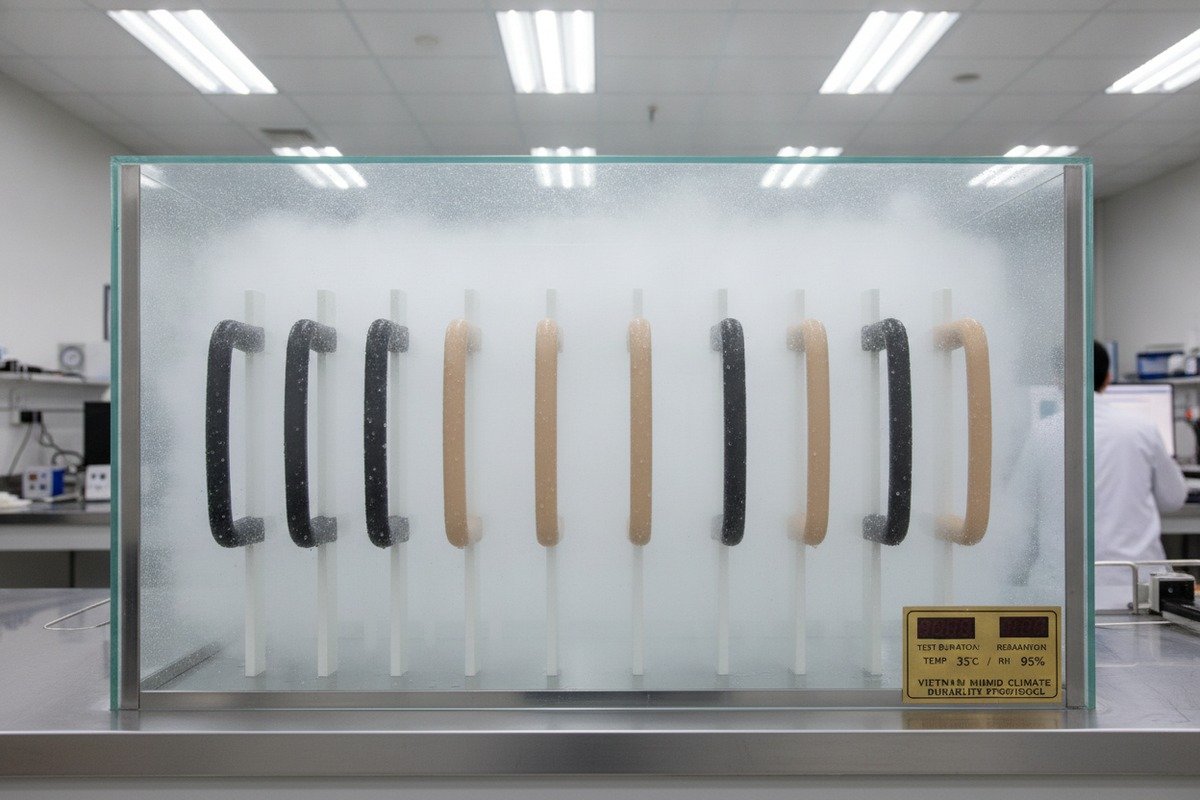
Where Cost Hides in an Aluminum Handle
The cost of an aluminum handle breaks down into four main buckets: raw material, extrusion, finishing, and packaging. Understanding each lets you make smart trade-offs.
Raw material cost tracks the aluminum ingot price plus alloy premium. For mass-market handles, 6063-T5 is the most cost-effective because it's the most commonly extruded alloy—mills produce it in high volume, so the premium is low.
Extrusion cost depends on profile complexity, die cost, and run length. Simpler cross-sections with fewer hollow chambers extrude faster and waste less material. That sleek L-shaped recessed pull with a single deep channel is actually efficient to extrude because the die is straightforward. Add internal ribs or double channels, and cost rises.
Finishing cost scales with process complexity and film thickness. Basic anodizing is cheapest. Powder coating in standard colors is moderate. Specialty finishes like PVD or multi-tone anodizing are premium.
Packaging cost is often overlooked. Bulk packaging in poly bags is cheapest. Individual sleeves and partitioned cartons cost more but reduce transit damage—and damage-related returns.
The Mass-Market Sweet Spot
For mass-market handles sold into Vietnamese apartment and office furniture projects, here's what we recommend:
- Alloy: 6063-T5
- Wall thickness: 0.8–1.0 mm
- Profile: Simple recessed or bar pull, single channel
- Finish: Natural silver anodizing (8–10 µm) or matte black electrophoresis
- Length: Standard sizes (96 mm, 128 mm, 160 mm center-to-center)
- Packaging: Poly bag, 50–100 pcs per carton
This combination gives adequate strength for daily residential use, decent corrosion protection 9 for dry to moderately humid environments, and a clean modern look. It also keeps the per-unit cost well within mass-market margins.
When Cheap Becomes Expensive
We've seen retailers push wall thickness below 0.8 mm to save a few cents per handle. The handles arrive looking fine but fail within months—bending during installation, denting from minor impacts, or losing finish adhesion because the thin walls deform under anodizing stress. The return rate spikes, and the retailer spends more on replacements and lost credibility than they saved on material.
A good rule: never cut below the structural minimum to chase price. Instead, reduce cost through smarter design—shorter handles, simpler profiles, standard colors, and larger order quantities that lower per-unit production costs. Our 300-ton ready stock means we can offer competitive pricing on popular sizes without requiring massive MOQs.
Durability vs. Cost Decision Matrix
| Decision Factor | Cost-Saving Choice | Durability Choice | Recommended for Mass Market |
|---|---|---|---|
| Alloy | 6063-T5 | 6061-T6 | 6063-T5 |
| Wall Thickness | 0.8 mm | 1.2–1.5 mm | 0.8–1.0 mm |
| Anodizing | 8 µm | 20+ µm | 8–10 µm |
| Profile Complexity | Simple bar pull | Multi-channel recessed | Simple recessed |
| Packaging | Bulk poly bag | Individual PE sleeve | Poly bag with dividers |
| Standard Lengths | Stock sizes only | Full custom range | Stock sizes |
The mass-market sweet spot sits in the middle column. You don't need premium-grade specs, but you should never drop below the minimum thresholds that prevent field failures.
What quality control benchmarks should I establish to minimize returns and maintain my reputation in the Vietnamese wholesale market?
In our 18 years of shipping handles to Vietnam and the Middle East, we've learned that the retailers with the lowest return rates are not the ones who buy the most expensive handles. They're the ones with the clearest QC benchmarks written into every order.
Establish QC benchmarks using AQL sampling at three stages—incoming material, in-process, and final inspection—with tier-specific defect classifications, dimensional checks on calibrated tools, finish verification against sealed samples, and a documented corrective action process for any non-conforming lot.
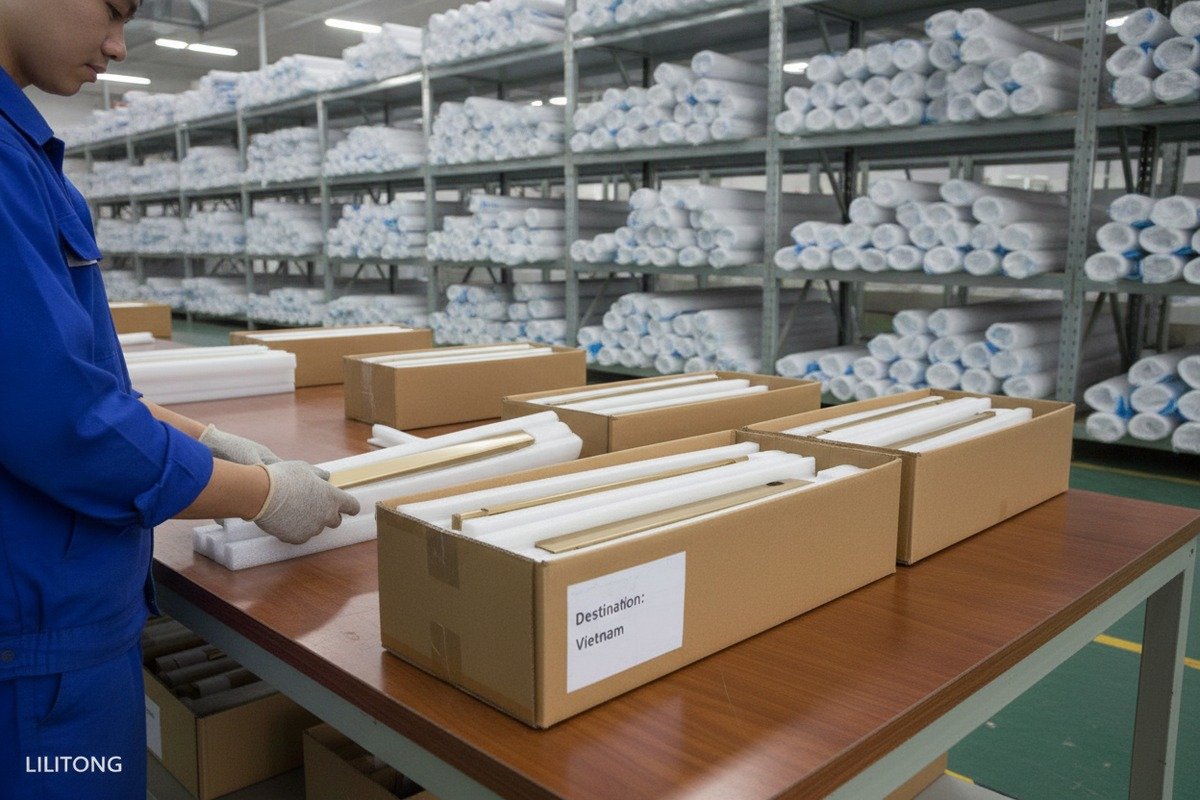
The Three-Stage Inspection Framework
Quality cannot be inspected into a product at the end. It must be built in at every stage. Here's how to structure your QC plan:
Stage 1 — Incoming Material Inspection: Check alloy mill certificates against your spec. Verify billet dimensions and surface condition. This catches material problems before extrusion begins.
Stage 2 — In-Process Inspection: During extrusion, measure wall thickness and profile dimensions on the first 10 pieces and then at regular intervals. During finishing, check film thickness, adhesion, and color against the golden sample. Flag deviations immediately so the line can adjust.
Stage 3 — Final Inspection: Before packing, inspect a random sample per AQL tables. Check dimensions, finish, edge condition, color consistency, and packaging integrity. Record everything. Ship only lots that pass.
Defect Classification by Tier
Not every defect is equally serious. And the same defect might be acceptable in an economy line but rejectable in a premium line. Define your classifications clearly.
| Defect Type | Economy Line | Mid-Range Line | Premium Line |
|---|---|---|---|
| Minor scratch (< 10 mm, not on grip surface) | Accept | Accept | Reject |
| Minor scratch (< 10 mm, on grip surface) | Accept | Reject | Reject |
| Color deviation ΔE 2.0–3.0 | Accept | Accept | Reject |
| Color deviation ΔE > 3.0 | Reject | Reject | Reject |
| Wall thickness below spec by 0.05 mm | Accept | Reject | Reject |
| Burr on edge | Reject (all tiers) | Reject | Reject |
| Hole center distance off by > 0.2 mm | Reject (all tiers) | Reject | Reject |
| Dent visible at 30 cm | Reject | Reject | Reject |
| Dent visible only at 10 cm | Accept | Accept | Reject |
| Packaging damage on arrival | Replace affected units | Replace affected units | Reject entire carton |
AQL Sampling Levels
For economy handles, AQL Level II with a 2.5 acceptance number for minor defects is standard. For premium handles, tighten to AQL Level II with 1.0 for minor defects and 0.65 for major defects. This means you inspect more rigorously where your brand risk is highest.
Corrective Action and Supplier Scorecards
Track every inspection result. If a supplier fails two consecutive lots on the same defect, issue a corrective action request. corrective action process 10 Require a root-cause analysis and a preventive measure within 48 hours. If the problem repeats a third time, reconsider the supplier relationship.
Build a simple supplier scorecard with four metrics: on-time delivery rate, first-pass inspection pass rate, return rate from your downstream customers, and responsiveness to quality issues. Review it quarterly. Share results with your supplier. Transparency drives improvement.
At our factory, we welcome scorecards from our retail partners because they help us calibrate our internal QC to their exact expectations. When a Vietnamese distributor tells us their kitchen cabinet customers need ΔE below 1.0 on champagne gold handles, we set our colorimeter accordingly—before production starts, not after complaints arrive.
Documentation and Traceability
Every lot should ship with a quality dossier: material certificate, dimensional inspection report, finish test results, and packing list. This matters for two reasons. First, it lets you trace problems back to specific production runs. Second, in Vietnam's growing export-oriented furniture sector, end customers and regulatory bodies increasingly expect documented quality evidence. Handle traceability also protects you if questions arise about material origin or compliance—an issue that has gained attention in recent trade policy developments affecting aluminum products in the region.
Conclusion
Setting differentiated quality standards for aluminum furniture handles is not complicated—but it does require discipline. Define a universal safety and dimensional baseline, then layer tier-specific requirements for finish, wall thickness, durability, and inspection intensity across your product lines. The result is protected margins, fewer returns, and a stronger reputation in Vietnam's competitive wholesale market.
Footnotes
1. Explains dimensional tolerances as permissible variations crucial for part function and manufacturing. ↩︎
2. Defines surface finish and its importance in manufacturing and aesthetics. ↩︎
3. Authoritative source explaining the anodizing process and benefits. ↩︎
4. Describes powder coating as a dry finishing method for aluminum, enhancing durability and appearance. ↩︎
5. Explains ASTM B117, a widely used standard for assessing corrosion resistance via salt spray. ↩︎
6. Details how aluminum alloys are classified and their varying properties for different applications. ↩︎
7. Defines a supplier quality agreement as a document outlining quality and GMP obligations between parties. ↩︎
8. Defines AQL and its application in product inspections. ↩︎
9. Explains how aluminum’s oxide layer provides natural corrosion resistance. ↩︎
10. Comprehensive guide to the Corrective and Preventive Action (CAPA) process. ↩︎