
Every week, our production team in Foshan receives inquiries from Vietnam developers who struggle with one recurring problem: the handles they ordered look nothing like the architect’s vision.
To align procurement with architectural design, Vietnam project developers should convert the architect’s visual brief into a measurable hardware specification, then validate that specification through factory samples, finish testing, and contract controls before committing to volume orders. This staged approach prevents costly mismatches between design intent and delivered product.
The gap between what an architect imagines and what a procurement team actually orders is where most projects bleed time and money salt spray test reports 1. This article walks you through a practical, step-by-step model we have refined over 18 years of supplying aluminum furniture handles 2 to developers across Vietnam and the Middle East. Each section addresses a specific pain point, from locking custom designs to verifying durability, so you can build a repeatable sourcing workflow that serves both your design team and your bottom line.
How can I ensure my custom aluminum handle designs perfectly match the aesthetic vision of my architectural projects?
On our factory floor, we see the disconnect every day: a beautiful rendering arrives, but it lacks the technical details a production team needs to deliver an exact match cross-cut adhesion tests 3.
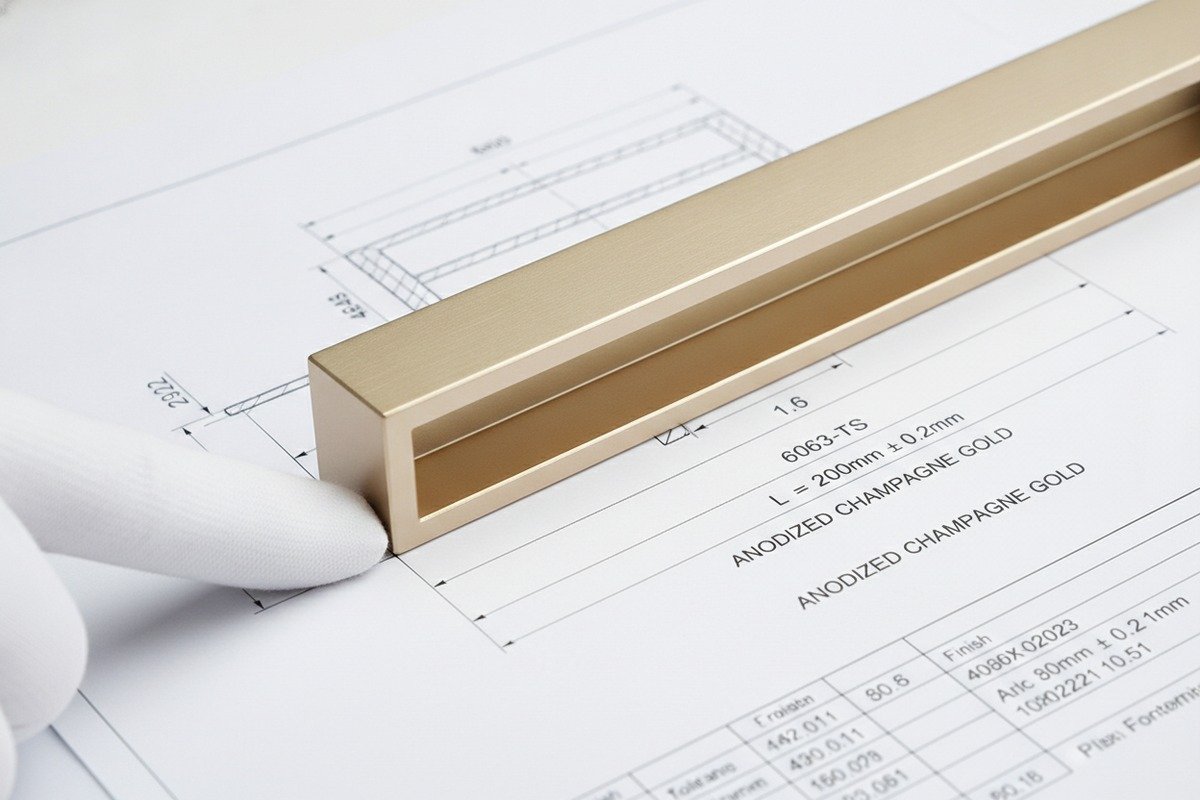
Start by translating mood boards and 3D renderings into a hardware specification sheet with measurable fields—profile dimensions, center-to-center spacing, alloy grade, finish code, edge radius, and surface tolerance. This document becomes the single source of truth that links the architect's vision to the factory's production parameters.

Why Renderings Alone Are Not Enough
An architect may specify "a sleek, minimalist recessed pull in champagne gold." That phrase describes a feeling, not a product. Our engineering team needs numbers. What is the exact length? What is the channel depth for finger clearance? Is champagne gold an anodized finish 4 or a powder coat? Without these answers, the factory guesses. And guesses lead to rejected shipments.
The solution is a bridge document. We call it a Handle Specification Sheet. It sits between the design concept and the purchase order OEM/ODM capacity 5.
What Goes Into a Handle Specification Sheet
| Field | Design Team Provides | Procurement Team Validates |
|---|---|---|
| Profile shape | Sketch or CAD drawing | Extrudability and tooling feasibility |
| Dimensions (L × W × H) | Target dimensions in mm | Manufacturing tolerance (±0.2 mm typical) |
| Center-to-center spacing | Hole distance per cabinet drawing | Match to cabinet door drill pattern |
| Alloy grade 6 | Usually not specified | Confirm 6063-T5 or equivalent for furniture use |
| Surface finish | Mood board reference | Anodized, powder-coated, or brushed—with finish code |
| Color | Pantone or sample swatch | Batch-to-batch ΔE value for consistency |
| Edge treatment | Sharp, chamfered, or radiused | Confirm radius in mm |
| Fastener type | Rarely specified by architects | Screw diameter, length, and head style |
| Finger clearance | Ergonomic sketch | Minimum 18 mm clearance for adult grip |
Match the Handle Type to the Design Language
Not all aluminum handles serve the same visual purpose. A concealed edge pull creates a seamless, handleless look for ultra-modern kitchens. A long bar handle adds a horizontal line that reinforces modern proportions. A recessed channel pull—like the slim rectangular profiles with deep geometric channels we produce—delivers a low-profile, architectural feel.
When our team works with Vietnam developers on hospitality or premium residential projects, we always ask one question first: "Is the handle meant to be seen or hidden?" That answer determines the entire product family before any spec is written.
The Iteration Cycle
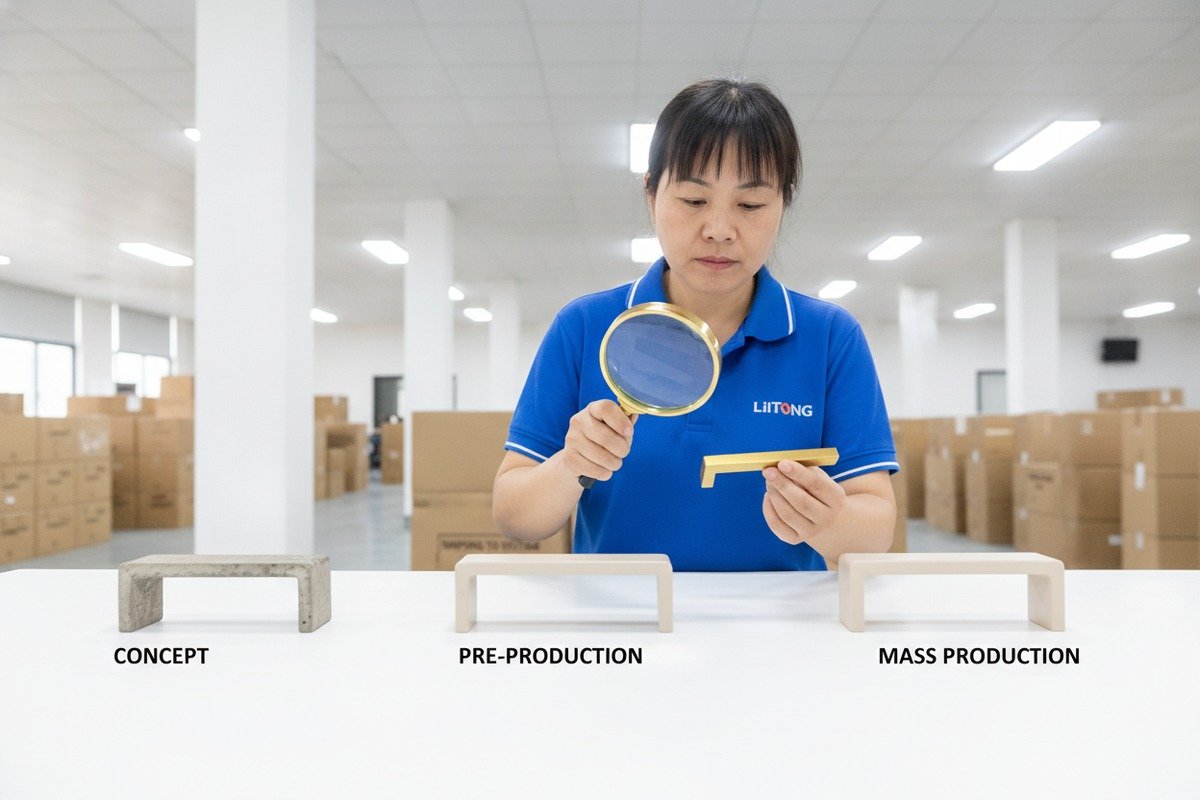
We recommend at least three sample stages. First, a concept sample—this is a single piece made to verify shape, proportion, and finish direction. Second, a pre-production sample produced on the actual tooling or extrusion die. Third, a mass-production approval sample pulled from the first production batch. Each stage gives the design team a physical touchpoint to approve before volume commitment.
This process adds a few days upfront. But it eliminates the far more expensive problem of receiving 5,000 handles that do not match the architect's intent.
What steps should I take to balance high-end design specifications with the lead time constraints of my Vietnam-based developments?
When we ship to Vietnam projects, time is almost always the tightest constraint. Developers face handover deadlines, and a delayed hardware shipment can hold up an entire joinery installation.
Balance design ambition with lead time by separating your handle order into two tracks: source ready-stock standard profiles for the majority of units, and reserve custom production only for hero areas like lobbies and show apartments. This dual-track approach cuts overall lead time while preserving design impact where it matters most.
The Two-Track Sourcing Model
Most large Vietnam developments have two tiers of interior specification. The bulk apartments or hotel rooms need a consistent, well-finished handle at volume. The public areas, penthouses, or branded suites need something unique. Trying to custom-produce every handle across both tiers is the fastest way to blow your timeline.
From our 300-ton ready-to-ship inventory, we can dispatch standard aluminum handles within 48 hours. These are proven profiles in popular finishes—matte black, champagne gold, brushed silver, charcoal grey. For custom pieces, our turnaround is 3 to 7 days for profile extrusion and finishing when the die already exists. New tooling adds time, but only for the first order.
Lead Time Breakdown by Order Type
| Order Type | Typical Lead Time | When to Use |
|---|---|---|
| Ready stock (standard profile, standard finish) | 48 hours to ship | Bulk apartment units, standard rooms |
| Semi-custom (existing die, custom finish or length) | 3–7 days | Mid-tier units, upgraded color schemes |
| Full custom (new die, new profile, custom finish) | 15–25 days | Lobbies, penthouses, branded suites |
| Reorder (repeat of previous custom order) | 5–10 days | Phase 2 or Phase 3 of same project |
How to Protect Your Timeline
First, issue the handle specification early—ideally at the same time joinery shop drawings are released. Do not wait until cabinets are built. Second, order samples during the design development phase, not during construction. Third, confirm stock availability before finalizing the specification. If a standard champagne gold bar handle is in stock and meets 90% of the design intent, it may be wiser to use it across all units and reserve custom production only for the 10% that truly needs differentiation.
When Custom Tooling Makes Sense
Custom extrusion dies 8 are a one-time investment. Once created, they belong to the project. If you have a multi-phase development with 2,000 or more units, a custom die pays for itself quickly and gives you a unique handle profile no competitor can replicate. We store client dies at our Foshan facility and re-run them on demand for future phases.
The key is to make the tooling decision early. A custom die typically takes 7 to 10 days to produce. If you add that to front-end planning instead of discovering the need mid-construction, it has zero impact on your handover schedule.
How do I verify that the aluminum handles I source from China meet the durability and finish standards required for my luxury builds?
In our testing lab, we routinely see the difference between a handle that looks good in a catalog photo and one that still looks good after three years of daily use in a humid Vietnamese climate.
Verify durability and finish quality by requiring salt spray test reports for corrosion resistance, cross-cut adhesion tests for coating integrity, and hardness tests for scratch resistance. Request a pre-production sample finished under the same process as the mass order, then inspect the first production batch against that approved benchmark before authorizing full shipment.
Why Vietnam's Climate Demands Extra Scrutiny
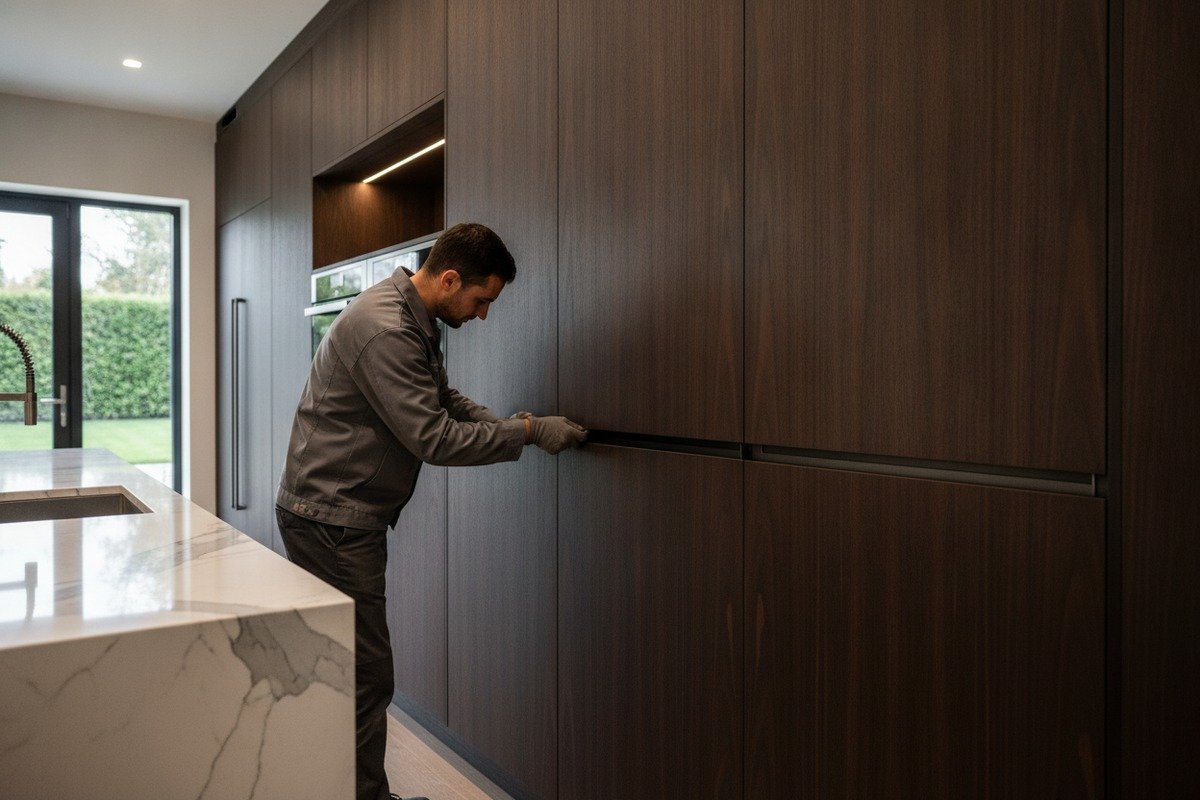
Vietnam's coastal and tropical regions present real challenges for metal hardware. High humidity, salt air in coastal cities like Da Nang and Nha Trang, and constant hand contact in hospitality environments all accelerate finish degradation. An anodized layer that performs well in a dry climate may pit or discolor within 18 months in a beachfront resort if the anodizing thickness is insufficient.
We recommend a minimum anodizing thickness of 15 microns for interior handles in standard Vietnamese environments, and 20 microns or more for coastal or outdoor-adjacent applications. For powder-coated handles, a minimum of 60 microns film thickness 9 is standard for furniture-grade durability.
Key Tests to Request From Your Supplier
| Test | What It Measures | Minimum Standard for Luxury Builds |
|---|---|---|
| Salt spray (ASTM B117) | Corrosion resistance | 200 hours minimum for interior; 500+ for coastal |
| Cross-cut adhesion (ASTM D3359) | Coating bond to substrate | Rating 4B or 5B (no peeling) |
| Pencil hardness (ASTM D3363) | Scratch resistance of finish | 2H minimum for powder coat 10 |
| Film thickness (ISO 2360) | Coating or anodizing depth | 15 µm anodized; 60 µm powder coat |
| UV resistance (ASTM G154) | Color fade under light exposure | 500 hours with ΔE < 1.0 |
| Abrasion resistance (Taber test) | Wear under repeated contact | Depends on use frequency; request supplier data |
The Sample-to-Batch Consistency Problem
One of the most common complaints we hear from Vietnam procurement teams is: "The sample was perfect, but the bulk order looked different." This happens when the sample is hand-finished or produced on a pilot line, while the bulk order runs on a different process or shift.
Our approach is to produce the pre-production sample on the same extrusion line and finishing equipment that will handle the mass order. We tag the sample with the exact process parameters—anodizing bath temperature, immersion time, dye concentration—and lock those parameters for the production run. This is what finish process control actually means.
Incoming Quality Check Protocol
When your handles arrive in Vietnam, your receiving team should check at least the following: visual color match against the approved sample under D65 daylight, dimensional spot check with calipers on at least 5% of pieces, coating thickness with a portable gauge, and mounting hole alignment with a go/no-go jig. Reject criteria should be defined in the purchase order, not negotiated after the shipment lands.
A 30-minute incoming inspection prevents weeks of reinstallation cost. It is the cheapest quality insurance in your entire project.
Where can I find a reliable supplier that provides the technical guidance and ready stock my procurement team needs for large-scale projects?
Over the past 18 years, our team has learned that what Vietnam developers really need is not just a handle seller—they need a production partner who can answer technical questions at midnight on WhatsApp and still ship the next morning.
Look for a supplier with at least three capabilities: substantial ready-to-ship inventory for fast fulfillment, proven OEM/ODM capacity for custom design collaboration, and a technical team that can advise on alloy selection, finish suitability, and installation compatibility. The right partner reduces your procurement team's workload and protects your project timeline simultaneously.
What Separates a Supplier From a Partner
A supplier fills orders. A partner helps you avoid mistakes before you place the order. When a Vietnam developer sends us a joinery drawing with handle cutout dimensions that do not match standard extrusion tolerances, we flag it immediately. When someone specifies a polished mirror finish for a 500-room hotel where housekeeping will wipe handles daily, we recommend a brushed or matte anodized alternative that hides fingerprints and micro-scratches. That is technical guidance in practice.
Supplier Evaluation Checklist
Before shortlisting any aluminum handle supplier, your procurement team should verify the following:
Factory fundamentals. Visit or request a virtual tour. Confirm the facility has its own extrusion press, anodizing line, and powder coating booth. A factory that outsources finishing has less control over quality and lead time.
Inventory depth. Ask for a current stock list with quantities and finishes. A supplier claiming ready stock should be able to show you 200 to 300 tons on hand, not a handful of samples.
Custom capability. Request examples of past OEM/ODM projects. Can they modify an existing profile? Can they create a new die? Do they offer design input or just execute?
Communication speed. Test responsiveness. Send a technical question via WhatsApp or email and measure how long a detailed answer takes. In our experience, procurement teams in Vietnam need responses within hours, not days.
Documentation quality. Ask for a sample purchase order, a test report, and a packing specification. If these documents are clear, bilingual, and detailed, the supplier operates at a professional level.
Why Ready Stock Matters for Vietnam Timelines
Vietnam construction projects often compress their fit-out schedules. Joinery installation and hardware mounting happen in the final weeks before handover. If your handle supplier needs 30 days to produce, you have no buffer for delays.
A supplier with 300 tons of ready inventory can ship standard handles within 48 hours. That means your procurement team can place orders closer to the installation date, reducing warehousing costs in Vietnam and giving the design team more time to finalize selections.
Contract Controls That Protect You
Even with the best supplier, contracts matter. Your purchase order should include the approved sample reference number, dimensional tolerances, finish specification, packaging requirements, delivery date with penalty clause for late shipment, defect acceptance rate, and remedy for nonconforming goods. Bilingual PO terms—English and Vietnamese or Chinese—reduce misinterpretation and speed up dispute resolution.
We issue bilingual commercial documents as standard practice because we know that a misunderstood clause costs far more than the time it takes to translate it properly.
The Value of a Single-Source Hardware Partner
For large-scale developments, consolidating your aluminum hardware procurement—handles, profiles for glass doors, trim pieces—under one supplier simplifies logistics, reduces the number of quality checkpoints, and gives you volume leverage on pricing. When your handle supplier also produces aluminum profiles for sliding doors and honeycomb panel trims, your procurement team manages one relationship instead of five. That is efficiency at the project management level, not just the product level.
Conclusion
Aligning procurement with architectural design is not a one-time task—it is a disciplined, repeatable workflow. Start with a measurable specification, validate through samples, lock commercial terms, and partner with a supplier who understands both your design ambition and your delivery reality.
Footnotes
1. Describes ASTM B117, a standard test for evaluating corrosion resistance of metals and coatings. ↩︎
2. Discusses types, materials, and selection criteria for aluminum furniture handles. ↩︎
3. Explains ASTM D3359, a standard visual adhesion test for coatings on metallic substrates. ↩︎
4. This is an authoritative source (Aluminum Anodizers Council) that directly explains what anodizing is, making it a suitable replacement. ↩︎
5. Provides a comprehensive technical guide explaining the differences between OEM and ODM manufacturing models. ↩︎
6. Details properties, uses in furniture, and benefits of 6063 aluminum alloy. ↩︎
7. Explains the purpose, components, and importance of a hardware requirements specification. ↩︎
8. Explains the creation of custom extrusion dies and their advantages in aluminum extrusion. ↩︎
9. This article provides an essential guide to understanding and measuring dry film thickness, which is directly relevant to the anchor text. ↩︎
10. Outlines the benefits of powder coating, including durability, environmental friendliness, and uniform finish. ↩︎