
Every year, our production team in Foshan ships hundreds of tons of aluminum handles 1, and we see one pattern repeat itself: buyers who source based on gut feeling lose shelf space to buyers who source based on data.
To get useful competitive analysis and market trend reports from your aluminum handle supplier, send a structured request that specifies your target market, price band, finish preferences, and application segment. Ask for three separate deliverables: a competitive benchmarking sheet, a trend insights summary, and a product selection matrix with SKU-level detail on MOQ, lead time, and finish durability.
This article breaks down exactly what to ask for, how to read the reports, and how to avoid the most common traps market trend reports 2. Let’s walk through it section by section.
What specific market data and trend insights should I ask my aluminum handle supplier to include in their reports?
Most buyers send a one-line email: "Can you send me a market report?" That request is too vague. Over the past 18 years of fulfilling OEM and ODM orders 3, our sales team has learned that the more specific the buyer's question, the more useful the supplier's answer.
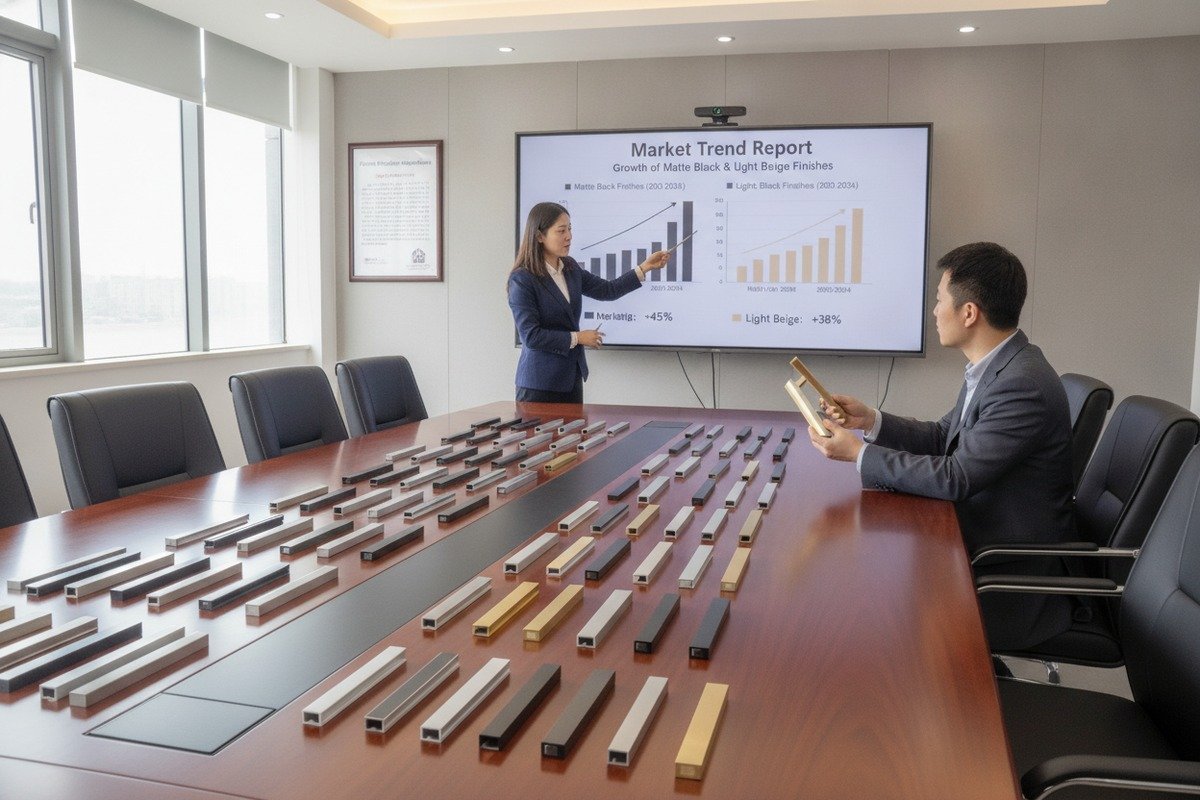
Ask your supplier to include three distinct report types: a competitive analysis comparing 3–5 rival brands by price tier and finish portfolio, a trend report covering handle shapes and finishes growing fastest in your target region, and a product selection matrix with hard data on MOQ, lead time, corrosion resistance, and defect rates.
Why One Generic Report Is Not Enough
A single PDF labeled "market report" usually mixes broad industry forecasts with the supplier's own catalog highlights recycled aluminum alloys 4. That does not help you decide which 15 SKUs to order for your next container. You need information sorted by decision type.
The cabinet hardware 5 market is projected to grow at roughly 7.1% CAGR over the coming years, and pulls or handles remain the dominant product category. Aluminum accounts for an estimated 18–27% of total material usage in furniture and cabinet hardware, depending on the dataset. These are useful context numbers, but they do not tell you which matte black bar pull will outsell a champagne gold edge pull in Dubai next quarter. That is where supplier-level intelligence becomes critical.
The Three Reports You Should Request
| Report Type | What It Covers | Why You Need It |
|---|---|---|
| Competitive Analysis 6 | Top 3–5 competitors, their price bands, finish portfolios, MOQs, lead times, and geographic focus | Helps you position your product range against real market alternatives |
| Trend Report | Handle shapes, finishes, sizes, and application segments growing or declining over the past 6–18 months | Helps you avoid stocking slow-moving styles and catch rising demand early |
| Product Selection Matrix | SKU-level data: alloy grade, finish type, salt spray test 7 hours, pull geometry, MOQ, lead time, customization options | Helps you compare apples to apples when choosing which handles to order |
Data Fields That Matter Most
Do not accept vague qualitative language like "this finish is popular." Push for numbers. Here are the specific data fields to request:
- Unit sales growth by handle style or finish over the last 12 months.
- Percentage breakdown of customer orders by finish.
- Average selling price by segment (residential vs. commercial vs. hospitality).
- Lead time trends over the past 6–12 months.
- Defect rate or return rate by finish type.
- Salt spray test results in hours.
- Production capacity per month.
- Export share by destination market.
When we prepare reports for our wholesale partners, we include salt spray test data for every anodized and powder-coated finish we produce. A champagne gold anodized profile that passes 500 hours of salt spray testing is a different product than one that passes 200 hours, even if they look identical in a photo. Hard data separates real quality from marketing claims.
Frame Your Request Around Your Decision
Before you send any request, write down the exact decision you are trying to make. Are you choosing between two finish families? Are you deciding whether to enter the hospitality segment? Are you trying to undercut a local competitor on price? The clearer your decision frame, the sharper the supplier's response will be.
How can I verify if a supplier's competitive analysis is accurate enough to guide my local furniture handle procurement?
Trusting a supplier's competitive analysis without checking it is like buying a house based only on the seller's description. From our experience exporting to Vietnam and the Middle East, we know that honest suppliers welcome verification because it builds long-term trust.
Verify supplier competitive analysis by cross-referencing their claims against three independent sources: public market research data, your own local sales history, and feedback from at least two other suppliers. Look for consistency in price band positioning, finish trend direction, and lead time estimates across all sources.
The Bias Problem
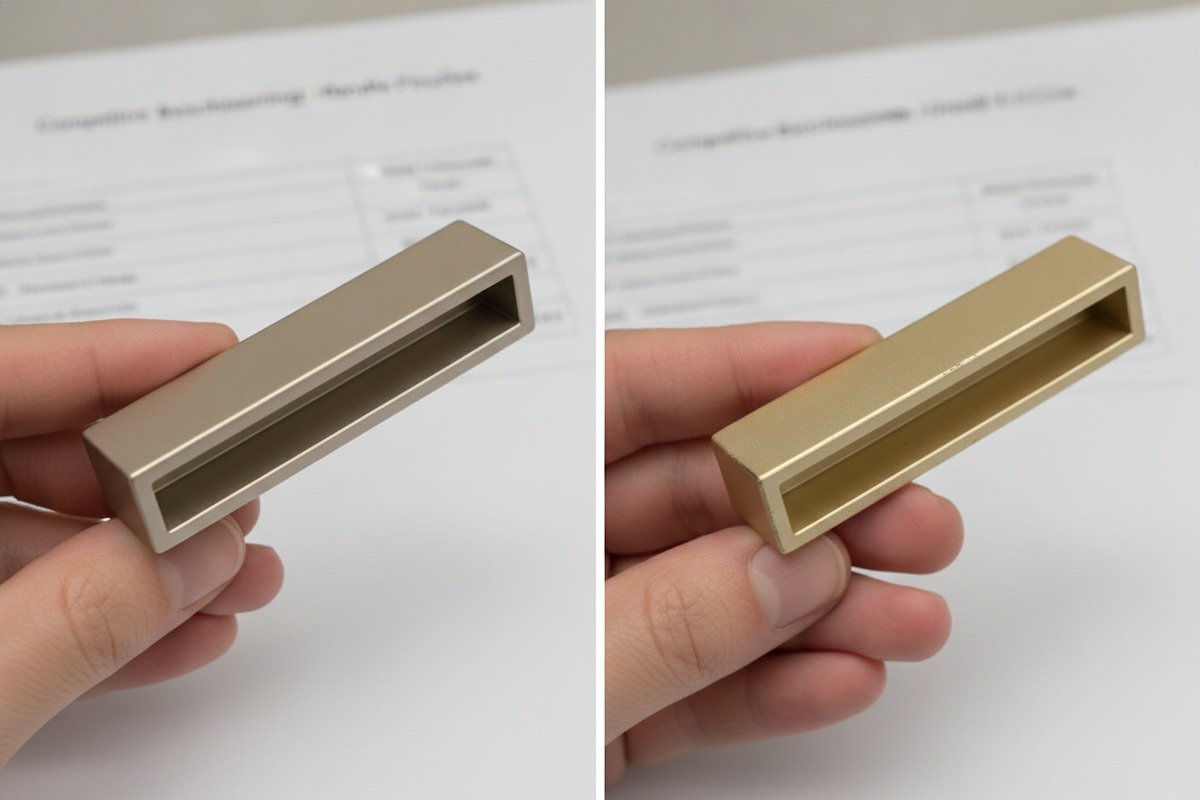
Supplier reports will naturally favor the supplier's own strengths. If a factory specializes in anodized finishes 8, their trend report will likely emphasize anodized growth. If they have low MOQs, their competitive analysis will highlight competitors with higher MOQs. This is not dishonesty. It is perspective. But you must account for it.
A Three-Source Verification Method
Use this simple framework to check any claim a supplier makes:
| Verification Source | What to Check | Red Flag If… |
|---|---|---|
| Public market reports | Overall growth rates, material share percentages, dominant finish trends | Supplier claims contradict multiple published datasets |
| Your own sales data | Which handles sold fastest last quarter, which finishes had the most returns, which price points moved volume | Supplier recommends products that conflict with your proven demand patterns |
| Second or third supplier | Ask the same questions to a different supplier and compare answers on pricing, lead times, and trend direction | Answers diverge significantly on basic facts like aluminum alloy pricing or standard lead times |
Specific Claims to Double-Check
Not every data point needs verification. Focus on claims that directly affect your purchasing decision:
- Price band claims. If a supplier says their price is 15% below the market average, ask two other suppliers to quote the same specification. Our team often provides comparison quotes against standard market pricing to help buyers see where we sit.
- Finish trend claims. If a supplier says matte black is declining, check whether your own local customers are still requesting it. Matte black remains one of the most specified finishes across residential kitchen hardware in many markets.
- Lead time claims. A supplier claiming 7-day turnaround on custom orders should be tested with a real order. We offer 3–7 day turnaround for custom products because we maintain 300 tons of ready-to-ship inventory and run dedicated extrusion lines 9.
- Durability claims. Request actual salt spray test certificates, not just stated hours. Ask for batch-level test reports, not just a general specification sheet.
When Supplier Data Contradicts External Data
Sometimes, a supplier's internal data will show different trends than a published report. This does not automatically mean the supplier is wrong. Public reports aggregate data across all regions and channels. A supplier focused on Middle Eastern markets may see champagne gold and brushed brass trending upward while a global report emphasizes matte black. The key is understanding the scope of each dataset. Ask the supplier: "What is the geographic and channel basis for your data?" If they cannot answer, the data is unreliable.
Which emerging design and finish trends in aluminum profiles should I focus on to stay ahead of my competitors?
When we develop new handle profiles on our extrusion lines, we track not only what is selling now but what architects and interior designers are specifying for projects 12–18 months out. That forward view is where competitive advantage lives.
Focus on five key trends: slim-profile and recessed pull designs for minimalist interiors, matte black and champagne gold anodized finishes, mixed-material combinations pairing aluminum with wood or leather, antimicrobial and easy-clean surface treatments for commercial projects, and sustainable handles made from recycled aluminum alloys.

Trend 1: Slim Profiles and Recessed Pulls
Minimalist and contemporary design continues to dominate residential and commercial interiors. Handles are getting thinner, longer, and less visually intrusive. Our recessed cabinet handles—the kind with a deep geometric channel for a finger grip and a low-profile L-shaped cross-section—have seen order volume increase steadily. These slim, architectural pulls in matte finishes like white, charcoal grey, and champagne gold fit the clean-line aesthetic that designers are specifying everywhere from Dubai apartment kitchens to Ho Chi Minh City wardrobe factories.
Trend 2: Finish Diversification Beyond Chrome and Brushed Nickel
The finish landscape is expanding fast. Here is what we see across our order book and across the broader market:
| Finish | Trend Direction | Key Application | Notes |
|---|---|---|---|
| Matte Black | Strong and stable | Residential kitchens, wardrobes | Still the single most requested finish in many markets |
| Champagne Gold / Light Bronze Anodized | Growing fast | Premium residential, hospitality | Our precision-engineered extruded profiles in champagne gold anodized finish are among our fastest-moving items |
| Brushed Brass | Growing | High-end residential | Often paired with dark cabinetry |
| Antique Brass / Oil-Rubbed Bronze | Stable | Traditional and transitional interiors | Niche but loyal customer base |
| Mixed-Metal Looks | Emerging | Designer and boutique projects | Combines two tones on one handle |
| Raw / Industrial Anodized | Emerging | Loft-style, commercial | Appeals to sustainability-minded buyers |
Trend 3: Sustainability as a Selling Point
Aluminum is inherently recyclable, and that matters more every year. Some of our wholesale partners now market their handles with "recycled aluminum" labels. If your local market values eco-credentials, ask your supplier what percentage of recycled content their alloys contain and whether they can provide documentation. This is not just a feel-good story. It is a real differentiator on retail shelves and in tender submissions for commercial projects.
Trend 4: Antimicrobial and Hygiene-Focused Surfaces
In hospitality and healthcare-adjacent commercial interiors, easy-to-clean and antimicrobial surfaces are gaining traction. Certain powder coating formulations now include antimicrobial additives. While this remains a smaller segment, it is growing. Ask your supplier if they offer or can source antimicrobial finish options.
Trend 5: Longer Pulls and Oversized Profiles
Handle lengths are increasing. Where 128mm center-to-center was standard, 192mm and even 256mm pulls are becoming common for wide drawers and tall cabinet doors. This affects die and extrusion tooling. If your supplier has flexible extrusion capabilities, they can offer custom lengths without requiring a full new die, which reduces your upfront cost.
How to Separate Real Trends From Noise
Not every design you see on Instagram becomes a bulk order. Ask your supplier: "What percentage of your actual orders in the last six months were for this style or finish?" If a finish looks exciting in a catalog but represents less than 2% of real orders, it may not be worth stocking deeply.
How do I use supplier-provided market reports to better align my custom handle orders with current consumer demands?
Receiving a report is only half the job. The other half is turning that report into a purchase order that actually matches what your customers want. In our 18 years of serving wholesalers and furniture factories, we have seen buyers who read reports carefully and act on them consistently outperform those who file reports and order the same old SKUs.
Use supplier market reports to build a product mix scorecard: map each potential SKU against trending finishes, price band fit, application segment growth, and your own local sales velocity data. Prioritize handles that score high on at least three of these four criteria before committing to a custom order.

Step 1: Build a Product Mix Scorecard
Take the trend data, competitive positioning, and product matrix from your supplier's reports and combine them into a simple scoring tool. Here is a template:
| SKU / Handle Style | Trending Finish? (Yes/No) | Fits Your Price Band? (Yes/No) | Application Segment Growing? (Yes/No) | Strong Local Sales History? (Yes/No) | Total Score (out of 4) |
|---|---|---|---|---|---|
| Recessed pull, matte black, 192mm | Yes | Yes | Yes | Yes | 4 |
| Bar pull, brushed nickel, 128mm | No | Yes | Yes | Yes | 3 |
| Edge pull, champagne gold, 256mm | Yes | Yes | Yes | No (new) | 3 |
| Decorative pull, antique brass, 96mm | No | No | No | Yes | 1 |
Handles scoring 3 or 4 go into your primary order. Handles scoring 2 get a small trial quantity. Handles scoring 1 get reviewed for possible phase-out.
Step 2: Match Finish Trends to Manufacturing Realities
A finish that is trending is only useful if your supplier can deliver it reliably and at scale. Ask these questions:
- Can you hold color consistency across a 5,000-piece order?
- What is the defect rate for this finish in the last three months?
- Is the raw material for this finish (e.g., specific anodizing chemicals or powder coating formulations) subject to supply disruption?
- What is the MOQ for this finish versus your standard finishes?
At our facility, we maintain dedicated anodizing and powder coating lines, which means we can guarantee batch-to-batch consistency for finishes like champagne gold anodized. But not every supplier has this setup. If a supplier cannot show you production samples from at least three different batches, be cautious about ordering a trendy finish in volume.
Step 3: Align Custom Orders With Channel Strategy
Supplier reports often include data on which distribution channels are growing. The global hardware market still sees offline channels dominating bulk and project purchasing, but e-commerce is increasingly influential for smaller orders and sample-driven sales. If your business is shifting toward online sales, you may need handles with strong visual appeal in product photography—think high-contrast finishes, clean lines, and distinctive profiles. If your business is project-based, durability certifications, bulk pricing, and logistics reliability matter more.
Step 4: Use Reports to Negotiate Better Terms
When you show a supplier that you have studied their competitive analysis and trend data, you signal that you are a serious, informed buyer. This often unlocks better terms. You can say: "Your report shows matte black at 35% of orders and champagne gold at 20%. I want to commit to a six-month rolling order for both finishes. Can we agree on a volume-based price and priority production scheduling?" That is a conversation no supplier wants to walk away from.
Step 5: Revisit Reports Quarterly
Market trends shift. A report from January may be outdated by July. Set a quarterly cadence with your supplier to refresh the competitive analysis and trend data. This keeps your product mix current and reduces the risk of overstock on declining styles. We encourage our partners to share their own sell-through data with us so we can refine our reports and adjust production planning together.
Common Mistakes to Avoid
- Ordering a full container of a trendy finish without testing it locally first.
- Ignoring your own sales data because a supplier report says something different.
- Treating all supplier reports as objective truth without cross-checking.
- Requesting reports but never reading them or acting on the findings.
- Focusing only on price data and ignoring finish durability and lead time information.
Conclusion
Smart sourcing starts with asking the right questions. Request structured, data-rich reports from your aluminum handle supplier, verify the claims, and turn the insights into a scored product selection plan that matches real demand.
Footnotes
1. Discusses the uses and benefits of aluminum in the furniture industry. ↩︎
2. Explains what market trend reports are and their strategic value. ↩︎
3. Clarifies the differences between Original Equipment Manufacturer (OEM) and Original Design Manufacturer (ODM). ↩︎
4. Highlights the sustainability and environmental benefits of recycling aluminum. ↩︎
5. Original Wikipedia page for ‘Cabinet hardware’ was a 404. The ‘Kitchen cabinet’ Wikipedia page includes a relevant section on cabinet hardware. ↩︎
6. Defines competitive analysis and its importance in business strategy. ↩︎
7. Original link was a 403. The Wikipedia page on ‘Salt spray test’ provides a direct and authoritative explanation of the test. ↩︎
8. Explains the electrochemical process of anodizing aluminum and its benefits. ↩︎
9. Describes the aluminum extrusion manufacturing process. ↩︎
10. Original link was a 403. The Wikipedia page on ‘Corrosion’ provides a comprehensive explanation of corrosion resistance. ↩︎