
Every week, our sales team receives dozens of pricing inquiries for aluminum furniture handles 1 — and most of them make one critical mistake. They ask for “the best price” without telling us how many pieces they need, what finish they want, or where the goods are shipping detailed RFQ 2. The result? A vague quote that helps nobody. The buyer can’t compare suppliers. We can’t offer the sharpest price. And weeks of back-and-forth emails follow before anyone gets real numbers on the table.
To get the best option based on order volume, send each Chinese supplier a single, detailed RFQ that specifies your handle dimensions, finish, and packaging, then ask for unit prices at multiple quantity tiers — such as 100, 300, 500, 1,000, and 3,000 pieces — including tooling, sample fees, and freight terms so you can compare total landed cost, not just headline price.
Below, I break down exactly how to structure that request, what volume thresholds actually trigger meaningful price drops, how mixing stock and custom handles affects your tiers, and how sharing your annual forecast can unlock pricing most buyers never see Trade Terms 3. Let’s get into it.
How Can I Structure My Inquiry to Get a Clear Tiered Pricing Breakdown for Aluminum Furniture Handles?
Most buyers send a one-line message — "How much for aluminum handles?" — and expect a useful answer. After 18 years of processing these inquiries at our Foshan facility, I can tell you that vague questions get vague quotes.
Structure your inquiry by providing exact product specs — alloy grade, dimensions, finish, mounting hole spacing, and packaging — then request a pricing table at four or five specific quantity levels, including separate line items for tooling, samples, and freight terms so every supplier quotes on the same basis.
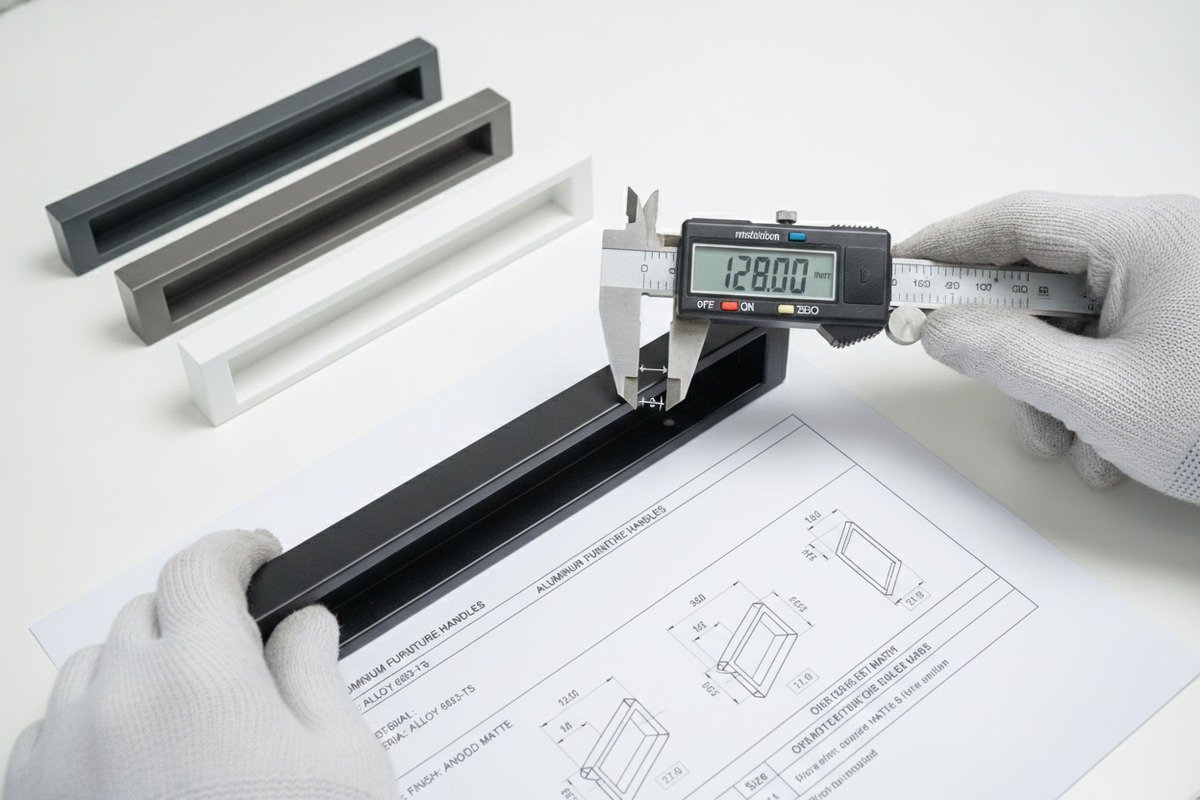
Why a Structured RFQ Saves You Time and Money
A structured RFQ does two things at once. First, it forces the supplier to give you comparable numbers. Second, it signals you are a serious buyer — and serious buyers get better prices. When we see a well-organized inquiry, our quoting team prioritizes it because we know the deal has a higher chance of closing.
Here is a practical template you can copy and customize:
Sample RFQ Message Structure
Start your email or WhatsApp message with these sections:
- Product Description — Include a photo or drawing, handle length, width, depth, alloy type (6063-T5 is standard for furniture handles), surface finish 4 (anodized, powder-coated, electrophoresis), and color.
- Quantity Tiers — Ask for prices at 100, 300, 500, 1,000, and 3,000 pieces.
- Tooling and Setup — Ask if there is a mold fee. Ask if the fee is separate or built into unit cost.
- Sample Terms — Request sample price, sample lead time, and whether the sample cost is refundable on bulk order.
- Packaging — Specify individual polybag, foam-lined box, or bulk carton. Ask for master carton dimensions and quantity per carton.
- Trade Terms — State whether you want EXW, FOB Foshan, or CIF to your port.
- Lead Time — Ask for production lead time at each quantity tier.
- Payment Terms — State your preferred terms or ask for the supplier's standard terms.
RFQ Information Checklist Table
| Information Item | Why It Matters | Example |
|---|---|---|
| Handle dimensions (L × W × D) | Ensures accurate material and weight calculation | 256 mm × 30 mm × 18 mm |
| Alloy grade 5 | Affects raw material cost and mechanical properties | 6063-T5 |
| Surface finish | Different finishes have different cost structures | Champagne gold anodized |
| Mounting hole spacing | Determines compatibility with existing furniture | 128 mm center-to-center |
| Quantity tiers requested | Enables apple-to-apple price comparison | 100 / 300 / 500 / 1,000 / 3,000 pcs |
| Packaging requirement | Affects per-unit packaging cost | Individual polybag + foam divider |
| Trade term | Determines who pays freight and at what point | FOB Foshan |
| Delivery port | Needed for CIF or DDP quotes | Ho Chi Minh City |
Avoid These Common Inquiry Mistakes
Do not ask for "your best price" without specifying quantity. Do not send a photo without dimensions. Do not forget to mention the finish — a brushed black handle costs differently from a champagne gold anodized one. And never assume that the quoted price includes shipping. Always confirm the trade term.
When you send a complete RFQ, most professional suppliers — including our team — can return a full tiered quote within 24 to 48 hours. Incomplete inquiries can take a week of clarification emails before you get any usable number.
What Volume Thresholds Should I Target to Get the Best Wholesale Price for My Furniture Factory?
When furniture factory owners message us asking "What's your MOQ?" they are really asking the wrong question. The real question is: at what volume does the price drop enough to justify tying up more cash in inventory?
For aluminum furniture handles, meaningful price breaks typically start at 300 pieces for stock items and 500 pieces for custom profiles. The sharpest wholesale pricing usually kicks in at 1,000 to 3,000 pieces, where raw material bulk buying and uninterrupted extrusion runs allow manufacturers to cut unit costs by 15–30% compared to small-batch pricing.
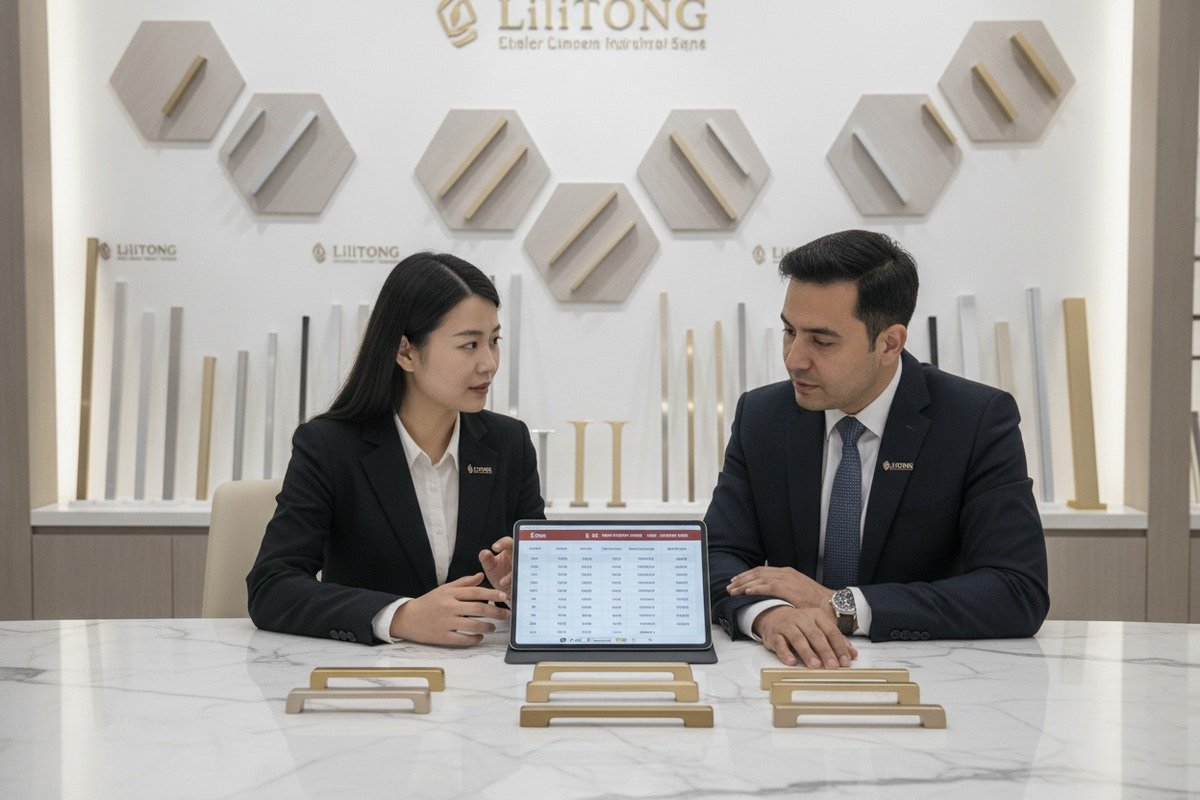
Understanding Where Cost Drops Happen
Aluminum handle production has several fixed-cost layers. Every production run requires machine setup, die mounting, and quality calibration — whether you order 50 pieces or 5,000. These setup costs are spread across the total order. The more pieces you order, the lower the per-piece share of that fixed cost.
Here is a realistic example of how tiered pricing 6 works for a standard 256 mm champagne gold anodized recessed cabinet handle from our production line:
Typical Tiered Pricing Example
| Order Quantity | Estimated Unit Price (FOB) | Setup Cost Per Piece | Lead Time |
|---|---|---|---|
| 100 pcs | $2.80 – $3.20 | High | 3–5 days (stock) |
| 300 pcs | $2.40 – $2.70 | Medium | 5–7 days |
| 500 pcs | $2.10 – $2.40 | Lower | 7–10 days |
| 1,000 pcs | $1.75 – $2.00 | Low | 10–15 days |
| 3,000 pcs | $1.45 – $1.70 | Minimal | 15–20 days |
Note: These are illustrative ranges. Actual prices depend on alloy grade, finish complexity, and market aluminum ingot pricing.
The Sweet Spot for Most Furniture Factories
For a mid-size furniture factory producing 200–500 units of cabinetry per month, the 500 to 1,000 piece tier usually delivers the best balance between price savings and cash flow. Ordering 3,000 pieces gives you the lowest unit price, but it ties up warehouse space and working capital 7. If your handle design changes or your end customer switches finishes, you are stuck with surplus inventory.
Stock vs. Production Lead Time
At our Foshan warehouse, we keep over 300 tons of ready-to-ship aluminum profiles and handles. Stock items at 100–300 pieces can ship within 48 hours. But once you move into production runs of 500+, expect 7 to 20 days because the extrusion line needs to be scheduled, and anodizing or powder coating adds processing time.
Calculate Your Real Break-Even Point
Do not just compare unit prices. Add up the total landed cost 8 at each tier:
- Unit price × quantity
- Plus tooling (if custom)
- Plus packaging
- Plus freight to your door
- Minus any sample credit
Then divide by the number of pieces. That gives you your true per-piece landed cost. Sometimes the 500-piece tier is actually cheaper landed than the 1,000-piece tier once you factor in higher freight weight and longer cash lockup.
How Does the Pricing Tier Change If I Mix Stock Aluminum Handles with Custom-Designed Profiles?
One of the most common scenarios we deal with at our facility is a buyer who wants 500 pieces of our best-selling matte black recessed handle — which we keep in stock — plus 200 pieces of a custom champagne gold profile with a proprietary cross-section for their signature cabinet line.
Mixing stock and custom handles in one order usually means two separate pricing structures: stock items follow standard volume tiers with no tooling fee, while custom profiles carry a mold or die charge plus higher per-unit pricing at low volumes. However, combining them in a single shipment can reduce total freight cost and sometimes unlock a relationship discount on the custom portion.
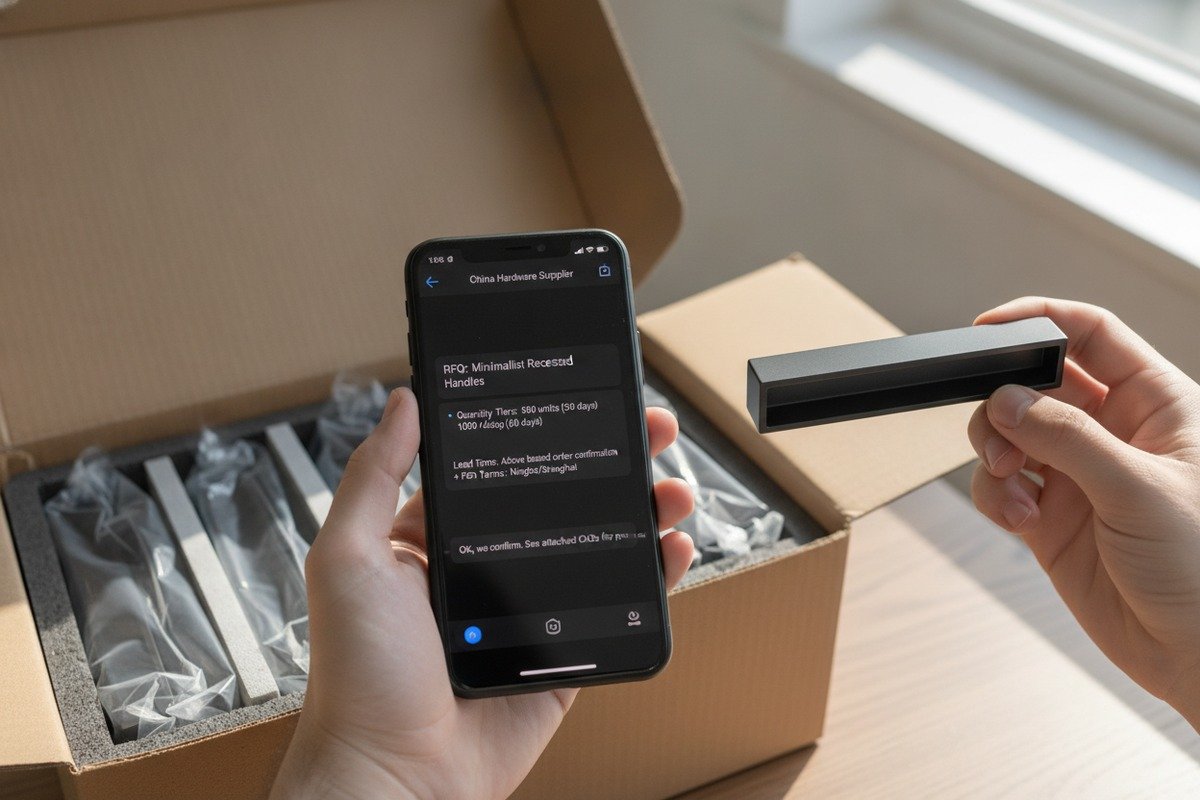
Why Stock and Custom Pricing Differ
Stock handles are pre-produced in large batches using existing extrusion die 9s. The manufacturer has already absorbed the tooling cost and spreads it across thousands of pieces sold to many buyers. So you pay only the material, finishing, and handling cost — plus a margin.
Custom handles require a new extrusion die or at least a die modification. Someone has to design it, cut the steel die, test the first extrusion runs 10, and calibrate the surface treatment. This die fee — typically $300 to $1,500 depending on profile complexity — is either billed upfront or amortized into the unit price.
How to Request a Mixed-Order Quote
When you send your RFQ, separate the items clearly:
- Line 1: Stock handle Model A — 500 pcs — matte black — standard packaging
- Line 2: Custom handle per Drawing B — 200 pcs — champagne gold anodized — individual polybag
Ask the supplier to quote each line separately, then provide a combined shipping cost. This way you can see exactly where the money goes.
Mixed Order Pricing Comparison
| Item | Type | Qty | Unit Price | Tooling Fee | Subtotal |
|---|---|---|---|---|---|
| 256 mm recessed handle, matte black | Stock | 500 | $2.10 | $0 | $1,050 |
| 280 mm custom profile handle, champagne gold | Custom (new die) | 200 | $3.50 | $800 | $1,500 |
| Combined freight (FOB Foshan) | — | — | — | — | $220 |
| Total landed before import duties | — | 700 | — | — | $2,770 |
Tips for Getting Better Pricing on Mixed Orders
First, ask if the custom handle can use an existing die with minor modifications. A modified die costs far less than a brand-new one. Second, ask if the tooling fee is refundable once your cumulative custom orders reach a certain volume — say, 2,000 pieces. Third, combine your stock and custom items into one shipment to share container or LCL space and cut per-piece freight.
At our factory, we encourage buyers to start with stock items for their core range and add one or two custom SKUs for differentiation. This keeps your average unit cost low while still giving your product line a unique look that competitors cannot easily copy.
Who Owns the Custom Die?
Always ask. If you paid for the die, you should own it. This means the supplier cannot use your die to produce handles for other buyers. Get this in writing before you pay the tooling fee. If the supplier owns the die, they can sell the same design to anyone — and your competitive advantage disappears.
Can I Negotiate Better Price Tiers by Sharing My Projected Annual Order Volume with the Manufacturer?
A furniture factory owner in Vietnam recently shared something that changed his entire sourcing cost structure. He told us he expected to need about 10,000 handles over the next 12 months, delivered in quarterly batches of 2,500. That single piece of information let our team quote him at a price tier he would never have reached by ordering 2,500 at a time without context.
Yes — sharing your projected annual volume gives the manufacturer confidence to offer lower per-unit pricing, improved payment terms, and even free tooling amortization, because predictable repeat orders reduce their sales cost and allow them to plan raw material purchases in bulk, which directly lowers production cost.
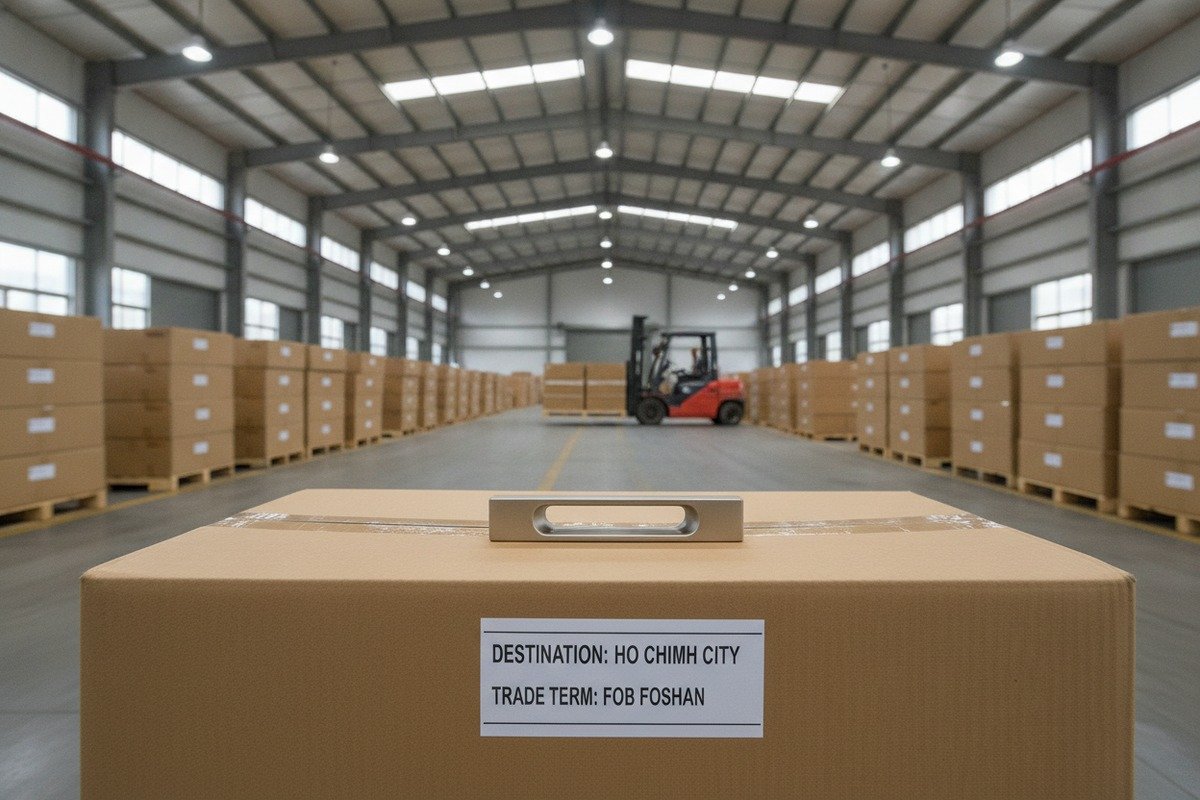
Why Annual Forecasts Unlock Hidden Pricing
Manufacturers care about two things above almost everything else: production line utilization and cash flow predictability. When a buyer commits — even informally — to a yearly volume, the factory can:
- Buy aluminum ingots in larger batches at a lower spot price.
- Schedule your runs during off-peak periods, reducing overtime costs.
- Reduce per-order sales and admin overhead because the relationship is already established.
- Keep your extrusion die mounted or readily accessible, cutting setup time.
All of these savings flow back to you as lower unit pricing.
How to Present Your Annual Volume
Do not just say "We buy a lot." Be specific. Here is a format that works well:
"We project ordering approximately 10,000 pieces of Model X over the next 12 months, shipped in quarterly batches of 2,500 pieces. Can you provide tiered pricing for individual batch orders of 2,500 as well as a blended annual rate for the full 10,000-piece commitment?"
This gives the supplier two numbers to work with and shows you understand how manufacturing scheduling works.
What You Can Negotiate Beyond Unit Price
Annual volume commitments open doors to benefits beyond just a cheaper handle:
- Lower or waived tooling fees — If your annual volume is large enough, many manufacturers will absorb the die cost entirely.
- Better payment terms — Instead of 50% deposit / 50% before shipment, you may negotiate 30/70 or even net-30 on repeat orders after the first successful delivery.
- Priority production scheduling — Your orders jump the queue during peak season.
- Free samples on new designs — When we know a buyer is reordering quarterly, we send samples of new finishes and profiles at no charge because we want to grow the relationship.
- Dedicated quality inspector — High-volume accounts at our facility get a named QC contact who knows their standards.
Annual Volume Negotiation Leverage Table
| Projected Annual Volume | Typical Negotiation Leverage | What to Ask For |
|---|---|---|
| Under 1,000 pcs/year | Limited — focus on trial order terms | Refundable sample fee, small MOQ |
| 1,000 – 5,000 pcs/year | Moderate — supplier sees growth potential | 5–10% below standard tier, flexible MOQ |
| 5,000 – 15,000 pcs/year | Strong — you become a key account | 10–20% below standard tier, free tooling, better payment terms |
| 15,000+ pcs/year | Very strong — supplier competes to keep you | Best possible unit price, net-30 terms, priority scheduling, dedicated QC |
The Trial Order Strategy
If you are new to a supplier and cannot yet commit to a large annual volume, propose a trial order approach. Order 300–500 pieces at a slightly higher price. But agree in writing that once you confirm quality and place a second order of 1,000+, the price drops to a pre-negotiated lower tier. This protects both sides. The supplier knows you are serious. You know the product meets your standards before scaling up.
At our facility, we actively encourage this approach. We would rather invest in a trial order that leads to a long-term quarterly buyer than chase one-time large orders from buyers who never return. And that mindset — building Guanxi, as it is known in Chinese business culture — is something you should look for in any supplier you consider partnering with.
Off-Peak Season Advantage
Ask your supplier when their slow season falls. For aluminum handle manufacturers in Foshan, it is typically between June and August when domestic furniture factory demand dips slightly. Placing your annual order with a delivery schedule that includes off-peak batches can earn you an additional 2–5% discount because the factory is eager to keep their lines running.
Conclusion
Getting the best price on aluminum furniture handles from China is not about finding the cheapest quote — it is about asking the right questions at the right volume. Send a complete, spec-driven RFQ with multiple quantity tiers, compare total landed cost, and share your annual forecast to unlock pricing most buyers never see.
Footnotes
1. Explains the manufacturing process and applications of aluminum alloy handles. ↩︎
2. Provides best practices and a guide for writing an effective Request for Quotation. ↩︎
3. Authoritative .gov source providing a comprehensive overview of Incoterms. ↩︎
4. Describes various types of aluminum finishes and their applications. ↩︎
5. Provides a comprehensive overview of different aluminum alloy grades, their properties, and uses. ↩︎
6. Defines tiered pricing as a strategy offering different discounts based on quantity or features. ↩︎
7. Defines working capital as funds available for daily operations and short-term obligations. ↩︎
8. Explains what total landed cost is and provides a formula for its calculation. ↩︎
9. Explains what an aluminum extrusion die is and its role in shaping aluminum profiles. ↩︎
10. Describes the aluminum extrusion process, shaping aluminum by forcing it through a die. ↩︎