
Every rainy season in Vietnam, our customer service inbox fills up with the same worried questions from distributors and furniture factory owners salt spray (ASTM B117) 1. Handles that looked perfect on arrival start showing white spots, chalky surfaces, or peeling coatings after just a few months. Our production team has spent years refining processes specifically for tropical markets, and the truth is clear: beautiful aluminum handles can fail fast if they are not tested for the real conditions they will face.
To test aluminum furniture handles for Vietnam’s hot and humid environment, you should combine accelerated laboratory tests—including salt spray (ASTM B117), humidity cycling (ASTM D2247), and UV exposure (ASTM G154)—with real-world field trials in local conditions, while verifying alloy grade, coating thickness, and adhesion quality before placing bulk orders.
This guide walks you through every test, every specification, and every question you should ask your supplier humidity cycling (ASTM D2247) 2. Whether you distribute handles in Ho Chi Minh City or run a furniture factory near Da Nang, the steps below will help you avoid costly failures and choose handles that last.
How can I verify that the surface treatment on my aluminum handles will resist corrosion in Vietnam's high humidity?
When we ship handles to partners in Southern Vietnam, we know those products will face relentless moisture from the moment they are installed UV exposure (ASTM G154) 3. Humidity levels in Ho Chi Minh City regularly exceed 85%, and during monsoon season, condensation forms on almost every metal surface indoors and outdoors.
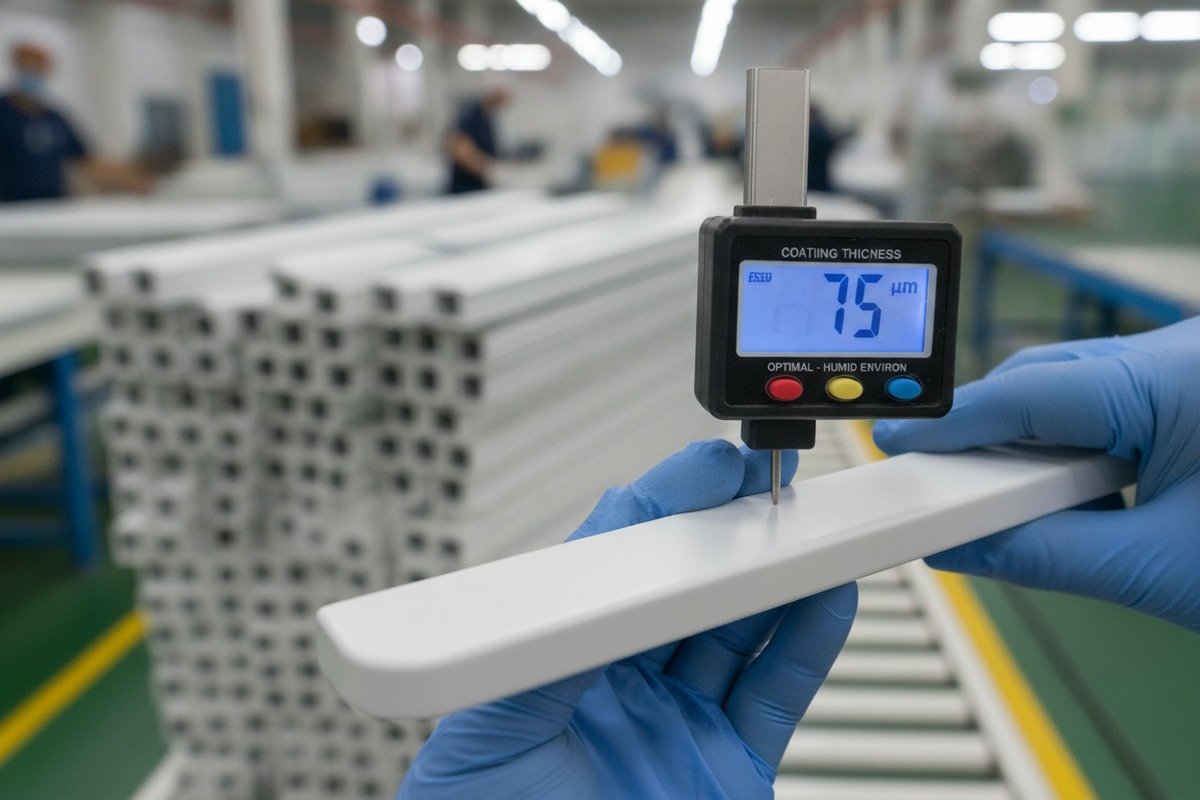
To verify corrosion resistance, request the supplier's humidity test report (ASTM D2247), confirm coating thickness is at least 60–80 microns, perform a cross-cut adhesion test (ASTM D3359), and visually inspect edges and welds for full coating coverage before approving any shipment.
Why Surface Treatment Is the First Line of Defense
Aluminum naturally forms a thin oxide layer that prevents rust. But in Vietnam, this natural layer alone is not enough. High humidity means water molecules constantly sit on the handle surface. If the protective coating is thin, porous, or poorly bonded, moisture seeps through and attacks the base metal. The result is pitting corrosion 4—tiny holes that grow over time and ruin both the look and the structure of the handle.
There are three main surface treatments 5 used on aluminum furniture handles. Each has strengths and weaknesses in tropical climates.
Comparing Surface Treatments for Vietnam
| Surface Treatment | Corrosion Resistance in High Humidity | UV Resistance | Typical Thickness | Best Use Case |
|---|---|---|---|---|
| Powder Coating | Excellent (if 60–80 microns) | Good (if UV-stabilized) | 60–120 microns | Indoor and outdoor handles |
| Type III Hard Anodizing | Very Good | Moderate | 25–75 microns | High-wear indoor handles |
| Standard Anodizing | Moderate (porous if unsealed) | Low to Moderate | 5–25 microns | Budget indoor handles only |
| Electroplating (Chrome/Nickel) | Variable (prone to white rust) | Low | 5–20 microns | Not recommended for humid climates |
What to Check Before You Approve
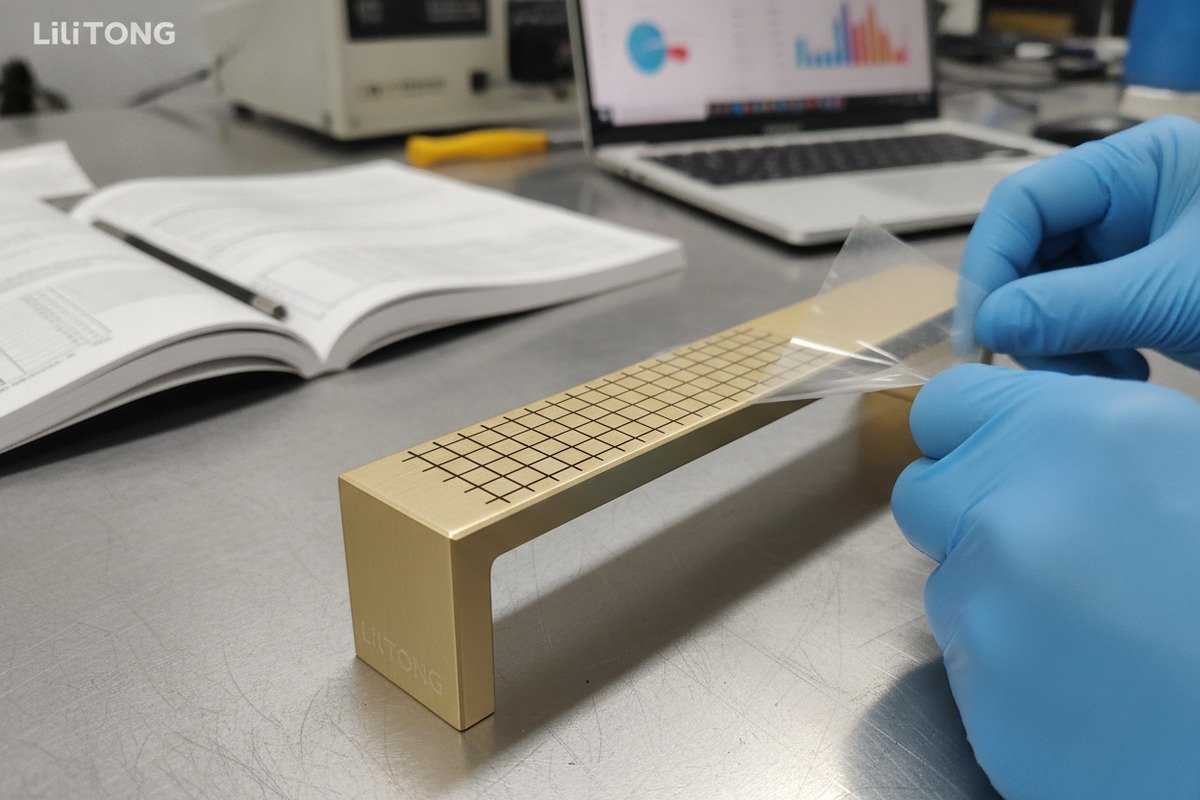
First, ask for the coating thickness measurement report. Our quality team uses a digital coating gauge on every batch. For Vietnam-bound orders, we never go below 60 microns on powder-coated handles. Second, run the cross-cut adhesion test 6 yourself. It is simple. Use a sharp blade to cut a small grid pattern into the coating. Press adhesive tape firmly over the cuts, then pull it off. If coating lifts with the tape, the bond is weak. That handle will fail within months in Vietnam's humidity.
Third, inspect the edges carefully. Coating tends to be thinnest at sharp edges and corners. If the edge of the handle shows bare metal or a very thin layer, moisture will find its way in. This is one of the most common failure points we see in returned samples from competitors.
Finally, check all welds. If the handle design includes welded joints, the weld area must be fully coated and sealed. Exposed welds are an open door for corrosion. One-piece extruded handles eliminate this risk entirely, which is why we recommend them for high-humidity markets.
The Role of Pre-Treatment
Before coating, the aluminum surface must be cleaned, degreased, and chemically etched. This step—called pre-treatment—creates a rough surface that helps the coating bond tightly. If a supplier skips or rushes this step, the coating looks fine at first but peels off under real humidity. Always ask your supplier to describe their pre-treatment process 7. A trustworthy manufacturer will explain each step clearly.
What specific salt spray test results should I demand from my supplier to ensure the handles won't oxidize over time?
Our export team works closely with buyers in coastal Vietnamese cities like Da Nang, Nha Trang, and Phu Quoc. In these areas, salt aerosols carried by ocean winds combine with high humidity to create one of the most aggressive corrosion environments on earth. Standard hardware that performs fine in inland areas can develop white rust within weeks near the coast.
Demand a salt spray test report per ASTM B117 showing at least 48 hours of exposure for indoor handles and 72 or more hours for coastal or outdoor use, with zero red rust, no visible pitting, and no coating delamination or blistering on the tested samples.
Understanding the Salt Spray Test
The salt spray test, also called the neutral salt fog test, is the industry standard for measuring how well a metal finish resists corrosion from salt exposure. During the test, handles are placed inside a sealed chamber and continuously sprayed with a fine mist of 5% sodium chloride solution at 35°C. The test runs for a set number of hours, and technicians inspect the samples at regular intervals for signs of corrosion.
This test compresses months or years of real-world coastal exposure into a few days. It is not a perfect simulation of Vietnam's complex environment, but it is the single most widely accepted benchmark for corrosion resistance. Every serious aluminum handle supplier should be able to provide this report.
What the Numbers Mean
| Test Duration (Hours) | Equivalent Exposure Level | Recommended For |
|---|---|---|
| 24 hours | Light indoor use, dry climate | Not suitable for Vietnam |
| 48 hours | Indoor use in high-humidity areas | Minimum for Vietnam (inland cities) |
| 72 hours | Semi-outdoor or coastal indoor use | Recommended for Da Nang, Nha Trang |
| 96–120 hours | Full outdoor coastal exposure | Beachfront properties, outdoor furniture |
| 200+ hours | Extreme marine environments | Boats, seaside commercial projects |
How to Read the Report
When your supplier provides a salt spray test report, look for these specific details. The report should state the test standard used—ASTM B117 is the most common. It should list the duration of exposure. It should include photos of the samples before and after testing. And it should clearly state the result: pass or fail.
A passing result means no red rust, no significant pitting, no blistering, and no delamination of the coating. Some minor surface haze may be acceptable on the uncoated backside of the handle, but the visible and functional surfaces must remain clean.
Red Flags to Watch For
Be cautious if a supplier cannot provide any salt spray data at all. This often means they have never tested their product for corrosion, or the results were poor. Also watch out for reports that show only 24 hours of testing. While 24 hours meets the minimum for some international standards, it is far too short for Vietnam's humid and coastal reality.
Another warning sign is when the supplier provides a generic report from the raw material mill rather than testing the finished handle. The finished product—with its specific coating, edges, and joints—is what matters. Raw aluminum alloy certificates are useful but not sufficient.
Going Beyond Standard Salt Spray
For handles destined for coastal Vietnam, we also recommend asking about cyclic corrosion testing 8. Unlike the constant salt fog of ASTM B117, cyclic tests alternate between salt spray, drying, and humidity phases. This more closely mimics how handles actually experience salt and moisture in real life—wet during rain, dry during sun, humid at night. Cyclic testing often reveals weaknesses that standard salt spray misses, especially at coating edges and joint areas.
How do I test if the coating on my custom furniture handles can withstand the extreme heat and moisture of my local market?
On our factory floor in Foshan, we cure powder coatings at around 200°C. But when those handles arrive in Vietnam and sit on a sun-facing cabinet near a window, surface temperatures can easily reach 60–70°C while indoor humidity hovers above 80%. This combination of heat and moisture is what breaks down coatings faster than either factor alone.
Test coating durability by combining UV resistance testing (ASTM G154, 500–1,000 hours), thermal cycling between 30°C and 80°C for 50 or more cycles, and a condensation humidity test (ASTM D2247, 1,000 hours), then verify results with a 6–12 month field trial at a Vietnamese installation site.

The Three Tests That Matter Most
Vietnam's climate attacks coatings in three ways simultaneously: UV radiation breaks down the polymer chains in the coating, heat accelerates chemical degradation, and moisture penetrates any weakness the other two create. To properly validate your handles, you need to test all three.
Test 1: UV Resistance (ASTM G154)
This test exposes handles to ultraviolet light using UVA-340 lamps that closely replicate sunlight. The test runs for 500 to 1,000 hours, with alternating cycles of UV exposure and condensation. After testing, measure the color change using a spectrophotometer. The result is expressed as ΔE (Delta E) 9. A ΔE below 2.0 means the color shift is barely visible to the human eye. Anything above 3.0 is noticeable and unacceptable for premium furniture handles.
Also check for chalking. Run your finger across the surface. If you see a white powdery residue on your fingertip, the coating's polymer has degraded. This chalking effect is extremely common on cheap handles in Southern Vietnam, where sunlight intensity is high year-round.
Test 2: Thermal Cycling
Thermal cycling 10 simulates the daily temperature swings that handles experience. In Vietnam, a handle on an outdoor cabinet might go from 60°C in afternoon sun to 25°C at night, or from hot outdoor air to cold air-conditioned indoor temperatures. Each cycle causes the coating and the aluminum to expand and contract at slightly different rates. Over time, this mismatch creates micro-cracks in the coating.
For a meaningful thermal cycling test, run at least 50 cycles between 30°C and 80°C. After testing, examine the coating under magnification for cracks, and repeat the cross-cut adhesion test to see if the bond has weakened.
Test 3: Humidity Condensation (ASTM D2247)
This test maintains the handle at 100% relative humidity and 38°C for 1,000 hours or more. It forces constant condensation on the surface, simulating the worst-case scenario in a Vietnamese rainy season. After 1,000 hours, inspect for blistering, bubbling, discoloration, or any sign that moisture has penetrated the coating.
Combining Lab and Field Results
| Test Type | Standard | Duration | What It Reveals | Pass Criteria |
|---|---|---|---|---|
| UV Resistance | ASTM G154 | 500–1,000 hrs | Fading, chalking, cracking | ΔE < 2.0, no chalking |
| Thermal Cycling | Custom protocol | 50+ cycles (30–80°C) | Coating cracking, adhesion loss | No cracks, adhesion Class 4–5 |
| Humidity Condensation | ASTM D2247 | 1,000+ hrs | Blistering, moisture penetration | No blisters, no corrosion |
| Field Trial | N/A | 6–12 months | Real-world combined effects | No visible degradation |
The Quick "Wet Sponge" Test
If you want a fast preliminary check before committing to lab tests, try this. Place the sample handle in a sealed plastic container with a soaked sponge. Close the lid and leave it in direct sunlight for 24 to 48 hours. This creates a mini greenhouse effect with high heat and near 100% humidity. After opening, check for water trapped under the coating, discoloration at edges, or any white spots. If the handle fails this simple test, it will certainly fail in Vietnam's real climate. This method does not replace formal lab testing, but it eliminates obviously poor-quality handles early in the sourcing process.
Cleaning Agent Compatibility
One often-overlooked factor is how local cleaning practices affect the coating. In Vietnam, many households and commercial spaces use cleaning agents that may be more acidic or alkaline than international norms. Ask your supplier if their coating has been tested against common cleaning chemicals. A handle that survives humidity but degrades from daily cleaning is still a failure. We recommend testing with a range of pH levels—from mildly acidic household cleaners to alkaline degreasers—to ensure the finish holds up under real usage patterns.
Can my manufacturer provide technical guidance on choosing the right aluminum alloy for long-term performance in tropical climates?
Years of working with buyers across Vietnam and the Middle East have taught our engineering team one clear lesson: the surface finish gets all the attention, but the alloy underneath determines the true lifespan of the handle. Choosing the wrong alloy is like painting a beautiful finish over a weak foundation.
Yes, a qualified manufacturer should provide detailed alloy recommendations based on your specific climate, application, and budget. For Vietnam's tropical environment, marine-grade alloys like 5052, 5083, or 6061 with higher magnesium content offer significantly better corrosion resistance than standard or high-copper alloys.

Why Alloy Choice Matters
Not all aluminum is the same. Different alloys contain different proportions of magnesium, silicon, copper, and other elements. These elements dramatically affect how the metal behaves in humid and salty conditions.
Copper-rich alloys, for example, are easier to machine but much more susceptible to corrosion. Magnesium-rich alloys form a denser, more stable oxide layer that resists pitting even when the surface coating is scratched or worn.
Alloy Comparison for Vietnam
Here is how the most common aluminum alloys compare for furniture handle applications in tropical environments:
| Alloy | Key Element | Corrosion Resistance | Strength | Extrudability | Suitability for Vietnam |
|---|---|---|---|---|---|
| 5052-H32 | Magnesium (2.5%) | Excellent | Medium | Good | Best for coastal/outdoor |
| 5083 | Magnesium (4.4%) | Excellent | High | Moderate | Heavy-duty coastal use |
| 6061-T6 | Mg + Si | Very Good | High | Excellent | Best all-around for handles |
| 6063-T5 | Mg + Si (lower) | Good | Medium | Excellent | Good for indoor handles |
| 2024 | Copper (4.4%) | Poor | Very High | Poor | Avoid for humid climates |
What to Ask Your Supplier
A good manufacturer will not just sell you a handle. They will guide you to the right alloy for your market. Here are the questions that matter:
First, ask which alloy they use as their standard for handles. If they say "aluminum" without specifying an alloy number, that is a red flag. Second, ask if they can switch to a marine-grade alloy like 5052 or 6061 for your order. Some factories are locked into one alloy for cost reasons, but a flexible supplier will offer options.
Third, ask for the mill certificate (also called a material test report) for the aluminum they use. This certificate lists the exact chemical composition of the alloy. Check that copper content is low—ideally below 0.1% for high-humidity applications.
One-Piece Extrusion vs. Cast or Assembled Handles
The manufacturing method also affects long-term performance. Extruded handles are formed by pushing heated aluminum through a die to create a continuous profile. This produces a dense, uniform grain structure with no weak points. Cast handles are poured into molds and can have internal porosity—tiny air bubbles that trap moisture.
For Vietnam, we strongly recommend one-piece extruded handles. They eliminate weld joints, reduce coating failure points, and provide a consistent alloy structure throughout the entire handle. Our extrusion lines are calibrated specifically for the slim, recessed profiles that are popular in modern Vietnamese furniture design.
Galvanic Corrosion: The Hidden Risk
If your aluminum handle is mounted using stainless steel screws, or if it contacts a different metal during installation, galvanic corrosion can occur. This happens when two dissimilar metals touch in the presence of moisture—exactly the condition found in Vietnam. The less noble metal (aluminum) corrodes faster.
To prevent this, use aluminum or stainless steel fasteners, and install a nylon or rubber washer between different metals. This small detail can add years to the life of your handles. When we prepare hardware kits for our Vietnamese customers, we include compatible fasteners and isolation washers as standard.
Ongoing Maintenance Guidance
Even the best alloy and coating combination benefits from basic care. Advise your end customers to wipe handles with a soft cloth and mild soapy water every few weeks, especially in coastal areas. Avoid abrasive cleaners or steel wool, which scratch through the coating and expose raw aluminum. Regular cleaning removes salt deposits and pollutants before they can cause damage.
Conclusion
Testing aluminum furniture handles for Vietnam's climate is not optional—it is the difference between a product that lasts and one that fails within a year. Focus on marine-grade alloys, verified coating thickness, and documented lab test results before every order.
Footnotes
1. Official standard for salt spray testing of materials. ↩︎
2. Official standard for testing water resistance of coatings in 100% relative humidity. ↩︎
3. Official standard for operating fluorescent UV lamp apparatus for material exposure. ↩︎
4. Comprehensive overview of localized corrosion forming small holes in metal. ↩︎
5. Explains various industrial processes altering material surfaces for properties. ↩︎
6. Official standard for evaluating adhesion of film coatings using tape test. ↩︎
7. Found a comprehensive explanation of metal pre-treatment from an authoritative industry source. ↩︎
8. Authoritative explanation of advanced corrosion testing simulating real-world conditions. ↩︎
9. Found a detailed explanation of Delta E from a reputable display technology company. ↩︎
10. Found a Wikipedia page explaining thermal cycling (also known as temperature cycling). ↩︎