
Every year around Tet, our production lines run at full tilt weeks ahead of the holiday, and still, some buyers miss their shipping windows. logistics delays 1 aluminum furniture handles 2 The orders come in late, specs change at the last minute, and suddenly a seven-day factory closure turns into a five-week delay. It is a pattern we have seen repeat for nearly two decades.
To avoid logistics delays during Vietnamese holidays, plan your aluminum furniture handle procurement backward from each holiday. Freeze specifications 12 weeks before closure, place orders 8–10 weeks out, ship goods 4–6 weeks early, and hold 3–4 weeks of safety stock to bridge factory shutdowns and post-holiday backlogs.
This guide breaks the problem into four parts: lead time before Tet, ready-to-ship stock 3 strategy, production-assembly coordination, and inventory management when cross-border shipping is restricted. Each section includes timelines, tables, and practical steps you can use right away.
How much lead time should I allow for my aluminum handle orders before the Vietnamese Tet holiday?
Most buyers underestimate how early Tet disruption actually starts. In our experience shipping to Ho Chi Minh City and Hanoi, the slowdown begins well before the official holiday week, and the recovery takes even longer than the shutdown itself.
You should allow at least 10–12 weeks of total lead time before Tet for aluminum handle orders. This covers specification lock, production, finishing, quality checks, export documentation, inland trucking, port handling, and ocean freight, plus a buffer for pre-holiday congestion at Vietnamese ports.
Why Tet Creates a Compound Disruption
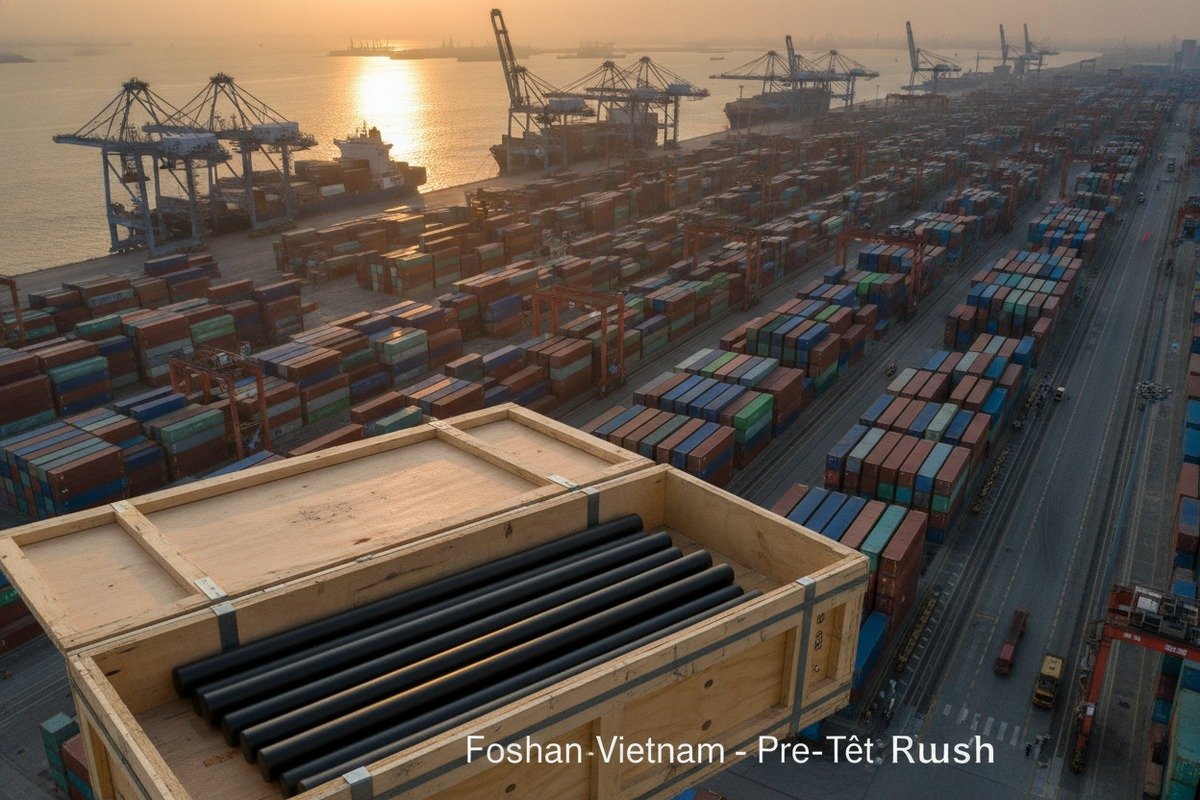
Tet is not a single-day event. Factories in Vietnam typically shut down for 7 to 20 days. But the real problem starts earlier and ends later. Workers begin traveling to their hometowns one to two weeks before the official closure. After the holiday, many return late. Full production capacity may not resume for two to three weeks post-Tet.
On the logistics side, trucking companies reduce capacity. Ports in Ho Chi Minh City and Hai Phong experience severe congestion as exporters rush to clear goods before the freeze. Vessel waiting times increase. Customs clearance slows. If your cargo misses the last pre-holiday vessel cutoff, it could sit at port for three weeks or more.
This is why we always tell our Vietnamese wholesale partners: treat the entire period from two weeks before Tet to three weeks after as a freeze window.
Breaking Down the Lead Time
Lead time is not one block. It is a chain of stages, and each one can be delayed independently. Here is how we break it down for a typical aluminum furniture handle order shipped from Foshan to Vietnam:
| Stage | Normal Lead Time | Pre-Tet Lead Time | Notes |
|---|---|---|---|
| Specification freeze & approval | 3–5 days | 5–7 days | Suppliers are busier; responses slow |
| Raw material sourcing (aluminum billet/bar) | 3–5 days | 5–10 days | Aluminum suppliers also face holiday demand |
| Extrusion & CNC processing 4 | 7–10 days | 10–14 days | Overtime capacity fills up fast |
| Surface finishing 5 (anodizing, powder coating) | 3–5 days | 5–7 days | Finishing lines are bottleneck resources |
| Quality inspection & packaging | 2–3 days | 3–5 days | QC staff may leave early |
| Export documentation 6 | 2–3 days | 3–5 days | Customs brokers handle higher volume |
| Inland trucking to port | 1–2 days | 2–4 days | Truck availability drops |
| Port handling & vessel loading | 3–5 days | 5–10 days | Congestion at Shekou/Nansha ports |
| Ocean freight 7 to Vietnam | 3–5 days | 3–7 days | Fewer sailings, possible rollover |
| Destination clearance & delivery | 2–3 days | 3–7 days | Vietnamese customs also slows down |
| Total | 29–46 days | 44–76 days | Pre-Tet can nearly double lead time |
The Practical Rule
Add at least 50% buffer to your normal lead time for any order that needs to arrive before Tet. If your standard cycle is 6 weeks, plan for 9–10 weeks. If your handles require custom finishes like champagne gold anodizing or specific hole-spacing for your cabinet line, add another week on top.
Vietnam's furniture market is projected to reach USD 2.4 billion by 2034, growing at a CAGR of 4.85%. This growth means more buyers are competing for the same factory slots and freight capacity before Tet. Starting early is not optional. It is a competitive advantage.
A Simple Calendar Approach
Here is what we recommend to our B2B partners every year:
- 12 weeks before Tet: Freeze handle specifications. Confirm the supplier's exact shutdown dates.
- 10 weeks before Tet: Place the order and confirm production slot.
- 8 weeks before Tet: Approve samples and packaging if custom.
- 6 weeks before Tet: Goods should be in production or finishing.
- 4 weeks before Tet: Ship from China. Aim for goods to clear Vietnamese customs before the congestion peak.
- 2 weeks before Tet: Your handles should be in your warehouse or at your furniture factory.
This backward planning approach removes guesswork. It also gives you room to catch problems before they become emergencies.
Can I use ready-to-ship stock to mitigate logistics delays during the peak furniture season?
When Tet approaches, our warehouse in Foshan becomes the busiest place in the building. Buyers who planned ahead are pulling from ready stock. Those who did not are scrambling for production slots that are already full.
Yes, ready-to-ship stock is one of the most effective tools to mitigate holiday logistics delays. By ordering popular aluminum handle SKUs from a supplier's existing inventory, you can cut lead time from weeks to days—our standard stock items ship within 48 hours—bypassing the production queue entirely.

How Ready Stock Works as a Buffer
The core idea is simple. If the handle you need already exists in a warehouse, you skip the production, finishing, and QC stages. You go straight to packaging, documentation, and shipping. For standard recessed handles in finishes like matte black, charcoal grey, champagne gold, or white—our most popular lines for the Vietnamese market—this can reduce your total procurement cycle 8 from 6–10 weeks to under one week.
We maintain roughly 300 tons of ready-to-ship aluminum profiles and handles at our Foshan facility. This inventory exists precisely for this reason: to give our wholesale and factory partners a fast fallback option when custom production timelines get tight.
When Ready Stock Works Best
Ready stock is ideal for:
- Standard finishes and sizes: Matte black, white, champagne gold, and light beige recessed handles in common lengths (128mm, 160mm, 192mm, 256mm centers).
- Repeat orders: If you ordered the same handle last quarter, chances are it is already in stock.
- Emergency top-ups: When your factory in Vietnam runs short mid-production and cannot wait for a new custom run.
When Ready Stock Is Not Enough
Ready stock has limits. It does not cover:
- Custom hole spacing for non-standard cabinetry.
- Unique surface treatments like brushed bronze or special RAL color powder coating.
- Project-specific labeling or packaging required by developers or hotel chains.
For these items, you still need to plan ahead and use the 12-week calendar approach.
A Hybrid Strategy
The smartest buyers we work with use a hybrid approach. They keep their routine SKUs covered by ready stock and reserve custom production capacity for project-specific handles. Here is how that breaks down:
| Handle Type | Sourcing Strategy | Typical Lead Time | Best For |
|---|---|---|---|
| Standard recessed handle, popular finish | Ready-to-ship stock | 2–5 days from order | Ongoing retail/wholesale replenishment |
| Standard profile, custom finish | Semi-custom production | 7–14 days | Seasonal color updates |
| Fully custom handle (new profile, new finish) | Full custom production | 21–35 days | Project/developer orders |
| Emergency fill for any standard SKU | Ready stock + express freight | 3–7 days delivered | Mid-production shortfall |
Vietnam's kitchen furniture market alone is expected to reach USD 401.30 million by 2031, with the B2B/project route being the fastest-growing channel. As project volumes grow, having a ready-stock supplier in your back pocket becomes more valuable, not less. It means you can say yes to urgent orders without gambling on holiday-disrupted production timelines.
Stock Coverage Recommendation
For the peak Tet period, we recommend our Vietnamese partners hold enough ready stock to cover at least 4–5 weeks of consumption. That accounts for one week of pre-holiday slowdown, up to two weeks of factory closure, and one to two weeks of post-holiday backlog.
If your monthly consumption is 2,000 handles, aim for 2,500–3,000 in your local warehouse before the holiday freeze begins. This is not overstock. It is insurance.
How do I coordinate my custom handle production with my factory's assembly schedule in Vietnam?
One of the most common calls we get from furniture factory owners in Vietnam sounds like this: "The cabinets are done, the glass is in, but the handles have not arrived." That one missing component holds up the entire line. It is a coordination problem, and it gets worse around holidays.
To coordinate custom handle production with your Vietnam assembly schedule, work backward from your cabinet installation date. Share your production calendar with your handle supplier, align sample approval and bulk production milestones with your factory's cutting and finishing stages, and build a 2-week buffer between handle delivery and assembly start.
The Root Cause of Misalignment
Furniture assembly in Vietnam follows a sequential flow: panel cutting, edge banding, drilling, surface finishing, hardware installation, and final assembly. Handles are installed near the end. This means buyers often treat handle procurement as a late-stage task.
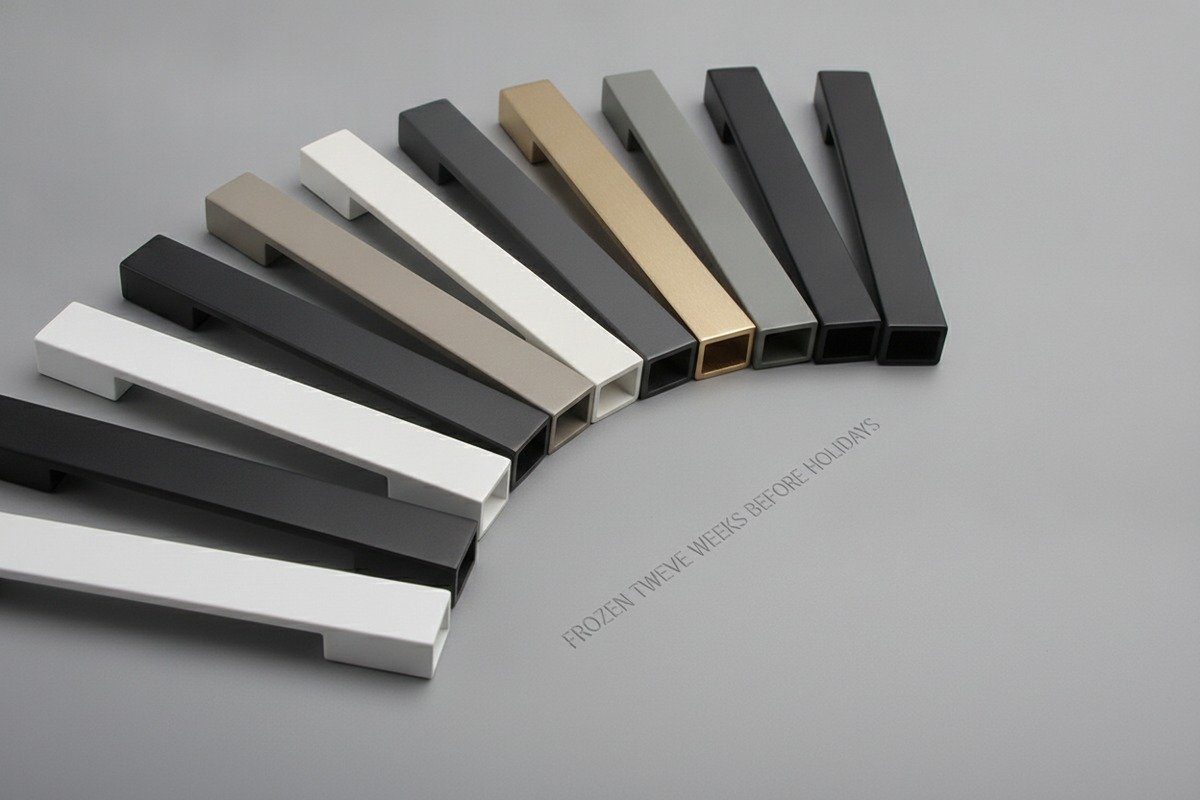
But custom handles—especially recessed aluminum pulls with specific profiles, champagne gold anodizing, or precise hole-spacing—need weeks of lead time on the supplier side. If you wait until your panels are cut to order handles, you are already behind.
Milestone Mapping
The solution is milestone mapping 9. Align your handle procurement milestones with your factory's production milestones. Here is a practical example for a kitchen cabinet project:
| Factory Milestone (Vietnam) | Handle Procurement Milestone (China Supplier) | Timing |
|---|---|---|
| Project confirmed, BOM finalized | Freeze handle specs, send drawings to supplier | Week 0 |
| Panel material ordered | Supplier confirms feasibility, quotes, and lead time | Week 1 |
| Panel cutting begins | Supplier produces and ships samples for approval | Week 2–3 |
| Edge banding and drilling | Buyer approves sample; bulk production starts | Week 3–4 |
| Surface finishing on panels | Handle production in progress (extrusion, finishing, QC) | Week 4–6 |
| Hardware received at factory | Handles arrive at Vietnamese factory warehouse | Week 6–7 |
| Handle installation and assembly | Handles mounted on cabinets | Week 7–8 |
| Final QC and packing | Complete units ready for delivery | Week 8–9 |
This table shows that handle specs need to be locked at the very start of the project, not when the factory is halfway through panel processing.
Streamlined Approvals Save Time
Vietnam's interior project market is growing. Reports indicate that streamlined approval procedures can shorten project timelines by three to six months and reduce costs by 5%. The same principle applies at the component level. If your sample approval process for a custom handle takes two rounds instead of one, that is 7–10 extra days in the critical path.
Our approach at the factory is to provide 3D renders and detailed spec sheets before producing physical samples. This pre-approval step catches issues—wrong finish shade, incorrect screw hole placement, packaging mismatch—before any aluminum is cut. It can save an entire approval cycle.
Communication Cadence
During the pre-holiday period, we recommend weekly check-ins between the buyer's procurement team and the handle supplier. A simple shared spreadsheet or WhatsApp group showing order status, production stage, and expected ship date prevents surprises.
Here is a minimum communication checklist:
- Week of order placement: Confirm production start date and estimated ship date.
- Mid-production: Get photo updates of extrusion and finishing stages.
- Pre-shipment: Review QC report, packing list, and shipping documents.
- Post-shipment: Track container and confirm ETA at Vietnamese port.
If your supplier cannot provide this level of visibility, that is a risk factor you need to address before the holiday window, not during it.
Dealing with Design Changes
Design changes close to holidays are a top cause of delay. A change in handle length, finish color, or mounting hole position can trigger re-quoting, re-sampling, and a production reset. That might cost you three weeks—and if those three weeks fall across Tet, it becomes six.
Lock your specs early. If a change is truly necessary within four weeks of the holiday, check if your supplier can accommodate it from existing tooling and stock finishes. If not, defer the change to the post-holiday order cycle.
What is the best way for me to manage my inventory of aluminum profiles when shipping from China is restricted?
Our team fields this question every January and February without fail. Shipping lanes between Foshan and Vietnamese ports get squeezed by holiday demand, and suddenly a buyer who was comfortable with two weeks of stock realizes that is not enough.
The best way to manage your aluminum profile inventory during restricted shipping periods is to maintain 4–5 weeks of safety stock, phase your orders into pre-holiday bulk and post-holiday replenishment batches, and diversify your inbound logistics with both sea and land freight options to reduce single-route dependency.

Why Shipping Restrictions Compound Inventory Risk
During Vietnamese holidays—especially Tet—and Chinese holidays like Chinese New Year (which often overlaps with Tet), both the origin country and destination country experience simultaneous disruption. Factories close in China. Ports congest in Vietnam. Freight forwarders reduce staff. The result is a double squeeze on your supply pipeline.
If you rely on just-in-time replenishment for aluminum handles and profiles, you are exposed. A single missed vessel cutoff can push your next delivery out by two to three weeks.
Sizing Your Safety Stock
Safety stock 10 should cover the longest realistic disruption window plus a recovery margin. For the Tet/Chinese New Year overlap, that typically means:
- Factory closure: 7–15 days (Chinese side) + 7–20 days (Vietnamese side)
- Post-holiday production ramp-up: 7–14 days
- Freight backlog clearance: 7–14 days
Total potential gap: 4–6 weeks of normal consumption. We recommend holding stock equal to at least 4 weeks of your average monthly usage for standard SKUs. For project-specific or custom-finish handles, aim for 5–6 weeks because replenishment takes longer.
Phased Ordering Strategy
Do not place one giant order. Phase it. This reduces your cash exposure and gives you flexibility to adjust quantities based on real demand signals.
| Order Phase | Timing | Purpose | Suggested Volume |
|---|---|---|---|
| Phase 1: Pre-holiday bulk | 10–12 weeks before Tet | Cover the full holiday window | 60% of holiday-period demand |
| Phase 2: Top-up | 6–8 weeks before Tet | Adjust for actual demand; fill gaps | 25% of holiday-period demand |
| Phase 3: Post-holiday replenishment | 1–2 weeks after reopening | Rebuild depleted stock | 15% + next cycle forecast |
This three-phase approach keeps your warehouse from being either overstocked (tying up cash) or understocked (risking production stoppages).
Alternative Freight Routes
When ocean freight from Chinese ports to Vietnamese ports is congested, consider these alternatives:
- Cross-border trucking: Foshan to Hanoi or Lang Son via road. Transit time is 3–5 days. It avoids port congestion entirely. We have used this route successfully for urgent small-lot shipments.
- Rail freight: Available on certain routes from Guangxi province to northern Vietnam. Less common for furniture hardware but viable for consolidated loads.
- Air freight: Expensive, but for high-value custom handles on tight project deadlines, the cost may be justified. A 500 kg shipment from Guangzhou to Ho Chi Minh City takes 1–2 days.
Compliance and Documentation
Aluminum extrusions shipped from China to Vietnam—and especially those that may be re-exported to the U.S.—are subject to trade scrutiny. U.S. trade authorities maintain active investigations on aluminum extrusion supply chains involving Vietnam. This makes documentation accuracy critical.
Make sure every shipment includes:
- Material test certificates for the aluminum alloy
- Certificate of origin
- Anodizing or surface treatment specifications
- Packing list with accurate weight and piece count
- Commercial invoice matching the purchase order
Errors in paperwork do not just cause customs delays. They can trigger compliance flags that affect your buyer's ability to re-export finished furniture to Western markets. We prepare a full documentation package for every shipment, and we recommend buyers verify these documents against their own compliance requirements before goods leave China.
The Cash vs. Risk Trade-Off
Some buyers push back on holding extra inventory. They say it ties up working capital. That is true. But consider the alternative. A missed installation deadline on a hotel furniture project because handles arrived three weeks late can cost you the entire contract. Vietnam's B2B project channel is the fastest-growing segment of the kitchen furniture market. Project buyers expect reliable delivery. One holiday-related failure can cost you the next project.
The math is straightforward. If carrying an extra 1,000 aluminum handles for four weeks costs you a few hundred dollars in storage, but a late delivery costs you a five-figure project penalty, the inventory is the better investment.
Conclusion
Holiday delays are a timing problem, not a purchasing problem. Plan backward from every Vietnamese holiday, lock specs early, hold buffer stock for standard aluminum handles, and keep your supplier communication tight. That is how you protect your production line and your reputation with downstream buyers.
Footnotes
1. Explains common challenges and disruptions in supply chain logistics. ↩︎
2. Replaced with a manufacturer’s page detailing aluminum handle profiles. ↩︎
3. Explains finished goods inventory as a type of stock available for immediate sale. ↩︎
4. Details the combined process of aluminum extrusion and CNC machining. ↩︎
5. Describes common types of aluminum finishes and their applications. ↩︎
6. Replaced with an authoritative government source on export documents. ↩︎
7. Explains the procedure and methods of ocean freight shipping. ↩︎
8. Explains the stages and importance of the procurement cycle. ↩︎
9. Defines project milestones and their importance in project management. ↩︎
10. Defines safety stock and its importance in inventory management. ↩︎