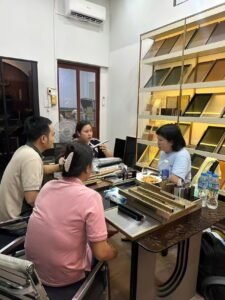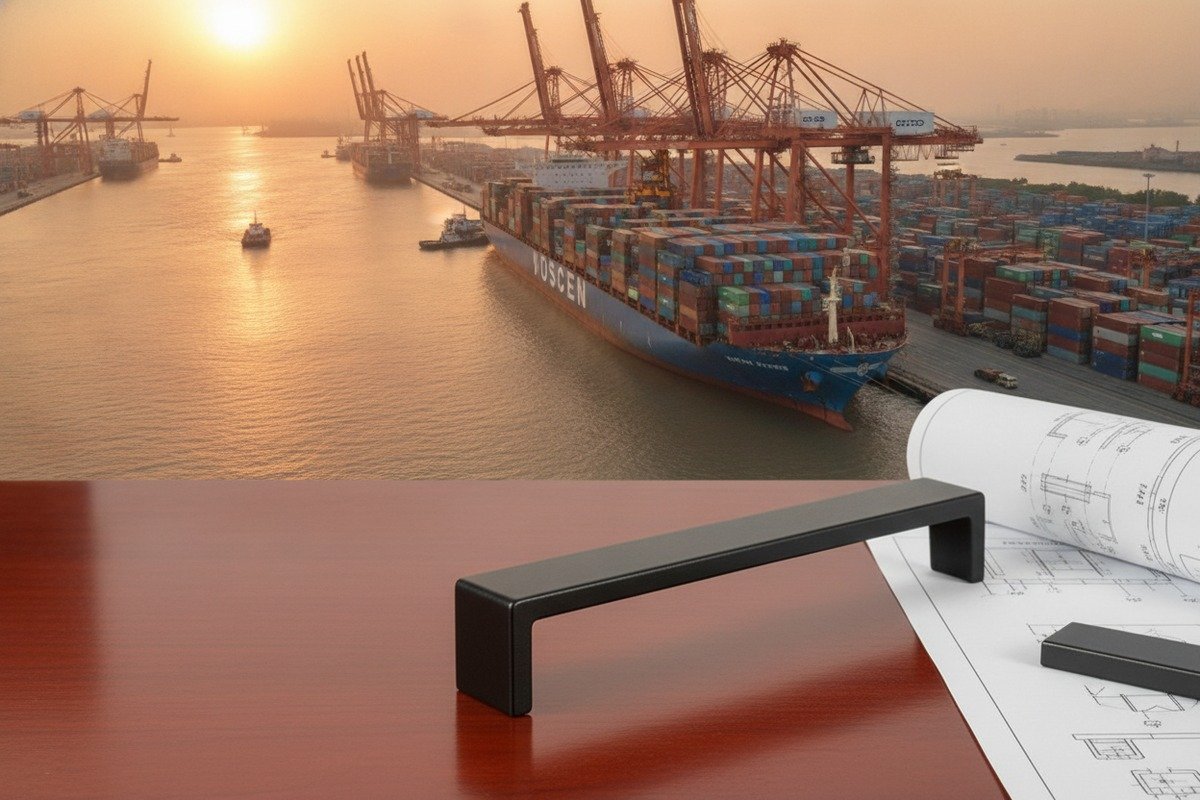
Every week, our sales team in Foshan fields the same urgent request from wholesalers across Vietnam and the Middle East: “Can you ship faster?” Lead time is not just a number on a purchase order ready-to-ship aluminum handle inventory 1. It is a chain of steps — raw material sourcing 2, die-casting, extrusion, finishing, inland transport, port clearance, and ocean freight — and geography touches every single link.
You can shorten lead times for aluminum furniture handles by combining China’s mature, clustered production ecosystem with Vietnam’s proximity to ASEAN shipping routes and favorable trade agreements. China delivers speed through integrated manufacturing, while Vietnam offers regional logistics flexibility and tariff advantages — together, they form the fastest sourcing strategy.
Below, we break down exactly how each country saves you time, where hidden delays live, and how to build a practical two-country sourcing workflow that keeps your warehouse stocked and your projects on schedule.
How Can I Use the Proximity of Foshan to the Vietnamese Market to Significantly Reduce My Shipping Times?
Our warehouse sits less than 300 kilometers from several major South China ports, and that short distance is one of the biggest reasons Vietnamese buyers keep coming back to us for aluminum furniture handles 3.
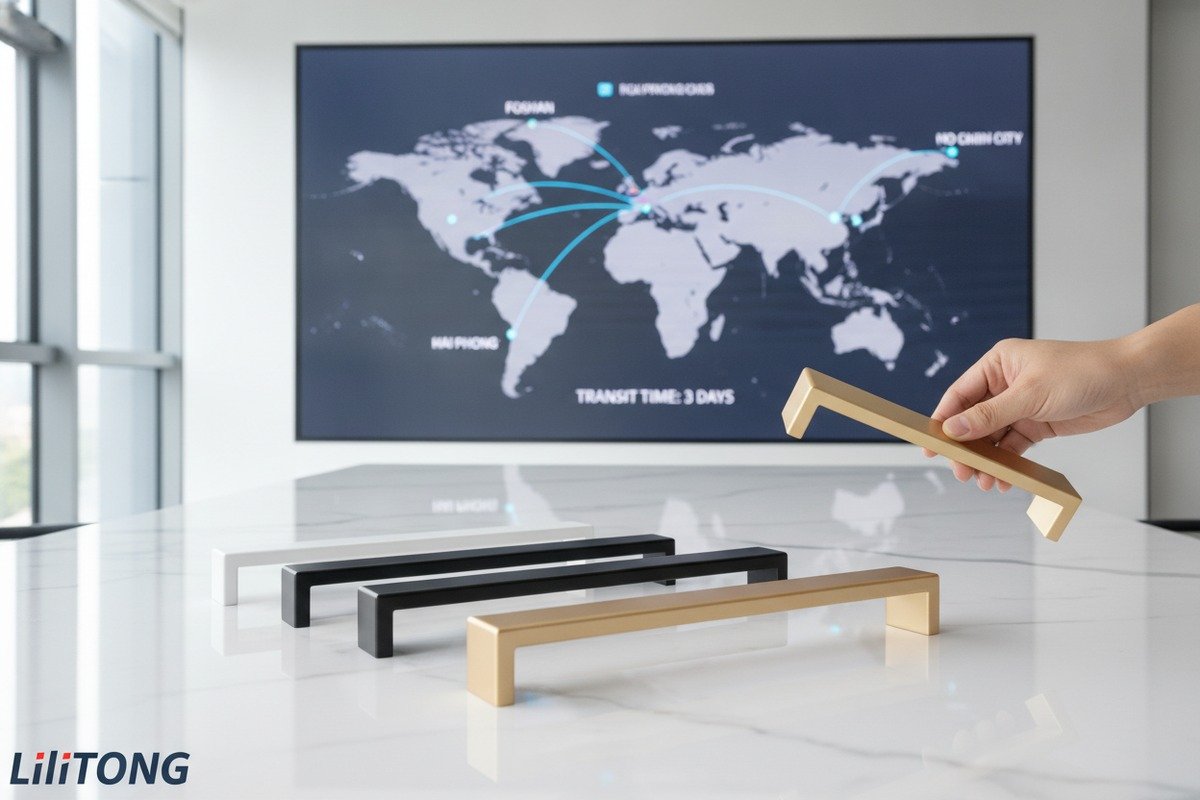
Foshan's location in the Pearl River Delta places it within one to three days of ocean transit to major Vietnamese ports like Hai Phong and Ho Chi Minh City. This proximity, combined with Foshan's world-class aluminum extrusion cluster, means you can cut total order-to-delivery time to as little as 5–10 days for stock items.
Why Foshan Is the Aluminum Hardware Capital
Foshan is not just another manufacturing city. It is home to one of the densest concentrations of aluminum extrusion plants 4, anodizing lines, CNC machining shops, and hardware assembly factories anywhere in the world. When we need a specific alloy billet, a specialty anodizing chemical, or a custom packaging insert, the supplier is often within a 30-minute drive. That clustering compresses production time because there are fewer handoffs, shorter waits for subcomponents, and almost zero inland freight delays.
For aluminum furniture handles — products like our minimalist recessed pulls with champagne gold or matte charcoal anodized finishes — the entire production chain from raw aluminum ingot to finished, boxed handle happens inside a 50-kilometer radius. Compare that to a factory in a less developed region that must import alloy blanks, ship them to a separate finishing plant, then truck the product to a distant port. Each extra step adds days.
Shipping Routes: Foshan to Vietnam
Here is a quick comparison of typical transit times from Foshan-area ports to key Vietnamese destinations:
| Route | Port of Origin | Port of Arrival | Estimated Sea Transit | Total Door-to-Door |
|---|---|---|---|---|
| Foshan → Hai Phong | Nansha / Shekou | Hai Phong | 2–3 days | 5–8 days |
| Foshan → Ho Chi Minh City | Nansha / Shekou | Cat Lai | 3–4 days | 7–10 days |
| Foshan → Da Nang | Nansha | Da Nang | 2–3 days | 6–9 days |
These transit times are dramatically shorter than shipping from Europe, Turkey, or even India. For a Vietnamese furniture factory owner who needs a restocking shipment of recessed aluminum handles, the practical difference between a 7-day and a 30-day delivery cycle is enormous. It means smaller safety stock, less capital tied up in inventory, and faster response to end-customer orders.
The Hidden Time Savings: Customs and Documentation
Vietnam and China share well-established trade corridors. Customs brokers on both sides handle thousands of hardware shipments per month. The documentation is standardized. We prepare commercial invoices, packing lists, and certificates of origin 5 as routine — no guesswork, no surprise holds. This familiarity reduces port dwell time, which is one of the most underestimated sources of delay in international sourcing.
Additionally, the ASEAN-China Free Trade Area agreement 6 has streamlined tariff treatment for many product categories. While this does not eliminate customs inspection, it does reduce the friction that causes goods to sit in a bonded warehouse for days.
How Does Sourcing from a Supplier with 300 Tons of Ready-to-Ship Inventory Help Me Avoid Project Delays?
We learned early in our 18 years of business that the most expensive thing in hardware sourcing is not the product itself — it is the project delay caused by waiting for it.
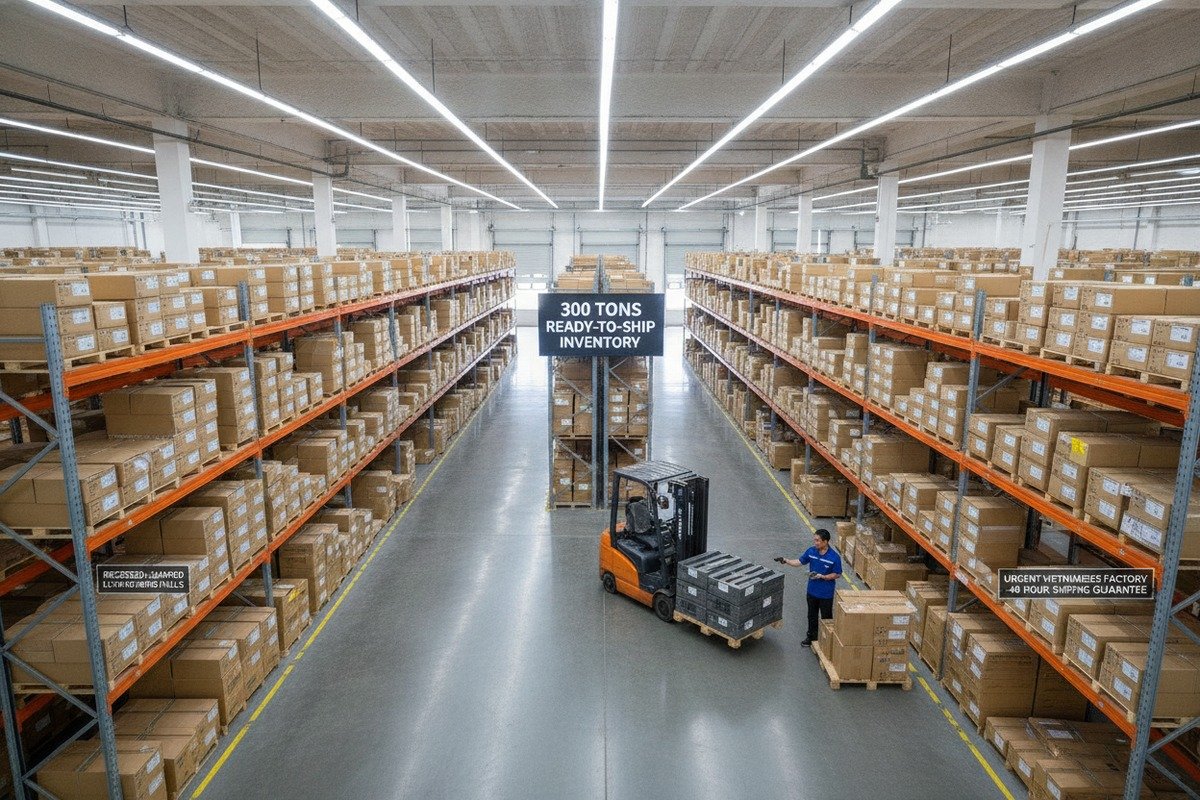
A supplier holding 300 tons of ready-to-ship aluminum handle inventory eliminates the longest phase of the lead-time chain: production. Instead of waiting 30–45 days for manufacturing, you select from existing stock, confirm your order, and receive shipment within 48 hours — turning weeks of waiting into days.
Breaking Down Where Lead Time Actually Lives
Most buyers think of lead time as "how long the factory takes to make my product." But lead time is really a chain of sequential steps. Here is where the time actually goes:
| Lead-Time Phase | Typical Duration (Custom Order) | Duration with Ready Stock |
|---|---|---|
| Order confirmation & deposit | 1–2 days | 1 day |
| Raw material procurement | 5–10 days | 0 days (already done) |
| Extrusion & die-casting 8 | 5–7 days | 0 days |
| Surface finishing (anodizing, plating) | 3–5 days | 0 days |
| Quality inspection & packing | 1–2 days | 1 day |
| Inland transport to port | 1–2 days | 1 day |
| Port processing & loading | 1–3 days | 1–3 days |
| Ocean transit (to Vietnam) | 2–4 days | 2–4 days |
| Total | 19–35 days | 6–11 days |
The difference is stark. When you source from a ready-stock inventory, you skip the entire production phase. For a building material distributor who just received a large order from a real estate developer, that time difference can mean winning or losing the contract.
How 300 Tons Translates to Real Coverage
Three hundred tons is not a random number. It represents our analysis of the most popular handle profiles, finishes, and sizes that our Vietnamese and Middle Eastern customers reorder most frequently. Our inventory includes:
- Recessed pulls in matte black, champagne gold, charcoal grey, white, and light beige
- Lengths from 64 mm to 1200 mm
- Standard and custom cross-section profiles for cabinet, wardrobe, and drawer applications
We replenish this stock continuously based on order history and seasonal demand patterns. The goal is simple: when you place an order for a popular SKU, we pick, pack, and ship within 48 hours.
The Risk of Relying on Made-to-Order Only
If your only option is a made-to-order supplier, you are exposed to every upstream disruption. Aluminum alloy prices spike? Your supplier waits to buy at a better price, and your order sits. Anodizing line breaks down? Add a week. Chinese New Year? Add three weeks. A ready-stock model absorbs these shocks because the product already exists, inspected and boxed, before you even pick up the phone.
For furniture factory owners in Vietnam who run lean production schedules, this buffer is critical. You cannot tell your assembly line to stop because handles have not arrived. Ready inventory turns your handle supplier from a bottleneck into a reliable utility.
Can I Really Get My Custom Aluminum Handle Orders Delivered Within a 7-Day Turnaround Time?
When we first started promising a 3-to-7-day turnaround on custom aluminum handles, even some of our own team members were skeptical. But after refining our workflow over nearly two decades, we consistently hit that window.
Yes, a 7-day turnaround for custom aluminum handle orders is achievable when your supplier operates within a tightly integrated manufacturing cluster, maintains pre-stocked raw materials, and has dedicated finishing lines. Our Foshan facility delivers custom orders in 3–7 days by keeping alloy billets, dies, and finishing chemicals on-site at all times.

What Makes 7 Days Possible
The secret is not speed at any single step. It is the elimination of waiting time between steps. In a typical factory, a custom order follows this sequence: receive specs → source material → schedule extrusion → queue for finishing → inspect → pack. In a fragmented supply chain, each handoff introduces a queue. Material arrives late. The anodizing line is busy with another job. The packaging team is waiting for inserts from a third-party supplier.
In our facility, we control most of these steps in-house or within our immediate supplier network. Here is how the 7-day clock actually works:
The 7-Day Custom Order Timeline
Day 1: Order confirmation, drawing review, and die selection. If we already have the die for your profile (and we have hundreds in our library), we skip die-making entirely. If a new die is needed, that adds time — but most furniture handle profiles fall within our existing die inventory.
Day 2–3: Extrusion and cutting. Aluminum billets are always in stock. We run extrusion on a scheduled rotation, and custom orders for handles are batched to minimize setup time.
Day 4–5: Surface treatment 9. Whether you need anodizing in champagne gold, powder coating in matte black, or electrophoretic finishing in light beige, our lines run daily. Custom color matching may add a day, but standard finishes are processed within 48 hours.
Day 6–7: Quality inspection, counting, packaging, and dispatch to the port or to our logistics partner for inland delivery.
When 7 Days Becomes 3 Days
If your custom order uses a profile we already extrude regularly and a finish we run in high volume, we can compress the timeline to 3 days. This is common for customers who reorder the same handle in a new length or a different finish variant. The die is ready. The alloy is ready. The finishing line knows the recipe. We just execute.
Honest Caveats
Not every custom order fits the 7-day window. If you need a completely new cross-section profile that requires a new extrusion die, add 5–7 days for die fabrication. If you request a non-standard surface treatment — say, a custom PVD coating in a color we have never matched — the sampling and approval process will extend the timeline. We always communicate this upfront so there are no surprises.
| Order Type | Typical Turnaround | Condition |
|---|---|---|
| Stock item, standard finish | 48 hours (shipping) | Item in 300-ton inventory |
| Custom length/finish, existing die | 3–5 days | Die and alloy in stock |
| Custom profile, existing finish | 7–10 days | New die required |
| Fully custom profile + new finish | 10–15 days | New die + color matching |
The key takeaway: the more you align your specs with profiles and finishes that your supplier already produces at scale, the faster your custom order ships. This is where working with an experienced manufacturer pays off — we can often suggest a slight design adjustment that keeps your aesthetic intent intact while shaving days off delivery.
How Can a One-Stop Supply Chain Service in China Simplify My Procurement Process for the Middle East and Vietnam?
Managing multiple suppliers across different countries is one of the biggest hidden time drains in hardware procurement. We hear it constantly from our distributors in Dubai, Riyadh, and Ho Chi Minh City: "I spend more time coordinating suppliers than I do selling product."
A one-stop supply chain service consolidates design consultation, material sourcing, extrusion, finishing, quality control, packaging, and export logistics under one roof. This eliminates inter-supplier coordination delays, reduces communication errors, and gives Middle Eastern and Vietnamese buyers a single point of contact for everything from sample approval to container loading.

The Real Cost of a Fragmented Supply Chain
When you source aluminum handles from one factory, surface finishing from another, packaging from a third, and freight forwarding from a fourth, you are not just paying four invoices. You are managing four timelines, four quality standards, four communication threads, and four potential failure points. A delay at any single node cascades through the entire chain.
Consider a real scenario: a furniture factory owner in Vietnam orders handles from a small extrusion shop, sends the raw profiles to a separate anodizing facility, then ships the finished handles to a packaging company before finally handing everything to a freight forwarder. Each handoff introduces 2–5 days of queue time, truck loading, and inspection. A process that should take 10 days stretches to 25.
What One-Stop Actually Means in Practice
At our Foshan facility, one-stop means we handle:
- Design and engineering consultation — our team reviews your drawings, suggests material and finish options, and confirms manufacturability before production starts
- Extrusion and machining — aluminum billets are extruded, cut, drilled, and CNC-machined on our own lines
- Surface treatment — anodizing, powder coating, electrophoresis, and sandblasting happen in-house
- Quality inspection — every batch goes through dimensional checks, surface quality grading, and salt spray testing where required
- Custom packaging — we label, box, and palletize according to your specifications, including private-label branding if needed
- Export logistics — our documentation team prepares all paperwork, coordinates with freight forwarders at Nansha or Shekou port, and provides tracking updates until the container ships
Why This Matters for Middle Eastern and Vietnamese Buyers Specifically
Middle Eastern and Vietnamese markets have distinct requirements that benefit from centralized control:
For Vietnam: Frequent smaller orders, rapid restocking cycles, and sensitivity to shipping cost. A one-stop supplier can consolidate multiple handle SKUs into a single shipment, reducing per-unit freight costs and simplifying customs clearance at Hai Phong or Cat Lai.
For the Middle East: Larger project-based orders with strict finish specifications (gold tones, brushed effects, and anti-fingerprint coatings are popular). A one-stop supplier ensures the exact same finish quality across thousands of pieces because one team controls the process end to end. There is no risk of a third-party finishing house interpreting "champagne gold" differently from what you approved on the sample.
The Dual-Country Strategy: China + Vietnam as a Resilience Pair
Some of our more sophisticated buyers use a dual-country approach. They source high-volume, complex, or precision handle orders from our Foshan factory — taking advantage of China's unmatched aluminum extrusion ecosystem. For overflow capacity, secondary product lines, or items where tariff advantages matter, they work with partners in Vietnam who handle final assembly, repackaging, or distribution into ASEAN markets.
This is not about Vietnam versus China. It is about using each country for what it does best. China excels at upstream speed — die-casting, extrusion, CNC work, and finishing where every input is locally available. Vietnam excels at regional distribution, labor-intensive assembly tasks, and accessing preferential tariff treatment under agreements like CPTPP and EVFTA.
The smartest buyers we work with treat China as their production engine and Vietnam as their distribution and tariff-optimization hub. This combination gives them the shortest total lead time and the best landed cost for markets across Southeast Asia, the Middle East, and beyond.
A Practical Decision Framework
Here is a simple framework for deciding where to place each part of your aluminum handle order:
| Decision Factor | Source from China (Foshan) | Consider Vietnam |
|---|---|---|
| Complex extrusion profiles | ✔ Best option — deep die library, fast setup | Limited die availability |
| Standard finishes at volume | ✔ In-house anodizing and coating lines | Possible if finishing capacity exists |
| Tariff-sensitive exports to EU/CPTPP markets | Consider rules of origin | ✔ EVFTA and CPTPP advantages |
| Rapid restocking (under 10 days) | ✔ 300-ton stock + 48-hour shipping | Depends on local inventory |
| Final assembly or repackaging for ASEAN | Can ship semi-finished to Vietnam | ✔ Lower labor cost, regional proximity |
| New product development and sampling | ✔ Faster iteration with integrated ecosystem | Longer sampling cycles |
The goal is not to force one country to do everything. It is to map each step of your procurement process to the location that completes it fastest and most reliably.
Conclusion
Geography is a sourcing tool, not just a line on a map. By combining China's integrated aluminum manufacturing ecosystem with Vietnam's regional logistics advantages, you build a supply chain that is fast, resilient, and cost-effective. Start with a supplier who already stocks what you need, then layer in strategic dual-country sourcing as your business grows.
Footnotes
1. Explains finished goods inventory management and its importance for meeting customer demand. ↩︎
2. Explains the process and strategies for effective raw material procurement in supply chain management. ↩︎
3. Describes the design, materials, and applications of aluminum handle profiles for furniture. ↩︎
4. The Aluminum Extruders Council (AEC) is an authoritative source. This page discusses the domestic supply of aluminum extrusions and the presence of numerous facilities, directly addressing ‘aluminum extrusion plants’. ↩︎
5. Defines certificates of origin and their importance in international trade transactions. ↩︎
6. Provides official information on the history and agreements of the ASEAN-China Free Trade Area. ↩︎
7. Details the Pearl River Delta’s role as a major manufacturing and economic hub in China. ↩︎
8. Provides a comprehensive overview of the die casting manufacturing process. ↩︎
9. Provides a broad overview of industrial surface finishing processes and their purposes. ↩︎
10. Highlights the advantages of a one-stop-shop approach in logistics and supply chain management. ↩︎