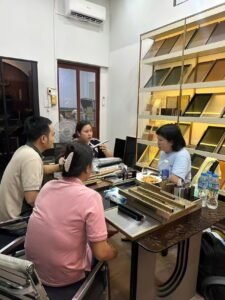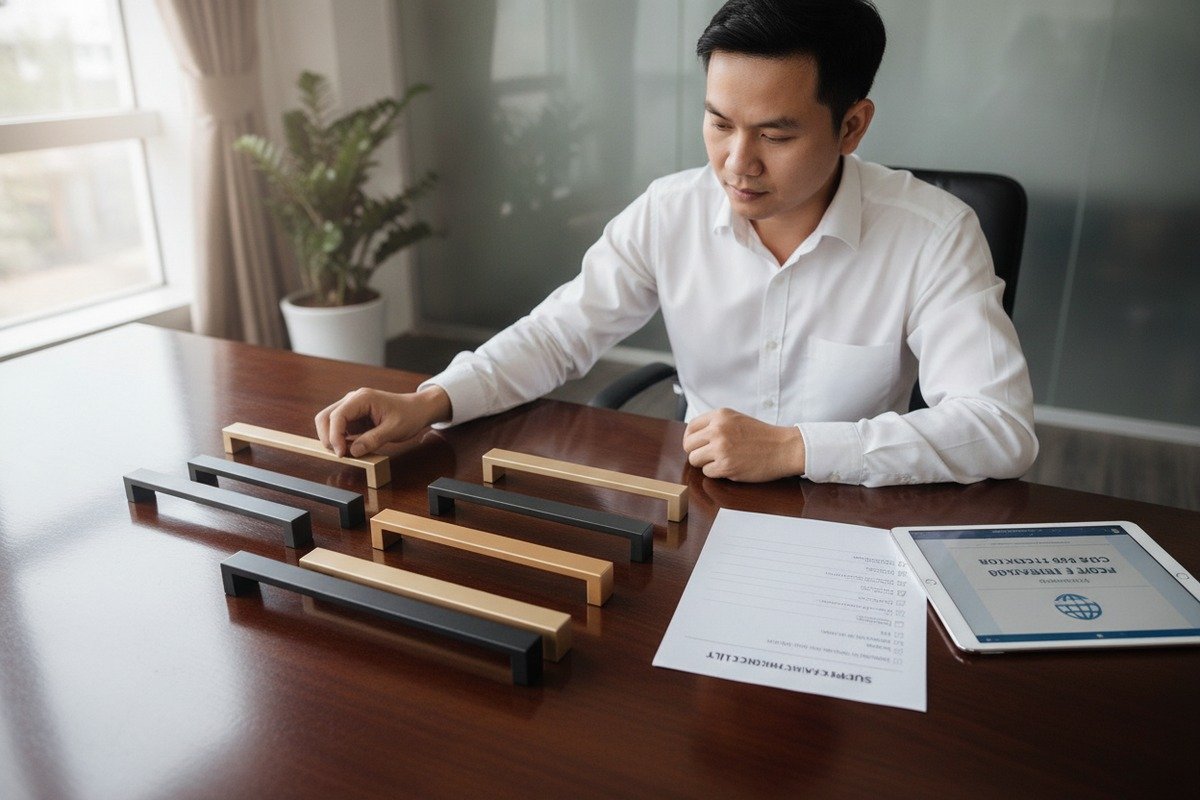
Every week, our sales team in Foshan fields calls from Vietnamese furniture factories asking the same question: why do their current aluminum handle suppliers keep missing deadlines, shipping inconsistent finishes, or refusing small custom orders? supply chain management 1 The frustration is real. And the cost of these sourcing failures adds up fast — delayed production runs, rejected batches, angry end customers. The problem is rarely about finding a supplier. The problem is finding the right sourcing method.
You can learn from Vietnamese peers by adopting their proven sourcing playbook: use trade fairs and industry associations to discover real factories, verify suppliers through samples and certifications, build tight communication routines, and evaluate total landed cost rather than just unit price. These methods reduce lead times, improve quality consistency, and strengthen your entire supply chain for aluminum furniture handles.
Below, we break down the specific strategies that successful Vietnamese buyers use at each stage of the sourcing process. Each section addresses a real pain point our customers face, and each offers steps you can apply right away.
How do my Vietnamese competitors manage their inventory to avoid long lead times for aluminum furniture handles?
Long lead times 2 kill production schedules. When our logistics team tracks orders to Vietnam, we see the same patterns — buyers who plan well rarely face delays, while those who react late always struggle.
Vietnamese competitors avoid long lead times by combining ready-stock purchasing with scheduled bulk orders, maintaining safety inventory of their most-used handle SKUs, and working with suppliers who hold 300+ tons of common profiles in stock. They also stagger orders across peak and off-peak seasons to keep their production lines running without interruption.
Why Lead Times Are Longer Than You Think
Most buyers assume lead time means production time. It does not. Lead time for aluminum furniture handles includes raw material sourcing, extrusion 3, machining, surface treatment, quality inspection, packing, and shipping. Vietnam relies on imported aluminum billets, which means raw material availability directly affects how fast your supplier can start production. If your supplier does not hold stock, you may wait an extra 7–15 days just for material procurement.
The Dual-Track Ordering System
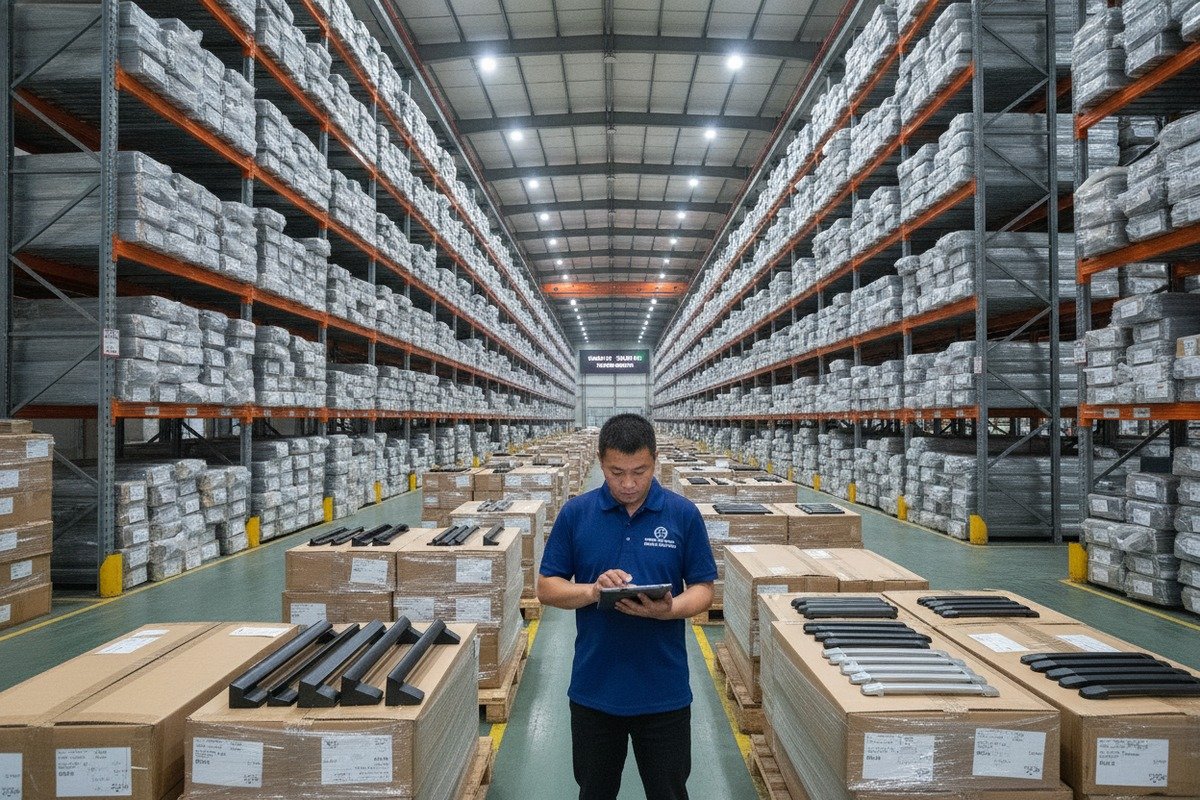
The smartest Vietnamese buyers we work with use a dual-track system. Track one is ready stock. They identify their top 10–15 handle SKUs by volume and ensure their supplier keeps those profiles in inventory. At our facility, we maintain over 300 tons of ready-to-ship inventory and can dispatch stock items within 48 hours. Track two is scheduled custom orders. For OEM handles 4 with unique finishes or dimensions, they place orders 30–45 days ahead of their production needs and confirm specs early to avoid revision delays.
Seasonal Planning Matters
Vietnam's furniture export cycle has clear peaks. Buyers who place custom orders during low season — typically Q1 and early Q2 — get faster turnaround and sometimes better pricing. Those who wait until Q3 compete with everyone else for production slots.
| Inventory Strategy | How It Works | Typical Lead Time Impact |
|---|---|---|
| Ready-stock purchasing | Buy from supplier's existing inventory of popular profiles | 2–5 days to ship |
| Scheduled bulk orders | Place orders 30–45 days before production need | 30–45 days total |
| Safety stock at your warehouse | Keep 2–4 weeks of top SKUs on hand | Immediate availability |
| Staggered seasonal ordering | Order custom items in Q1/Q2 off-peak | 20–30 days (faster slots) |
| Dual-source backup | Maintain a secondary supplier for critical SKUs | Reduces stockout risk by 50%+ |
What Your Peers Do Differently
Many Vietnamese furniture factory owners told us they stopped placing single large orders once a quarter. Instead, they now place smaller monthly orders for custom items and top up stock items every two weeks. This rolling approach smooths out their cash flow and keeps their assembly lines fed without warehouse overflow. The key lesson is that inventory management 5 is not just about buying more — it is about buying smarter and matching your order rhythm to your production rhythm.
What quality control steps should I take to ensure my imported handles consistently meet my factory's standards?
Quality inconsistency 6 is the number one complaint we hear from Vietnamese furniture factories importing aluminum handles. A sample looks perfect, but the bulk shipment arrives with uneven anodizing, loose tolerances, or scratched surfaces.
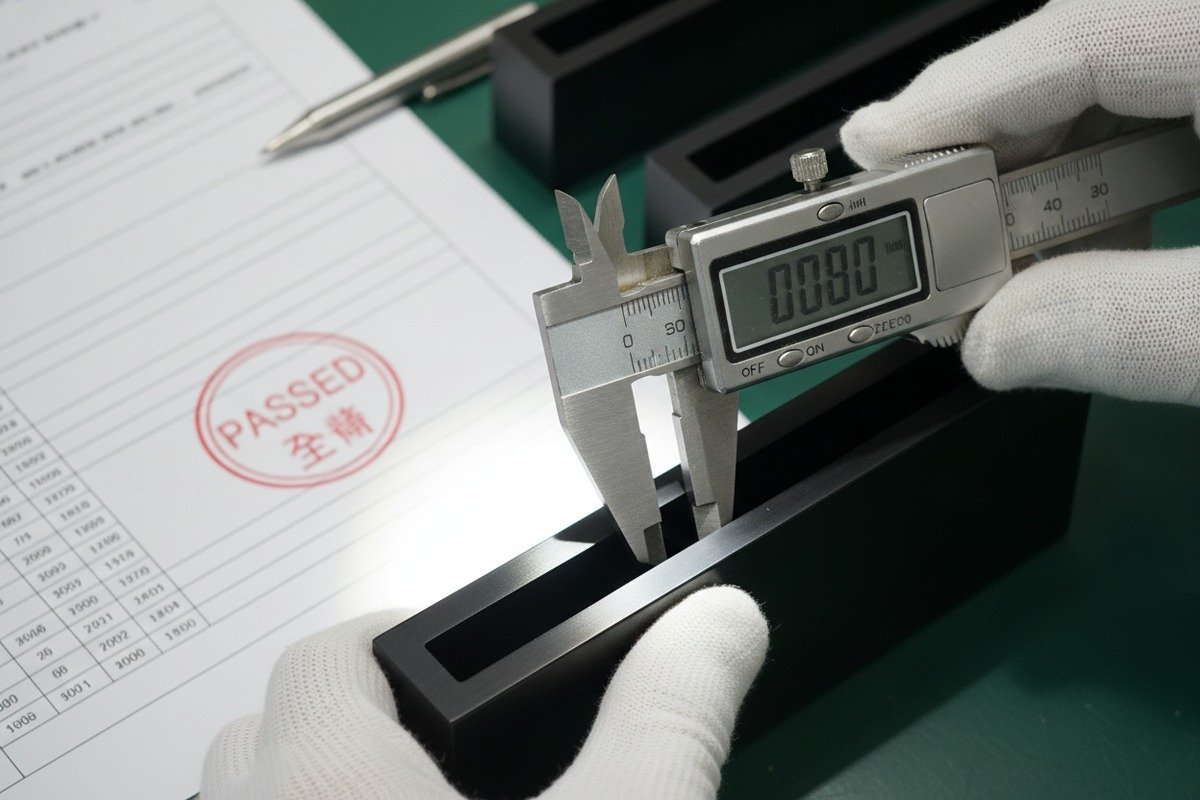
To ensure consistent quality, you should establish a written specification sheet covering dimensions, tolerances, surface finish, color codes, and packaging. Then require first-article inspection, in-process checks during production, and pre-shipment inspection with photo documentation. Vietnamese peers who follow this routine report defect rates below 2%, compared to 8–12% for buyers who skip structured QC.

Start With a Specification Sheet
A specification sheet is your contract with reality. It should include the exact alloy grade (typically 6063-T5 for furniture handles), dimensional tolerances (±0.1mm for precision profiles), surface treatment type (anodized, powder-coated, or electrophoretic), color reference (RAL or Pantone code), hardness requirements, and packaging method. Without this document, "good quality" means different things to you and your supplier.
The Three-Stage QC Framework
Vietnamese buyers who achieve consistent results use a three-stage QC framework:
Stage 1: First-Article Inspection. Before mass production begins, the supplier produces 5–10 pieces using the exact same tooling, material, and finish as the bulk run. You or your QC agent inspects these against the specification sheet. This catches problems before they scale.
Stage 2: In-Process Checks. During production, the supplier's QC team checks dimensions, finish quality, and assembly fit at regular intervals — typically every 500–1,000 pieces. Our QC team photographs each checkpoint and shares results via WhatsApp so buyers can flag issues in real time.
Stage 3: Pre-Shipment Inspection. Before packing, a final random-sample inspection is performed using AQL (Acceptable Quality Level) sampling tables. For aluminum handles, an AQL of 1.5 for critical defects and 2.5 for minor defects is standard among experienced Vietnamese importers.
Common Defects and How to Catch Them
| Defect Type | What It Looks Like | How to Catch It | Prevention Method |
|---|---|---|---|
| Uneven anodizing | Color variation across the handle surface | Visual comparison against color master sample | Consistent bath chemistry and timing |
| Dimensional drift | Handle length or channel depth outside tolerance | Caliper and gauge measurement at each stage | Regular die maintenance and calibration |
| Surface scratches | Visible marks on matte finish | White-glove visual inspection under angled light | Protective film wrapping during handling |
| Mounting hole misalignment | Screw holes do not match furniture panel drilling | Go/no-go fixture check | CNC programming verification before each run |
| Packaging damage | Dents or bends from poor packing | Pre-shipment carton drop test and visual check | Individual foam or PE bag wrapping per handle |
The Role of Vietnamese-Speaking QC Staff
Several successful Vietnamese buyers we supply have a dedicated Vietnamese-speaking staff member who communicates directly with our production team. This eliminates translation delays and reduces misunderstandings about technical terms. When a buyer says "matte champagne gold," that phrase can mean different things depending on context. Having someone who can visit the factory or review live video of the production line makes a real difference.
Certifications to Request
Ask your supplier for ISO 9001 certification 7, SGS or TÜV test reports for surface hardness and corrosion resistance, and REACH/RoHS compliance documentation 8 if you export to the EU. These are not just paperwork — they indicate that the factory has systems in place to repeat quality consistently. Vietnamese peers who skip certification checks often discover too late that their supplier outsources finishing to an uncontrolled subcontractor.
How can I negotiate lower MOQs with Chinese manufacturers for my custom OEM aluminum handle projects?
High MOQs block small and mid-sized Vietnamese furniture factories from testing new handle designs. We see it constantly — a buyer wants a custom recessed pull in champagne gold, but the supplier demands 5,000 pieces minimum for a new extrusion die.
You can negotiate lower MOQs by choosing suppliers who already stock similar base profiles, sharing tooling costs upfront, consolidating multiple handle styles into a single order, and building a long-term volume commitment rather than pushing for a one-time discount. Experienced Vietnamese peers typically start with MOQs of 200–500 pieces per SKU by using these strategies with capable mid-sized Chinese factories.
Why MOQs Exist in the First Place
MOQs are not arbitrary. They reflect real production economics. An aluminum extrusion die 9 costs $300–$800 depending on complexity. Surface treatment lines need a minimum batch to justify setup time. Packing and labeling changeovers also have a fixed cost. When a supplier quotes a high MOQ, they are telling you their break-even point. Understanding this gives you leverage because you can address the cost drivers directly.
Five Tactics Vietnamese Peers Use to Lower MOQs
Tactic 1: Use existing dies. If your handle design is close to a profile the factory already produces, you can skip the die cost entirely. At our facility, we have over 200 existing extrusion die sets. Many Vietnamese buyers start by browsing our catalog, pick a base profile, and then customize only the finish and length. This drops the MOQ dramatically — sometimes to as few as 200 pieces.
Tactic 2: Pay for tooling separately. Offer to pay the die cost as a one-time fee. This removes the supplier's need to amortize the tooling across a large first order. You own the die, and subsequent orders can be much smaller.
Tactic 3: Consolidate SKUs. If you need five handle styles, place them as one combined order rather than five separate POs. The factory runs them sequentially, and the total volume justifies the setup. We process orders like this regularly and can turn around 3–7 days for custom production when the combined quantity is reasonable.
Tactic 4: Commit to annual volume. A buyer who says "I need 200 pieces now, but I plan to order 3,000 over the next 12 months" gets a very different response than one who says "I just need 200 pieces." Vietnamese peers who sign framework agreements with projected annual volumes consistently get lower per-order MOQs.
Tactic 5: Start with stock finishes. Anodized silver, matte black, and champagne gold are our highest-volume finishes. Choosing one of these instead of a custom PMS color eliminates the need for a special coating batch, which further reduces the MOQ threshold.
| MOQ Reduction Tactic | How It Lowers MOQ | Best For |
|---|---|---|
| Use existing extrusion dies | Eliminates die cost; factory can run small batches | Buyers who can adapt designs to available profiles |
| Pay tooling fee upfront | Removes amortization pressure from first order | Buyers with unique designs who plan repeat orders |
| Consolidate multiple SKUs | Raises total order volume while keeping per-SKU count low | Buyers with diverse product lines |
| Annual volume commitment | Gives supplier revenue certainty in exchange for flexibility | Established buyers with predictable demand |
| Choose stock surface finishes | Avoids minimum batch for custom coating | Buyers prioritizing speed and cost over unique color |
The Relationship Factor
Chinese manufacturers — including our team — value relationship continuity. A buyer who communicates clearly, pays on time, and provides feedback after each shipment earns trust. That trust translates into flexibility on MOQs, faster sample turnaround, and priority production slots during peak season. Vietnamese peers who treat their Chinese supplier as a long-term partner rather than a transaction endpoint consistently report better terms.
What technical support should I expect from my supplier to help me streamline my furniture production process?
Many Vietnamese furniture factory owners tell us the same thing: they do not just need a handle supplier. They need a technical partner who understands how the handle fits into the final furniture piece and can help solve production problems before they reach the assembly line.
You should expect your supplier to provide Design for Manufacturability (DFM) feedback on your handle drawings, material and finish recommendations suited to your end-use environment, dimensional compatibility checks with your cabinet or door panels, sample iterations with fast turnaround, and ongoing technical communication via WhatsApp or video call to resolve issues during production.

DFM: Design for Manufacturability
DFM is not a buzzword. It is a practical conversation between your design team and the supplier's engineering team before any metal is cut. When a Vietnamese buyer sends us a handle drawing, our engineers review it for extrudability, wall thickness uniformity, surface treatment feasibility, and mounting compatibility. We often suggest small changes — a slightly wider finger channel, a thicker mounting flange, a chamfered edge instead of a sharp one — that make the handle easier to produce, more durable, and cheaper to manufacture. These suggestions save money and prevent downstream assembly problems.
What DFM Feedback Looks Like in Practice
Here is an example. A furniture factory in Ho Chi Minh City sent us a drawing for a recessed pull with a 1.0mm wall thickness and a deep geometric channel. Our engineers flagged that the thin wall would deform during anodizing due to thermal stress. We recommended increasing the wall to 1.2mm and adjusting the channel geometry slightly. The buyer approved the revision, and the final handle had zero warping issues across 5,000 pieces. Without that early DFM conversation, the entire batch could have been rejected.
Technical Support Checklist
Your supplier should be able to provide the following technical support at each project stage:
Pre-production stage:
- Review CAD drawings or sketches and provide DFM feedback
- Recommend alloy grade based on strength, weight, and finish requirements
- Advise on surface treatment options (anodized, electrophoretic, powder coat) and their durability trade-offs
- Confirm dimensional compatibility with your panel thickness and mounting hardware
Sample stage:
- Produce first-article samples within 3–7 days
- Provide samples in multiple finishes for comparison
- Include a measurement report with each sample showing actual vs. nominal dimensions
Production stage:
- Share QC checkpoint photos and data via WhatsApp
- Respond to technical questions within 24 hours
- Adjust production parameters if you report fit issues on your assembly line
Post-delivery stage:
- Investigate and resolve any quality complaints with root-cause analysis
- Suggest design improvements for the next order based on production data
The Communication Factor
Technical support is only useful if communication is fast and clear. Our team uses WhatsApp for daily communication with Vietnamese buyers because it supports photos, videos, voice messages, and quick responses. When a buyer's assembly worker finds that a handle does not sit flush against a cabinet panel, they can send a 10-second video clip. Our engineer watches it, identifies the issue, and proposes a fix — often within the same day.
Vietnamese-speaking staff on either side of the relationship dramatically improve technical alignment. Even small misunderstandings about terms like "brush finish" versus "sandblast finish" or "recessed" versus "flush-mount" can cause an entire order to be produced incorrectly. Peers who have invested in bilingual technical communication report far fewer revision cycles and faster time-to-production.
Automation and Advanced Manufacturing
Some Vietnamese buyers are now asking suppliers about CNC machining precision, automated surface treatment lines, and digital quality tracking. These are valid questions. A supplier with automated extrusion and CNC post-processing can hold tighter tolerances across large runs. A supplier with data-tracked anodizing lines can reproduce the exact same champagne gold finish batch after batch. When evaluating technical support, ask whether the factory uses manual or automated processes for the steps that matter most to your product consistency.
Conclusion
The most successful Vietnamese furniture factories do not source aluminum handles based on price alone. They build a sourcing system — combining trade fair discovery, structured QC, smart MOQ negotiation, and deep technical collaboration — that produces reliable results order after order. Apply these peer-tested methods, and your supply chain will become a competitive advantage rather than a constant headache.
Footnotes
1. Defines supply chain management and its components for a foundational understanding. ↩︎
2. Explains lead time in manufacturing, its causes, and impact on operations. ↩︎
3. Provides a basic overview of the aluminum extrusion manufacturing process. ↩︎
4. Clarifies the definition and role of Original Equipment Manufacturers (OEM) in supply chains. ↩︎
5. Offers a comprehensive guide to inventory management, its benefits, and techniques. ↩︎
6. Details common quality issues in manufacturing, including inconsistent quality and their causes. ↩︎
7. Official source for information on the ISO 9001 quality management standard. ↩︎
8. Compares REACH and RoHS regulations for chemical substances in products within the EU. ↩︎
9. Explains what an aluminum extrusion die is and its role in the manufacturing process. ↩︎
10. Defines Design for Manufacturability (DFM) and its benefits in product development. ↩︎