
Every week, our export team in Foshan fields calls from Vietnamese distributors asking one nervous question: will anti-dumping duties hit my next shipment of aluminum handles Ministry of Industry and Trade (MOIT) 1? anti-dumping duty policies 2
To learn about Vietnam’s anti-dumping duty policies on imported aluminum products, start by confirming the exact HS code for your furniture handles, then check Vietnam’s Ministry of Industry and Trade (MOIT) trade-remedy notices, cross-reference active ADD case lists, and verify whether your product’s classification and origin fall within any covered scope before placing an order.
This article walks you through each step. We will cover where to find official updates, how to calculate duty impact, which HS code 3s matter, and what documentation your supplier should provide. Let’s get into it.
Where can I find the most recent official updates on Vietnam's anti-dumping duties for Chinese aluminum profiles?
When we prepare commercial invoices for shipments to Ho Chi Minh City or Hanoi, our documentation team must know the current duty landscape inside out. Missing a single policy update can mean a surprise cost that wipes out your margin.
The most reliable source for official updates is Vietnam's Ministry of Industry and Trade (MOIT) website, specifically its Trade Remedies Authority of Vietnam (TRAV) portal, which publishes all active anti-dumping investigation notices, preliminary and final determinations, duty rate schedules, and annual review results for covered products including aluminum.

Primary Official Sources
The Vietnamese government maintains a structured trade-remedy framework. TRAV is the lead agency. It publishes Decisions, Circulars, and Notices in Vietnamese, with some English summaries. Here is a quick reference list of where to look:
| Source | What You Find There | Language |
|---|---|---|
| TRAV (trav.gov.vn) | Active ADD/CVD cases, scope descriptions, duty rates, review schedules | Vietnamese (some English) |
| MOIT Official Gazette | Legal texts of trade-remedy Decisions | Vietnamese |
| Vietnam Customs (customs.gov.vn) | HS-code-level duty tables, import tariff schedules | Vietnamese / English |
| WTO Trade Remedies Gateway 4 | Vietnam's ADD notifications to the WTO Committee on Anti-Dumping Practices | English |
| ITC Market Access Map 5 | Tariff and trade-remedy data by HS code and country pair | English |
How to Search Effectively
Start with the HS code. If you are sourcing a recessed aluminum cabinet handle like the champagne-gold anodized profile we produce, the classification likely falls under HS heading 8302 (base metal mountings, fittings, and similar articles for furniture). The specific subheading — for example, 8302.42 — covers furniture fittings made of base metal. Search TRAV's case list for that code.
Next, search for the broader product description. Vietnam had 9 product groups and 74 HS codes subject to anti-dumping duties on imports from China as of late 2024. Aluminum extrusions and aluminum profiles may appear under headings in Chapter 76 6 (aluminum and articles thereof), not Chapter 83. If your handle is classified as a finished hardware fitting under 8302, it may sit outside the scope of an extrusion-focused case. But if it is classified as an aluminum profile under 7604 or 7608, the risk profile changes entirely.
Stay Updated Through Alerts
Policy changes fast. A new investigation can launch with a single MOIT Decision. We recommend setting up Google Alerts with keywords such as "Vietnam anti-dumping aluminum," "TRAV aluminum," and "MOIT trade remedy." Also subscribe to trade-law newsletters from firms that specialize in Southeast Asian customs compliance. Checking quarterly is the bare minimum. Checking monthly is safer.
Don't Ignore U.S. and EU Cases
Even if your destination market is Vietnam, pay attention to U.S. and EU anti-dumping cases on Vietnamese-origin aluminum. In 2024, the U.S. Department of Commerce 7 issued final determinations on aluminum extrusions from Vietnam with company-specific dumping margins of 14.15% and a Vietnam-wide entity rate of 41.84%. In July 2025, the U.S. launched an anti-circumvention investigation into disposable aluminum products from Vietnam and Thailand. These cases do not directly impose costs on imports into Vietnam, but they reveal which product flows are under scrutiny and can signal future Vietnamese domestic action.
How do I calculate the impact of these anti-dumping taxes on my total sourcing budget for aluminum handles?
Our pricing team builds landed-cost models for every quotation we send to Vietnam. We have seen buyers receive a great FOB price and then get blindsided at customs because they did not factor in trade-remedy duties. That is a painful and avoidable mistake.
To calculate the impact, add the applicable anti-dumping duty rate to the CIF value of your aluminum handles, then combine it with the standard import duty, VAT, and any other trade-remedy surcharges to arrive at your true landed cost per unit before local logistics and warehousing.

The Landed-Cost Formula
Here is a simplified breakdown of how duties stack:
| Cost Component | Typical Range | How It Applies |
|---|---|---|
| FOB Price (China) | Your negotiated price | Base cost from manufacturer |
| Ocean Freight + Insurance | 3%–8% of FOB | Gets you to CIF value 9 |
| Standard Import Duty (Vietnam) | 0%–20% depending on HS code and FTA eligibility | Applied on CIF value |
| Anti-Dumping Duty (if applicable) | 2.85%–35.58% on covered Chinese aluminum products | Applied on CIF value |
| VAT (Vietnam) | 10% | Applied on (CIF + Import Duty + ADD) |
| Customs Handling / Local Fees | ~1%–2% of CIF | Port and brokerage fees |
A Worked Example
Suppose you order 5,000 champagne-gold recessed aluminum handles from our factory at an FOB price of USD 1.20 per piece. Total FOB is USD 6,000. Freight and insurance add 5%, bringing CIF to USD 6,300.
If the standard import duty is 15% and no anti-dumping duty applies, your duty is USD 945. VAT at 10% on (6,300 + 945) = USD 724.50. Total landed cost is roughly USD 7,969.50, or USD 1.59 per handle.
Now add a hypothetical 20% anti-dumping duty. That is USD 1,260 on top. VAT recalculates on (6,300 + 945 + 1,260) = USD 850.50. New total: approximately USD 10,355.50, or USD 2.07 per handle. The ADD alone pushed your per-unit cost up by about 30%.
Why Small Rate Changes Matter at Scale
A furniture factory ordering 50,000 handles per quarter will feel even a 5% ADD shift. At FOB USD 1.20, a 5% ADD on CIF adds roughly USD 3,150 per quarter. Over a year, that is USD 12,600 — enough to fund a new product line sampling run or hire an additional worker.
Practical Tips to Protect Your Budget
First, always request CIF pricing from your supplier so you know the dutiable value upfront. Second, ask your customs broker in Vietnam to run a duty simulation before you confirm the order. Third, build a 10%–15% contingency buffer into your sourcing budget for any product that could be reclassified or swept into a new investigation. Fourth, explore whether ASEAN-China Free Trade Agreement (ACFTA) preferential rates apply. If your handles qualify under the right HS code and you have the proper Certificate of Origin (Form E), the standard import duty may drop to 0%–5%, partially offsetting any ADD exposure.
Which specific HS codes for aluminum furniture hardware are currently subject to Vietnam's trade enforcement?
In our Foshan facility, we stamp HS codes on every packing list and commercial invoice. Getting the code wrong does not just cause a customs delay — it can trigger the wrong duty rate or even flag your shipment for anti-dumping review.
Aluminum furniture handles most commonly fall under HS 8302.42 (base metal mountings and fittings for furniture), while raw aluminum profiles are classified under Chapter 76 codes such as 7604 and 7608. Vietnam's active ADD cases on Chinese aluminum primarily target Chapter 76 extrusion products, so finished furniture hardware under 8302 may sit outside current enforcement scope — but classification must be verified case by case.
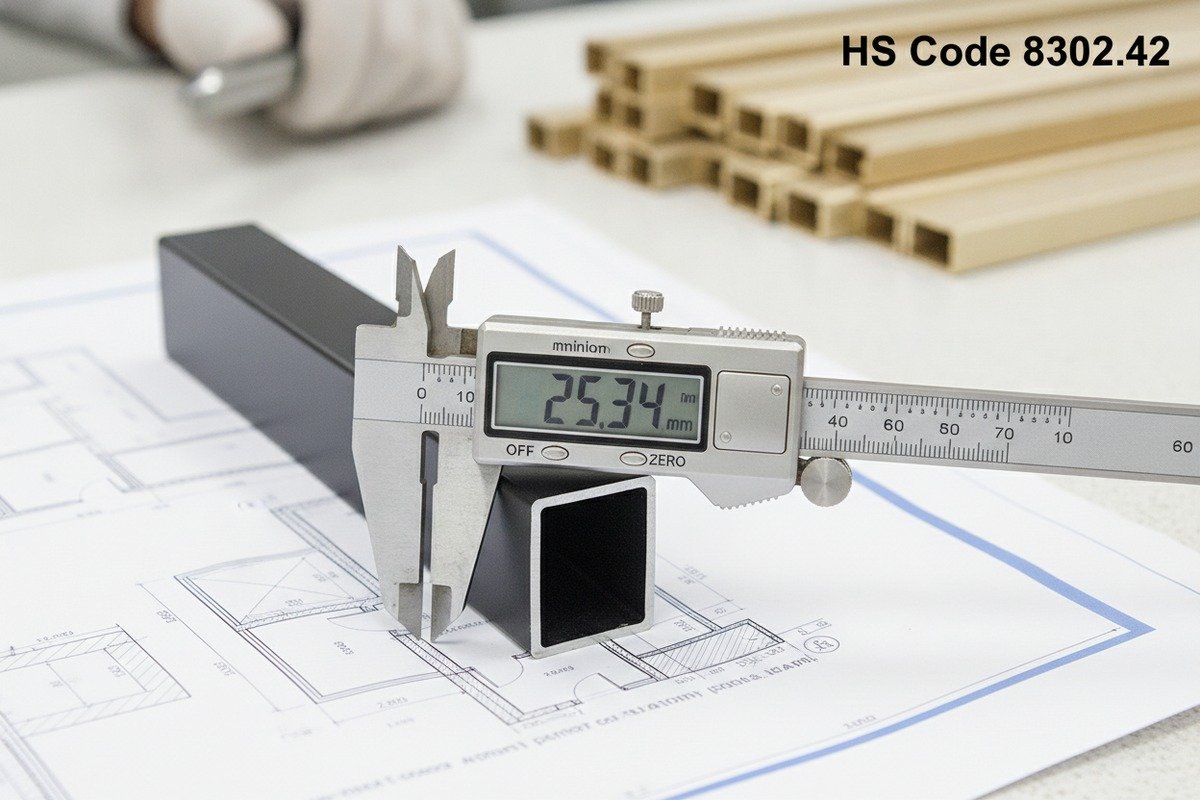
Key HS Codes to Know
Here is a comparison of the most relevant codes:
| HS Code | Description | Likely ADD Exposure (Vietnam) |
|---|---|---|
| 7604.10 | Aluminum profiles, not alloyed | Higher risk — often within extrusion ADD scope |
| 7604.21 | Hollow aluminum profiles, alloyed | Higher risk — often within extrusion ADD scope |
| 7608.20 | Aluminum alloy tubes and pipes | Moderate risk — may be within scope depending on case |
| 8302.42 | Base metal mountings, fittings for furniture | Lower risk — typically classified as finished hardware, not raw extrusion |
| 8302.49 | Other base metal mountings and fittings | Lower risk — similar rationale as 8302.42 |
| 7616.99 | Other articles of aluminum | Variable — depends on product description and end use |
Why Classification Is the Decisive Factor
Trade-remedy cases define a "covered merchandise" scope. The scope is a legal description. It specifies physical characteristics, production process, end use, and sometimes even dimensions. A long aluminum extrusion bar shipped in 6-meter lengths is clearly within an extrusion case. But a 128mm recessed cabinet pull that has been cut, machined, anodized, and packaged as finished hardware? That product may fall outside the scope.
The critical question is: does the product match the legal description in the active trade-remedy Decision? If Vietnam's ADD on Chinese aluminum extrusions uses language similar to the U.S. case — covering "shapes and forms produced by an extrusion process" — then a finished handle that began life as an extrusion could still be swept in. However, if the handle is classified under 8302.42 as a finished furniture fitting, many customs authorities treat it as outside the extrusion scope.
How to Confirm Your Classification
Do not guess. Take these steps:
- Review the product's material certificate and production process. Our handles are extruded, then CNC-cut, drilled, surface-treated, and individually packaged. That post-extrusion processing is key to arguing finished-goods status.
- Submit a binding classification ruling request to Vietnam Customs before your first shipment. This gives you a written determination of the HS code.
- Cross-check that HS code against TRAV's list of covered HS codes. As of late 2024, Vietnam maintained ADD measures across 74 HS codes on Chinese goods. If your code is not on that list, your product is currently outside ADD scope.
- Re-verify every 6 months. New investigations can add codes to the covered list at any time.
Anti-Circumvention Risk
Even if your handle's HS code is clear, be aware of anti-circumvention. If authorities suspect that a manufacturer is performing minimal processing in Vietnam on Chinese aluminum inputs simply to avoid ADD, they can investigate and potentially extend duties. The 2025 U.S. anti-circumvention case on disposable aluminum products from Vietnam illustrates this risk. The lesson: genuine, substantial transformation matters. A handle that is merely re-packaged in Vietnam from a Chinese semi-finished extrusion has higher circumvention risk than one fully manufactured and finished in China and shipped directly.
Can my Chinese manufacturer provide the necessary documentation to help me comply with Vietnam's import regulations?
Over the past 18 years, our team at LiliTONG has shipped thousands of orders to Vietnamese distributors and furniture factories. We know exactly which documents get questioned at customs and which ones sail through without a second look.
Yes, a capable Chinese manufacturer should provide commercial invoices with accurate HS codes, material test certificates, Certificates of Origin (Form E for ACFTA), detailed packing lists, production process descriptions, and anodizing or surface treatment records — all of which are essential for demonstrating compliance with Vietnam's import and trade-remedy regulations.

The Documentation Checklist
Here is what we include with every shipment to Vietnam and what you should demand from any supplier:
- Commercial Invoice with unit price, total value, HS code, product description, and Incoterms.
- Packing List with net weight, gross weight, carton dimensions, and quantity per carton.
- Certificate of Origin (Form E) issued by China's authorized body, enabling ACFTA preferential duty rates.
- Material Test Certificate (MTC) confirming aluminum alloy grade (e.g., 6063-T5), chemical composition, and mechanical properties.
- Surface Treatment Report showing anodizing thickness, color code, and salt spray test results.
- Production Process Description outlining extrusion, cutting, CNC machining, anodizing, and packaging steps. This is critical for proving the product is finished hardware, not a raw extrusion.
- Bill of Lading or Airway Bill.
- Fumigation Certificate if wooden pallets are used.
Why Production Process Records Matter Most
When an ADD investigation or customs review occurs, the authorities want to know what the product is and how it was made. A one-page production flowchart showing that your aluminum handle went through extrusion → cutting to length → CNC drilling → deburring → anodizing → quality inspection → individual packaging demonstrates substantial manufacturing. This supports classification under 8302.42 rather than a raw extrusion code.
We provide this flowchart as a standard part of our export documentation package. If your current supplier cannot or will not provide it, that is a red flag. It suggests either a lack of process control or an unwillingness to support your customs compliance — both of which put your shipment at risk.
How to Evaluate Supplier Compliance Readiness
Ask these five questions before confirming any order:
- Can you provide a Form E Certificate of Origin for every shipment?
- Do you have material test certificates from your billet supplier?
- Will you include a production process description with each shipment?
- Can you confirm the correct HS code and provide supporting classification notes?
- Have you exported to Vietnam before, and can you share reference documents from past shipments?
A supplier who answers yes to all five — and can show you samples of the actual documents — is ready to support your compliance needs. We keep templates of all these documents on file and can issue them within 24 hours of shipment confirmation.
What Happens If Documentation Is Incomplete
Vietnam Customs can hold your shipment for inspection, request additional paperwork, reclassify the product under a different HS code (potentially one with higher duties or ADD exposure), or in the worst case, impose penalties. The clearance delay alone can cost you warehouse fees, container demurrage charges, and lost sales. In our experience, a single documentation gap on a 20-foot container of aluminum handles can cost a buyer USD 500–2,000 in port charges and 7–14 days of delay. That is why we invest in getting documents right the first time.
Ongoing Compliance Is a Partnership
Trade-remedy compliance is not a one-time task. Regulations change. New investigations launch. HS code interpretations evolve. The best approach is to build a long-term relationship with a manufacturer who monitors these changes alongside you. We track MOIT updates as part of our standard export operations because our business depends on smooth customs clearance for our Vietnamese customers. When a policy changes, we notify affected buyers before their next order — not after their container is stuck at Cat Lai port.
Conclusion
Anti-dumping duty compliance starts before you source, not after your container ships. Verify your HS code, check MOIT's active case list, calculate the full landed cost, and demand complete documentation from your manufacturer. Our team at LiliTONG is ready to help you navigate every step — reach out at Al**************@********************************************te.com.
Footnotes
1. Official website for Vietnam’s trade and industry regulations. ↩︎
2. Explains the purpose and types of trade remedy measures, including anti-dumping. ↩︎
3. Defines the Harmonized System (HS) code for product classification. ↩︎
4. Provides access to WTO members’ anti-dumping notifications and data. ↩︎
5. Offers tariff and trade-remedy data by HS code and country. ↩︎
6. The official Harmonized Tariff Schedule (HTS) website is the authoritative source. Users can navigate to Chapter 76 from this main portal. ↩︎
7. Official U.S. government body involved in trade and economic development. ↩︎
8. Official agency responsible for trade remedy investigations in Vietnam. ↩︎
9. Explains the Cost, Insurance, and Freight (CIF) Incoterm for international trade. ↩︎
10. The official Harmonized Tariff Schedule (HTS) website is the authoritative source. Users can navigate to Chapter 83 from this main portal. ↩︎