Walking through hundreds of exhibitor booths at a massive trade fair can feel overwhelming, especially when every supplier claims to offer “factory-direct pricing” and “premium quality.” Over the past 18 years, our production team in Foshan has welcomed countless buyers who first discovered us at exhibitions — and they all share the same frustration: how do you tell the real manufacturers from the middlemen?
To find high-quality aluminum furniture handle suppliers at the Canton Fair or Vietnam building materials exhibitions, prepare a supplier scorecard before the show, physically inspect samples at booths for finish consistency and machining precision, ask targeted questions to verify factory ownership, and compare multiple exhibitors before shortlisting candidates for post-fair factory audits.
This guide walks you through a practical, step-by-step sourcing playbook anodizing tanks 1. You will learn how to separate genuine factory suppliers from traders, what to inspect when you hold a sample in your hand, and which questions cut through marketing noise. Let’s start with the most important skill: verifying whether an exhibitor actually makes their own handles.
How can I verify if an aluminum handle exhibitor at the Canton Fair is a direct manufacturer with its own production facility?
At every Canton Fair 2, our booth neighbors include both factories like ours and pure trading companies with polished catalogs. Buyers who cannot tell the difference often end up paying more for less control over quality and lead times powder coating lines 3.
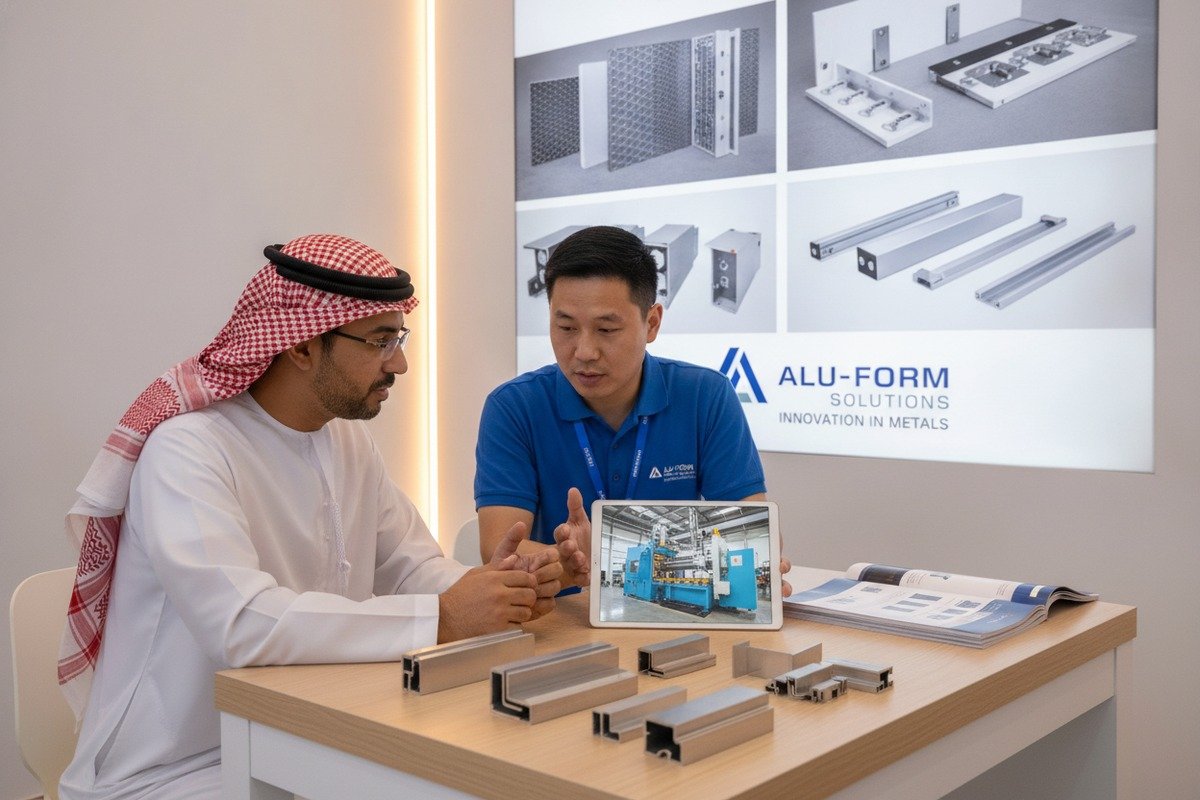
To verify a direct manufacturer, ask for factory photos with timestamps, request details about their extrusion and anodizing equipment, check if staff can answer technical questions on the spot, and look for evidence of in-house tooling capability — traders typically cannot explain production processes in depth.
Why This Matters for Your Bottom Line
The difference between a factory and a trader is not just about price. When you work with a genuine manufacturer, you get shorter lead times, more flexibility on custom orders, and direct communication with the people who actually make your handles. Traders add a margin and often lack the ability to adjust production quickly. For buyers serving markets in Vietnam or the Middle East, where reorder speed and color-matching consistency matter, this distinction can make or break your business.
The Questions That Reveal the Truth
Start with simple, open-ended questions. Ask the booth staff to describe their production line. A real manufacturer will mention specific equipment — extrusion presses 4, CNC cutting machines, anodizing tanks, powder coating lines. They will know the tonnage of their press and the capacity of their anodizing line. Traders tend to give vague answers like "we have a partner factory" or "our supply chain handles that."
Ask what aluminum alloy grade 5 they use. Our production, for example, primarily works with 6063-T5 alloy 6 for furniture handles because it offers the right balance of strength, machinability, and surface finish quality. A manufacturer will explain why they chose a specific alloy. A trader will often just say "high-quality aluminum."
Documentary Evidence to Request
| Evidence Type | What a Manufacturer Provides | What a Trader Typically Provides |
|---|---|---|
| Factory photos | Dated photos of extrusion, CNC, and finishing lines | Generic or stock photos of a factory they do not own |
| Business license | Manufacturing-category license with factory address | Trading-company license or unclear classification |
| Equipment list | Specific machine models, quantities, and capacities | Vague descriptions or no equipment details |
| Staff technical knowledge | Detailed answers about tolerances, finishes, alloys | Redirects questions or promises to "check with the factory" |
| Sample lead time | Can produce custom samples in 3–7 days | Needs 2–4 weeks because they must relay to a subcontractor |
Use Canton Fair Phase 2 Strategically
Canton Fair Phase 2 is specifically focused on building materials and furniture, which means the density of relevant exhibitors is high. Before you go, download the exhibitor list and filter for furniture hardware and aluminum profile categories. Mark the booths you want to visit first. This pre-screening saves hours of wandering and lets you spend more time doing deep evaluations at the booths that matter.
One additional tip from our experience exhibiting: visit the same booth twice — once on day one for a quick introduction, and again on day two or three with specific technical questions. The way a supplier responds under repeated scrutiny tells you a lot about their confidence and transparency.
What specific quality benchmarks should I check when inspecting aluminum furniture handle samples at the Vietnam Building Materials Exhibition?
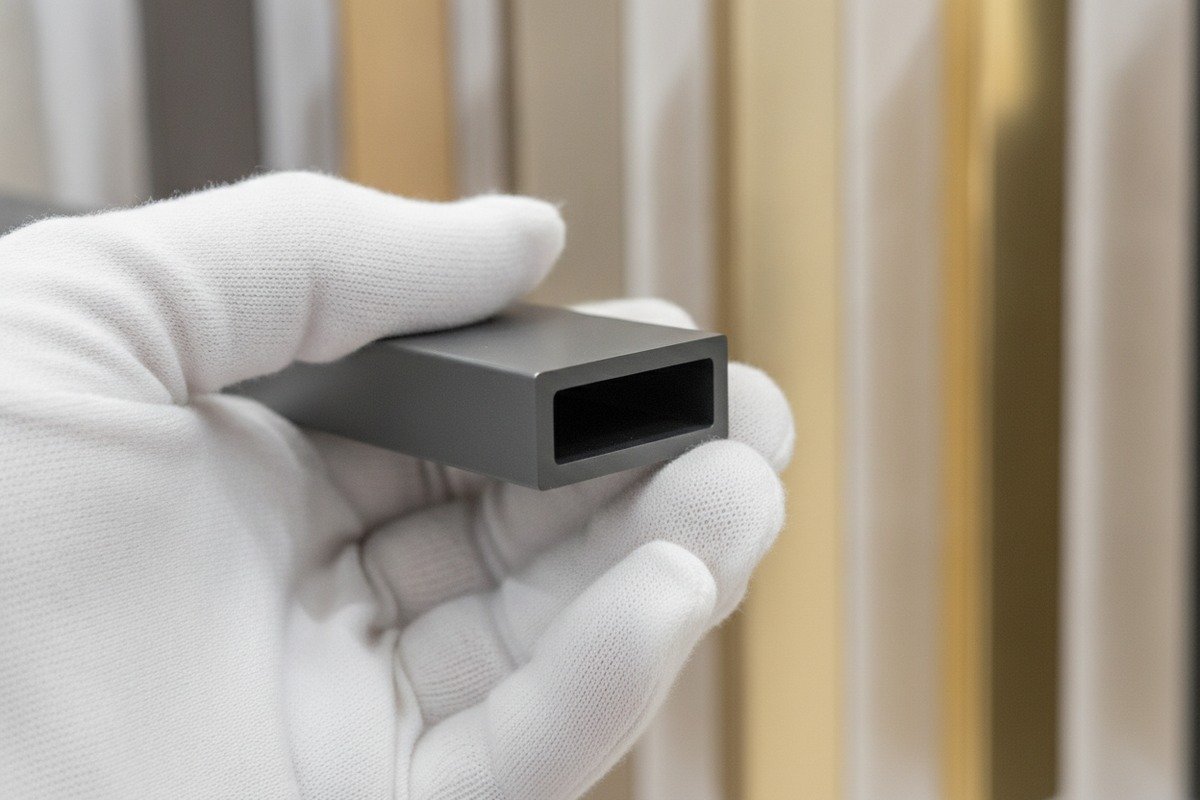
When our team prepares samples for exhibitions, we know that experienced buyers will hold a handle under the light, run a finger along every edge, and check the mounting holes with a caliper. These quick physical checks reveal more than any product brochure.
When inspecting aluminum handle samples, check for anodizing or coating uniformity under multiple light angles, feel for burrs or sharp edges along all machined surfaces, measure dimensional accuracy at mounting points, and compare finish color across several pieces from the same batch to confirm consistency.
Surface Finish Is the First Test
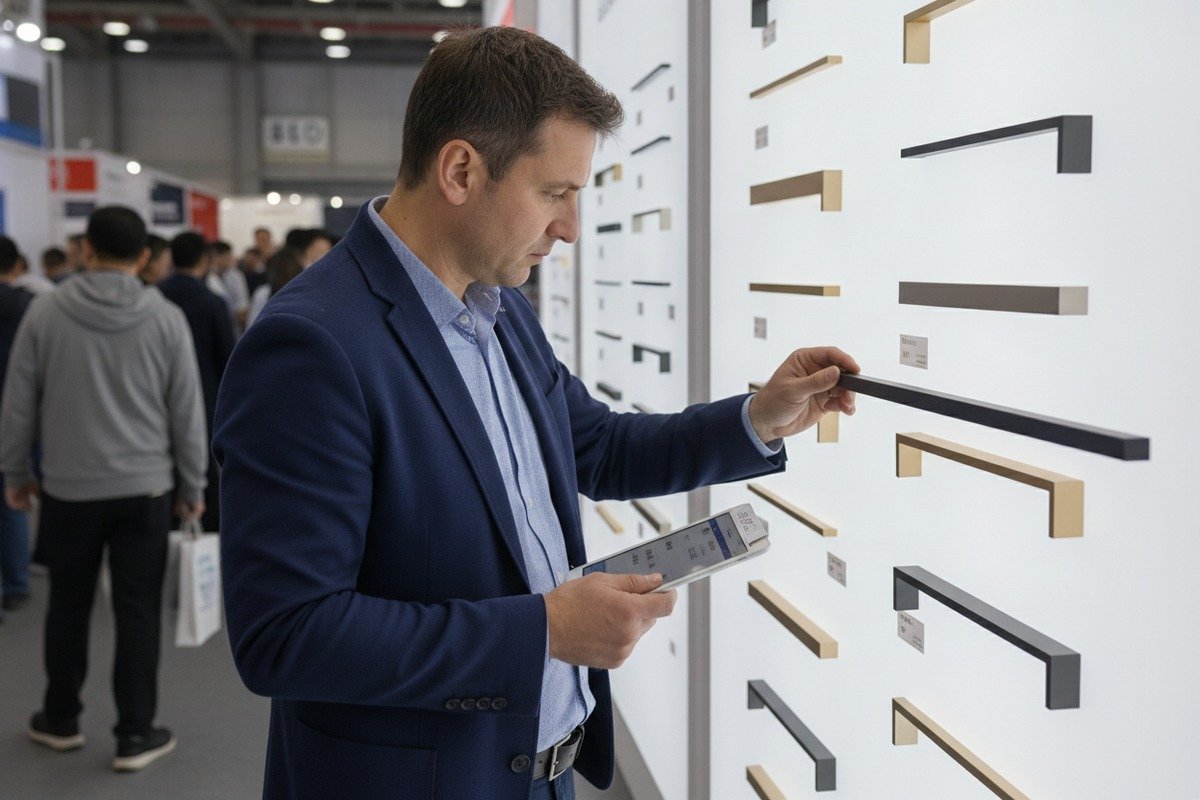
The surface finish of an aluminum furniture handle is the first thing your end customer sees and touches. Whether the handle uses anodizing, powder coating, or electrophoresis, the finish must be uniform. At the exhibition booth, pick up three or four handles of the same SKU and line them up. Look at them under the booth light, then step into natural light if possible. Color variation between pieces from the same batch is a red flag.
For the popular champagne gold and matte black finishes that sell well in Vietnam and the Middle East, even slight inconsistency is noticeable when handles are installed across a row of kitchen cabinets or wardrobe doors. Our anodizing process targets a color tolerance within Delta E ≤ 1.5 to ensure visual uniformity — ask your potential supplier what their standard is.
Edge Quality and Machining Precision
Run your fingertip along the edges of the handle. A well-machined aluminum handle should feel smooth and clean. Burrs, rough spots, or uneven edges indicate poor CNC finishing or inadequate deburring. For recessed handles and slim-profile pulls — the kind with a deep geometric channel for finger grip — check inside the channel as well. Buyers often overlook this area, but it is where your customers will actually touch the handle every day.
Dimensional Accuracy Matters for Installation
Bring a small digital caliper 7 to the fair. Measure the hole-to-hole spacing on several samples. For furniture handles, even a 0.5mm deviation can cause problems during installation on cabinet doors. Check the screw hole diameter and depth too.
| Quality Benchmark | What to Inspect | Acceptable Standard |
|---|---|---|
| Surface finish uniformity | Compare 3–5 pieces under different lighting | No visible color variation (Delta E ≤ 1.5) |
| Edge smoothness | Run finger along all edges and inside channels | No burrs, sharp points, or rough patches |
| Dimensional accuracy | Measure hole spacing, width, depth with caliper | Tolerance within ±0.2mm |
| Corrosion resistance | Ask for salt spray test 8 results | ≥ 200 hours for anodized; ≥ 500 hours for powder coated |
| Structural rigidity | Apply gentle pressure to the handle body | No flex, bending, or creaking |
| Packaging protection | Ask to see actual shipping packaging | Individual PE film or foam wrap; partitioned cartons |
Do Not Trust Display Samples Alone
This is a critical point. The samples on display at a booth are usually the best pieces from a production run. They may have been hand-selected and even hand-polished. Ask the exhibitor if you can see samples from their regular production stock — or better yet, request that they send you samples from an actual batch after the fair. This post-fair sample comparison is how you discover whether the exhibition quality matches real production quality.
Vietnam Exhibition Context
Vietnam building materials exhibition 9s serve a different strategic purpose than the Canton Fair. They help you discover regional manufacturers who may offer proximity advantages for ASEAN markets, shorter shipping times, and sometimes lower MOQs. However, the aluminum handle manufacturing ecosystem in Vietnam is still developing compared to clusters like Foshan. Use Vietnam shows to diversify your supply chain and find complementary suppliers, but apply the same rigorous quality benchmarks.
How do I identify suppliers at these trade shows who can provide both ready-to-ship stock and custom OEM services for my business?
One of the most common challenges our customers face is balancing two needs at once: they want fast delivery on popular styles from stock, and they also want the ability to develop exclusive designs for their market. Not every supplier can serve both needs well.
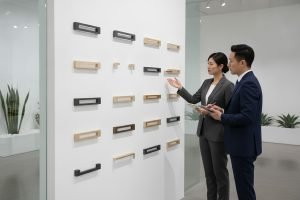
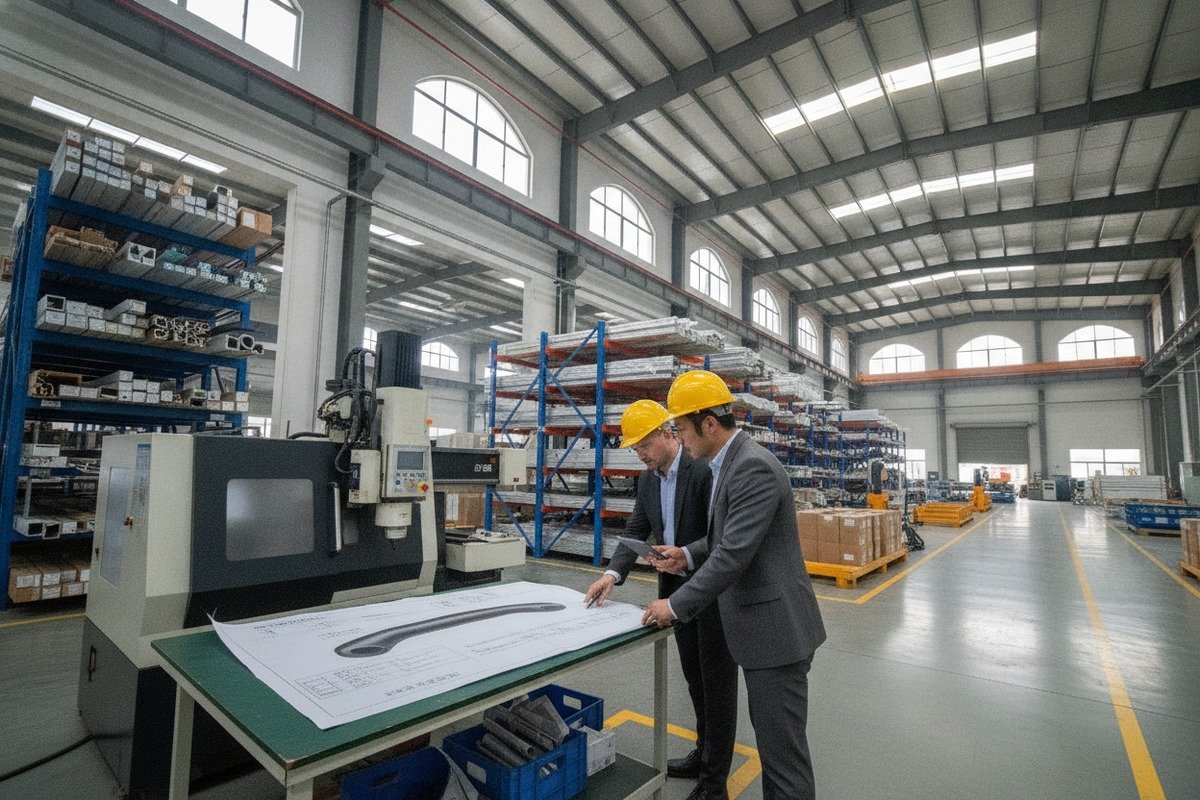
Look for exhibitors who display a wide range of standard handle styles with stated stock quantities, while also showcasing custom-finished or OEM project examples with client-specific packaging — this dual presentation signals that the supplier operates both a warehouse inventory system and a flexible custom production line.
Why Dual Capability Matters
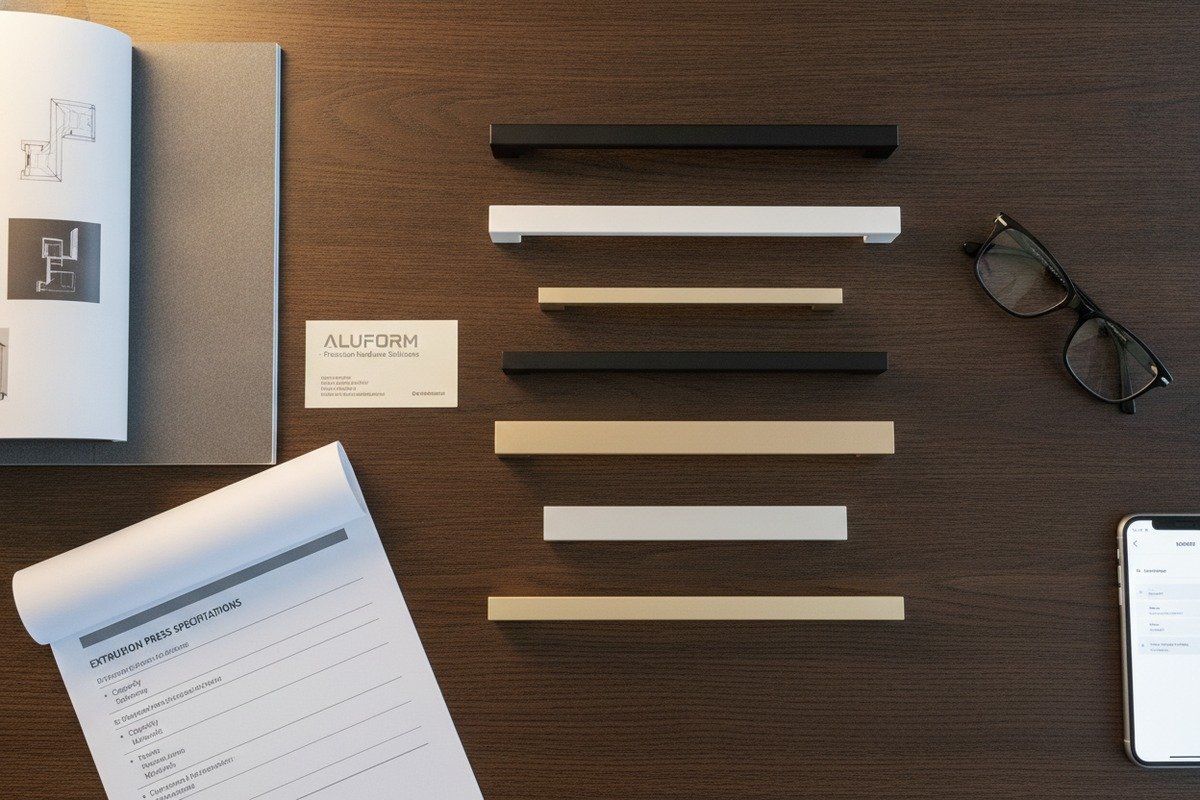
If you are a building material distributor in Ho Chi Minh City or a furniture factory purchasing manager in Dubai, your business reality involves two types of orders. First, you need bread-and-butter handles — matte black bar pulls, champagne gold recessed handles, white slim profiles — that you can reorder quickly when stock runs low. Second, you occasionally receive project-based orders that require custom lengths, special hole spacing, unique colors, or branded packaging.
A supplier who only does custom work will be slow for restocking. A supplier who only sells from a fixed catalog will limit your ability to win project contracts. The best partner offers both.
What to Look for at the Booth
At our booth, for example, we typically show our 300-ton ready-to-ship inventory catalog alongside project showcase boards that feature custom OEM work. Here is what you should look for:
- Stock catalog with SKU numbers and stated quantities. A supplier with real inventory will have organized product codes, not just loose samples.
- Custom project examples. Look for handles with client logos, special finishes, non-standard dimensions, or unique packaging. This proves they have done OEM work before.
- Sample turnaround time. Ask how quickly they can produce a custom sample. We offer 3–7 day turnaround for custom products, which is possible because we control the full process in-house. A supplier quoting 3–4 weeks likely subcontracts.
- MOQ flexibility. Stock items often have lower MOQs than custom items. Ask about both. This tells you how the supplier structures their production.
Supplier Capability Comparison Framework
| Capability | Stock-Only Supplier | Custom-Only Supplier | Dual-Capability Supplier |
|---|---|---|---|
| Delivery speed for standard items | Fast (24–48 hours) | Slow (needs production run) | Fast from inventory |
| Custom lengths and finishes | Not available | Available | Available |
| MOQ for standard items | Low (often per-carton) | High (production batch) | Low |
| MOQ for custom items | Not available | Medium to high | Flexible |
| Reorder consistency | High (same stock SKU) | Variable | High |
| Packaging customization | Rarely | Usually | Usually |
| Sample turnaround | Immediate (from stock) | 1–4 weeks | 3–7 days |
Ask About Their Workflow for Custom Orders
Go deeper than "do you do OEM?" Ask specifically: What is your process when I send you a new handle design? How do you handle tooling? Who pays for the mold? How many revisions are included? What is the timeline from design approval to first production batch?
A capable OEM supplier will walk you through a clear process. They will mention mold design, sample approval, small-batch trial, and then mass production. They will be transparent about tooling costs and timelines. If the answers are vague or overly optimistic, proceed with caution.
Post-Fair Verification
After the fair, request a small trial order that includes both stock items and one custom variation. This real-world test tells you more than any booth conversation. Check whether the stock items arrive within the promised timeframe. Check whether the custom sample matches your specifications. This dual test is the fastest way to confirm a supplier's actual capability.
What are the most important questions I should ask exhibitors to ensure their aluminum profiles meet my local market standards in Vietnam or the Middle East?
Every market has specific requirements. When we ship handles to our partners in Vietnam, the priorities are different from what our Middle Eastern clients need. Knowing the right questions saves you from receiving a container of handles that look great but fail to meet local expectations.
Ask exhibitors about their aluminum alloy grade certifications, surface treatment durability test results (such as salt spray hours), compliance with relevant import standards, packaging specifications for humid or hot climates, and their experience exporting to your specific target market — these answers reveal whether the supplier understands your local requirements.
Market-Specific Requirements You Must Address
Vietnam and Middle Eastern markets have different environmental and regulatory conditions. Vietnam's tropical climate means high humidity, which accelerates corrosion on poorly finished aluminum. The Middle East has extreme heat, salt-laden air in coastal cities like Dubai and Jeddah, and strong UV exposure. Your handles must withstand these conditions without fading, corroding, or degrading.
Here are the key questions organized by market:
Questions for Vietnam Market Sourcing
- What alloy grade do you use, and can you provide a material test certificate?
- How many hours of salt spray resistance does your anodized finish achieve?
- Do you have existing clients or distribution partners in Vietnam?
- Can you provide packaging that protects against humidity during sea freight?
- What is your shipping timeline to Ho Chi Minh City or Haiphong port?
Questions for Middle East Market Sourcing
- Does your coating process include UV-resistant treatment?
- What salt spray test standard do your handles meet (ASTM B117 or equivalent)?
- Do you have experience with color matching for desert-toned interiors (champagne gold, bronze, sand beige)?
- Can you provide documentation for import customs clearance in UAE or Saudi Arabia?
- Do you offer Arabic-language packaging or labeling if needed?
Core Technical Questions for Any Market
| Question Category | Specific Question | Why It Matters |
|---|---|---|
| Material grade | What aluminum alloy do you use (6063, 6061, other)? | Determines strength, machinability, and corrosion baseline |
| Surface treatment | What finishing process (anodizing, powder coat, electrophoresis)? | Affects durability, color options, and environmental resistance |
| Corrosion testing | How many hours of salt spray testing has your finish passed? | Direct indicator of long-term durability in humid or coastal environments |
| Color consistency | What is your Delta E tolerance 10 for batch-to-batch color matching? | Ensures handles look uniform when installed across multiple cabinets |
| Certifications | Do you hold ISO 9001, SGS, or other relevant quality certifications? | Provides third-party verification of quality management systems |
| Export experience | What percentage of your production is exported, and to which countries? | Suppliers with export experience understand documentation, packaging, and compliance |
| Packaging standard | How do you protect handles during ocean freight? | Handle damage from poor packaging is one of the most common post-delivery complaints |
Do Not Skip the Sustainability Question
Increasingly, buyers in both Vietnam and the Middle East are being asked by their own customers about sustainability. Ask whether the supplier uses recycled aluminum content, what their waste management practices look like, and whether they have any environmental certifications. This is not just about ethics — it is becoming a market access requirement in certain project tenders and retail channels.
Compare China and Vietnam Suppliers Strategically
Sourcing from China, particularly from the Foshan hardware cluster, gives you access to a deep ecosystem of aluminum extrusion, finishing, and hardware manufacturing expertise. The supply chain is mature, tooling costs are competitive, and customization options are extensive. Vietnam-based suppliers may offer advantages in shipping proximity for ASEAN buyers and potential tariff benefits, but the depth of aluminum handle specialization is still catching up.
The smart approach is not to choose one over the other. Use the Canton Fair to find your primary, high-capability manufacturing partner. Use Vietnam exhibitions to find supplementary suppliers for standard items or to hedge against supply chain disruptions. Both sourcing channels are valuable when used strategically.
Red Flags to Watch For
Be cautious if an exhibitor cannot name their alloy grade, has no test reports, claims "universal certification" without specifics, or avoids questions about their export history. These gaps suggest the supplier may lack the quality infrastructure your market demands.
Conclusion
Finding the right aluminum furniture handle supplier at a trade fair comes down to preparation, hands-on inspection, and asking the right questions — then verifying everything with post-fair samples and trial orders before committing to a long-term partnership.
Footnotes
1. Official site for the Aluminum Anodizers Council, detailing the anodizing process. ↩︎
2. Official website for the Canton Fair, a major international trade exhibition. ↩︎
3. Provides information on the powder coating process and technology. ↩︎
4. Explains the aluminum extrusion process and associated equipment. ↩︎
5. Authoritative resource on aluminum and its various alloy grades. ↩︎
6. Provides detailed information on the properties and applications of 6063-T5 aluminum alloy. ↩︎
7. Guide on how to use a digital caliper for accurate measurements. ↩︎
8. Details the ASTM B117 standard for operating salt spray (fog) apparatus. ↩︎
9. Found official website for Vietbuild exhibitions. ↩︎
10. Explains the Delta E metric for quantifying color differences. ↩︎