
Every year, our production team in Foshan handles dozens of compliance inquiries from overseas buyers who are unsure whether the aluminum handles they are importing will clear environmental regulations at customs.
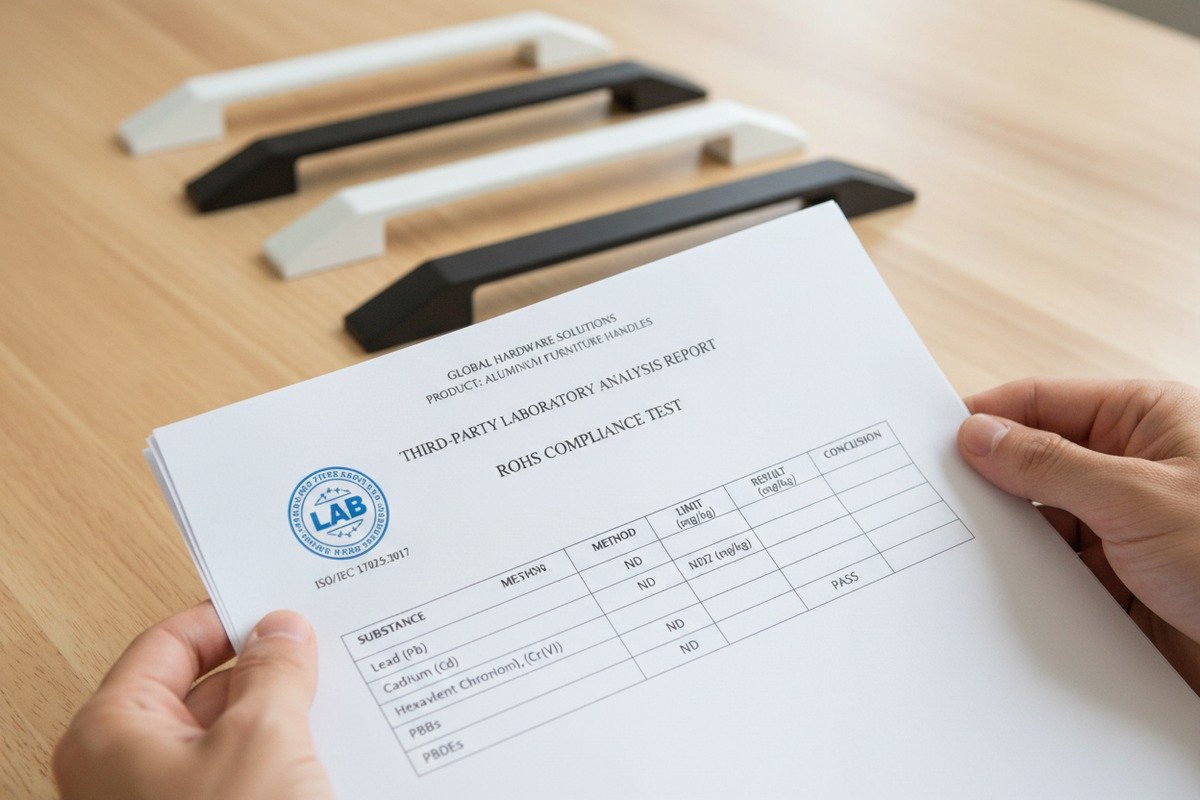
To determine if a supplier’s aluminum furniture handles have passed RoHS testing, request a part-specific Declaration of Conformity, material composition certificates for the base alloy, surface treatment declarations, and third-party lab test reports from accredited laboratories covering all ten RoHS-restricted substances.
RoHS compliance 1 is not a simple stamp or logo. It is a documentation-and-testing claim tied to specific parts, coatings, finishes, and intended end products. Below, we break down exactly what documents to ask for, how to verify them, and where the real compliance risks hide in aluminum hardware sourcing.
What Specific RoHS Certification Documents Should I Request From My Aluminum Handle Manufacturer?
When we ship handles to buyers in the Middle East and Southeast Asia, many of them tell us they have never received proper RoHS paperwork from their previous supplier — just a vague "eco-friendly" label.
You should request five key documents: a RoHS Declaration of Conformity tied to the exact SKU, a material composition certificate for the aluminum alloy, a surface treatment compliance declaration, third-party lab test reports from an accredited lab, and batch-level traceability records linking raw material to finished product.
Why a Generic RoHS Logo Is Not Enough
Many suppliers put a green RoHS logo on their product pages or packaging. This means almost nothing without supporting evidence. RoHS compliance is about proving that each restricted substance stays below its legal limit in every homogeneous material layer of the finished handle. A logo alone does not prove that.
The Five Documents You Need
Here is a clear breakdown of what to ask for and why each document matters:
| Document | What It Proves | When to Request It |
|---|---|---|
| RoHS Declaration of Conformity 2 (DoC) | The supplier formally declares the specific part meets RoHS limits | Always — this is your first-line evidence |
| Material Composition Certificate (Mill Certificate) | Shows the alloy grade and elemental composition of the base aluminum | Always — confirms the metal itself is compliant |
| Surface Treatment Declaration | States that anodizing, plating, or powder coating processes are RoHS-compliant | Always — coatings are a major risk area |
| Third-Party Lab Test Report | Independent lab analysis of restricted substances in the finished handle | For new suppliers, unknown alloys, or high-risk finishes |
| Batch Traceability Records | Links raw material source, coating batch, and production lot to the finished SKU | For audit-grade compliance or regulated markets |
What to Look For in Each Document
The Declaration of Conformity must name the exact part number or SKU. It should reference the current RoHS directive and list the ten restricted substances. A DoC that only says "our products are RoHS compliant" without specifying which products is a red flag.
The material composition certificate — sometimes called a mill certificate — should come from the alloy supplier. It shows the percentage of each element in the aluminum. For RoHS purposes, you are mainly checking that lead content is below 0.1% by weight in any homogeneous material.
The surface treatment declaration matters more than many buyers realize. Our anodizing lines use chromium-free sealing processes specifically to avoid hexavalent chromium contamination. But not every factory does this. If the supplier uses chromate conversion coatings or certain plating baths, hexavalent chromium can easily exceed the 0.1% RoHS limit.
Third-party lab reports should come from an accredited laboratory — look for ISO 17025 accreditation 3. The report must test for all ten RoHS substances. Common test methods include XRF spectrometry for metals and gas chromatography for phthalates.
Traceability records are especially important if you are building a regulated assembly. These records let you trace any compliance issue back to the exact raw material batch, production date, and coating process used.
The Ten RoHS-Restricted Substances
| Substance | Maximum Limit (by weight in homogeneous material) |
|---|---|
| Lead (Pb) | 0.1% (1000 ppm) |
| Mercury (Hg) | 0.1% (1000 ppm) |
| Cadmium (Cd) | 0.01% (100 ppm) |
| Hexavalent Chromium (Cr6+) | 0.1% (1000 ppm) |
| Polybrominated Biphenyls (PBB) | 0.1% (1000 ppm) |
| Polybrominated Diphenyl Ethers (PBDE) | 0.1% (1000 ppm) |
| Bis(2-ethylhexyl) phthalate (DEHP) | 0.1% (1000 ppm) |
| Butyl benzyl phthalate (BBP) | 0.1% (1000 ppm) |
| Dibutyl phthalate (DBP) | 0.1% (1000 ppm) |
| Diisobutyl phthalate (DIBP) | 0.1% (1000 ppm) |
For aluminum furniture handles, the substances that matter most are lead (in the alloy) and hexavalent chromium (in coatings). The four phthalates are mainly relevant if the handle includes plastic or rubber components, such as decorative inserts or grip pads.
How Can I Verify That the RoHS Test Reports Provided by a Chinese Supplier Are Authentic?
In our 18 years of working
Footnotes
1. Official EU information on the Restriction of Hazardous Substances (RoHS) Directive. ↩︎
2. Overview of EU standards and the significance of a Declaration of Conformity for products. ↩︎
3. Details the international standard for the competence of testing and calibration laboratories. ↩︎