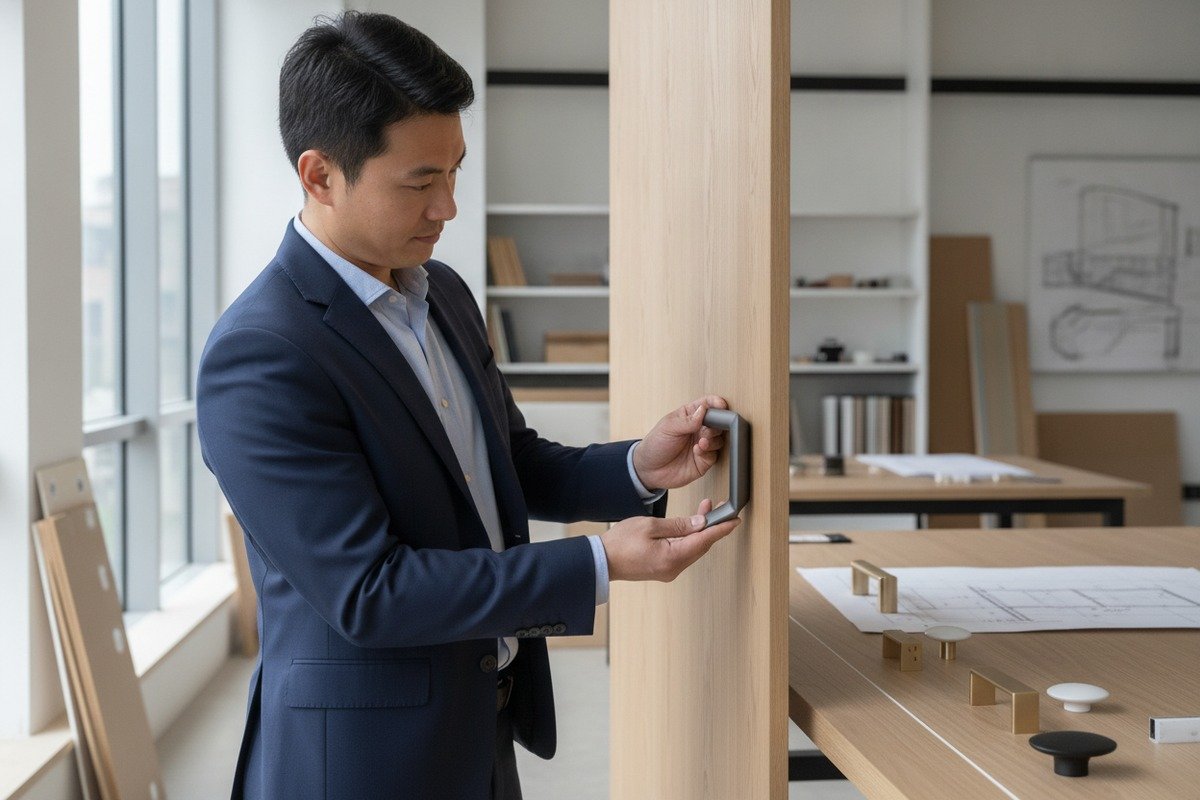
Every week, our production team in Foshan processes orders where buyers pick a handle length based on spec sheets alone—then regret the choice once it is installed on actual furniture fronts. aluminum furniture handle 1
To evaluate how different aluminum handle lengths affect furniture appearance when sourcing, judge each length against the scale of the cabinet or drawer front, assess visual weight and style alignment, then verify proportions with physical samples installed on real furniture—not just by reading dimensions on paper.
Handle length is one of the most underestimated decisions in furniture hardware sourcing. Below, we break down the exact principles, ratios, and testing methods you need to get this right before placing a bulk order.
How Do I Determine the Ideal Handle-to-Door Ratio to Ensure My Furniture Looks Well-Proportioned?
Getting the ratio wrong is one of the fastest ways to make quality furniture look cheap. Ideal Handle-to-Door Ratio 2 We see this mistake repeat itself across orders from factories in Vietnam and the Middle East every single month.
The ideal handle-to-door ratio depends on the furniture face size: for drawers, the handle should be roughly one-third of the drawer width; for tall doors, use handles that span one-quarter to one-third of the door height to maintain balanced, intentional proportions.
Why Proportion Is the Starting Point
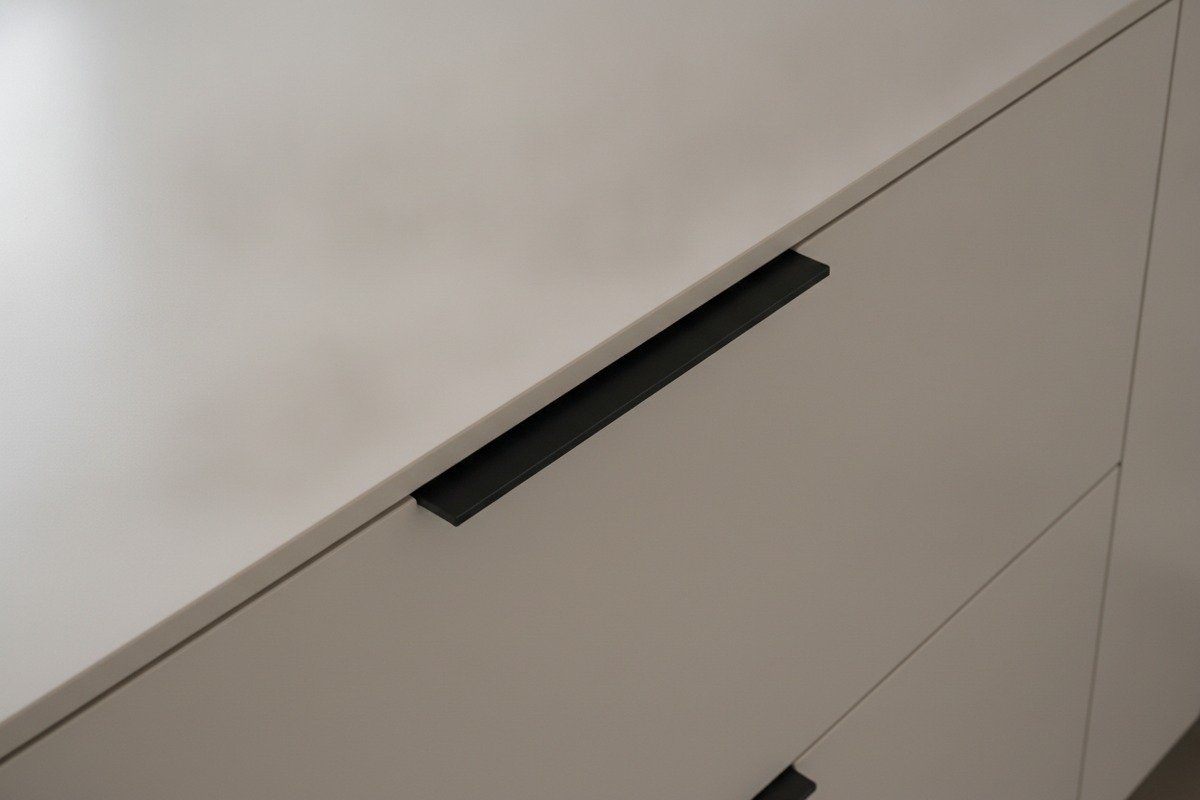
Proportion is the first thing the human eye evaluates—before finish, before color, before texture. A handle that is too short for a wide drawer front looks like an afterthought. A handle that is too long for a small cabinet door feels aggressive and heavy. The goal is simple: the handle should look like it belongs on the furniture, not like it was borrowed from a different piece.
In our experience exporting recessed aluminum profiles 3 and slim architectural pulls, the one-third rule for drawer width is the most reliable starting point. It is not rigid. But it works as a baseline for nearly every modern furniture style 4.
Practical Ratio Guidelines
Here is a quick reference table based on common furniture dimensions we encounter in custom orders:
| Furniture Front Type | Front Width / Height | Recommended Handle Length | Ratio Used |
|---|---|---|---|
| Small drawer | 300–450 mm wide | 96–128 mm | ~1/3 of width |
| Medium drawer | 500–700 mm wide | 160–224 mm | ~1/3 of width |
| Wide drawer | 750–1000 mm wide | 256–320 mm | ~1/3 of width |
| Standard cabinet door | 400–500 mm tall | 128–160 mm | ~1/3 of height |
| Tall pantry door | 1200–2000 mm tall | 400–600 mm | ~1/4 to 1/3 of height |
What Happens When You Ignore the Ratio
When the handle is undersized—say a 96 mm pull on a 900 mm wide drawer—the furniture face looks empty and unfinished. The eye searches for something to anchor to and finds nothing substantial. In contrast, mounting a 450 mm handle on a 400 mm wide cabinet door makes the hardware dominate the furniture. The piece feels crowded.
How to Test Before You Commit
Before finalizing a bulk sourcing order, request two or three sample lengths from your supplier. Mount them on an actual furniture front. Step back two to three meters and look. The right handle should feel invisible in terms of proportion—it should not jump out, and it should not disappear. This step takes 15 minutes but saves thousands of dollars in regret.
Our team often ships sample sets specifically so factory buyers can do this comparison on their own production lines before committing to a container load.
Will Choosing Full-Length Aluminum Profiles Give My Custom Cabinets a More Modern, High-End Aesthetic?
Full-length profiles are one of the most requested items on our production line right now. Furniture factories in the Middle East especially favor them for kitchens and wardrobes targeting the premium residential market.
Yes, full-length aluminum profiles typically deliver a more modern and high-end aesthetic because they create continuous horizontal or vertical lines that visually unify the cabinet front, eliminate visual interruption, and give the furniture a seamless, architectural quality.
The Visual Logic Behind Full-Length Handles
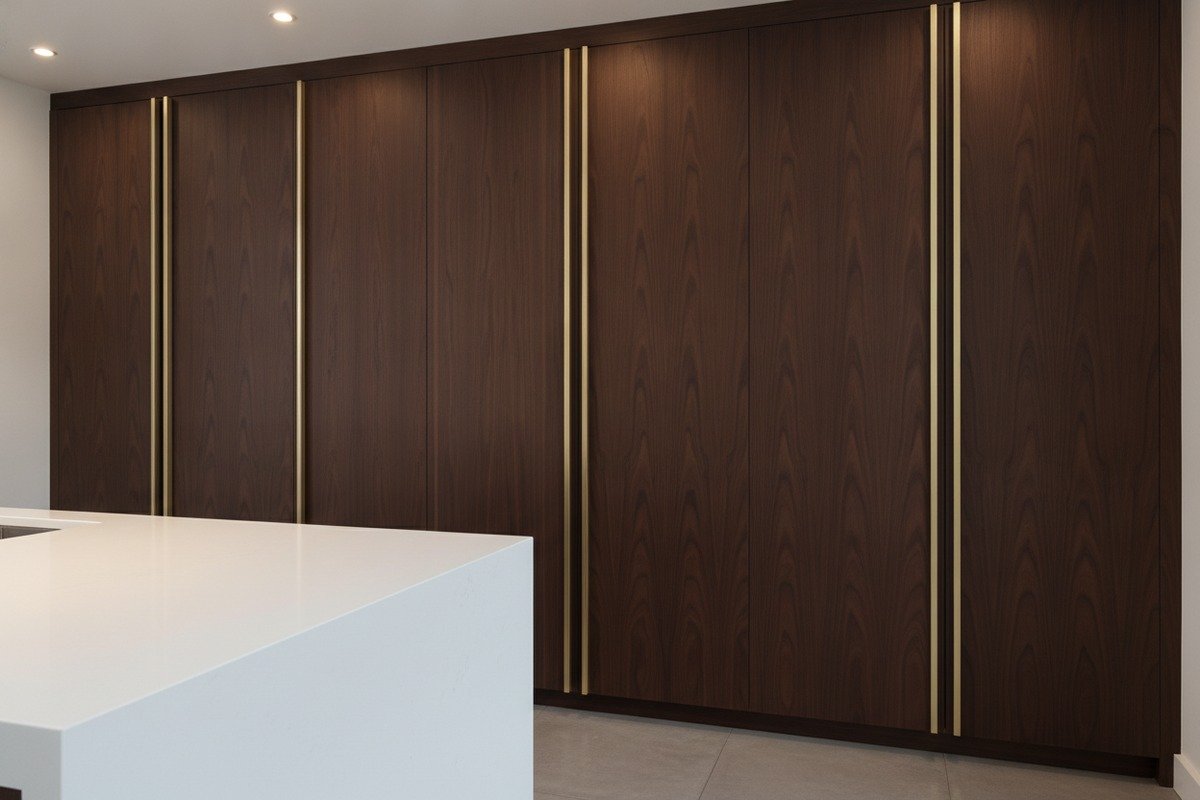
A full-length handle—running the entire width or height of the furniture front—turns hardware into an integrated design element 5 rather than an accessory. It eliminates the start-and-stop effect that shorter handles create. The eye reads a single clean line from edge to edge. This is the same principle architects use when they run trim or molding continuously across a wall: it reads as intentional, confident, and designed.
Our champagne gold anodized profiles and matte charcoal grey recessed pulls are popular precisely for this reason. The slim rectangular form with a deep geometric channel creates a shadow line that adds depth without adding bulk.
When Full-Length Works Best
Full-length aluminum handles are most effective in these scenarios:
- Handleless-look kitchens where the handle integrates into the top or bottom edge of the door
- Wide base cabinets and island drawers where a single line anchors the visual mass
- Floor-to-ceiling wardrobes where vertical continuity matters
- Minimalist or contemporary furniture collections where clean geometry defines the style
When Full-Length Can Backfire
Full-length is not always the answer. On very small cabinet doors—under 350 mm wide—a full-length handle can feel like overkill. The hardware becomes the entire visual identity of the piece, and the panel itself disappears. Also, if the aluminum profile is too thick or heavy in cross-section, a long run amplifies the visual weight. A 3-meter extruded handle in a chunky profile will make the furniture feel industrial, not elegant.
Profile Thickness Matters as Much as Length
This is a critical sourcing nuance. With aluminum, length and profile cross-section are linked. A long handle with a thin, crisp L-shaped profile can look refined and elegant. The same length in a 20 mm thick bar profile can overpower the furniture front. When evaluating full-length options, always ask for the cross-section drawing, not just the length specification.
| Profile Type | Cross-Section Depth | Best Use Case | Visual Effect |
|---|---|---|---|
| Slim recessed (L-shaped) | 8–12 mm | Handleless kitchens, modern wardrobes | Clean shadow line, minimal visual weight |
| Medium bar pull | 12–18 mm | Standard drawers, cabinet doors | Balanced presence, moderate visual weight |
| Thick architectural rail | 18–25 mm | Commercial furniture, heavy doors | Strong statement, can feel industrial |
Finish Considerations for Full-Length Profiles
Because the handle runs the full width or height, any finish imperfection is magnified. A small scratch or anodizing inconsistency 6 that is invisible on a 128 mm pull becomes very noticeable across 900 mm. When sourcing full-length aluminum profiles 7, insist on inspecting finish consistency across the entire run length. Our quality control team checks every piece under direct light at a 45-degree angle for exactly this reason.
Can I Source Custom-Cut Lengths From My Supplier to Fit My Factory's Unique Furniture Designs?
One of the biggest frustrations our buyers share is being forced to choose from fixed catalog lengths that do not match their furniture dimensions. This is especially common when sourcing from large trading companies that only stock standard sizes.
Yes, reputable aluminum handle suppliers—especially manufacturers with in-house extrusion and cutting capability—can provide custom-cut lengths tailored to your exact furniture dimensions, often with turnaround times of 3 to 7 days for non-stock sizes and reasonable minimum order quantities.
Why Custom Cutting Changes the Game
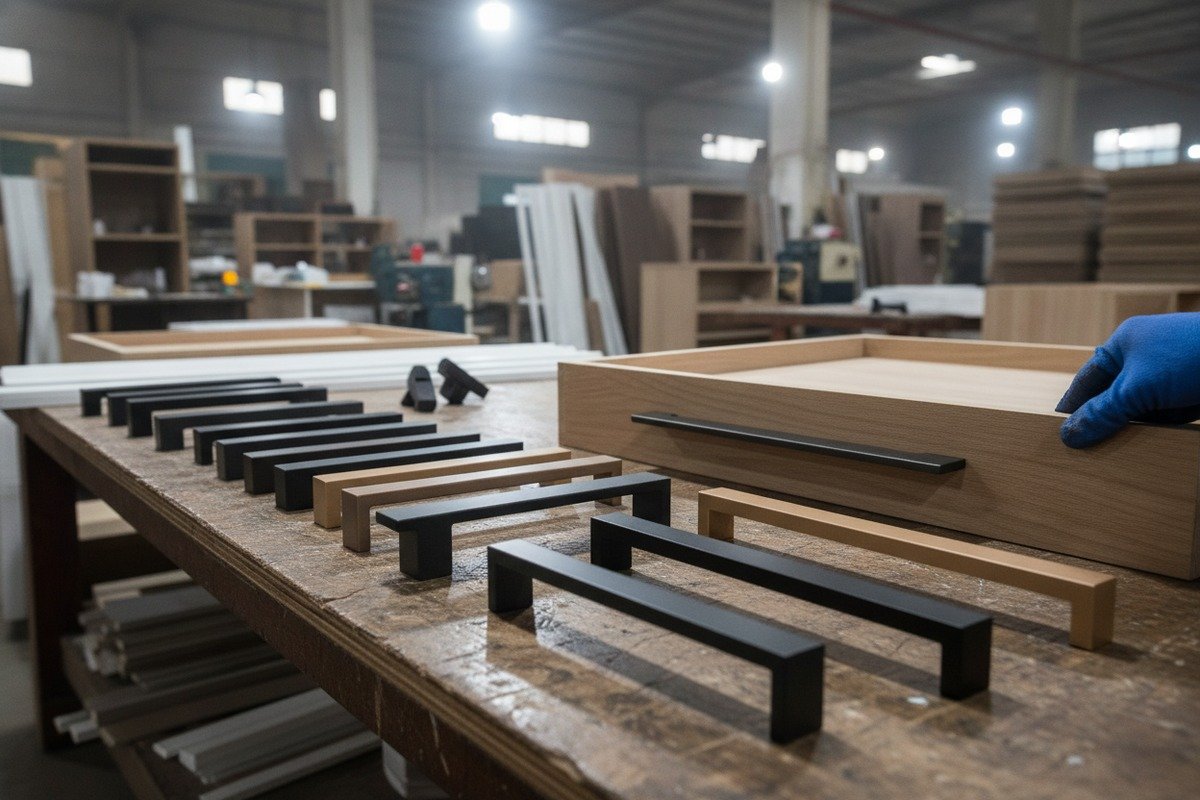
Standard catalog lengths—96 mm, 128 mm, 160 mm, 256 mm, 320 mm—cover many needs. But furniture factories building custom kitchens, wardrobes, or vanities frequently need lengths that fall between or beyond these standards. A 740 mm wide island drawer does not look right with a 256 mm handle or a 320 mm handle. It needs something closer to 240 mm or 280 mm—or even a full 700 mm run.
When your supplier can cut to your specification, you gain full control over proportion. You are no longer designing around the hardware catalog. The hardware serves the furniture, not the other way around.
What to Ask Your Supplier
Before committing to a custom-cut order, clarify these points:
- Minimum order quantity per length: Some factories require 200 pieces per custom length. Minimum order quantity 8 Others, like our facility, can accommodate smaller runs for sample or trial orders.
- Tolerance: Ask for the cutting tolerance. For aluminum profiles, ±0.5 mm is standard. Anything above ±1 mm will cause visible inconsistency across a row of cabinets.
- End finishing: When aluminum profiles are cut to length, the raw cut edge needs deburring and sometimes end-cap installation. Confirm whether your supplier includes this in the price or charges extra.
- Lead time: Stock items might ship in 48 hours. Custom-cut lengths typically take 3 to 7 working days, depending on volume and finishing requirements.
End Caps and Edge Safety
This is a detail many buyers overlook during sourcing but regret during installation. A cleanly cut aluminum profile should have smooth, rounded, or capped ends. Sharp edges on a 600 mm kitchen handle are a safety hazard—especially in homes with children. When sourcing custom-cut lengths, always request a sample of the finished end before approving production.
Our engineering team recommends either integrated radius ends (where the profile is designed to self-close) or snap-on end caps in matching finish. Both options add less than $0.05 per piece to the unit cost but dramatically improve the look and safety of the installed handle.
Cost Implications of Custom Lengths
| Order Type | Typical MOQ | Lead Time | Unit Cost Impact |
|---|---|---|---|
| Stock standard length | 50–100 pcs | 48 hours | Base price |
| Custom cut from stock profile | 100–200 pcs | 3–5 days | +5–10% |
| Custom extrusion + custom cut | 500–1000 pcs | 15–25 days | +15–25% |
Custom cutting from an existing profile shape is much cheaper and faster than creating a new extrusion die. If your design uses a standard cross-section but needs a non-standard length, this is the most cost-effective path.
Practical Tip: Order a Length Kit
When working with a new supplier, request a "length kit"—a set of 5 to 8 handles in graduated lengths, all using the same profile and finish. Mount each one on your actual furniture fronts. Photograph the results. This simple exercise removes all guesswork and gives your design team a clear visual reference for future orders.
How Does the Handle Length Affect the Visual Consistency Across My Entire Furniture Collection?
When we review bulk orders from furniture factories, the most common design problem is not a single bad handle choice—it is inconsistency across the collection. A kitchen with three different handle lengths on doors, drawers, and pantry units can look fragmented even if each individual handle is well-proportioned.
Handle length directly controls visual consistency: using one or two standardized lengths across an entire furniture collection creates a unified rhythm and professional appearance, while mixing too many lengths without a clear design rationale fragments the look and lowers perceived quality.

The Concept of Visual Rhythm
Think of a row of cabinets like a musical phrase. Visual Rhythm 9 Each handle is a beat. When the beats are evenly spaced and similarly sized, the phrase feels coherent. When they jump around—a 96 mm here, a 320 mm there, a full-length pull on the next unit—the rhythm breaks. The eye has no pattern to follow. The furniture looks assembled from parts rather than designed as a whole.
This is why many high-end kitchen and wardrobe brands limit their collections to one or two handle lengths. They pick one length for drawers and one for doors. Some use the same length everywhere and rely on orientation—horizontal for drawers, vertical for doors—to differentiate.
One Length vs. Two Lengths vs. Many
Here is a decision framework we share with our factory buyers:
| Strategy | Best For | Risk Level | Visual Effect |
|---|---|---|---|
| Single length everywhere | Ultra-minimalist, handleless-look collections | Low risk | Maximum uniformity, very clean |
| Two lengths (one for drawers, one for doors) | Modern kitchens, bedroom wardrobes | Low to medium risk | Balanced variety with clear logic |
| Three or more lengths | Custom-designed furniture with varied front sizes | Medium to high risk | Can look intentional or chaotic depending on execution |
How to Manage Multiple Lengths Without Losing Cohesion
If your furniture designs require three or more handle lengths, follow these rules to maintain visual consistency:
- Keep the profile and finish identical. Length can vary, but the cross-section shape, color, and surface texture must match across every piece.
- Use length differences that are clearly intentional. A 128 mm and a 160 mm handle look almost the same from across a room—it reads as a mistake, not a choice. If you vary length, make the difference obvious: 128 mm and 320 mm, for example.
- Align handles on a common centerline. When handles of different lengths share a horizontal or vertical center axis, the collection reads as organized even with mixed lengths.
- Test the full collection together, not piece by piece. Set up all furniture units side by side and evaluate the handle layout from 2 to 3 meters away. This
Footnotes
1. Provides general information on aluminum handles in furniture manufacturing. ↩︎
2. Explains the importance of proper handle-to-door ratios in furniture design. ↩︎
3. Details the characteristics and applications of recessed aluminum profiles in design. ↩︎
4. Defines characteristics and trends in modern furniture design and aesthetics. ↩︎
5. Explains what integrated furniture is and its benefits, aligning with the concept of design elements integrated into furniture. ↩︎
6. Describes potential issues and quality control in the anodizing process for aluminum. ↩︎
7. Discusses the aesthetic and functional aspects of full-length aluminum profiles in cabinetry. ↩︎
8. Provides information on typical minimum order quantities (MOQ) in manufacturing and sourcing. ↩︎
9. Explains the concept of visual rhythm as a design principle and its impact on aesthetics. ↩︎