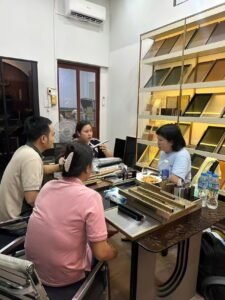
Over the past 18 years, our Foshan production floor has hosted hundreds of buyers who came to see exactly how we make aluminum furniture handles — and the ones who arrived with a structured plan always left with better outcomes.
To arrange an effective on-site factory inspection, you should plan three stages: a supplier audit to verify legitimacy and capacity, a pre-production check to confirm raw materials and tooling, and an in-process or pre-shipment inspection to catch defects before goods leave the factory. Each stage requires a tailored checklist focused on aluminum alloy control, surface finish, dimensional accuracy, and packaging integrity.
This guide walks you through every step — from booking your Foshan trip to writing the final inspection report China’s National Enterprise Credit Information Publicity System 1. Whether you plan to visit yourself or send a third-party inspector, the framework below will help you avoid the most common sourcing mistakes with aluminum handles.
What steps should I take to prepare for a successful on-site visit to a Foshan aluminum handle factory?
Many buyers treat a factory visit like a casual tour extrusion or die-casting 2. That mindset leads to wasted flights and missed red flags. When we welcome procurement teams at our facility, the best-prepared visitors always bring documents, tools, and a clear agenda.
Before visiting a Foshan aluminum handle factory, you should verify the supplier's business license, prepare a detailed inspection checklist, share your product drawings and approved samples in advance, pack calibrated measuring tools, and schedule the visit during active production — not during a holiday shutdown or between orders.

Verify the Supplier Before You Book a Flight
Start with desktop research. Ask the supplier for their business license, export license, and any ISO or quality system certificates 3. Cross-check the company name on China's National Enterprise Credit Information Publicity System. Confirm the factory address on Google Maps or Baidu Maps. If the listed address is a residential building or a tiny office, that is a red flag. You want to see an industrial zone address in Foshan, which is China's main hub for aluminum processing and furniture hardware.
Build Your Inspection Checklist Early
Do not arrive empty-handed. Write a checklist that covers both the factory and the product. Below is a preparation checklist you can adapt.
| Preparation Item | Details | Why It Matters |
|---|---|---|
| Approved sample | Bring the physical golden sample or a detailed photo set | Serves as the visual and dimensional benchmark |
| Product drawing with tolerances | Include center-to-center distance, hole diameter, profile cross-section | Prevents disputes over "close enough" dimensions |
| Material specification | Alloy grade (e.g., 6063-T5 4), surface treatment spec | Confirms the factory uses the correct aluminum |
| Measuring tools | Digital caliper, feeler gauge, surface roughness tester | Enables on-the-spot dimensional verification |
| AQL sampling plan 5 | Inspection level, acceptance limits, defect classification | Sets the statistical basis for pass/fail decisions |
| Communication plan | WeChat or WhatsApp contact for factory liaison, translator if needed | Avoids delays and misunderstandings on-site |
Choose the Right Timing
Timing matters more than most buyers realize. If you visit when the factory has no active orders, you will see idle machines and clean floors — but you will learn nothing about real production quality. Schedule your visit when your order (or a similar order) is running on the line. For our factory, the busiest production months are March through June and September through November. Visiting during these windows gives you the most honest view of capacity, workflow, and worker skill.
Also confirm that your visit does not fall on Chinese public holidays. Chinese New Year 6 (late January or February) shuts down most factories for two to four weeks. The Golden Week in early October is another dead period.
Share Specs in Advance
Send your drawings, material requirements, finish expectations, and packaging standards to the factory at least one week before your visit. This gives the engineering team time to prepare samples, pull production records, and set up a meaningful walkthrough. If the factory cannot produce a sample or answer basic technical questions before you arrive, that tells you something important about their capability.
What specific production and quality control processes should I observe during my factory inspection?
When our production line is running recessed aluminum handles — the kind with a deep geometric channel and a sharp L-shaped cross-section — every step from extrusion to anodizing affects the final product. Skipping even one observation point can mean you miss the root cause of future defects.
During your factory inspection, observe the full process chain: aluminum billet storage and alloy verification, extrusion or die-casting, CNC cutting and drilling, deburring, surface treatment (anodizing, powder coating, or electrophoresis), color matching, final assembly, quality checkpoints at each stage, and packaging. Pay special attention to surface finish consistency and dimensional control.
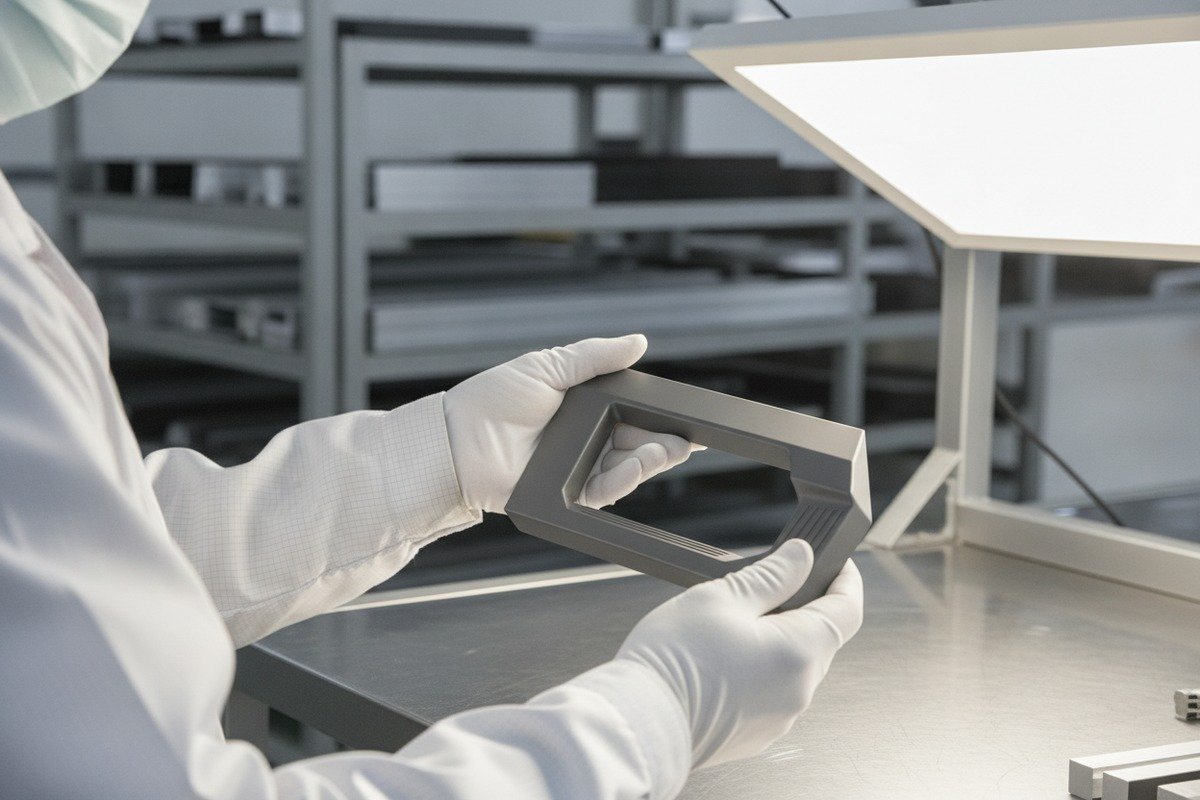
Follow the Material from Start to Finish
A proper inspection is not a conference room presentation. Walk the factory floor in the order that material flows. Start at the raw material warehouse. Check the aluminum billets or bars. Ask to see the mill certificates that confirm alloy grade and temper. For furniture handles, 6063-T5 is common because it extrudes well and accepts anodizing cleanly. If the factory cannot show you material certificates, that is a warning sign.
Key Production Stages to Watch
Move from raw material to each processing station. Here is what to look for at each stage.
| Production Stage | What to Observe | Common Defects to Watch For |
|---|---|---|
| Extrusion | Die condition, extrusion speed, cooling method | Dimensional drift, surface lines, twist |
| CNC Cutting | Blade condition, fixture accuracy, cut length consistency | Length variation, burrs on cut ends |
| Drilling / Tapping | Drill bit condition, fixture alignment, hole position accuracy | Off-center holes, thread damage, metal chips in holes |
| Deburring | Method (tumbling, manual, CNC), edge smoothness | Sharp edges, inconsistent radius, scratches |
| Surface Treatment | Bath chemistry, rack loading, oven temperature, timing | Orange peel, bubbles, color inconsistency, poor adhesion |
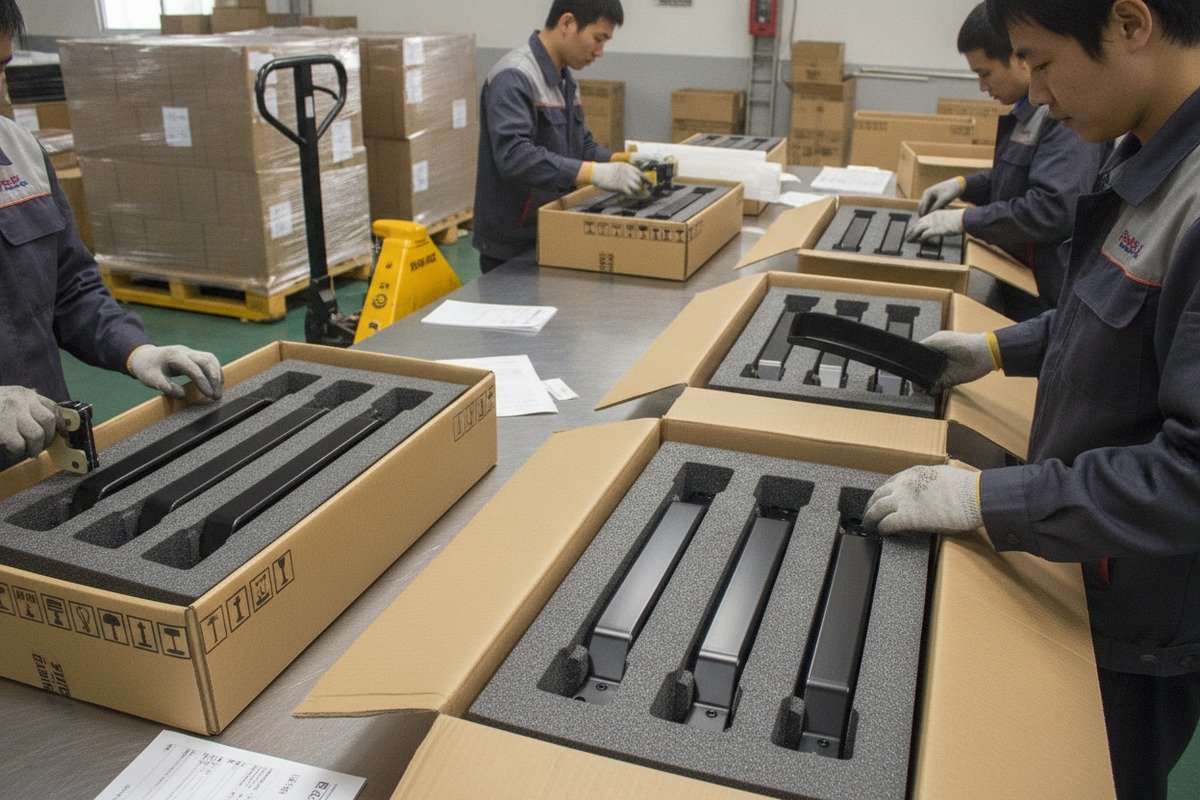
| Packaging | Protective film, foam separation, carton strength | Scratches from handle-to-handle contact, dents in transit |
Inspect the Quality Control System
Look beyond the production line. Ask to see the QC room. A capable factory will have calibrated measuring instruments, a light box for color comparison, and documented inspection records. Ask how often they calibrate their tools. Ask to see the rejection log — how many pieces per batch fail, and what happens to them. A factory that claims zero defects is not being honest. A factory that tracks defects and shows corrective actions is trustworthy.
Surface Finish Deserves Extra Attention
For aluminum furniture handles, the surface finish is the first thing your customer sees. Whether the handle has a matte champagne gold anodized finish or a charcoal grey powder coat, you need to verify consistency. Check at least five pieces from different production batches under the same lighting. Look for scratches, pits, color variation, gloss differences, and coating thickness. If the factory uses anodizing, ask about the oxide layer thickness 7 — for architectural-grade handles, 10 to 15 microns is a reasonable minimum.
In-Process vs. Final Inspection
Many buyers only inspect finished goods. That is a mistake. In-process inspection catches problems when they are cheap to fix. If you find a drilling error after 5,000 handles are anodized and packed, the rework cost is enormous. If you catch it after the first 200 pieces, the factory adjusts the fixture and continues. This is why we encourage buyers to define at least two inspection checkpoints: one after machining and one after surface treatment.
How can I verify the supplier's actual manufacturing capacity and ready-to-ship inventory while on-site?
One frustration we hear from buyers is discovering — too late — that their "factory" is actually a trading company that outsources everything. With 300 tons of ready-to-ship inventory in our own warehouse, we welcome buyers to count, measure, and verify. But not every supplier operates this way.
To verify real capacity, count the production machines and check their condition, ask for recent production logs showing daily output, inspect the finished goods warehouse for actual stock levels, cross-check inventory labels against your order specifications, and request to see the factory's order book or shipping records from the past three months. Real manufacturers can show you these without hesitation.
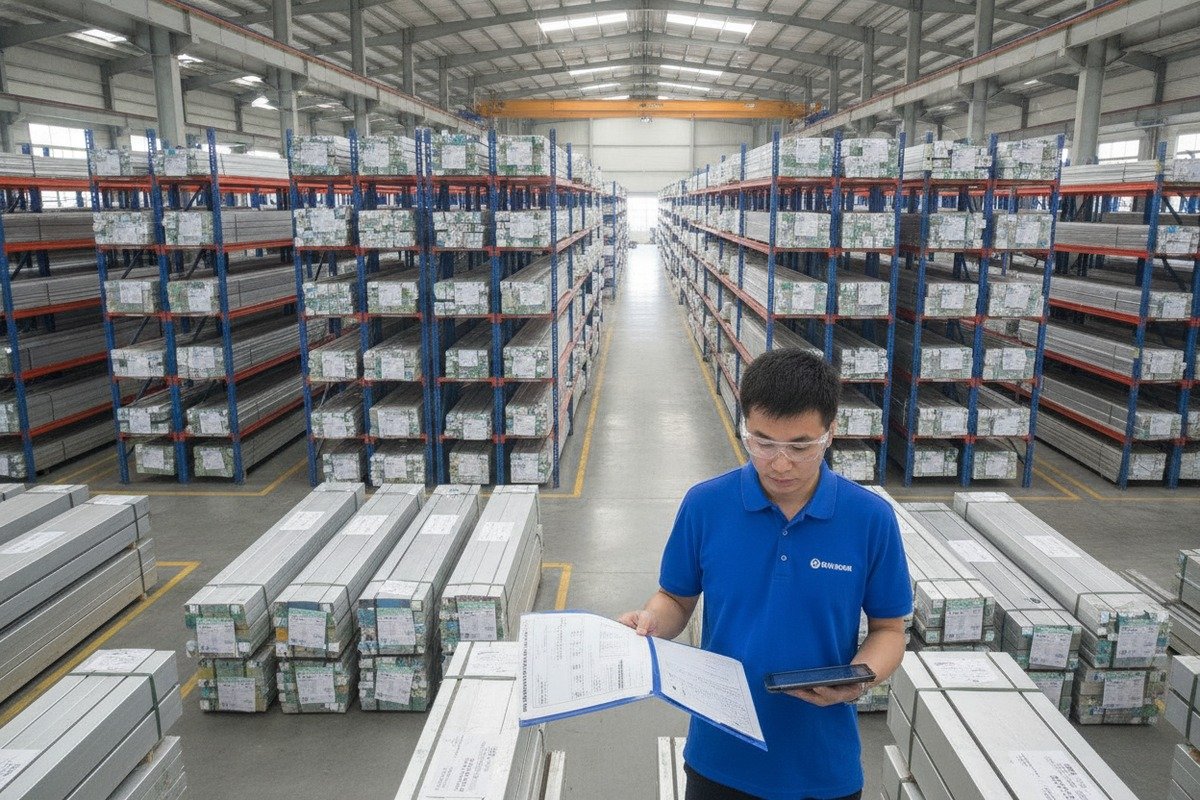
Count Machines and Measure Utilization
Walk through the production area and count the extrusion presses, CNC machines, anodizing lines, and powder coating 8 ovens. Ask about each machine's daily run time. A factory with five CNC centers running two shifts can produce far more than a factory with two machines on one shift. Ask to see the maintenance log for key machines. Well-maintained equipment produces consistent parts. Neglected machines drift out of tolerance.
Check the Warehouse Honestly
Go into the finished goods warehouse. Do not just look — open cartons. Check whether the handles inside match the labels. Verify quantities in a few randomly selected cartons. For a supplier that claims 300 tons of ready stock, you should see organized racks, clear labeling by SKU, and a system for first-in-first-out inventory rotation.
Cross-Reference Documents
Ask for shipping records from the last three to six months. A real manufacturer can show you bills of lading 9, packing lists, and commercial invoices. Look at the destination countries, order volumes, and product types. This tells you whether the factory actually exports aluminum handles or merely claims to.
| Verification Method | What It Reveals | Red Flag If Missing |
|---|---|---|
| Machine count and condition | Real production capacity | Few machines or visibly idle/broken equipment |
| Daily production log | Actual output per shift | No records or vague verbal claims |
| Warehouse walk-through | Real inventory levels and organization | Empty shelves, mismatched labels, dusty stock |
| Shipping records (3–6 months) | Export experience and order consistency | Refusal to share or inconsistent documentation |
| Worker headcount | Labor capacity and skill level | Very few workers relative to claimed output |
| Subcontractor disclosure | Whether key steps are outsourced | Evasive answers about finishing or machining sources |
Ask About Subcontracting
Some factories handle extrusion in-house but outsource anodizing or powder coating. This is not necessarily bad, but you need to know. If the surface treatment is done off-site, ask where. If possible, visit that subcontractor too. Quality problems often originate at subcontracted steps because the main factory has less control over the process.
Evaluate Lead Time Realism
Ask the factory to walk you through the production timeline for a typical order. From order confirmation to shipment, how many days does each step take? Compare this to the lead time they quoted you. If they promised 7 days but the anodizing subcontractor alone needs 5 days, the math does not work. A factory that gives realistic lead times is more reliable than one that promises impossible speed.
What technical questions should I ask the factory's engineering team about my custom handle requirements?
Our engineering team fields technical questions from overseas buyers every week. The buyers who ask the right questions end up with better products and fewer surprises. The ones who only discuss price often face problems later.
Ask the factory's engineers about their extrusion die design capability, the aluminum alloy grades they stock, their tolerance control methods for center-to-center drilling distance, the surface treatment options and their durability ratings, minimum order quantities for custom profiles, how they handle color matching across production batches, and their process for prototyping and sample approval before mass production.
Questions About Material and Alloy
Start with the basics. Ask which aluminum alloys the factory uses for furniture handles and why. 6063-T5 is the industry standard for extruded handles because it balances strength, extrudability, and surface finish quality. If your handle requires higher strength — for example, a long architectural pull that bears load — ask whether they can work with 6061-T6. Ask how they verify incoming aluminum billets. Do they test hardness? Do they require mill certificates from their aluminum supplier?
Questions About Tooling and Dies
If you need a custom profile — like the recessed, L-shaped cross-section handle with a deep finger channel — ask about die design. Who designs the die? How long does die fabrication take? What is the die life before it needs replacement? A good extruder will tell you a die lasts 3 to 10 tons depending on complexity. Ask who owns the die after production. In many Chinese factories, the buyer pays for the die but the factory keeps physical custody. Clarify this upfront.
Questions About Tolerance and Fit
For handles, the center-to-center hole distance is critical. If your handle mounts on a cabinet door with pre-drilled holes, even a 0.5 mm deviation can cause installation problems. Ask how they control this tolerance. Do they use CNC drilling with fixture jigs? How often do they verify the jig with a calibrated gauge? Ask what their standard tolerance is — for aluminum furniture handles, ±0.2 mm on hole positions is a reasonable expectation for quality production.
Questions About Surface Treatment Durability
Your end customers will touch these handles thousands of times. Ask about coating adhesion, salt spray resistance, and UV stability. For anodized handles, ask about the oxide layer thickness and sealing method. For powder-coated handles, ask about the coating thickness (typically 60–80 microns for furniture hardware) and the cross-hatch adhesion test result. If you are sourcing matte finishes in colors like champagne gold or charcoal grey, ask how they ensure batch-to-batch color consistency. Do they use a spectrophotometer, or do they rely on visual comparison only?
Questions About Prototyping and Approval
Ask how many sample rounds are included before mass production. Ask how long each sample takes. At our facility, a custom handle sample typically takes 3 to 7 days after die completion. Ask whether the sample is made on the actual production line or hand-finished in a lab. A lab-made sample may look perfect but not represent what the production line can achieve consistently.
Questions About Intellectual Property
If your handle design is proprietary, ask what measures the factory takes to protect your design files, drawings, and tooling. Do they sign non-disclosure agreements 10? Do they segregate your dies from other customers' tooling? This is especially important for custom architectural handles with unique profiles.
Summary of Key Technical Questions
| Topic | Question to Ask | What a Good Answer Looks Like |
|---|---|---|
| Alloy | What alloy grade do you use for extruded handles? | "6063-T5 for standard handles; we can source 6061-T6 for structural applications." |
| Tolerance | What is your standard tolerance on hole center distance? | "±0.2 mm using CNC drilling with fixture jigs, verified every 50 pieces." |
| Surface treatment | What is the anodized layer thickness? | "12–15 microns with hot-water sealing for furniture-grade handles." |
| Color control | How do you match color across batches? | "We use a spectrophotometer and keep a master color sample on file." |
| Die ownership | Who owns the extrusion die? | "The buyer pays for the die; we store it on-site and it is exclusive to your order." |
| Prototyping | How many days for a custom sample? | "3–7 days after die is ready, made on the production line, not hand-finished." |
| IP protection | Do you sign NDAs and segregate tooling? | "Yes. We sign NDAs, store dies in a locked area, and do not share designs." |
Footnotes
1. Provides information on China’s official government database for enterprise registration and credit. ↩︎
2. Compares and contrasts the manufacturing processes of die casting and metal extrusion. ↩︎
3. Explains ISO 9001 certification as a framework for quality management systems. ↩︎
4. Details the properties, composition, and common applications of the 6063-T5 aluminum alloy. ↩︎
5. Defines Acceptable Quality Level (AQL) as a statistical tool for quality control sampling plans. ↩︎
6. Explains the impact of Chinese New Year on factory shutdowns and supply chain operations. ↩︎
7. Explains the concept of oxide layer thickness in anodizing and its importance for durability. ↩︎
8. Describes the powder coating process, its applications, and advantages as a finishing method. ↩︎
9. Defines a bill of lading as a legal instrument used in transportation and shipping. ↩︎
10. Explains the purpose of non-disclosure agreements in protecting confidential business information. ↩︎