I watched a batch of 5,000 zinc alloy handles fail quality checks last month. The bubbling appeared three weeks after surface treatment. Our customer in Ho Chi Minh City had already paid the deposit.
Aluminum handles outperform zinc alloy in batch production because their surface treatment stays predictable at scale. I've managed cabinet handle manufacturing for 18 years, and the real difference isn't raw strength—it's how each material behaves when you need consistent quality across thousands of units.
 Quality difference between aluminum and zinc alloy handles in production")
You're choosing between two materials that look identical in samples but behave very differently when your order hits 1,000 pieces. Let me show you what happens in our factory.
What Makes 18 Years Manufacturing Experience Matter in Material Choice?
I started at our Foshan factory when zinc alloy was the default choice. Everyone wanted it. It looked premium in showrooms.
Manufacturing experience reveals that material problems don't show up in samples—they appear at production scale. I've rejected more zinc alloy batches for surface defects than I can count, while aluminum maintains quality predictability across large orders.

The Hidden Cost Pattern I See Every Quarter
Here's what actually happens when we run both materials through our production line:
| Quality Check Point | Aluminum Handles | Zinc Alloy Handles |
|---|---|---|
| Pre-treatment surface prep | Stable across batches | Varies with casting quality |
| Coating adhesion failure rate | 0.8-1.2% typical | 3.5-6.8% typical |
| Post-humidity chamber inspection | Predictable aging patterns | Interface corrosion appears |
| Customer complaint triggers | Installation damage visible | Delayed oxidation after install |
| Rework cost per 1000 units | $180-220 labor + materials | $420-580 labor + materials |
I'm not saying zinc alloy fails every time. I'm saying when it fails, you can't see it coming. Last year we had three batches pass our 48-hour salt spray test, then customers reported bubbling after two months in Dubai warehouses. The humidity got into the coating-substrate interface. Aluminum showed surface oxidation in the same conditions, but the coating stayed attached.
The difference matters most when you're ordering 2,000+ handles. With aluminum, if I see a problem in the first 100 pieces, I know what I'm fixing. With zinc alloy, everything can look perfect until it doesn't. That's the experience cost—I've learned to predict aluminum's behavior patterns, but zinc alloy still surprises me.
How Does Our 5000㎡ Factory With CNC Machining Change Material Performance?
Our CNC equipment can work both materials. But they respond differently to precision machining, and that affects your final product consistency.
Factory-scale CNC machining exposes material behavior differences that matter for batch orders. Aluminum maintains dimensional tolerance tighter than zinc alloy because its machining properties stay consistent, which means fewer rejected pieces in large production runs.
![CNC machining precision for aluminum cabinet handles]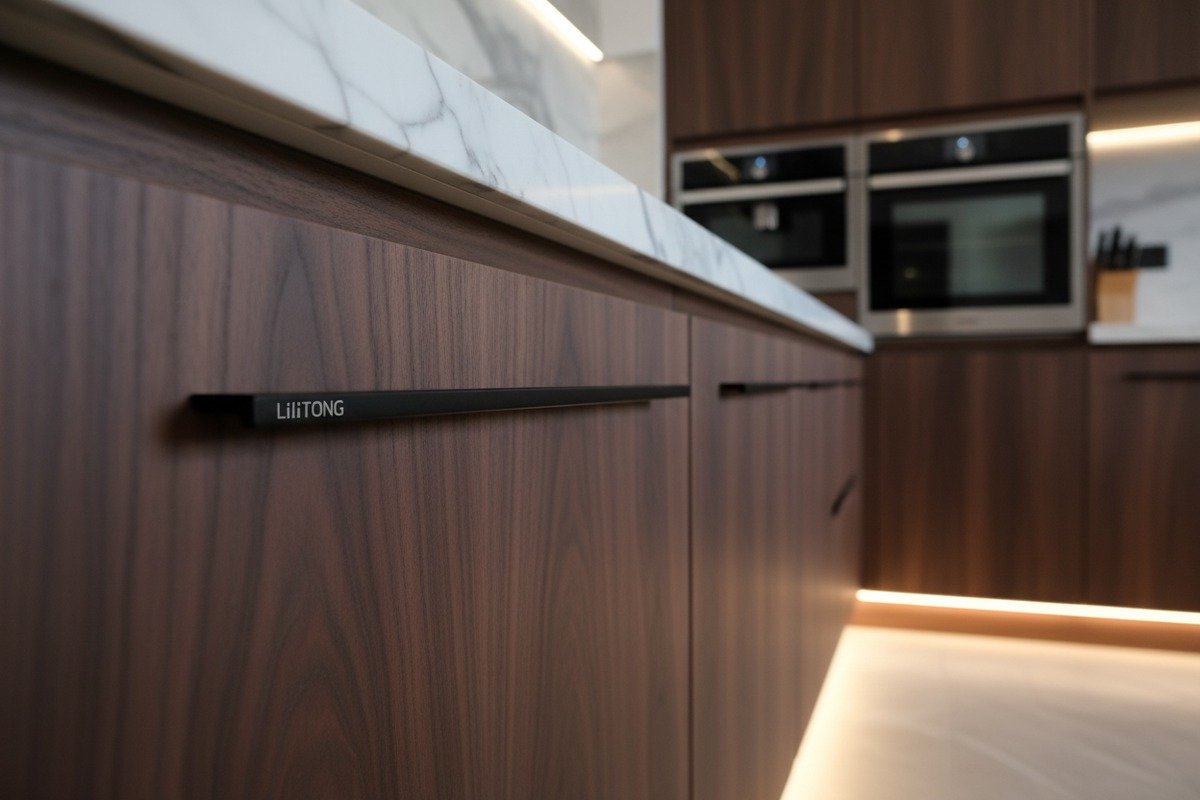 "CNC equipment processing aluminum handles with precision")
What Happens When We Machine 1000 Handles
I stand at our CNC stations twice a week to check tool wear patterns. Here's what I notice:
Aluminum cuts clean. The chips curl away consistently. Tool bits last longer. When I measure handle dimensions at piece #50 and piece #950 in a production run, they match within 0.05mm. That matters for furniture manufacturers who need handles to align across 50 cabinet doors.
Zinc alloy creates more variables. The casting structure isn't uniform—some areas machine harder than others. This isn't because zinc alloy is "bad." It's because the die-casting process creates internal grain patterns that aluminum extrusion doesn't have. When our tools hit these variations, the surface finish changes slightly.
| Machining Factor | Impact on Aluminum | Impact on Zinc Alloy |
|---|---|---|
| Tool wear rate | 12-15 hours between changes | 8-11 hours between changes |
| Surface finish consistency | Consistent across batch | Requires mid-batch adjustment |
| Dimensional drift in long runs | Minimal (±0.03mm) | Moderate (±0.08mm) |
| Edge quality after drilling | Clean, no burrs | Requires deburring step |
| Tolerance holding in production | Holds to piece #1000+ | Quality checks every 200 pieces |
This doesn't mean we can't produce quality zinc alloy handles. We do. But I need to stop production twice as often to verify dimensions. That increases your per-piece cost even though the raw material is cheaper. For wholesale buyers who need 3,000 handles to match perfectly, aluminum gives me confidence I can hit your spec without surprises.
Why Does 300T+ Stock Available Matter More for Aluminum?
We keep 300+ tons of material in stock because our customers need fast turnarounds. But stocking both materials taught me something about stability.
Large material inventory reveals storage behavior differences—aluminum stock maintains consistent processing quality for months, while zinc alloy raw materials require fresher batches to avoid surface treatment complications during production.
 "Factory warehouse showing aluminum and zinc alloy material inventory")
The Storage Problem Nobody Tells Wholesale Buyers
I learned this the expensive way five years ago. We had zinc alloy ingots sitting for four months. When we ran them through production, the oxidation layer that formed during storage interfered with our surface treatment adhesion. The parts looked fine until the paint started peeling three weeks later.
Aluminum doesn't do this. It forms a natural oxide layer immediately, but that layer is stable. It doesn't keep growing. It actually helps the subsequent coating process. When I pull aluminum from stock that's been sitting for six months, it processes the same as fresh material.
This matters for your business because:
Stock age impact on production:
- Aluminum from 6-month-old stock: No additional prep needed
- Zinc alloy from 6-month-old stock: Requires extra cleaning steps, adds $0.15-0.22 per handle in processing cost
Why this affects your order: When you call me with an urgent 2,000-piece order, I can pull aluminum stock immediately. If you want zinc alloy and my fresh stock is committed to other orders, I either make you wait 2-3 weeks for new material, or I process older stock knowing I need extra QC steps. That's why I recommend aluminum for customers who value delivery speed and consistency.
The storage stability also protects you in humid markets. If you're a distributor in Vietnam or the Middle East, your handles might sit in a warehouse for months before installation. Aluminum handles that went through our QC process will behave the same way six months later. Zinc alloy handles carry a timer—the coating-substrate bond degrades faster in storage, especially if humidity varies.
How Do We Deliver Custom Orders In 3–7 Days?
Fast turnaround isn't just about production speed. It's about material predictability when you're rushing.
Custom order speed depends on surface treatment reliability—aluminum's predictable coating process lets us compress production schedules to 3-7 days, while zinc alloy custom orders need 10-14 days to accommodate surface treatment curing and QC verification time.
The Real Bottleneck in Quick Custom Orders
When a furniture factory calls me with a custom finish requirement, here's what determines if I can deliver in one week:
Day 1-2: Machining and prep Both materials can be machined quickly. No difference here.
Day 3-4: Surface treatment This is where aluminum wins. Our powder coating process for aluminum is straightforward:
- Clean the surface (30 minutes)
- Apply coating (2 hours including setup)
- Cure at 180°C (45 minutes)
- Cool and inspect (1 hour)
For zinc alloy custom orders:
- Clean the surface (30 minutes)
- Apply primer layer (1.5 hours)
- Cure primer at 140°C (30 minutes)
- Apply finish coating (2 hours)
- Cure finish at 160°C (45 minutes)
- Cool slowly to prevent bubbling (3 hours)
- Wait 24 hours before QC to check for delayed defects
- Inspect (1 hour)
Day 5-7: QC and packaging With aluminum, if the part passed visual inspection after coating, it's done. I pack it.
With zinc alloy, I need to wait. I've seen too many batches look perfect on Day 5, then show bubbling on Day 6. So I hold zinc alloy custom orders an extra 48 hours for observation. This isn't excessive caution—it's learned experience from customer complaints.
| Production Timeline Factor | Aluminum Custom Order | Zinc Alloy Custom Order |
|---|---|---|
| Machining completion | Day 2 | Day 2 |
| Surface treatment complete | Day 3 | Day 4 |
| QC verification ready | Day 4 | Day 6 (+ 48hr hold) |
| Shipping ready | Day 5-7 | Day 10-14 |
| Rush order possible? | Yes, with confidence | Risky due to QC needs |
When you're a distributor who just won a project bid and needs handles fast, this timeline difference matters. I can't compress the zinc alloy wait time without increasing your defect risk. The chemistry needs time to stabilize. Aluminum doesn't have this limitation—the coating either stuck or it didn't, and I can tell immediately.
The Risk Factor in Rush Orders
Here's what I've learned managing urgent custom orders: Aluminum lets me take risks I can't take with zinc alloy.
Last month a Dubai customer needed 1,500 custom-finish handles in 6 days. Airport hotel project, deadline moved up. I said yes because we were using aluminum. I knew if something went wrong in coating on Day 3, I could strip and recoat on Day 4 without waiting for primer curing. The customer got their handles on Day 6.
If that order was zinc alloy, I would have said 12 days minimum. I can't strip and recoat zinc alloy quickly—the substrate chemistry doesn't allow it. Once you've applied primer to zinc alloy, you're committed to that batch. If problems appear, you're starting over with fresh material. That turns a 6-day rush job into a 15-day nightmare.
This is why 80% of our custom orders now use aluminum. It's not because zinc alloy can't achieve the same finish. It's because aluminum forgives mistakes in compressed timelines.
Conclusion
I've rejected thousands of zinc alloy handles over 18 years, not because the material is inferior, but because its surface treatment fails unpredictably at scale. Aluminum handles give you consistent quality across large orders, faster turnarounds on custom work, and predictable aging behavior in humid markets—that's what protects your reputation with customers.