Every year, our Foshan factory ships hundreds of tons of aluminum handles to Vietnam alloy grade (6063-T5 or 6061) 1. And every year, we get the same worried question from new buyers: “Will these handles last?” It is a fair concern. Vietnam’s tropical climate destroys cheap hardware fast 20µm anodizing 2. Handles that look perfect in a showroom can pit, peel, and corrode within months if the engineering is wrong. The cost of failure is not just a returned shipment — it is a lost client and a damaged reputation in one of Southeast Asia’s fastest-growing furniture markets.
To evaluate whether aluminum furniture handles will meet Vietnam’s durability requirements, you must verify the alloy grade (6063-T5 or 6061), demand surface treatments of at least 20µm anodizing or UV-stabilized powder coating, require third-party salt spray test reports (ASTM B117, 48–96 hours minimum), and audit the supplier’s production consistency and warranty terms for a 10-year projected lifespan.
This guide breaks down each evaluation step. We will cover alloy selection, surface treatment specs, how to interpret salt spray test data, and what to look for in a supplier’s production process UV-stabilized powder coating 3. Let us get into the details.
How Can I Verify if the Aluminum Alloy Grade Is Resistant Enough to Withstand Vietnam's High Humidity?
We have seen buyers receive shipments labeled simply "aluminum" with no alloy specification ASTM B117 4. In Vietnam's 80%+ humidity, that vagueness is a recipe for disaster. The wrong alloy corrodes, bends, and fails — sometimes within the first rainy season.
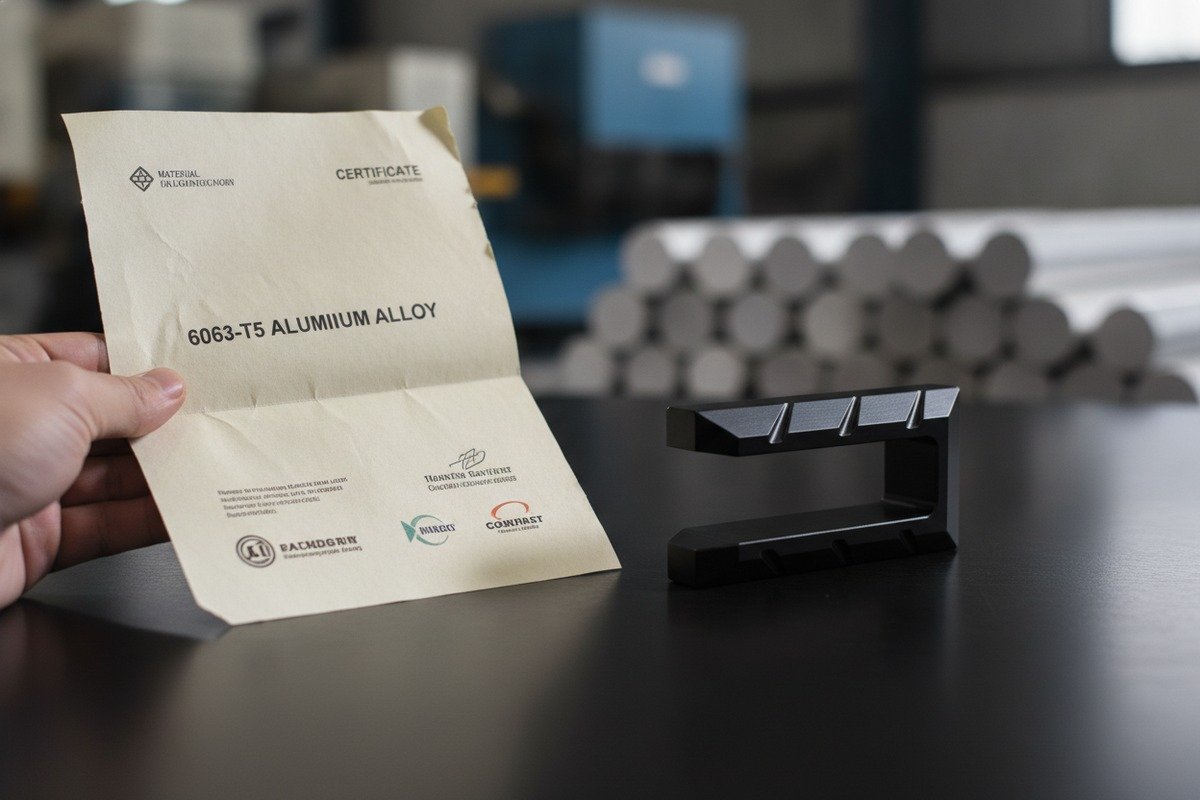
To verify alloy resistance for Vietnam's humidity, request a Material Test Certificate (MTC) specifying the exact grade — ideally 6063-T5 for standard handles or 6061-T6 for heavy-duty applications. Both grades offer strong corrosion resistance, but you must confirm the grade in writing before placing any order.
Why Alloy Grade Matters More Than You Think
Aluminum is not a single material. It is a family of alloys, each with different strength, corrosion resistance, and workability. In our production lines, we primarily use 6063-T5 for furniture handles. This grade extrudes beautifully, takes anodizing well, and resists the kind of atmospheric corrosion that Vietnam's climate throws at hardware daily.
However, not all suppliers use 6063-T5. Some use recycled scrap aluminum with unknown composition. This scrap often contains impurities — iron, copper, zinc — that create weak points where corrosion starts. You cannot see these impurities with your eyes. You need documentation.
The Two Alloys You Should Know
| Property | 6063-T5 | 6061-T6 |
|---|---|---|
| Tensile Strength | 186 MPa | 310 MPa |
| Corrosion Resistance | Excellent | Very Good |
| Extrudability | Excellent | Good |
| Surface Finish Quality | Superior | Good |
| Best Use Case | Decorative handles, slim profiles | Heavy-duty pulls, high-load applications |
| Cost | Standard | 10–15% higher |
How to Get Proof
First, ask your supplier for a Material Test Certificate. Material Test Certificate (MTC) 5 This document comes from the aluminum billet supplier and lists the exact chemical composition. A legitimate manufacturer will provide this without hesitation. If they refuse or say "it's just aluminum," that is a red flag.
Second, check the temper designation. The "T5" in 6063-T5 means the aluminum was artificially aged after extrusion. This heat treatment increases its strength and hardness. Without proper tempering, the handle may be too soft and deform under repeated use.
Third, consider a simple hardness test on your sample. A Rockwell or Brinell hardness test can confirm the temper. We routinely perform these checks in our quality lab, and any serious manufacturer should do the same.
Solid vs. Hollow Profiles
For recessed handles and slim architectural pulls — like the minimalist designs we produce in matte white, charcoal, champagne gold, and black — the cross-section design also affects durability. Solid aluminum profiles resist bending and warping far better than hollow ones. In humid environments, hollow profiles can also trap moisture internally, accelerating hidden corrosion. Always ask whether the handle profile is solid or hollow, and choose solid when the application demands long-term reliability.
What Surface Treatment Specifications Should I Require to Ensure My Handles Don't Oxidize or Peel Over Time?
On our production floor, we often say the alloy is the skeleton, but the surface treatment is the armor. Even the best 6063-T5 handle will fail in Vietnam if the coating is thin, poorly applied, or not engineered for tropical UV and humidity exposure.
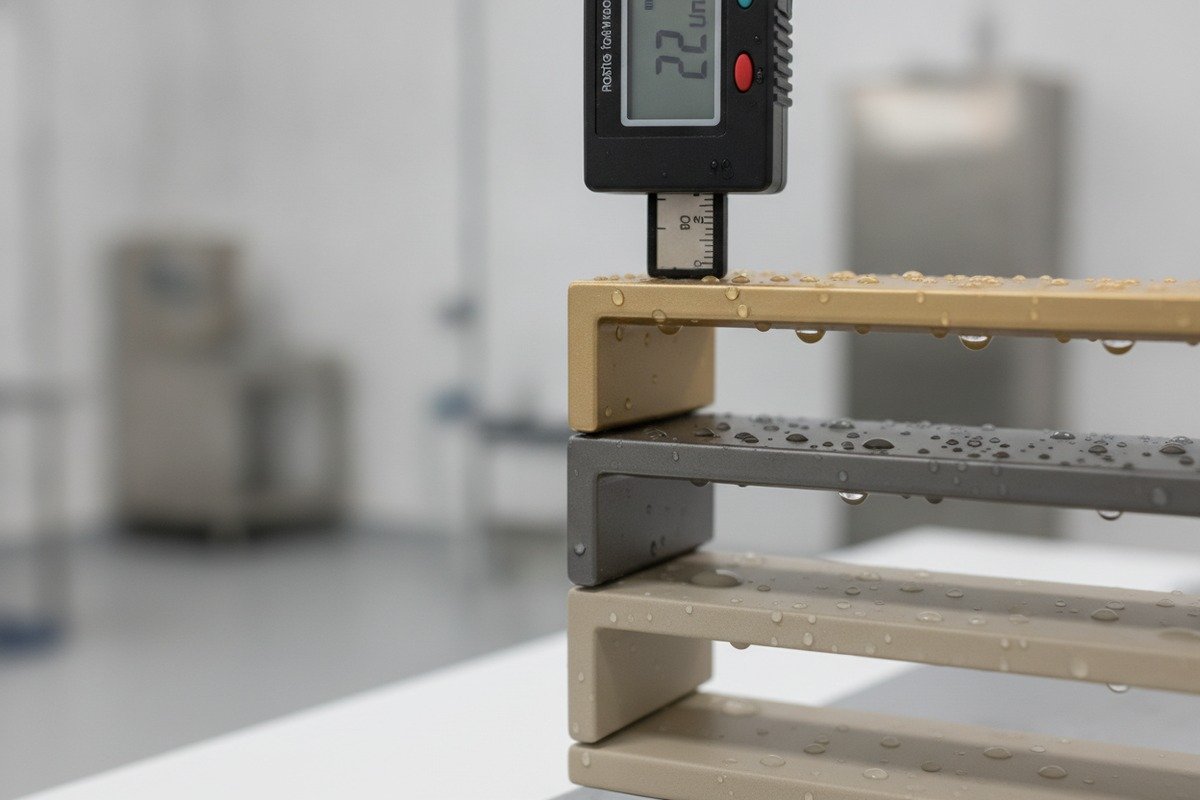
For Vietnam's market, require anodizing thickness of at least 20µm for coastal areas (15µm minimum for inland use), or UV-stabilized polyester powder coating with a minimum 60µm film thickness. Both treatments must pass cross-cut adhesion testing (ASTM D3359) and show no degradation after 1,000 hours of UV exposure testing.
Understanding Your Options
There are three main surface treatments for aluminum handles: anodizing, powder coating, and electrophoresis (e-coating). Each has strengths and weaknesses for Vietnam's specific conditions.
Surface Treatment Comparison
| Feature | Anodizing | Powder Coating | Electrophoresis (E-Coating) |
|---|---|---|---|
| Corrosion Resistance | Excellent (with 20µm+) | Very Good | Excellent |
| UV Resistance | Moderate | Excellent (if UV-stabilized) | Good |
| Color Options | Limited (metallic tones) | Wide range | Limited |
| Scratch Resistance | High (hard oxide layer) | Moderate | Moderate |
| Recommended Thickness | 15–25µm | 60–80µm | 15–25µm |
| Best For | Champagne gold, bronze, natural metallic finishes | Matte white, black, charcoal, custom colors | Uniform coverage on complex shapes |
| Vietnam Suitability | Excellent for coastal areas | Excellent for indoor and UV-exposed areas | Good for all environments |
Anodizing: The Gold Standard for Metallic Finishes
When you see our champagne gold and light bronze handles, those finishes come from anodizing. The process converts the aluminum surface into a hard aluminum oxide layer. This layer is not a coating that sits on top — it grows into the metal itself. That is why anodized finishes do not peel.
The critical number is thickness. Standard anodizing runs 10–15µm. For Vietnam's coastal provinces like Da Nang, Nha Trang, and Ho Chi Minh City, we recommend 20µm or thicker. High-quality anodized aluminum resists saltwater corrosion up to 10 times better than untreated aluminum. This is not a marketing claim — it is a measurable difference in salt spray hours.
Powder Coating: The Versatile Shield
For our matte white, charcoal grey, and black handles, powder coating is the go-to treatment. The process uses electrostatic application followed by heat curing. The result is a thick, uniform, and durable finish.
But not all powder coatings are equal. Cheap polyester coatings without UV stabilizers become brittle and chalky after two to three years in Vietnam's intense sunlight. Always ask your supplier if the powder is UV-stabilized and what brand they use. Reputable powder brands include AkzoNobel, Jotun, and Tiger. If the supplier cannot name the powder brand, be cautious.
The Cross-Cut Adhesion Test
This is a simple but powerful test you can do yourself. Take a sharp blade and cut a small grid pattern (6 lines x 6 lines) into the handle surface. Press adhesive tape firmly over the grid, then pull it off quickly. If any coating squares lift off, the adhesion has failed. A properly treated handle should show zero lifting. We perform this test on every production batch, and it takes less than one minute.
Do Not Forget the Mounting Hardware
A common and costly mistake: you source a beautifully anodized aluminum handle, then pair it with uncoated steel screws. Within weeks, the steel screws rust. The rust bleeds onto the aluminum, creating ugly stains and galvanic corrosion at the contact point. Always specify stainless steel 304 screws or zinc-plated fasteners to match the handle's durability.
Can I Trust the Salt Spray Test Results Provided by Chinese Manufacturers for Long-Term Durability?
We get this question a lot, and it is a smart one. Our factory runs salt spray tests in-house, but we also understand why buyers feel skeptical about self-reported data. The answer is nuanced — some results are reliable, and some are not.
**You can trust salt spray test results only when they come from accredited third-party labs (such as SGS, Bureau Veritas, or TÜV), follow the ASTM B117 or ISO 9227 standard, and the tested samples are taken from actual production batches — not specially prepared showcase pieces
Footnotes
1. Explains properties and uses of 6063 aluminum alloy, mentioning 6061. ↩︎
2. Provides anodizing thickness ranges and specifications for aluminum. ↩︎
3. Explains ultraviolet cure powder coatings and their benefits for durability. ↩︎
4. Describes the ASTM B117 standard for salt spray testing and its purpose. ↩︎
5. Defines Material Test Certificate (MTC) and explains its importance in quality assurance. ↩︎
6. Explains galvanic corrosion, its causes, and how it affects different metals. ↩︎