
Every week, our sales team in Foshan fields calls from furniture factories in Ho Chi Minh City and Hanoi asking the same question: should we keep buying handles locally, or switch to a Chinese supplier like you surface finishing 1? The answer is never simple. The cheapest unit price on a quote sheet can become the most expensive option once you add tariffs, shipping delays, rework costs, and the risk of inconsistent finishes across batches.
To compare costs accurately, you must calculate the Total Landed Cost — not just the FOB unit price. This includes tooling, surface finishing, shipping, import duties, quality inspection, packaging, and risk of rework. In 2026, Vietnam wins on tariff-sensitive orders for the US and EU, while China wins on high-volume, complex machining with ready stock and faster turnaround.
Below, we break down every cost layer so you can make a clear, data-driven decision quality inspection 2. Whether you run a furniture factory in Binh Duong or distribute handles across Southeast Asia, this guide will help you see the full picture.
How do I calculate the total landed cost of importing Chinese aluminum handles versus buying from a Vietnamese supplier?
Most buyers compare only the unit price on two quotes and pick the lower number. That approach has cost many furniture factories thousands of dollars in unexpected fees, delayed shipments, and rejected batches.
To calculate Total Landed Cost, add these seven layers: FOB unit price, tooling amortization, surface treatment, freight and insurance, import duties and taxes, quality inspection fees, and packaging costs. Only this full sum reveals which source is truly cheaper for your specific order size and destination market.
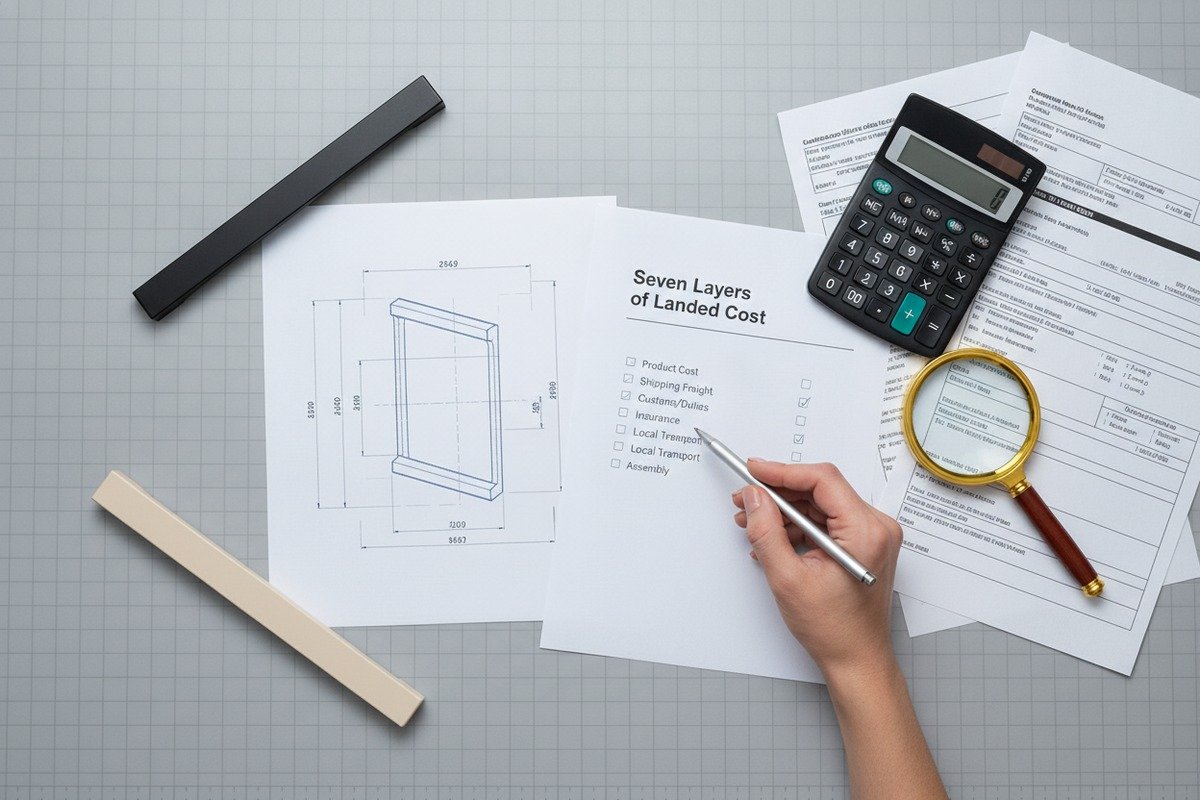
Understanding the Seven Cost Layers
Let me walk you through each layer with real numbers. On our production floor, we track these costs daily because our clients in Vietnam ask for full transparency before placing orders.
Layer 1: FOB Unit Price. This is the base manufacturing cost. China typically offers a lower FOB price for standard handles due to massive economies of scale. Vietnam can be competitive or even cheaper for labor-intensive finishing work on custom designs.
Layer 2: Tooling and Mold Amortization. If you need a custom handle profile, you pay for a die or mold. Spread that cost across your total order volume to get the true per-unit tooling cost.
Layer 3: Surface Treatment. Anodizing 3, powder coating, and painting each carry different costs. Vietnam's lower labor rates can reduce finishing costs by 10–20%.
Layer 4: Freight and Insurance. Shipping from China to Vietnam is short — typically 2–5 days by sea. But container rates, port fees, and inland trucking add up fast.
Layer 5: Import Duties and Taxes. This is where the game changes. If your final product goes to the EU or US, Vietnam's EVFTA and CPTPP agreements 4 can cut duties by 10–20% compared to Chinese-origin goods.
Layer 6: Quality Inspection. Pre-shipment inspections cost $250–$400 per day regardless of origin country. But the frequency of inspections matters. If a supplier has inconsistent quality, you inspect more often.
Layer 7: Custom Packaging. Barcodes, retail boxes, and protective inserts can add 3–8% to the unit cost.
Sample Total Landed Cost Comparison
Here is a simplified comparison for a mid-volume order of 10,000 aluminum recessed cabinet handles shipped to a Vietnamese furniture factory:
| Cost Layer | China Supplier (USD) | Vietnam Supplier (USD) |
|---|---|---|
| FOB Unit Price 5 (per piece) | $0.85 | $0.95 |
| Tooling (amortized per piece) | $0.05 | $0.07 |
| Surface Treatment (per piece) | $0.15 | $0.12 |
| Freight to HCMC (per piece) | $0.08 | $0.02 |
| Import Duty to Vietnam (per piece) | $0.04 | $0.00 |
| QC Inspection (per piece) | $0.03 | $0.03 |
| Custom Packaging (per piece) | $0.06 | $0.05 |
| Total Landed Cost (per piece) | $1.26 | $1.24 |
The numbers are close. But notice how China's lower FOB price gets eroded by freight and duty. For orders destined to the EU or US market, the gap widens significantly in Vietnam's favor due to tariff advantages.
The Hidden Variable: Rework Cost
One cost that never appears on a quote is rework. When handles arrive with scratches, uneven anodizing, or wrong dimensions, you either rework them or scrap them. From our experience shipping over 300 tons of ready stock annually, we have learned that tight in-factory QC eliminates most rework. If you source from any supplier — Chinese or Vietnamese — always ask for their defect rate and rework policy before signing a contract.
Will the superior finish and durability of Chinese-made handles justify the shipping costs for my furniture factory?
When our engineers develop a new champagne gold anodized profile or a matte charcoal powder-coated recessed handle, the finish must survive years of daily use. Vietnamese furniture factories tell us they worry about two things: will the color fade, and will the coating chip during assembly?
Chinese manufacturers with 18+ years of experience in aluminum surface treatment deliver finishes — anodizing, powder coating, and electrophoresis — that meet international durability standards. The shipping cost from Foshan to Ho Chi Minh City is modest, typically $0.05–$0.10 per handle, and is justified when the finish quality reduces warranty claims and elevates the furniture brand.
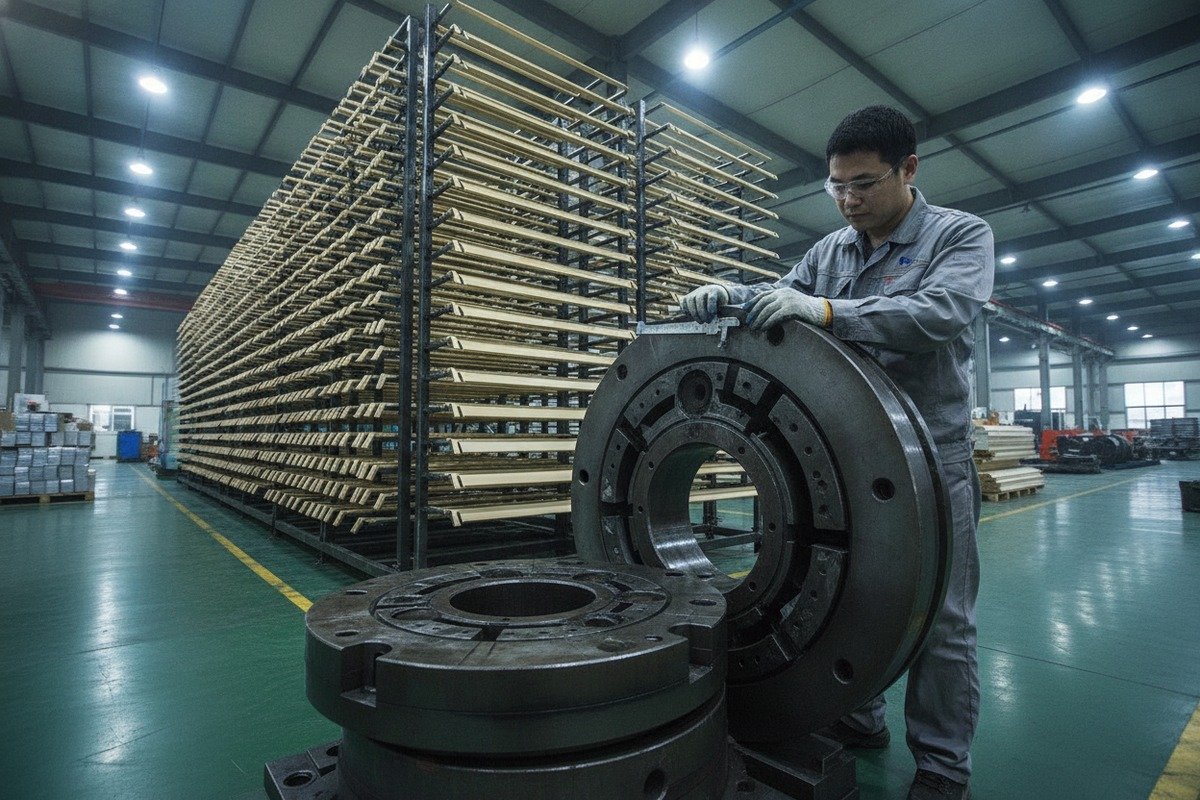
Why Finish Quality Matters More Than You Think
A furniture handle is one of the first things a customer touches. A rough edge, a patchy anodize, or a powder coat that chips within months reflects poorly on the entire piece of furniture. In the mid-to-high-end market, finish quality is not optional — it is the product.
Comparing Finish Capabilities
| Finish Type | China Capability | Vietnam Capability |
|---|---|---|
| Anodizing (matte/satin) | Mature; wide color range; consistent batch-to-batch | Growing; limited color range; some batch variation |
| Powder Coating 8 (RAL colors) | Fully automated lines; salt spray tested 500+ hrs | Semi-automated; salt spray tested 200–400 hrs |
| Electrophoresis | Available at scale; excellent corrosion resistance | Limited availability; fewer specialized facilities |
| Champagne Gold / Bronze Tones | Highly refined; precise color matching across orders | Available but harder to match across repeat orders |
| Custom Multi-tone Finishes | Yes, with CNC + selective masking | Limited; usually single-tone only |
The Durability Test
On our production line, every batch undergoes salt spray testing 9, adhesion testing, and UV resistance checks. These are not just for export certificates. They predict how the handle will perform in humid climates like southern Vietnam or the Gulf region.
A handle that passes 500 hours of salt spray testing will last years in a kitchen or bathroom environment. One that only passes 200 hours may start showing corrosion spots within 12–18 months. The cost difference per handle is small — maybe $0.03–$0.05 more for the premium finish. But the warranty claim cost on a corroded handle can be $2–$5 per unit when you factor in shipping, replacement, and lost customer trust.
Shipping Cost Reality Check
Shipping aluminum handles from Foshan to Ho Chi Minh City is not expensive. A 20-foot container holds roughly 8,000–12,000 handles depending on size and packaging. At current 2026 rates, sea freight for this route runs about $800–$1,200 per container. That translates to roughly $0.07–$0.15 per handle. For a product that sells wholesale at $1.00–$3.00 per piece, the shipping cost is a minor fraction.
The real question is not whether shipping costs are justified. It is whether you can afford the risk of using a lower-quality finish to save a few cents per unit. In our experience, the answer for mid-to-high-end furniture is always no.
Can I find a local Vietnamese manufacturer that offers the same level of OEM customization as a specialized Chinese factory?
Our team visits furniture trade shows in Ho Chi Minh City every year. We see the Vietnamese hardware sector growing fast. But when a client asks us for a custom recessed handle with a specific L-shaped cross-section, champagne gold anodizing, laser-engraved branding, and retail-ready packaging — all in a 3–7 day turnaround — that level of integrated OEM service is still rare in Vietnam.
Vietnamese manufacturers are improving rapidly in standard aluminum hardware, but specialized OEM customization — including custom die design, multi-finish options, laser engraving, and low-MOQ flexibility — remains a core strength of established Chinese factories with dedicated R&D teams and 18+ years of tooling experience.
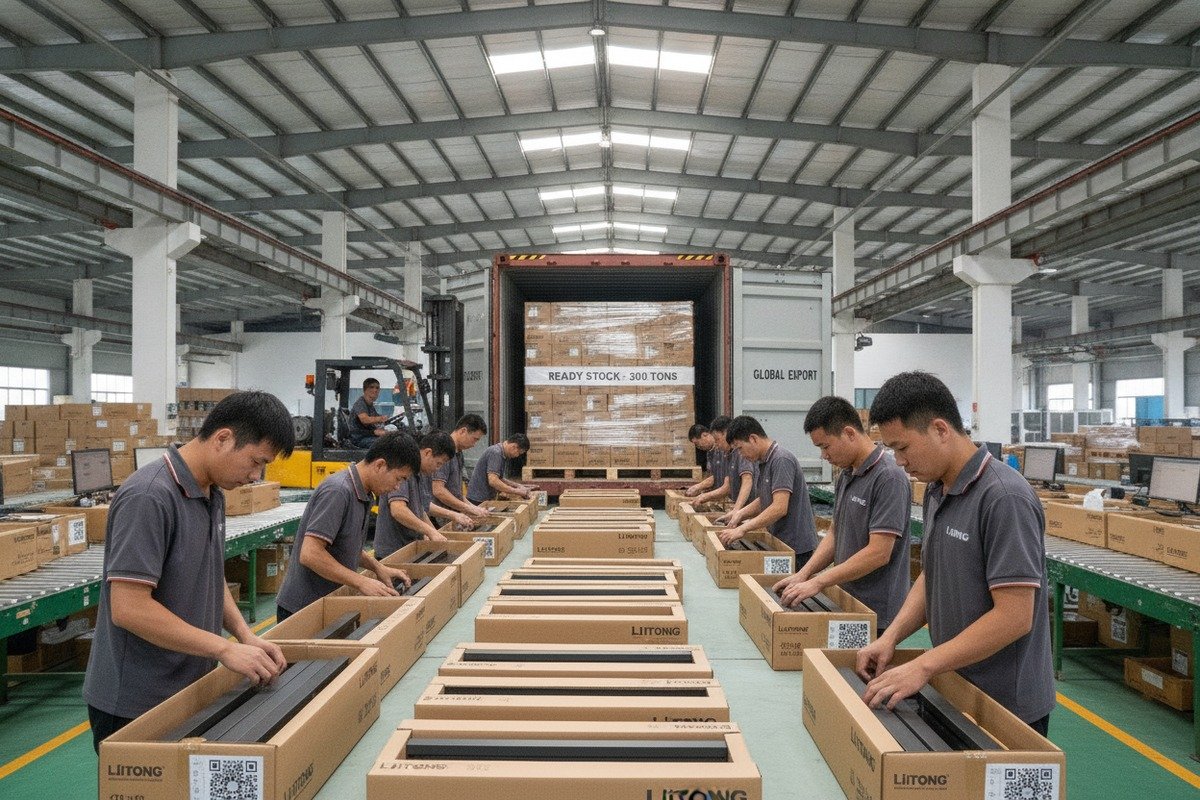
What Does True OEM Customization Include?
OEM customization 10 is more than changing a color. It includes:
- Profile Design: Creating a new extrusion die or casting mold from scratch based on the client's drawing.
- Dimensional Precision: Holding tolerances to ±0.1mm on critical mating surfaces.
- Surface Treatment Options: Offering anodizing, powder coating, electrophoresis, brushing, sandblasting, or polishing — and combining them on a single handle.
- Branding: Laser engraving logos, part numbers, or batch codes directly onto the handle.
- Packaging: Custom inserts, branded boxes, barcodes, and retail-ready packaging.
- Technical Support: Helping the client optimize the design for manufacturability, cost, and durability.
Where Vietnam Stands in 2026
Vietnamese metal hardware factories in Binh Duong and Dong Nai have invested heavily in CNC equipment and basic anodizing lines. For simple handles — straight pulls, basic knobs — they can deliver good quality at competitive prices with lower MOQs.
However, for complex profiles like a recessed handle with a deep geometric channel and a precise L-shaped cross-section, the tooling precision required is high. China's tooling industry is decades ahead. A complex extrusion die in China costs $1,500–$5,000 and is ready in 7–10 days. The same die in Vietnam may cost $2,000–$6,000 and take 15–25 days, with a higher chance of requiring revision.
MOQ Flexibility Comparison
One area where both countries can compete is MOQ flexibility. However, the dynamics differ:
- China (specialized factory): MOQ as low as 200–500 pieces for stock profiles; 1,000–3,000 pieces for custom OEM orders. With 300 tons of ready inventory, we can ship stock items within 48 hours.
- Vietnam (local manufacturer): MOQ can be as low as 100–300 pieces for simple items. But custom tooling orders often require 2,000–5,000 pieces to justify the mold cost.
The key insight: if you need a truly custom handle in small-to-mid volume, a Chinese factory with existing tooling infrastructure can often deliver faster and cheaper than a Vietnamese factory building that capability from scratch.
Technical Support Gap
Another factor that matters to furniture factory owners is technical guidance during the design phase. When a client sends us a rough sketch, our engineers refine it for manufacturability — adjusting wall thickness, draft angles, and surface treatment compatibility. This kind of collaborative development is a hallmark of experienced Chinese OEM factories. In Vietnam, this service is still emerging, and many buyers report a gap in pre-production technical support.
How does the 48-hour shipping from China's ready stock compare to the lead times of local Vietnamese distributors?
Time is money in furniture manufacturing. When a production line stops because handles have not arrived, every hour of downtime costs labor, electricity, and missed delivery deadlines. Our clients in Vietnam have told us that their biggest frustration is not the price — it is the wait.
China's ready-stock model — with 300 tons of inventory and 48-hour dispatch — delivers aluminum handles to Vietnamese ports in 4–7 days total. Local Vietnamese distributors may offer same-day pickup, but they carry limited SKUs and often face 2–4 week restocking delays. For consistent supply of diverse handle styles, China's ready-stock system is faster in practice.

Breaking Down the Timeline
Let us compare the actual timelines from order placement to handles arriving at your factory gate in Vietnam.
| Scenario | Day 1–2 | Day 3–5 | Day 6–7 | Day 8–14 | Day 15–30 |
|---|---|---|---|---|---|
| China Ready Stock | Order confirmed, packed, dispatched | Sea freight HCMC | Customs clearance, delivery | — | — |
| China Custom Order | Order confirmed, production starts | — | — | Production + finishing (7–14 days) | Shipping + delivery |
| Vietnam Local (In Stock) | Order confirmed, pickup/delivery | — | — | — | — |
| Vietnam Local (Restock) | Order confirmed, production starts | — | — | Production (14–21 days) | Finishing + delivery |
The Ready-Stock Advantage
Here is what most buyers do not realize: a Vietnamese distributor who carries stock is essentially a middleman. They buy from a manufacturer — often a Chinese one — and warehouse a limited selection. When that stock runs out, the restocking cycle is 2–4 weeks or longer.
We maintain over 300 tons of aluminum handles and profiles in our Foshan warehouse. This includes popular finishes like matte black, champagne gold, charcoal grey, and light beige in multiple lengths. When a client in HCMC orders a standard recessed handle, we pack it within 48 hours. Sea freight to Ho Chi Minh City takes 2–4 days. Add one day for customs clearance, and the handles are at the factory gate in under a week.
Custom Orders: A Different Calculation
For custom OEM orders, the timeline is different. Our turnaround for custom handles is 3–7 days for production, plus 2–4 days for shipping to Vietnam. Total: roughly 5–11 days.
A Vietnamese manufacturer making the same custom handle from scratch — including tooling — may take 15–25 days for the die alone, plus another 7–14 days for production and finishing. Total: 22–39 days.
The gap is significant. For furniture factories that need to respond quickly to design changes or rush orders, this speed difference directly impacts their ability to win contracts.
Inventory Risk vs. Lead Time Risk
Some buyers prefer local sourcing to avoid carrying inventory. That makes sense — until the local distributor runs out of your specific SKU. Then you face a choice: wait 3–4 weeks, or scramble for an alternative that may not match your previous batches.
With a reliable Chinese partner who maintains deep ready stock, you reduce lead time risk without carrying excess inventory yourself. The 48-hour dispatch model essentially turns the Chinese factory's warehouse into your buffer stock.
Conclusion
The smartest sourcing decision starts with Total Landed Cost, not unit price. Match your order volume, customization needs, target market, and timeline to the right supplier — and always test with a pilot order first.
Footnotes
1. Wikipedia offers a broad and comprehensive definition of surface finishing and categorizes various industrial processes. ↩︎
2. The ‘Complete Guide to Quality Inspection’ provides a thorough definition and outlines various types of quality inspection relevant to manufacturing. ↩︎
3. Describes anodizing as an electrochemical process enhancing durability and corrosion resistance of metal surfaces. ↩︎
4. Discusses the benefits of EVFTA and CPTPP for Vietnam’s trade and economic growth. ↩︎
5. Defines FOB price as goods’ cost at exporting country’s frontier, including transport and taxes. ↩︎
6. Explains the comprehensive calculation of all costs from factory to customer. ↩︎
7. Defines customs duty as a tariff or tax imposed on goods transported across international borders. ↩︎
8. Fractory offers a clear explanation of the powder coating process, detailing its application and curing. ↩︎
9. Describes a standardized corrosion test method for evaluating material and coating resistance in a saline environment. ↩︎
10. Vectair Systems provides a direct and relevant definition of OEM customization as tailoring a product to fit a brand’s vision. ↩︎