
Every week, our sales team receives inquiries from furniture distributors asking for “anti-fingerprint handles.” The problem is, that phrase alone tells a coating supplier almost nothing ISO 2409 1. Without clear specs, you risk getting samples that look fine on arrival but show every thumbprint within a week of real use.
To request anti-fingerprint treatment for aluminum furniture handles, define it as a specification package — not a vague feature. Specify the base material, surface prep, finish appearance, coating chemistry, durability tests, and cleaning requirements. This approach ensures your supplier quotes the right system and delivers consistent, verifiable results.
Below, we break down the exact technical terms, quality checks, lead-time impacts, and business reasons you need to make this request correctly. Whether you run a furniture factory or distribute hardware to premium brands, this guide gives you the language and checklists to get it right the first time.
What specific technical terms should I use when asking my supplier for an anti-fingerprint coating?
Most buyers lose leverage the moment they write "please provide anti-fingerprint finish" in an email. Our engineering team has seen this phrase interpreted in at least five different ways by five different coating shops.
Use terms like "oleophobic clear topcoat," "hydrophobic nano-coating," or "anti-smudge anodized finish." Specify the substrate condition, desired gloss level, coating thickness tolerance, and the test standards you expect. This precision prevents miscommunication and ensures you receive comparable quotes from multiple suppliers.
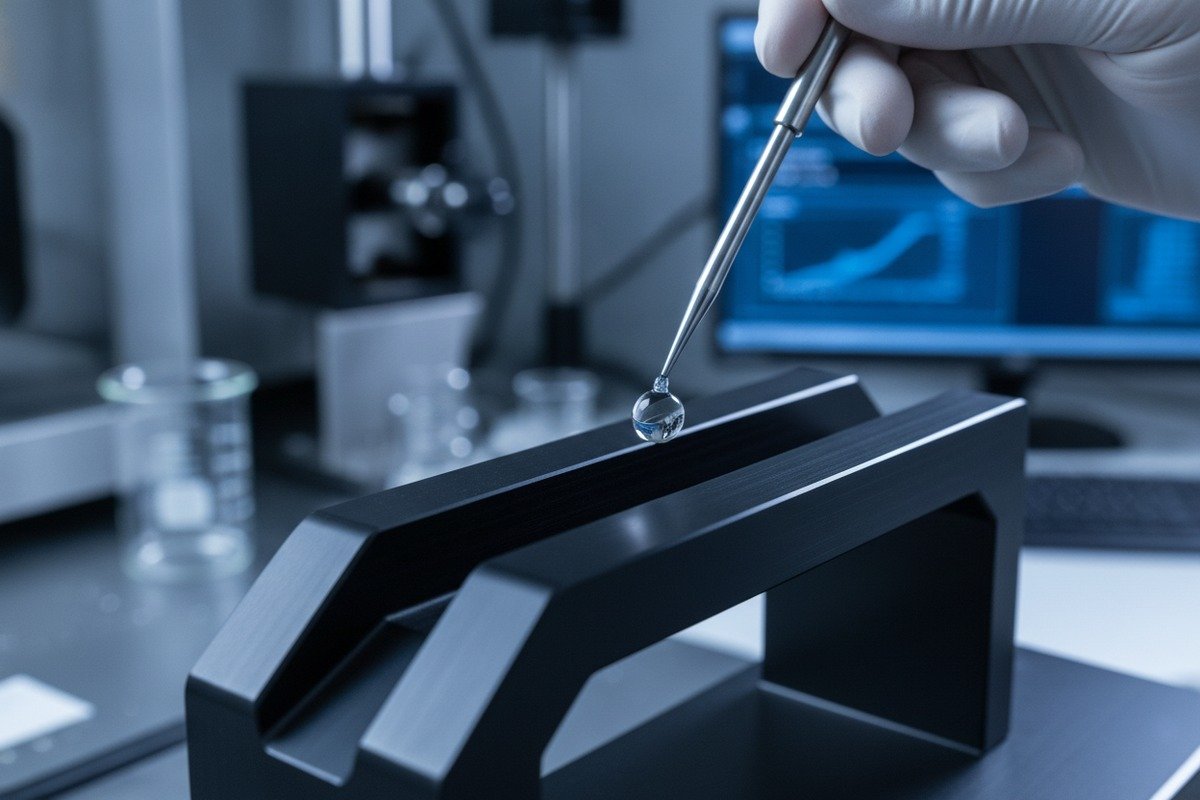
Why "Anti-Fingerprint" Alone Is Not Enough
The term "anti-fingerprint" is a marketing description, not a technical specification. Different suppliers hear it differently. One may offer a nano-spray coating. Another may suggest a special anodizing process. A third may simply apply a matte powder coat and call it "fingerprint-resistant" because the texture hides smudges visually. None of these are wrong, but they deliver very different results. If you do not define what you actually need, you cannot compare quotes fairly.
Key Terms to Include in Your RFQ
Here is a reference table of terms you should use when writing your inquiry. Match these to your product requirements.
| Term | What It Means | When to Use It |
|---|---|---|
| Oleophobic coating 2 | Repels skin oils and reduces fingerprint adhesion | Handles touched frequently by bare hands |
| Hydrophobic coating 3 | Repels water and moisture | Handles in kitchens, bathrooms, or humid climates |
| Nano-coating (clear) 4 | Ultra-thin transparent layer applied over the base finish | When you want to preserve the original brushed or matte look |
| Anti-smudge topcoat | General term for easy-clean surface layer | Suitable for most indoor furniture hardware |
| Anodized + sealed | Anodic oxide layer with a pore-sealing step | For bare aluminum profiles needing integral protection |
| Powder coat with AF additive | Powder coating formulated with anti-fingerprint properties | When the handle is already powder-coated |
How to Structure Your Request
A strong RFQ should read like this:
"We require an anti-fingerprint, easy-clean finish for extruded aluminum furniture handles (6063-T5 alloy). The base surface is brushed matte. The coating must be clear or near-invisible, preserve the existing appearance, and resist visible fingerprints from normal hand contact. Please confirm your coating system, pretreatment method, curing process, film thickness, and available test data for adhesion, abrasion resistance, and chemical resistance to common household cleaners."
This type of language immediately tells the supplier you understand the process. It also forces them to respond with specifics rather than vague promises. When we prepare quotes for our overseas partners, a detailed RFQ like this cuts the back-and-forth time by at least half.
Appearance Goals vs. Performance Goals
Be clear about which matters more to you. Some coatings preserve the exact look of a champagne gold anodized handle. Others add a soft-touch feel that changes the tactile experience slightly. If your end client is a high-end furniture brand, even a subtle change in gloss or texture may cause a rejection. State your gloss target in GU (gloss units) and mention whether the handle must maintain a specific tactile character.
How can I verify if the anti-fingerprint treatment on my aluminum handles meets professional quality standards?
When samples arrive at our inspection station, they always look clean and perfect. The real question is what happens after 500 touches, 50 cleaning cycles, and six months on a showroom cabinet door.
Verify anti-fingerprint quality by requesting adhesion cross-hatch tests, abrasion resistance data, chemical resistance results against household cleaners, and a simple fingerprint contact test on production samples. Ask your supplier for third-party test reports and conduct your own wipe-and-touch trials before approving mass production.

The Fingerprint Contact Test You Can Do Yourself
Before you invest in lab testing, do a simple field test. Press your thumb firmly onto the coated handle surface. Wait 10 seconds. Then try to wipe the mark off with a dry microfiber cloth. On a good anti-fingerprint surface, the mark should disappear with one or two light wipes. On a poor surface, you will see a smear that requires cleaning solution. This takes 30 seconds and immediately separates good coatings from marketing claims.
Professional Tests to Request from Your Supplier
The table below lists the most important tests. Ask your supplier to provide data for at least the first four.
| Test | Standard / Method | What It Measures | Acceptable Result |
|---|---|---|---|
| Cross-hatch adhesion | ASTM D3359 5 or ISO 2409 | Coating bond to substrate | 4B or 5B rating (minimal peel) |
| Pencil hardness 6 | ASTM D3363 | Surface scratch resistance | 2H or higher |
| Abrasion resistance | Taber test 7 or rub test (500+ cycles) | Coating durability under friction | No visible coating loss or haze |
| Chemical resistance | Exposure to isopropyl alcohol, glass cleaner, kitchen degreaser | Tolerance to common cleaners | No discoloration, softening, or peeling after 24-hour spot test |
| Salt spray (optional) | ASTM B117 | Corrosion resistance | 48–200 hours depending on indoor/outdoor use |
| UV resistance (optional) | ASTM G154 | Color and gloss stability under light | Minimal Delta E change after 500 hours |
What to Watch for in Supplier Test Reports
Not all test reports are equal. Some suppliers provide in-house data with no third-party verification. Others reference standards but do not share the actual numbers. When reviewing reports, look for the test method name, the number of samples tested, the specific results (not just "pass"), and the date of testing. If the supplier cannot produce a report, ask them to send samples to a mutually agreed testing lab. This is standard practice in mid-to-high-end hardware sourcing.
Red Flags During Sample Evaluation
Watch for these warning signs on prototype samples: uneven coating thickness visible as color variation under angled light, orange-peel texture on what should be a smooth surface, a sticky or rubbery feel that traps dust, or any bubbling near edges and screw holes. These issues almost always get worse in mass production. At our facility, we run a pre-production pilot batch of 50–100 pieces specifically to catch these problems before scaling up.
Long-Term Performance Expectations
Durability claims vary widely. Some coating suppliers claim 5–8 years of indoor performance. Others are more conservative. The honest answer is that real-world durability depends on cleaning frequency, the chemicals used, and how often the handle is touched. For indoor furniture handles, a well-applied oleophobic nano-coating should maintain easy-clean performance for at least 3–5 years under normal residential use. Ask your supplier to state their expected service life in writing, with the conditions defined.
Will requesting an anti-fingerprint finish significantly impact my production lead times or MOQ?
This is one of the first questions our distribution partners in Vietnam and the Middle East ask. They need to plan inventory carefully, and any extra process step raises concerns about timing and cost.
Anti-fingerprint treatment typically adds 1–3 days to production lead times and may increase the unit cost by 5–15%, but it rarely changes MOQ requirements significantly. Most added time comes from surface pretreatment and curing. Suppliers with in-house coating lines absorb this more efficiently than those who outsource the step.

Where the Extra Time Goes
The anti-fingerprint coating is usually the last step in the finishing process. Before it can be applied, the aluminum handle must be fully cleaned, degreased, and sometimes passivated. If the handle is anodized, the anodizing and sealing must be complete and dry. The coating itself — whether sprayed, dipped, or rolled — requires a curing period. Spray-applied nano-coatings may cure in minutes at room temperature. Baked topcoats may need 20–30 minutes in an oven at 150–200°C. These steps add real time, but they are not dramatic.
Typical Lead Time Comparison
| Production Scenario | Standard Finish Lead Time | With Anti-Fingerprint Coating | Added Time |
|---|---|---|---|
| Stock handles, anodized, in-house coating | 2–3 days | 3–5 days | 1–2 days |
| Custom handles, powder-coated, outsourced AF coating | 7–10 days | 10–14 days | 3–4 days |
| Custom handles, anodized, in-house nano-coating | 5–7 days | 6–9 days | 1–2 days |
| Large order (5,000+ pcs), full in-house line | 10–15 days | 12–17 days | 2–3 days |
These numbers are based on what we see in our own production scheduling and from feedback with partner coating shops. Your actual results depend on order size, finish complexity, and whether the supplier handles the coating in-house or sends parts to a subcontractor.
MOQ Considerations
Most anti-fingerprint coating systems do not require large batch minimums by themselves. The coating material consumption is low — often just 2–5 ml per square meter of surface area for nano-coatings. However, if the supplier uses a specialized spray booth or dipping line for the anti-fingerprint step, they may prefer to batch orders together to justify setup and cleaning time. In practice, this means your MOQ for anti-fingerprint handles might be 200–500 pieces instead of 100 pieces for a standard finish. Ask your supplier directly about their coating line setup and minimum batch run.
Cost Impact
The cost increase varies by coating type
Footnotes
1. International standard for assessing paint coating resistance to separation from substrates. ↩︎
2. Explains how oleophobic coatings repel skin oils and resist greasy substances. ↩︎
3. Defines hydrophobic coatings as water-repellent surface layers. ↩︎
4. Describes nano-coatings as ultra-thin layers measured on the nanoscale. ↩︎
5. Standard test method for assessing coating adhesion using a tape test. ↩︎
6. Test method for determining film hardness using pencils. ↩︎
7. Method for determining abrasion resistance of materials using a rotary platform. ↩︎