
Every year, we ship hundreds of thousands of aluminum furniture handles from our Foshan production lines, and the question EU-bound buyers ask most often catches many sourcing professionals off guard — not about price, not about MOQ, but about compliance documentation.
To evaluate a Chinese supplier’s EU compliance ability for aluminum furniture handles, assess five dimensions: product classification accuracy, chemical safety evidence (REACH/RoHS), mechanical performance test reports from accredited labs, batch traceability systems, and the supplier’s experience preparing technical files for EU customs clearance.
This guide walks you through every step, from the certifications you should demand to the red flags that reveal a supplier who can make handles but cannot support EU market access. Let’s break it down section by section.
What specific certifications should I request to ensure my aluminum handles comply with REACH and RoHS standards?
When our export team prepares shipments for European distributors, the first compliance conversation always centers on chemical safety — and the confusion between REACH and RoHS trips up even experienced buyers.
Request a REACH SVHC declaration covering the full Candidate List, a RoHS test report from an accredited lab covering lead, cadmium, mercury, hexavalent chromium, and phthalates, and ensure both documents reference your specific handle model, alloy grade, and surface finish — not a generic product family.
Understanding REACH vs. RoHS for Furniture Hardware
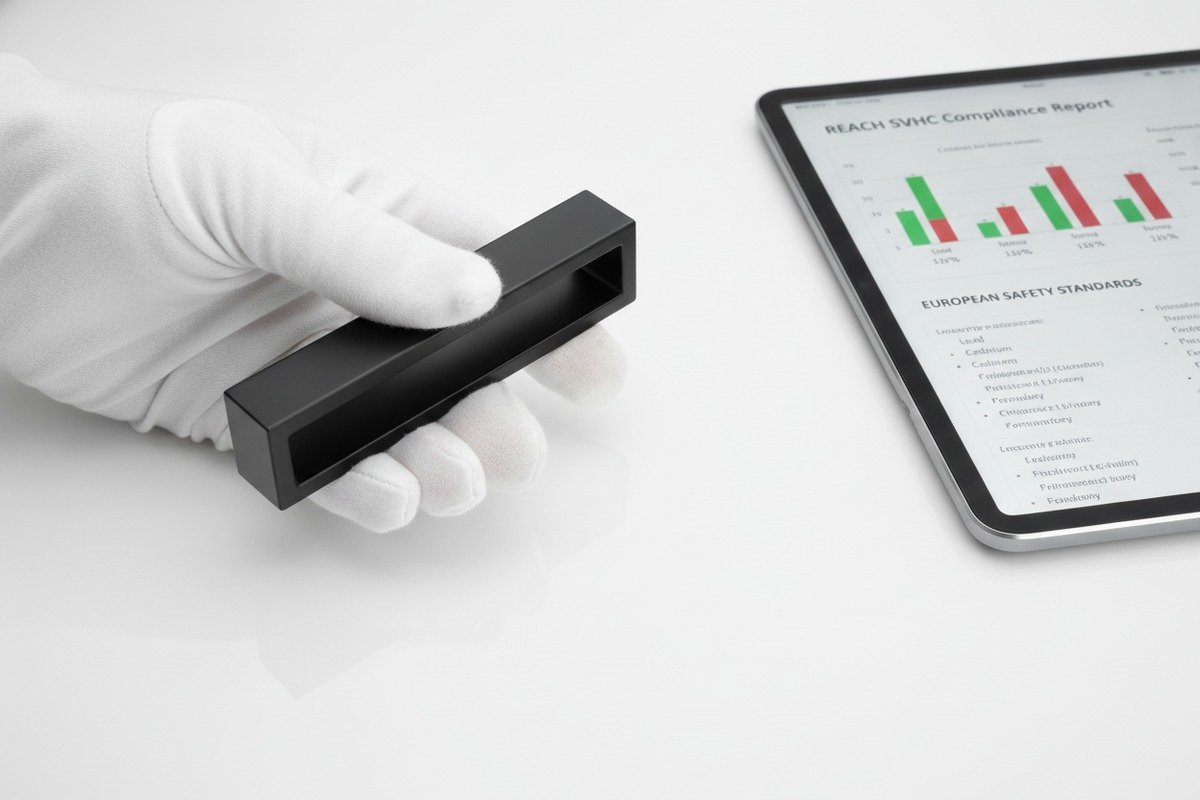
Many buyers confuse these two frameworks. REACH is a broad EU chemical regulation 1 that applies to virtually all products placed on the EU market. It restricts Substances of Very High Concern (SVHCs) 2 and requires suppliers to declare if any SVHC is present above 0.1% by weight in any article. RoHS, on the other hand, was originally designed for electrical and electronic equipment 3. Standard aluminum furniture handles do not fall under RoHS scope unless they contain electronic components. However, many EU buyers still request RoHS test reports as a voluntary quality benchmark, and some retailers impose RoHS limits in their purchasing specifications regardless of legal scope.
What Documents to Request
The key is specificity. A generic "REACH certificate" that covers "metal hardware" is almost worthless. You need documents tied to your exact product.
| Document | What It Must Show | Red Flag If Missing |
|---|---|---|
| REACH SVHC Declaration | Product model, alloy grade, finish type, current SVHC Candidate List version | Outdated list version, no product-specific reference |
| REACH Annex XVII Compliance | Confirmation that restricted substances 4 (e.g., nickel release for skin contact, cadmium in coatings) are within limits | No mention of coating or plating chemistry |
| RoHS Test Report (voluntary) | Heavy metal content in substrate and finish, lab name, accreditation number | In-house test only, no third-party lab |
| Material Safety Data Sheet (MSDS) for coatings | Chemical composition of powder coat, anodizing chemicals, or paint | Supplier claims "no chemicals used" |
Where the Real Risk Hides
For plain aluminum handles, the base metal itself rarely fails REACH. The risk sits in surface treatments. Anodizing baths, powder coatings, electroplating solutions, and even packaging inks can introduce restricted substances like lead, cadmium, or hexavalent chromium 5. On our production line, we maintain separate chemical compliance files for every coating supplier we use, and we re-test whenever a coating batch changes. That level of control is what you should look for.
Ask the Right Questions
Do not just ask "Do you have REACH certification?" Instead, ask: "Can you provide a third-party REACH SVHC test report for this specific handle model, including separate analysis of the aluminum substrate and the champagne gold anodized finish?" That question alone will tell you whether the supplier understands EU chemical compliance or is just handing you a boilerplate document.
How can I verify that the chemical composition of the aluminum alloy meets my EU safety requirements?
Our metallurgical team works with specific alloy grades every day — 6063-T5 6 for most extruded furniture handles, 6061-T6 when higher strength is needed — and we have learned that EU buyers who skip alloy verification often face problems downstream.
Verify aluminum alloy composition by requesting the supplier's mill test certificate (MTC) with heat number traceability, then cross-check it against EN 573 or EN 755 standards. For coated handles, also request XRF or ICP-OES test results on the finished surface to confirm no restricted elements were introduced during finishing.

Why Alloy Grade Matters for EU Compliance
Not all aluminum is the same. The alloy grade determines mechanical properties, corrosion resistance, and even chemical safety. For furniture handles, common alloys include 6063, 6061, and sometimes 5052. Each has a defined composition range for elements like silicon, magnesium, copper, zinc, lead, and chromium. EU safety expectations include corrosion resistance over the product's intended lifespan and absence of hazardous elements above regulated thresholds.
How to Read a Mill Test Certificate
A Mill Test Certificate (MTC), also called a material certificate or a 3.1 certificate under EN 10204 7, is the foundational document. It shows the chemical analysis of the aluminum billet or ingot before extrusion.
| Element | 6063 Alloy Typical Range (%) | Why It Matters for EU Compliance |
|---|---|---|
| Silicon (Si) | 0.20 – 0.60 | Affects anodizing quality and surface finish consistency |
| Magnesium (Mg) | 0.45 – 0.90 | Primary strengthening element; affects durability |
| Iron (Fe) | ≤ 0.35 | Too much iron reduces corrosion resistance |
| Copper (Cu) | ≤ 0.10 | High copper can cause galvanic corrosion issues |
| Lead (Pb) | ≤ 0.05 (often restricted further) | Restricted under REACH; some EU buyers demand ≤ 0.01% |
| Chromium (Cr) | ≤ 0.10 | Hexavalent chromium in coatings is heavily restricted |
| Zinc (Zn) | ≤ 0.10 | Relevant for corrosion behavior |
The Surface Finish Trap
Even if the base alloy is perfectly compliant, the finishing process can introduce non-compliant substances. Anodizing, powder coating, electroplating, and PVD coating each have different chemical profiles. For example, a champagne gold anodized finish — one of the most popular finishes we produce — uses specific dye chemistry that must be verified separately from the aluminum substrate. Chromate conversion coatings, once common as a pre-treatment, can contain hexavalent chromium, which is restricted under REACH Annex XIV.
Practical Verification Steps
First, request the MTC from the supplier and check that the heat number matches the production batch. Second, ask for a spectroscopic analysis (OES or XRF) of the finished handle, not just the raw billet. Third, if the supplier uses recycled aluminum — which is increasingly common and environmentally beneficial — confirm that the recycled input is controlled for trace contaminants like lead or cadmium, which can accumulate in scrap streams. In our facility, we source billets from certified smelters and maintain incoming material inspection records for every batch, which allows us to trace any handle back to its original alloy melt.
When to Commission Independent Testing
If you are placing a first order with a new supplier, or if the order value is significant, commission your own testing through an accredited lab such as SGS, TÜV, Bureau Veritas, or Intertek. Ask the lab to test both the substrate and the coating layer. The cost is modest — typically $200–$500 per sample set — and the peace of mind is worth far more than the expense.
What steps should I take to audit a Chinese supplier's quality management system for EU market readiness?
We have hosted dozens of buyer audits at our Foshan facility over the past 18 years, and the audits that uncover the most useful information always follow a structured approach rather than a casual factory walkthrough.
Audit a Chinese supplier's quality management system by evaluating five areas: incoming material control, in-process inspection procedures, final product testing capabilities, document and batch traceability systems, and change-control protocols. Request ISO 9001 certification as a baseline, but always verify practices on the factory floor against what the paperwork claims.
The Difference Between a Certificate and a System
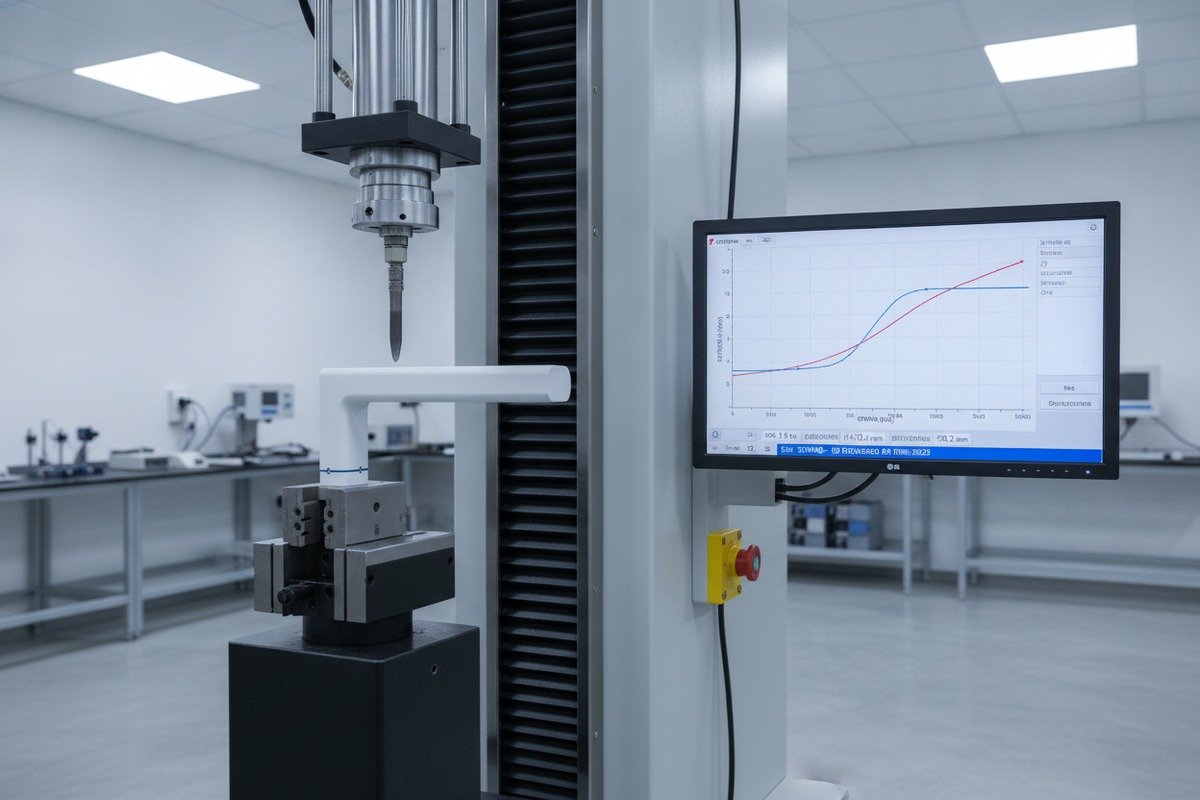
Many factories hold an ISO 9001 certificate 8. Fewer actually operate a quality management system that lives up to the standard. An ISO 9001 certificate tells you the factory passed an audit at a point in time. It does not guarantee that every handle leaving the factory today meets your specification. Your job as a buyer is to verify that the system is real and active, not just a framed certificate on the conference room wall.
A Five-Part Audit Framework
Here is a practical framework you can use to evaluate a supplier's QMS for EU readiness.
| Audit Area | What to Check | EU Relevance |
|---|---|---|
| Incoming Material Control | MTC verification, alloy grade spot checks, coating material supplier qualifications | Ensures restricted substances are controlled at source |
| In-Process Inspection | Dimensional checks during machining/extrusion, surface finish inspection after anodizing/coating | Catches defects before they become non-conforming shipments |
| Final Product Testing | Pull strength tests, edge radius checks, corrosion resistance spot tests, visual inspection criteria | Directly relates to product safety and performance under EU expectations |
| Document Traceability | Batch numbering, production date records, material-to-shipment linkage, packing list accuracy | Required for EU technical files and market surveillance response |
| Change Control | Procedures for alloy change, coating supplier change, mold/die revision, dimension tolerance revision | Prevents a compliant sample from becoming a non-compliant production run |
What Good Looks Like on the Factory Floor
When you walk through the production area, look for visible evidence of quality control. Are there inspection stations between process steps? Do workers have access to specification sheets or work instructions at their stations? Are rejected parts physically separated and labeled? Is there a calibration schedule for measuring equipment? In our facility, every extrusion batch gets a dimensional check within the first 30 minutes of a production run, and every anodizing batch includes a coating thickness measurement before parts move to packing. These are the kinds of controls that prevent compliance drift.
Common Red Flags During Audits
Watch for these warning signs. The supplier cannot show you a single rejected part or rework record — that usually means they are not inspecting, not that they have zero defects. The quality manager cannot explain the testing procedure for corrosion resistance. Batch numbers on finished products do not match any traceable production record. The supplier tells you "we test everything" but cannot produce a single test report with a date and signature. These are signs that the factory produces handles but does not manage compliance.
Remote Audit Options
If you cannot visit the factory, consider hiring a third-party inspection company to conduct a factory audit on your behalf. Companies like SGS, TÜV, Asia Inspection (now QIMA), and Bureau Veritas offer factory audit services in China's furniture hardware manufacturing regions including Foshan, Jieyang, and Dongguan. A remote audit is better than no audit, but nothing replaces the information you gather from walking the floor yourself.
Ask About Their EU Experience
A factory that has successfully supplied EU markets before will have a different level of documentation maturity. Ask for references, shipment records, or even redacted customs clearance confirmations. A supplier who has navigated EU import requirements understands why batch traceability, correct HS classification, and compliant labeling matter — not because a regulation says so, but because they have seen what happens when these details are wrong.
How do I evaluate if a manufacturer has enough experience handling the documentation required for EU customs clearance?
Over the years, we have learned that getting aluminum handles through EU customs is less about the physical product and more about the paper trail behind it — and the suppliers who understand this distinction are the ones worth working with long-term.
Evaluate a manufacturer's EU documentation experience by checking whether they can produce accurate commercial invoices with correct HS codes (typically 8302.41 for base-metal furniture fittings), provide certificates of origin, supply REACH declarations linked to specific shipment batches, and prepare the technical file content that the EU Responsible Person needs under the General Product Safety Regulation (GPSR).

Why Documentation Experience Matters More Than You Think
A visually perfect handle can be stopped at an EU port if the documentation is incomplete, inconsistent, or incorrect. Customs authorities check HS codes 9, origin declarations, and compliance markings. Market surveillance authorities can request technical files, test reports, and traceability records at any time after the product is placed on the market. Since December 2024, the EU General Product Safety Regulation (GPSR) 10 requires an EU Responsible Person for products sold in the EU, and that person needs documentation from the manufacturer to fulfil their obligations.
Key Documents Your Supplier Must Be Able to Provide
Here is a practical checklist of documents you should request and evaluate.
| Document | Purpose | What to Verify |
|---|---|---|
| Commercial Invoice | Customs valuation and product identification | Correct HS code (8302.41.90 is common for aluminum furniture fittings), accurate product description, quantity, unit price |
| Packing List | Shipment contents verification | Matches invoice, includes net/gross weights, carton dimensions, batch numbers |
| Certificate of Origin | Determines applicable duty rate, anti-dumping assessment | Issued by authorized body (e.g., CCPIT in China), matches invoice details |
| REACH Declaration of Conformity | Chemical compliance evidence | References current SVHC Candidate List, specific to product model and finish |
| Material Test Certificate | Alloy and coating composition proof | Traceable heat/batch number, accredited lab analysis |
| Technical File Content | EU market surveillance readiness | Product description, risk assessment, test reports, labeling artwork, user instructions |
| EU Responsible Person Information | GPSR requirement since Dec 2024 | Supplier understands the requirement and can include RP contact on product or packaging |
Evaluating Real Experience vs. Claims
Ask the supplier direct questions. "How many EU shipments have you completed in the past 12 months?" "Can you show me a sample commercial invoice for an EU order with correct HS classification?" "Have you ever had a shipment held at EU customs, and how did you resolve it?" A supplier with genuine EU experience will answer these questions confidently and specifically. A supplier without experience will give vague answers or redirect the conversation to product features.
The Anti-Dumping Duty Question
This is an area many buyers overlook. Certain aluminum products exported from China to the EU are subject to anti-dumping duties. While standard furniture handles are generally not covered by the same anti-dumping orders that apply to aluminum extrusions used in construction, the classification matters enormously. If your handle is made from an extruded aluminum profile and customs classifies it as an aluminum extrusion rather than a finished furniture fitting, you could face unexpected duties. A knowledgeable supplier will understand this distinction and help you document the product correctly to avoid misclassification.
The CBAM Factor
The EU Carbon Border Adjustment Mechanism (CBAM) is increasingly relevant for aluminum imports. While CBAM is still in its transitional phase for aluminum products, importers must report embedded emissions. A supplier who tracks energy sources, uses verified recycled aluminum content, or can provide carbon footprint data for their production process is better positioned to support your long-term EU market access. In our facility, we track energy consumption per ton of finished product and maintain records of our billet suppliers' recycled content ratios, which gives our EU-bound customers a head start on CBAM reporting.
The Practical Test
Before placing a large order, request the supplier to prepare a complete mock documentation package for a hypothetical EU shipment. Review it carefully. Check whether the HS code is correct. Verify that the REACH declaration references the right product. Confirm that batch numbers on the packing list match the test reports. This exercise costs nothing but reveals everything about the supplier's documentation capability.
Conclusion
Evaluating a Chinese supplier for EU compliance is a documentation, testing, and traceability exercise — not just a price negotiation. Focus on chemical evidence, alloy verification, quality system audits, and real documentation capability to protect your EU market access.
Footnotes
1. Replaced with an authoritative overview of REACH from the European Commission. ↩︎
2. Official ECHA explanation of SVHCs. ↩︎
3. Official EU directive for hazardous substances in EEE. ↩︎
4. Official ECHA page on restrictions of hazardous substances. ↩︎
5. Replaced with the European Commission’s RoHS Directive page, which lists hexavalent chromium as a restricted substance. ↩︎
6. Provides detailed information on the specific aluminum alloy. ↩︎
7. Explanation of EN 10204 and 3.1 certificates by a certification body. ↩︎
8. Official information on the ISO 9001 quality management standard. ↩︎
9. Official EU customs information on Harmonised System (HS) codes. ↩︎
10. Replaced with the official EUR-Lex link to the EU General Product Safety Regulation (EU) 2023/988. ↩︎