
When our production team ships over 300 tons of aluminum handles 1 each year, we see firsthand what happens when a buyer’s single supplier fails — orders stall, mismatched finishes reach end customers, and entire furniture lines get delayed supply chain risk 2. The problem is real and costly, yet most wholesalers and factory owners only think about backup sourcing after a disruption has already hit.
To reduce supply chain risk, develop two to three alternative aluminum handle suppliers by creating a standardized specification package, splitting order volume strategically across a primary and secondary source, qualifying each supplier through pilot runs, and monitoring quality consistency, lead times, and finish matching on an ongoing basis.
This article walks you through a practical framework OEM and ODM customization 3. We will cover how to find reliable secondary suppliers, how to split orders without losing cost advantages, how to keep your custom handle specs consistent across factories, and how to evaluate whether a backup supplier can actually deliver during peak seasons. Let us get into it.
How do I identify reliable secondary suppliers for aluminum handles who offer both ready stock and customization?
Finding a backup supplier sounds easy until you realize most handle vendors are either stock-only traders or custom-only factories with long lead times freight forwarder relationships 4. The gap between those two models creates real sourcing headaches for wholesalers.
Identify reliable secondary suppliers by looking for manufacturers who maintain ready-to-ship inventory of popular handle profiles while also operating in-house extrusion and finishing lines capable of OEM and ODM customization, then verify their capabilities through sample orders and factory documentation.

Why Stock Plus Custom Matters
A supplier that only stocks standard handles cannot help you when a furniture factory client needs a unique profile or a specific champagne gold anodized finish. On the other hand, a supplier that only does custom runs will leave you waiting 15 to 30 days for basic orders. You need both capabilities in one source.
In our experience exporting aluminum handles to Vietnam and the Middle East, the buyers who recover fastest from supply disruptions are those whose backup suppliers already hold 200 to 300 tons of common profiles in stock. That buffer buys time while custom orders go through production.
Where to Start Your Search
Begin with these channels:
- B2B platforms: Alibaba, Made-in-China, and Global Sources let you filter by "manufacturer" and check if they list both stock items and OEM services.
- Trade shows: Canton Fair and local furniture hardware expos in Foshan or Guangzhou let you inspect samples and talk to engineers directly.
- Referrals: Ask non-competing buyers in your network which suppliers they use as backups.
- Google search with specific terms: Search for "aluminum furniture handle manufacturer ready stock OEM" rather than generic terms.
Supplier Capability Checklist
Use this table to screen potential secondary suppliers before requesting samples.
| Criteria | What to Verify | Red Flag If Missing |
|---|---|---|
| In-house extrusion | Do they own extrusion presses or outsource? | No control over lead times or alloy quality |
| Finishing capability | Can they anodize, powder coat, and brush in-house? | Finish variation risk increases with subcontracting |
| Stock inventory | Do they hold at least 100 tons of common profiles? | Cannot fulfill urgent orders within 48 hours |
| Customization turnaround | Can they deliver custom handles in 3–7 days? | Too slow for peak season flexibility |
| Export experience | Do they ship regularly to your target region? | Packaging, labeling, and logistics may be unreliable |
| Minimum order quantity | Is the MOQ flexible enough for backup-level volumes? | You cannot keep them active with small orders |
| Certifications | ISO 9001 5, SGS testing, or equivalent | No formal quality management system in place |
Verify Before You Commit
Never approve a secondary supplier based on catalogs alone. Request physical samples of your most common SKUs. Compare them side by side with your primary supplier's handles under the same lighting conditions. Check hole spacing with calipers. Test the finish with a salt spray reference if corrosion resistance matters for your market. Only after the samples pass should you proceed to a pilot order.
How should I distribute my order volume among multiple manufacturers to keep my costs low and MOQs manageable?
One of the biggest fears when splitting orders across suppliers is losing the volume discount 7 that comes with consolidation. Our sales team hears this concern weekly from wholesalers who want resilience but do not want to pay more per handle.
Distribute your order volume by allocating 60 to 70 percent to your primary supplier for best pricing, 20 to 30 percent to a qualified secondary supplier to keep them production-ready, and reserving 5 to 10 percent capacity with a tertiary supplier through periodic small orders or sample runs.
The Volume Split Model
This is not about dividing orders equally. Equal splits weaken your buying power everywhere. Instead, concentrate enough volume with your primary supplier to hold your best price tier, while giving the secondary supplier enough business to stay engaged and familiar with your specs.
| Supplier Tier | Volume Share | Purpose | Order Frequency |
|---|---|---|---|
| Primary | 60–70% | Best cost, deepest relationship, main production | Every order cycle |
| Secondary | 20–30% | Qualified backup, active and tested regularly | Monthly or quarterly |
| Tertiary | 5–10% | Emergency capacity, niche finishes, or regional hub | Quarterly or semi-annually |
How to Negotiate MOQs With Backup Suppliers
Backup suppliers know they are not getting your full volume. That makes some reluctant to offer low MOQs. Here is how to handle it:
- Be transparent. Tell them upfront they are your secondary source and explain the growth path if they perform well. Honest suppliers prefer this to false promises of large orders that never come.
- Bundle SKUs. Instead of ordering 50 pieces of one handle, combine several handle styles into a single order to meet their minimum production run.
- Align with their stock cycles. If they already produce a handle close to your spec for other customers, your order can ride on their existing production batch, which lowers the effective MOQ.
- Negotiate annual volume commitments. Offer a projected annual quantity rather than per-order minimums. This gives the supplier planning confidence.
Avoid the "Paper Supplier" Trap
A backup supplier who only receives one sample order per year is not truly a backup. When a crisis hits, they will not have your tooling set up, their operators will not remember your finish spec, and your order will be treated as a new project. Keep the secondary supplier warm with real orders. Even a small monthly shipment of standard handles maintains familiarity and responsiveness.
Cost Impact Reality
Will your total cost per handle increase slightly? Possibly, by 2 to 5 percent on the secondary supplier's portion. But compare that to the cost of a stockout — lost sales, emergency air freight, customer penalties, and reputational damage. The small premium is insurance, not waste.
How can I ensure that my custom aluminum handle specifications remain consistent across different production facilities?
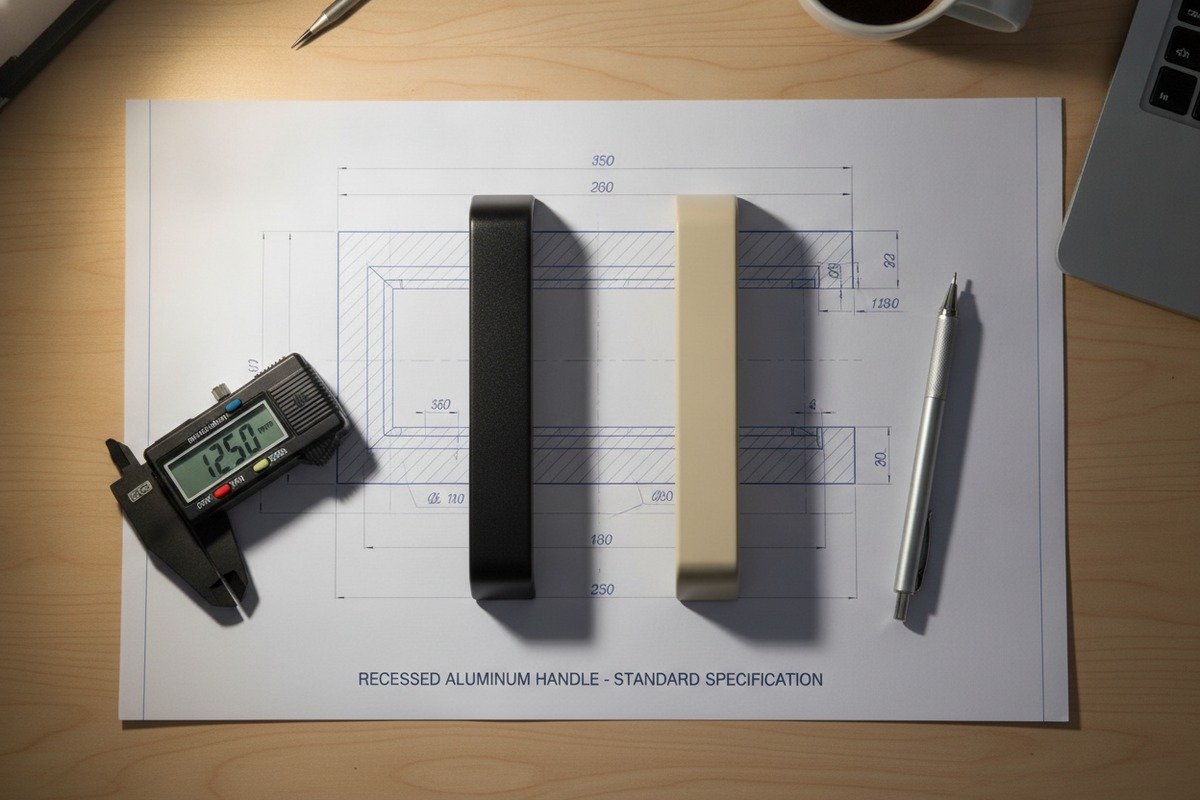
This is the question that keeps procurement managers awake at night. Aluminum handles look like simple products, but even a 0.3 mm difference in channel depth or a slight shade variation in champagne gold anodizing creates a visible mismatch on a finished cabinet. When we produce recessed handles with precise geometric channels and matte finishes, we know how tight the tolerances need to be.
Ensure specification consistency by creating a master specification package that includes exact dimensions, tolerances, alloy grade, surface finish standards with color samples, coating thickness requirements, and pull strength criteria, then require every supplier to produce first articles against a single golden sample for approval.

Build a Master Specification Package
Your spec package is the single source of truth. Without it, each supplier interprets your requirements differently. Here is what it should contain:
- Dimensional drawing with tolerances for length, width, depth, hole spacing, and channel profile
- Material grade (e.g., 6063-T5 aluminum alloy 8)
- Surface finish standard — not just a description like "matte champagne gold," but a physical reference sample or a Pantone/RAL color code
- Coating type and thickness (e.g., anodized at 10–15 microns, or powder coated at 60–80 microns)
- Corrosion resistance requirement (e.g., minimum 48-hour salt spray test 9)
- Pull strength / durability spec (e.g., handle must withstand 30 kg pull force without deformation)
- Edge quality requirement — no burrs, no sharp edges, smooth finger contact
- Packaging and labeling rules — box dimensions, barcode format, inner packing protection
The Golden Sample Method
A golden sample is a single approved handle that serves as the physical benchmark. Every supplier receives an identical golden sample. When they produce a pilot batch, their output is compared directly against this reference piece. This removes ambiguity.
We keep golden samples at our facility for every handle family we produce. When a buyer needs to qualify a second source, we provide duplicates of that golden sample for direct comparison. This practice eliminates arguments about "close enough."
Specification Consistency Checklist
| Specification Element | Why It Matters | Common Variation Risk |
|---|---|---|
| Hole spacing (center to center) | Must match existing furniture drill patterns | ±0.5 mm causes installation misalignment |
| Overall length | Visible inconsistency on adjacent cabinets | Different extrusion dies may vary slightly |
| Channel depth | Affects finger grip comfort | Shallow channels feel different to users |
| Anodize color | Visible mismatch across a kitchen or closet | Different anodizing baths produce shade shifts |
| Coating thickness | Affects durability and corrosion resistance | Thin coating wears prematurely |
| Edge radius | Sharp edges cause customer complaints | Under-deburred handles feel rough |
| Alloy grade | Affects strength and weight | Lower-grade alloy bends under load |
Change Control Between Suppliers
When you switch a production run from Supplier A to Supplier B, do not assume the specs will carry over automatically. Require a fresh first-article inspection for every supplier changeover. Compare the first articles from each supplier side by side. Measure at least five critical dimensions. Inspect the finish under standardized lighting. Only after written approval should the supplier proceed to full production.
Addressing Finish Matching in Practice
Anodized finishes 10 are especially tricky. Two factories using the same anodizing parameters can still produce slightly different shades due to differences in bath chemistry, water quality, and alloy composition. The practical solution is to require suppliers to send finish samples from each production batch before shipping. Build this into your purchase order terms. A 48-hour sample approval step can save you from receiving 5,000 handles in the wrong shade.
What criteria should I use to evaluate if a backup supplier can meet my 48-hour shipping requirements during peak seasons?
Peak season is where backup suppliers either prove their value or expose their weaknesses. When our warehouse processes urgent orders, we ship within 48 hours because we hold ready stock and have logistics partnerships already in place. Not every supplier can do that, and the difference becomes critical when your customers need handles yesterday.
Evaluate a backup supplier's 48-hour shipping capability by checking their current stock levels of your specific handle SKUs, their warehouse proximity to shipping ports or logistics hubs, their freight forwarder relationships, their order processing speed, and their track record during previous high-demand periods.

Why 48-Hour Shipping Is Not Just About Speed
Fast shipping requires several systems working together. A supplier might claim they can ship in 48 hours, but if they do not hold your specific finish, length, or packaging configuration in stock, that claim falls apart under real conditions.
The 48-Hour Readiness Scorecard
Use this scorecard to evaluate whether a backup supplier can genuinely deliver under peak season pressure. Rate each criterion on a 1 to 5 scale.
| Evaluation Criteria | What to Assess | Score (1–5) |
|---|---|---|
| Stock depth for your SKUs | Do they hold your specific handle models in ready inventory? | ___ |
| Warehouse location | Is the warehouse within 2 hours of a major port or logistics hub? | ___ |
| Order processing time | Can they confirm, pick, pack, and handoff within 12 hours? | ___ |
| Freight forwarder relationship | Do they have standing contracts with reliable carriers? | ___ |
| Peak season capacity | Have they successfully shipped under similar time pressure before? | ___ |
| Packaging readiness | Is your custom packaging pre-printed and stocked? | ___ |
| Communication speed | Do they respond within 2 hours during business hours? | ___ |
| Documentation accuracy | Can they produce invoices, packing lists, and customs docs error-free? | ___ |
A total score below 28 out of 40 means the supplier is not ready for 48-hour fulfillment. Address gaps before peak season arrives.
Test Under Real Conditions
The only way to know if a backup supplier can ship in 48 hours is to test it. Place a real order during a moderately busy period and track every step: confirmation time, packing time, pickup time, and transit time. Do not rely on promises. Measure actual performance.
Common Failure Points During Peak Season
Here are the most frequent reasons backup suppliers fail the 48-hour test:
- Stock not replenished. They sold their buffer inventory to other customers before your order arrived.
- Custom packaging unavailable. Your branded boxes were not pre-produced, so packing is delayed.
- Freight capacity booked out. During peak season, trucking and container slots fill up. Suppliers without standing logistics contracts get bumped.
- Key staff unavailable. Small operations may have limited weekend or holiday coverage.
- Documentation errors. Incorrect commercial invoices or packing lists cause customs holds.
Build a Contingency Protocol
Work with your backup supplier to create a written peak-season protocol. This should specify: minimum stock levels they must maintain for your top 10 SKUs, pre-approved packaging and labeling, a named contact person for urgent orders, and agreed shipping methods. Review this protocol 60 days before each peak season starts. If the supplier cannot commit in writing, they are not a reliable backup for time-critical fulfillment.
The Real Cost of Missing the 48-Hour Window
When a handle shipment is late, the impact cascades. Furniture factories halt assembly. Wholesalers lose credibility with their retail customers. Rush air freight to recover can cost five to ten times more than standard shipping. The cheapest supplier who cannot ship on time ends up being the most expensive choice in the long run.
Conclusion
Building two to three qualified aluminum handle suppliers is not about collecting business cards. It is about creating a tested, specification-controlled sourcing system that keeps your supply chain moving when disruptions hit. Start now, before the next peak season forces you to scramble.
Footnotes
1. Provides information on the aluminum industry and its products. ↩︎
2. Defines supply chain risk management and its importance. ↩︎
3. Explains the definitions and differences between OEM and ODM manufacturing models. ↩︎
4. Describes the definition and crucial role of freight forwarders in logistics and supply chains. ↩︎
5. Provides information on the ISO 9001 quality management system standard. ↩︎
6. Found a comprehensive guide to B2B platforms from a reputable business solutions provider. ↩︎
7. Defines volume discount and its economic principles in purchasing. ↩︎
8. Details the properties and common applications of 6063-T5 aluminum alloy. ↩︎
9. Explains the standardized method for corrosion resistance testing. ↩︎
10. Explains the electrochemical process of anodizing for aluminum surfaces. ↩︎